
 Posted in
Fashion, Fashion
Posted in
Fashion, Fashion
Pashmina in exile: remembering the hands behind the fabric
Text Maryam Iqbal
You can buy a “pashmina” for $10 online. Soft, pastel shawls stitched with machine-perfect paisleys, tassels dangling from the edges. On TikTok, influencers model glossy “pashmina” hijabs sourced from Shein. In downtown Amman, market stalls display mass-produced shawls stamped with stickers reading “Authentic Kashmiri” and simultaneously “Made in India.” But behind the label, something deeper is being erased.
True pashmina comes from Kashmir: a place where not only the craft, but the conditions under which it survives, are too often ignored. Kashmir remains one of the most heavily militarised zones in the world, with up to 700,000 Indian troops stationed across the valley. Yet under the constant shadow of these conditions, artisans continue to weave, stitch, and preserve a centuries-old tradition.
Not all wool is pashmina. True pashmina begins high in the Himalayas, in the frigid altitudes of Ladakh, where the Changthangi goat produces a soft, insulating undercoat known as pashm. This fine wool is painstakingly hand-combed, cleaned, and spun into delicate threads. There, it is woven by hand on wooden looms by Kashmiri artisans, many of whom have learned the craft through generations of dedication. What’s produced is a textile prized for its softness, warmth, and near-weightless drape.

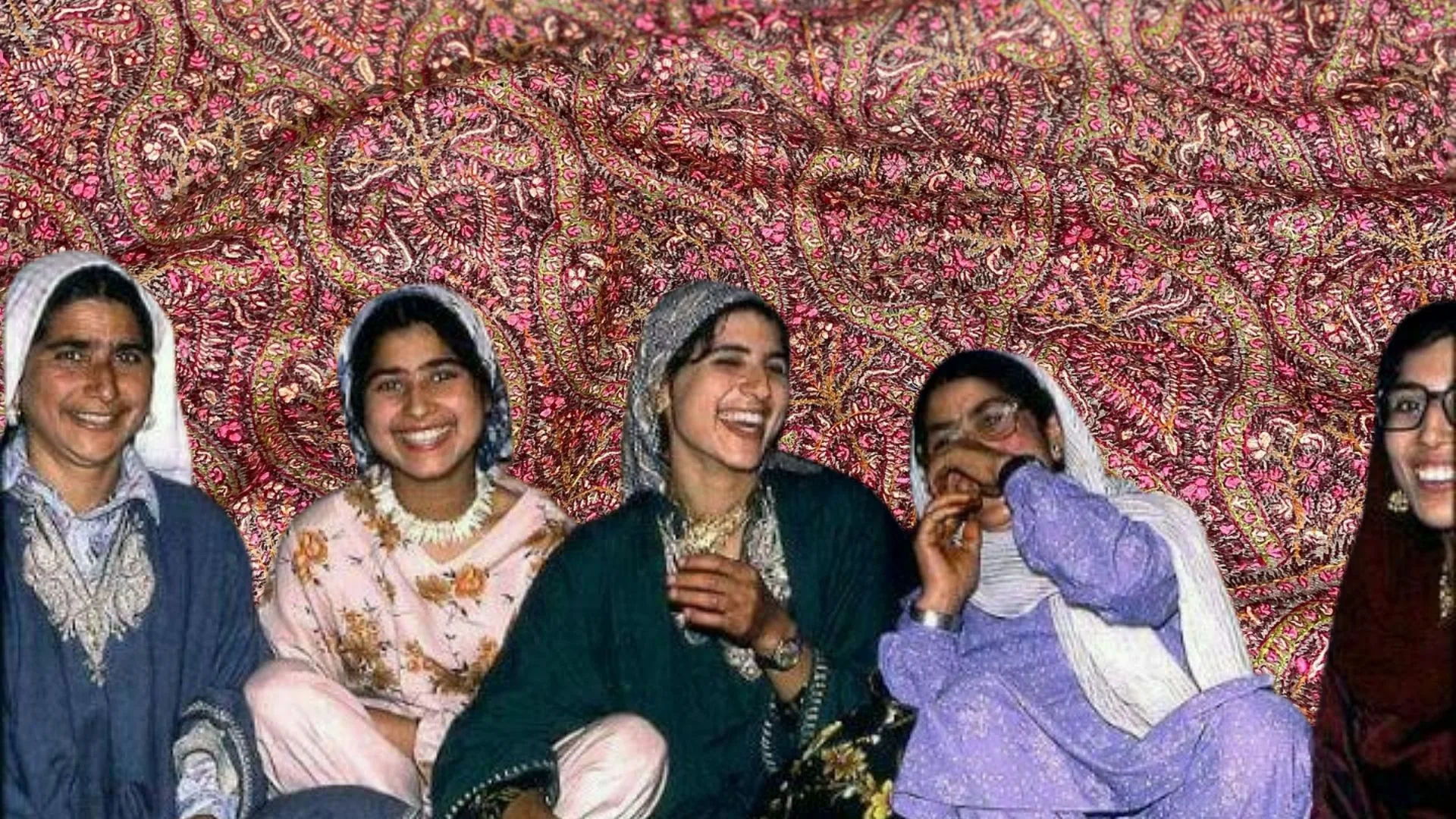
The motifs embroidered onto these shawls carry stories as layered as the fabric itself. Among the most enduring is the paisley – a curved teardrop, known in Persian as boteh (a cluster of leaves). While its origins trace back to Persia, it was in Kashmir that the motif was reimagined, refined, and infused with new meaning. Over centuries, Kashmiri artisans transformed the boteh into a symbol of fertility and continuity of life. However, by the 18th and 19th centuries, British colonial traders had turned Kashmiri shawls into coveted imports, prompting textile mills across Europe to replicate the design on industrial looms. The motif endured, but detached and extracted from its roots; its origin faded from collective memory.
Sheikh Adnan’s family has worked to preserve this memory since 1893. A fourth-generation artisan and founder of Shawlwala – a small, Srinagar-based label committed to honouring the tradition of handmade shawls – Adnan tells me that for his family, pashmina is a story of culture as resistance. “These shawls aren’t just made, they’re lived,” he says. “Every piece passes through so many hands: the one who combs the goat, the spinner, the weaver, the dyer, the washerman, the embroiderer. Sometimes it takes more than two years to finish one piece. Imagine the time, patience, and love that goes into that.”
_
At the heart of Kashmiri textile tradition is Sozni embroidery, a needlework technique so delicate it defies the eyes. Often applied to pashmina shawls, Sozni is done entirely by hand using slender silk or cotton threads and impossibly precise stitching. “It’s said that a single square inch can carry thousands of delicate stitches, so fine that they sometimes look like they’ve been painted, not stitched,” explains Sheikh Adnan. What looks soft is, in fact, the result of extraordinary control. The most skilled Sozni artisans are even said to embroider in reverse, crafting patterns nearly identical on both sides of the shawl.
Sheikh Adnan describes it in relation to another heritage under siege: “Palestinian Tatreez and Kashmiri Sozni feel like they come from the same soul, just shaped by different lands,” he says. “Both are done entirely by hand, passed down from generation to generation. The only real difference is in the technique – tatreez uses thick threads and bold patterns, while Sozni is much finer, undoubtedly the finest in the world.”
Beyond the needlework, it’s the emotion and inheritance each thread carries that gives it meaning. “When facing erasure,” Adnan continues, “every piece of culture – whether it’s your art, your language, or the culture itself – becomes a form of resistance. These embroideries aren’t just beautiful. They carry grief, memory, love, and defiance.”

—
Just as every stitch holds memory, the motifs embroidered into these shawls carry their own unique vocabulary. Indigenous to the valley, the Chinar tree’s broad, flame-shaped leaves are a marked symbol of Kashmiri identity and resistance. Even the maple leaf emoji – bearing its likeness – has served as a stand-in for the Kashmiri flag as a defiance of censorship. Woven into shawls and etched into woodwork, the Chinar leaf remains a reminder that what grows from the land carries the people with it.
“The Chinar is very close to every Kashmiri’s heart,” Sheikh Adnan tells me. “We grow up under its shade. It’s there in every season, turning golden and crimson in autumn as it carries our memories.” In Kashmiri shawl embroidery, the Chinar appears again and again as a symbol of rootedness in a land that is constantly being stripped away.
Adnan often draws a parallel between the Chinar tree for Kashmiris and the olive tree for Palestinians. “Both represent endurance, roots, belonging.”
Other motifs in Kashmiri embroidery speak this same language. The Tree of Life represents regeneration and continuity – that even through grief, something new can grow. The badaamdaar, or almond blossom, is stitched delicately onto shawls as a sign of spring, a softness that returns even in harsh times. The paisley, borrowed from Persian boteh, has been reinterpreted over centuries to represent the womb as a symbol of life, protection, and creation.
Where maps shift and names are contested, trees remember. Palestinian women stitched the cypress so their villages would not vanish when borders moved; Kashmiri artisans embroider Chinar leaves so the valley’s light still falls across the shoulders of those who leave. The threads keep hearts rooted, even in exile.\

“All these motifs,” Adnan says, “are more than decoration. In both Palestinian and Kashmiri craft, they’re a quiet language. They tell the world who we are, even when we’re not allowed to say it out loud.”
—
In a world flooded with imitations, it’s easy to reduce pashmina to a question of authenticity – real or fake, pure or blended. But Sheikh Adnan complicates that binary. The more urgent question, he suggests, is not just what you wear, but whose labor you honor in wearing it. “It’s not about something’s expense,” he tells me, “but rather your connection to it.” That connection means buying directly from Kashmiri artisans – not middlemen or corporations that exploit and underpay workers, but the hands that spin, weave, and embroider these shawls into being.
Not everyone can afford an authentic pashmina shawl, and that’s something Adnan understands. In Kashmir, many artisans also work with Tusha, a soft Merino wool alternative that is more accessible, but still crafted by hand and embroidered with traditional Sozni. “Even a small piece, when made by a real artisan, carries meaning,” he says. “It is the work that is being handmade and is done by us that matters the most, not machines that are mass-producing it or copies that are elsewhere.”
But for Kashmiri artisans like Adnan, the work has faced not only the threat of appropriation but complete devastation. “In the recent past, Kashmir has gone through repeated periods of deep unrest and disruption,” he tells me.
In 2019, when India revoked Kashmir’s already limited constitutional autonomy, the region was placed under an unprecedented communications blackout. For months, Kashmiris had no access to mobile networks, internet, or landlines. “We couldn’t reach our artisans. We couldn’t sell a single piece,” Adnan recalls. “And since our family business supports not just our own household, but hundreds, sometimes thousands of artisans. Whether it was the unrest of 2010, the devastating floods of 2014, the turmoil of 2016, or the situation in 2019 — life in the Valley came to a complete halt for months.”
“Communication is part of the process. We rely on continuity, connection, and visibility — without it, we’re paralyzed,” Adnan explains. “We couldn’t reach our artisans. We couldn’t sell a single piece. And since our family business supports not just our own household, but hundreds, sometimes thousands of artisans who work with us, the impact was heartbreaking.”

Already under pressure from machine-made replicas flooding the market, the repeated unrest only deepened the blow. “Many artisans stopped working,” he says. “They turned to other jobs. Some lost faith in the craft entirely.”
And yet, even as some walked away, others kept weaving – not just for livelihood, but for the sake of remembrance. “In Kashmir, they’ve tried to erase our culture in many ways. Every day we wake up and witness new forms of cultural aggression. But we hold on to it,” Adnan explains. “We stitch it, we wear it, we pass it down. Because culture isn’t just what we have — it’s how we survive. It’s how we tell the world that we are still here.”
What is woven by hand cannot be unwritten. The thread carries what the tongue cannot safely say. The shawl, like the land, remembers. It travels further than the weaver ever will – wrapping shoulders from Beirut to Tunis to London – hoping to remind the world whose hands built beauty from survival.