
 Posted in
Here/Now Algeria,
Posted in
Here/Now Algeria,
Here/Now: Lokher is building his own surrealist movement in Algeria
Text Hamdi Baala | Photography Cornawy
Abdou Salah does not remember this story because he was too young, but relatives told him that when he was 5 or 6 years old, he reproduced a drawing from a school book. His teacher was so impressed that she called his mother and told her how talented he was. His mother went on to nurture her son’s passion, buying him drawing tools and CDs.
Lokher, meaning “The Other”, is the name he uses as an artist. He was born in 1998 in Algiers to parents who weren’t artists (“a very normal Algerian family,” he says), but his mother liked drawing, and his father had an interest in music when he was young. They tried to push him toward “more serious” things when he was a teenager, feeling he was spending too much time drawing, but they supported him once they saw he was serious about art and wanted to join the École Nationale des Beaux Arts.

He graduated in 2023 with a Master’s degree. Last December in Algiers, he held his first solo exhibition, during which he showcased his collection “Kawkab” (Planet). A series of acrylic-on-canvas paintings exploring the state of daydreaming. “There’s this possibility of materialising a feeling, and the paintings try to achieve that”, he said. The work portrays a highly detailed, surrealist world where the characters’ limbs float beside them or melt into the ground. It’s a world where branches could grow off the wings of giant birds. In a scene titled “Reaction of a Kiss”, a woman with a giant orange sphere where her head should be is seen holding a man who is lying sideways, the lower half of his body covered in green leaves.


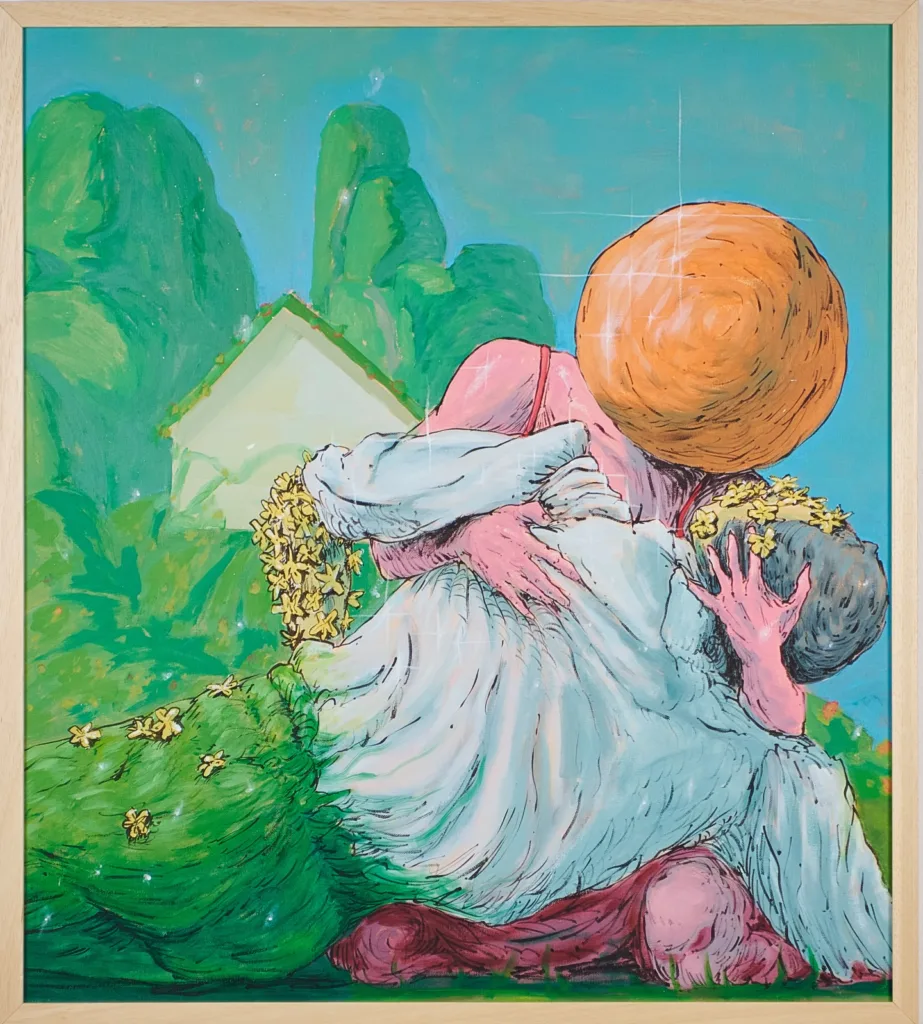
In Lokher’s case, self-expression is rooted in his creative process. The vast, surrealist universe he depicts in his paintings is a way of looking inward and trying to make sense of his emotions, thoughts and surroundings. “I intuitively lean toward surrealism. Since I was a child, I loved drawing things that don’t exist,” he explained, adding that he sometimes dreams that he is painting, and tries to reproduce what he saw once he wakes up. “The result is often surrealist, and sometimes just absurd”, he said.
In most of Lokher’s paintings, the colours are vivid, and contrast is high. It is tempting to see a Manga influence: the palette certainly appears to be from a Studio Ghibli production. The artist admits that while there is some truth to that,, having watched anime series since he was a child, he jokes that it’s not the sole inspiration. “Inspiration comes to me from China,” a sarcastic comment on how hard it is to pinpoint what stimulates him. More importantly, however, it was his colourblindness which had a significant impact on his work. “I did research on colour theory, and I concluded that I needed to increase saturation in order to see colours the way other people see them”, he said.
Lokher discovered painting in his second year at the fine arts school and took painterly expression as a speciality. “I was practising a lot on canvas and small formats in the workshop at school. That is when I developed an interest in canvas painting,” he said. Before that, he explored urban art, painting on the walls of abandoned areas near where he lived. The large format of murals allowed him a freedom and intuitiveness of movement that a canvas did not.