
 Posted in
Dazed MENA 100 2025, Dazed 100 2025
Posted in
Dazed MENA 100 2025, Dazed 100 2025
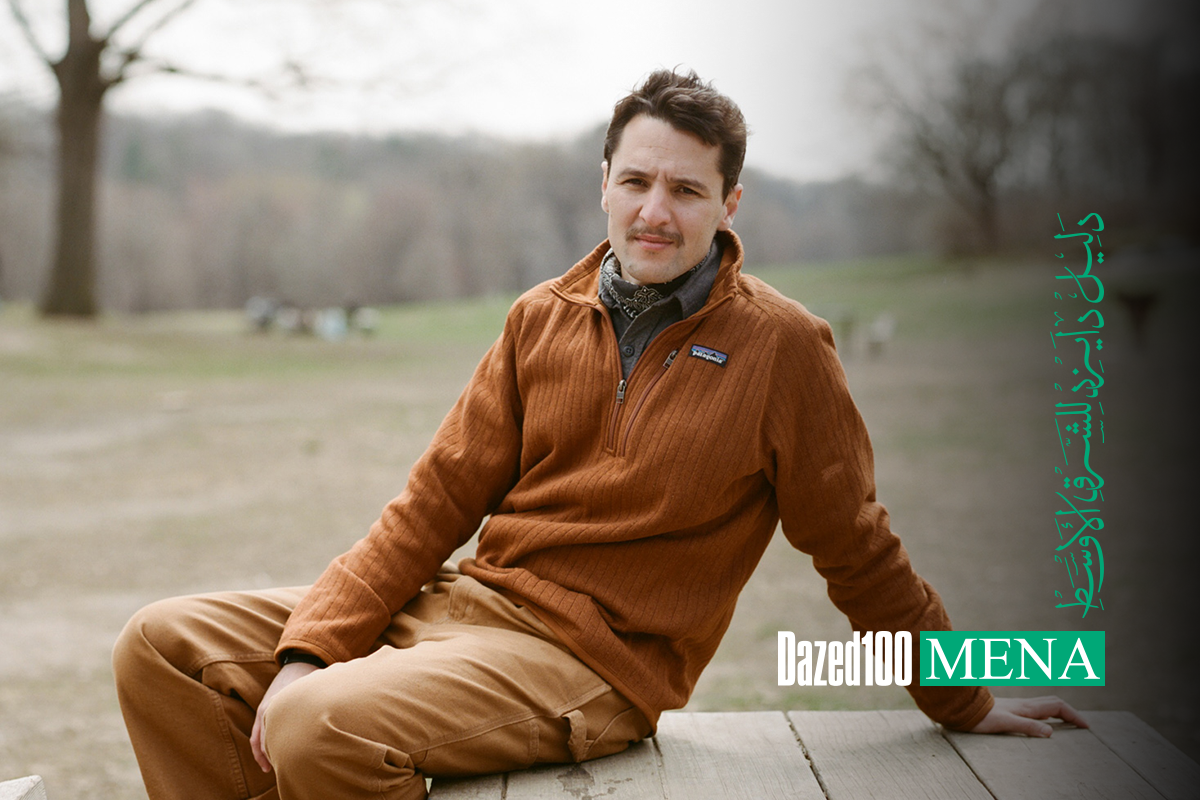
Fethi Sahraoui: Capturing Algeria in Silence and Subtlety
Text Raïs Saleh
In a region often depicted through noise and narrative excess, Fethi Sahraoui’s images speak with rare restraint. His lens lingers—on the shimmer of light on concrete, the pause in a man’s gesture, the emptiness between moments. The Algerian photographer is part of a generation that rejects spectacle in favour of sincerity.
“I owe a lot to boredom, actually,” he says with the kind of self-awareness that dominates his work. “I grew up in small towns where there wasn’t much to do, and that emptiness created a strong urge to tell stories. When I discovered photography as a language, boredom suddenly became a detail from the past.”
That ‘language’ has since taken Sahraoui far beyond Hassi R’Mel and Mascara, where he studied foreign languages before turning his curiosity inward. A Magnum Foundation Fellow, his work has appeared in The New York Times, exhibited at the Arab World Institute in Paris, and even been installed at the Carnegie Museum of Art in Pittsburgh. Despite this international recognition, his gaze remains local—fixated on the rhythm and melancholy of everyday Algeria.
“At first, I was inspired by the classic masters of photography,” he explains. “That expanded to literature, poetry, anything that could feed the imagination. Nowadays, I’m most inspired by the mundane. Sometimes a single line, seemingly futile, can spark the beginning of a photographic adventure.”
This fascination with the ordinary has made Sahraoui one of the most distinctive contemporary photographers from North Africa. His 2022 photobook Triangles of Views, produced as part of 220Collective, maps the subtle choreography of Algerian existence – youth, solitude, belonging – with a deliberate quietness that feels radical in an age of overexposure.
That quietness, however, has also made him a controversial figure in the Arab art scene, where photography is often expected to document either grandeur or grievance. As a result, Sahraoui’s choice to look inward, to linger on stillness, is almost political. His work neither flatters nor sensationalises his country; it humanises it.
“I don’t expect my work to change anything directly,” he says. “I do hope it provokes questions and awakens curiosity, though. If someone pauses, trying to understand what’s going on in an image, that moment of attention already feels like an achievement.” It’s a sense of questioning that runs deep in his own journey. He speaks candidly of a period of disconnection, of looking west, away from his roots. “There was a time when I turned my back on this region,” he admits. “But over time, I found my way back, and now feel profoundly rooted. If there’s one thing I’m sure of today, it’s that my work – and perhaps myself – are better understood in this region than anywhere else.”
Today, as Sahraoui works on a new film project derived from one of his long-term photographic studies, he is again negotiating the line between seeing and being seen. “The process is both painful and joyful,” he reflects. “It’s reconnecting me with my native landscape through something I thought I’d lost.” Whether film or photography, Sahraoui’s lens insists that stillness is not absence but presence, reminding audiences that even boredom, if one listens closely enough, can become a form of art.