
 Posted in
Dazed MENA 100 2025, Dazed 100 2025
Posted in
Dazed MENA 100 2025, Dazed 100 2025
Jenia Kim: Sewing the Fragments of a Scattered Past
Text Hamza Shehryar
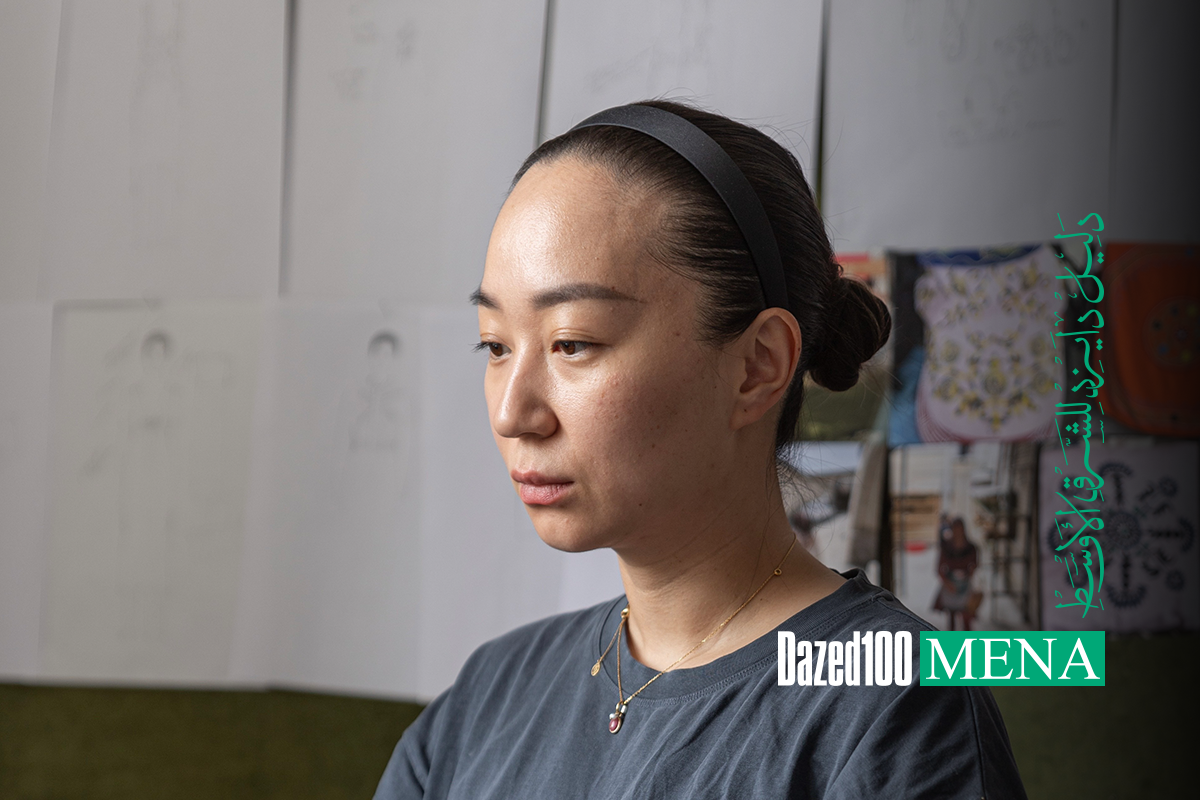
In the quiet courtyards of Tashkent, Jenia Kim has built something extraordinary. Through her label J.Kim, the Korean-Uzbek designer is transforming fabric into a form of storytelling—garments that remember, reimagine, and reconcile the fragments of an identity she carries.
Born into the Koryo-saram community – ethnic Koreans of the former Soviet Union who were forcibly displaced across Central Asia from the Russian Far East in 1937 – Kim grew up surrounded by traces of migration. “Clothing was my way of self-expression,” she tells Dazed MENA. “My aunt was a dressmaker, and choosing outfits felt like a family ritual even in kindergarten. I knew early on that garments could carry emotion, memory, and a sense of home.”
That sense of home still anchors everything she creates. After spending years between Russia and Uzbekistan, Kim returned to Tashkent to build J.Kim. “Our workshop is a home,” she explains. “We cook together and welcome guests. Most of our seamstresses work from their own homes, too, close to their families.”
This intimacy has shaped J.Kim into something larger than a fashion brand. It’s a living ecosystem of women’s labour, local craft, and cultural memory. Each piece, sewn by home-based makers across Tashkent, carries the marks of both Uzbek craftsmanship and Korean sensibilities. “Producing locally with women who sew from home turned the brand into a community, not only a studio,” she proudly describes.
Kim’s collections are often described as tactile poems, filled with quilt-like layering, delicate knots, and shapes inspired by hanbok silhouettes and Central Asian tailoring. And beneath their beauty lies a social vision. “I want regional knowledge and women’s labour to be valued as culture, not merely production,” she insists. “If our pieces make people curious about Uzbekistan and Koryo-saram histories, that’s real change.”
Observation is her creative process. “I design from life—market sellers, family rituals, improvised repairs, small gestures,” she continues. “My research is tactile: handling textiles, learning techniques, translating them into new forms.” That grounded curiosity is what keeps J.Kim authentic and rooted within the local community. In fact, the designer has opened a store that doubles as a cultural hub, selling garments alongside handmade objects and connecting with the city’s pulse, in the heart of one of Tashkent’s oldest bazaars.
“Our stories cross cultures but speak one language,” she says. “The language of care.” That care also extends into education and preservation. Her upcoming exhibition in Doha, which explores “identity transplantation” through Koryo-saram histories, is an example of just that—a mission that remains central to Kim’s practice. “I hope to see parity without exoticisation,” she continues, reflecting on the region’s creative scene. “Creators should be presented on equal terms, with institutions commissioning work here and supply chains that let makers stay close to their families.”