
 Posted in
Dazed MENA 100 2025, Dazed 100 2025
Posted in
Dazed MENA 100 2025, Dazed 100 2025
Omer Asim: Reclaiming Identity Through Fashion and the Forgotten
Text Farah Ibrahim
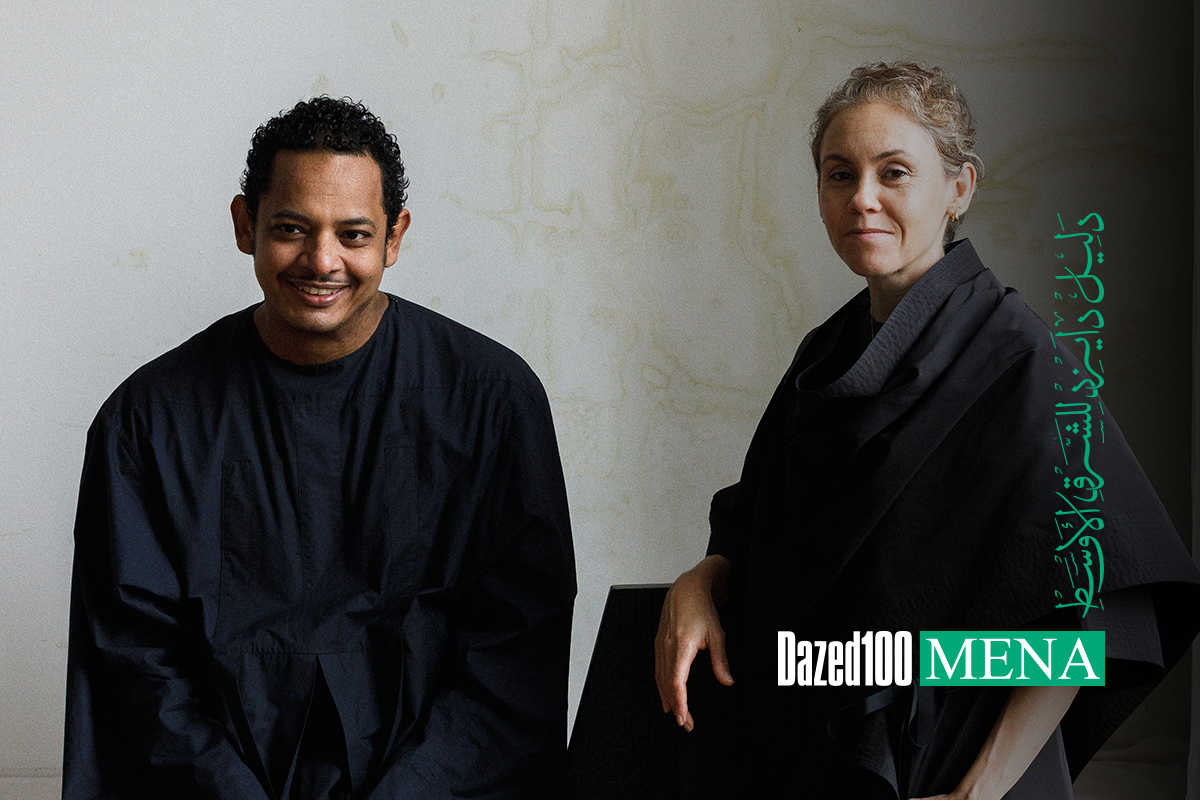
Omer Asim has a method for understanding this human life. The label’s co-creative directors Omer Asim and Maya Antoun make garments and objects to process, in truth, the transience of this delicate existence. Their practice begins long before silhouette or style. It begins in the abstract: in thought, ritual, memory, and the emotional sediment of leaving one home and building another.
Trained in adjacent disciplines and Sudanese in origin, both Asim and Antoun treat design as inquiry into being. The former, trained originally in architecture and later in psychoanalysis, passed through Savile Row and Vivienne Westwood before building his own practice. The latter, meanwhile, is a jewellery maker who refined her craft at Central Saint Martins. Together, they explore the space where form, anthropology, ritual, structure, and the psychology of adornment meet.
“We began as children in Khartoum creating in the way all children do and moved to the UK as young adults, leaving behind a country in a tumultuous political and socioeconomic state,” they share. “Creation became a method of survival, a way to process displacement, memory, and the emotional weight of departure. Through our work, we articulate how we experience and make sense of our transient existence.”
This sense of transience shapes the silhouette of the brand itself. The aesthetic is restrained, sculptural, monastic, and gently ancestral. Their shapes feel organic rather than designed, as if discovered in the strata between the ancient and the future. Their reference points come from Sudanese and pre-modern concepts of dress and beauty: rituals, care systems, and methods that existed long before industrial fashion. These are not used nostalgically but reconfigured: “These cultural ideations are channelled into alternative formations to make-design garments and objects astride heritage and dynamism, a regressive future.”
The phrase “a regressive future” frames the great paradox that defines their mission. They move forward by turning to look back, examining what fashion has left behind, industrialised, or forgotten altogether. They are also fascinated by the space before an object becomes whole. “The starting point can vary from a piece of fabric, garment or object we have made previously that becomes a catalyst to explore its potential further,” they say. “We have a strong interest in the practices of making. What is discarded and/or concealed during the progression of making holds a very active and attractive space for us.”
It is a philosophy that prioritises process over product. “We aim to facilitate a dialogue around contemporary cultural ideations in relation to media consumption, dress, mind, and body.” Omer Asim pieces are treated not as things to purchase, but as artefacts that ask the wearer to consider what we choose to inherit, perform, and put on our bodies. “Our purpose is to create considered cultural projects to substantiate the brand’s proposition of its garments and objects as contemporary cultural artefacts, moving away from the capitalist approach to art.”
Asim and Antoun’s most recent projects show their practice expanding far beyond fashion into installation, scent, and collaborative spatial work. “We’ve been fortunate to create an exciting series of work collaborating with incredible artists,” they say. It began with a collaboration with artist Scarlett Rouge, evolved into an olfactory experience with master perfumer Sileno Cheloni, and took new form in a site-specific installation with silversmith David Clarke during Milan Fashion Week 2025. “We hope to continue with the next iteration of these site-specific manifestations; revealing new and renewed collaborations.”