
 Posted in
Dazed MENA 100 2025, Dazed 100 2025
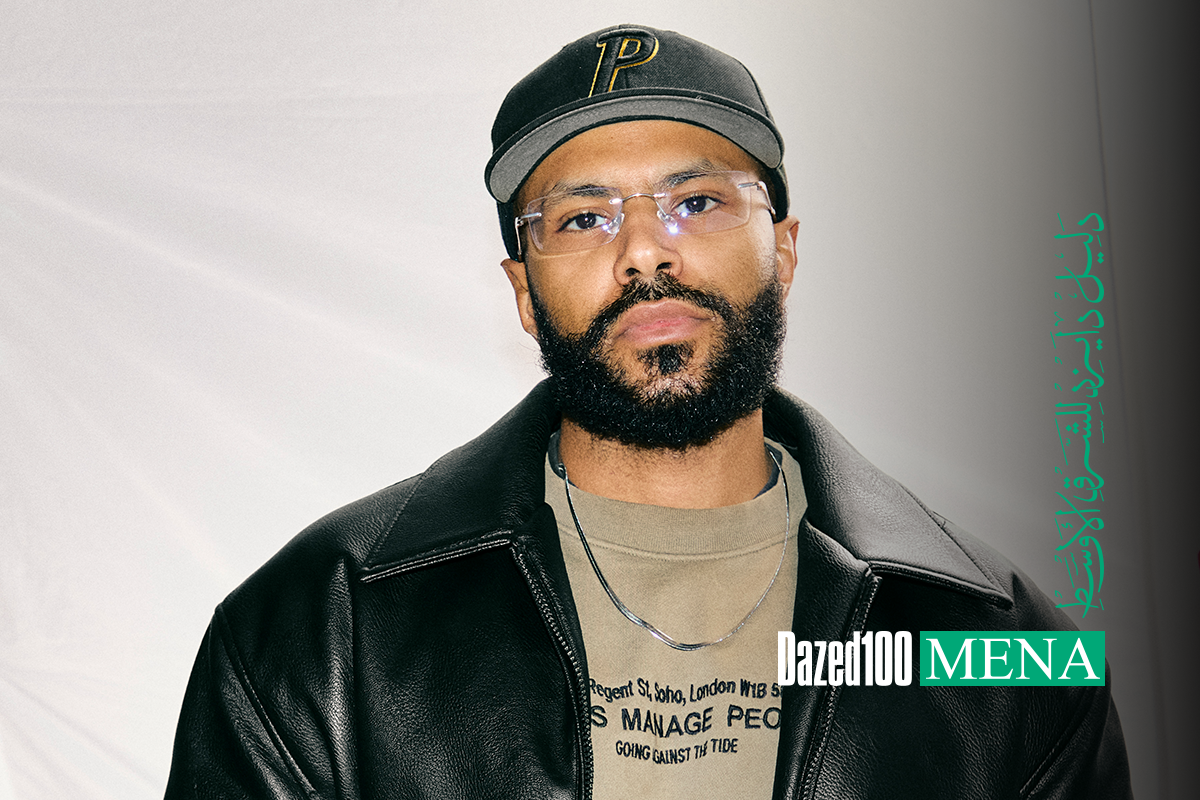
Sabb Adams: Bearing Witness to the Unseen
Text Mai El Mokadem
There are those who train their lens on the thunderclap and the flash, actively choreographing a scene for the camera. And then there are image makers like Sabb Adams, whose mastery lies in stillness and observation. He doesn’t seek to direct reality; he simply waits for its unvarnished, potent truth to finally surface. Born British-Eritrean and raised between Riyadh and Nottingham, his gaze has been shaped by liminal spaces: places where cultures overlap and identities blur.
Long before the gallery walls or lustrous editorials, it was curiosity that pulled him in—a shared family computer in a living room, a pirated copy of Photoshop from LimeWire, a generation learning their way through pixels and piracy. That chaos, very millennial and distinctly unfiltered, became the beginning. One obsession at a time, it all “snowballed” into a language that now lives somewhere between documentary and editorial, witness and storyteller.
Adams is drawn to people others overlook. Whether he’s documenting British lowrider culture, Afro-diasporic identity, the electricity of Cuban streets, or the unexpected stillness of a domestic moment, his work functions less as aesthetics and more as evidence that these lives, these places once existed—exactly as they were.
“I want people to be seen with dignity, without stereotypes or being shaped into something they’re not,” he says. It’s a simple statement, but in an era addicted to distortion, it’s radical. You can almost feel the heat of the pavement, the rough upholstery of a car seat, the hum of a neighbourhood in the background. Adams’ lens holds out against flattening, against trendification, and against the reduction of culture to a moodboard. Instead, he offers intimacy. Presence. Truth.
His images feel sunwarmed and soft, dipped in nostalgia but not saccharinely sentimental. There’s a blunt honesty in the way he frames faces, bodies, interiors, chrome, fabric, skin. The colour in his work is an emotional feat; bruised reds, electric neons, dusted blues, and skin tones rendered with reverence. In his craft, Sabb Adams chooses texture. He chooses grain. He chooses people as they are: layered, complicated, dignified. And in photography, he draws from the observational legacy of Helen Levitt and Vivian Maier.
For him, the defining achievement isn’t a viral moment or singular accolade—though the milestone of photographing Ronaldinho is not lost on him. It’s something far more enduring: paying his bills, feeding his family, and travelling, all through his craft. Art as livelihood.
His belief in authenticity only sharpens in the shadow of automation. AI may simulate the world, but it cannot replicate reality or energy. It cannot feel the heat of a street. It cannot witness the silence between a father and child. It cannot sit for hours without pressing the shutter. “You type a couple words and it will generate a scene, but it can’t sit with someone or earn their trust,” he reflects. “It takes a lot more to get there. Every moment that leads to that image is part of that image, and that’s what AI can never imitate.”
Looking ahead, Adams doesn’t dream of escape. He dreams of ownership, of more voices claiming their stories instead of seeking approval for them. He sees a region dense with unspoken narratives and soul, the kind the world hasn’t learned how to view properly—yet. “Authenticity still has value, and always will.” And with his current project, How We Roll, still shrouded in intentional silence, he continues to prove that in an industry addicted to speed, anticipation can still be an art form.