
 Posted in
Life & Culture,
Posted in
Life & Culture,
Meeting Points: How Paris becomes a diasporic lighthouse each June
Text Yasmin Alrabiei
The air around Paris is so thick with lore that it puts the ‘city’ in multiplicity. Every generation seems to inherit its own version and add another layer to the pile. In Baldwin’s Giovanni’s Room, we hear “you feel, in Paris, all the time gone by”– an ode to a place so saturated with romance it aches. Then, PSG games and their aftermath routinely trigger memes that Paris will be turned inside out regardless of the outcome, because intensity is the city’s default setting. Romance and riot are its twin exports–both are its image. Both are Paris. But for a city so often imagined through grand boulevards and monuments, some of Paris’s most enduring cultural routes run through diasporic neighbourhoods, rhizomatic webs of international epics each complete with their own heroes–like those living in Château Rouge and Barbès.
From Aya Nakamura’s pop dominance to Pogba and Mbappé sitting within nodes of France’s (seemingly, indomitable) football legacy, or even sharp young voices like Moroccan-Algerian Feris Barakt, committed to amplifying environmental issues within working-class French suburbs, diasporic figures continue to inform what “French” looks and sounds like.
We can’t flatten what is, in reality, a far more entangled cultural milieu owing to the ubiquity of diasporic worldmaking. French rap, football culture, street style, nightlife, vernacular language and neighbourhood functions weren’t simply appended to a stable, solid Parisian identity. They are the very fibres of this capital, where you’ll find everyone from each random corner of your life meeting this June.
Part of what makes these June encounters feel meaningful is that they emerge from relationships that predate the current attention they are receiving. Paris didn’t just suddenly become a meeting point. Its venues, football pitches, record shops, cafés, neighbourhood festivals, community radio stations, banlieue fashion ecosystems, and artistic exchanges have sustained the city–but also our surrounding cities–for decades, and now, are just far more obviously setting the cultural agenda.
A series of developments, from the city’s post-Olympic 2024 embrace of public culture to the expansion of Fashion Week into a broader creative gathering for diaspora in neighbouring cities with more versatile, accessible activations, have made visible networks that were already alive. And in the creative industries, those just starting out or well-established designers, musicians, footballers, photographers and artists increasingly move through the same spaces, closing the distance between fields that once appeared separate through organic yet destined friendships. June concentrates these movements into a single month. So now, Paris is the place where dispersed friends from neighbouring European cities find themselves in at the same place, at the same time.
Once a year, on 21 June, the city’s sonic geography surfaces all at once and together. Fête de la Musique suspends the usual hierarchy of venues: raï and chaâbi pulsing out of street speakers next to Amapiano and zouk, and, more recently, experimental reggaeton; Caribbean sound system culture anchors block parties with French drill and trap, via London and Atlanta influences, across the road. DJs move between neighbourhoods and their sets and locations circulate online faster than any programme can map them.
What that one night makes audible has been building in Château Rouge, Barbès, and Seine-Saint-Denis for decades. It travelled through Barbès cafés and cabarets after a first wave of Algerian migrants drafted for the French effort in the First World War, through Algerian giant Warda’s voice singing in her father Mohamed Fattouki’s cabaret named TAM (standing for Tunisie, Algérie, and Maroc)–one of many cabarets and nightlife venues animating Barbès. Later, through Rachid Taha’s first solo record album in 1989, actually named Barbès, of which one iconic refrain sings, “Barbès is better than the Champs-Élysées; you find the bottom of the world in Barbès; you hear all the languages in Barbès.” Its streets catalogue memories of Algeria, Morocco, Syria, Kurdistan, Tunisia and more.
A short walk away, it continued to traverse the freight networks, Senegalese spice shops and Congolese hair salons of Château Rouge. “Little Africa”, where a Google search returns YouTube vlogs titled “Exploring the Black Side of Paris”. It continued in the studio collectives of the banlieues, where rappers SDM and RK developed a suburban storytelling form that the French cultural mainstream took years to acknowledge. Fête de la Musique grants this iconic audio-mosaic for one night, in unadulterated volume. Where passports and visas trap us, this day makes clear that music can travel unbounded.
The recent Nike collaboration around Aya Nakamura’s Stade de France shows this continuum, through backstage looks co-designed with her brand Nakamura Industrie and Paris collective Baara, and a dedicated space inside Nike’s House of Innovation on the Champs-Élysées, complete with Nike By You customisation. It is an outstretched arm of the same banlieue-to-global circuit that has been brewing regardless of who later discovers it.
Creative communities have become increasingly accustomed to being discovered, packaged and marketed back to themselves. Fashion Week would go on to absorb football aesthetics, but before that, Nike was already in the cages of Seine-Saint-Denis in 5-a-side games on cracked concrete pitches and Tech Fleece zipped up over Nike TNs.
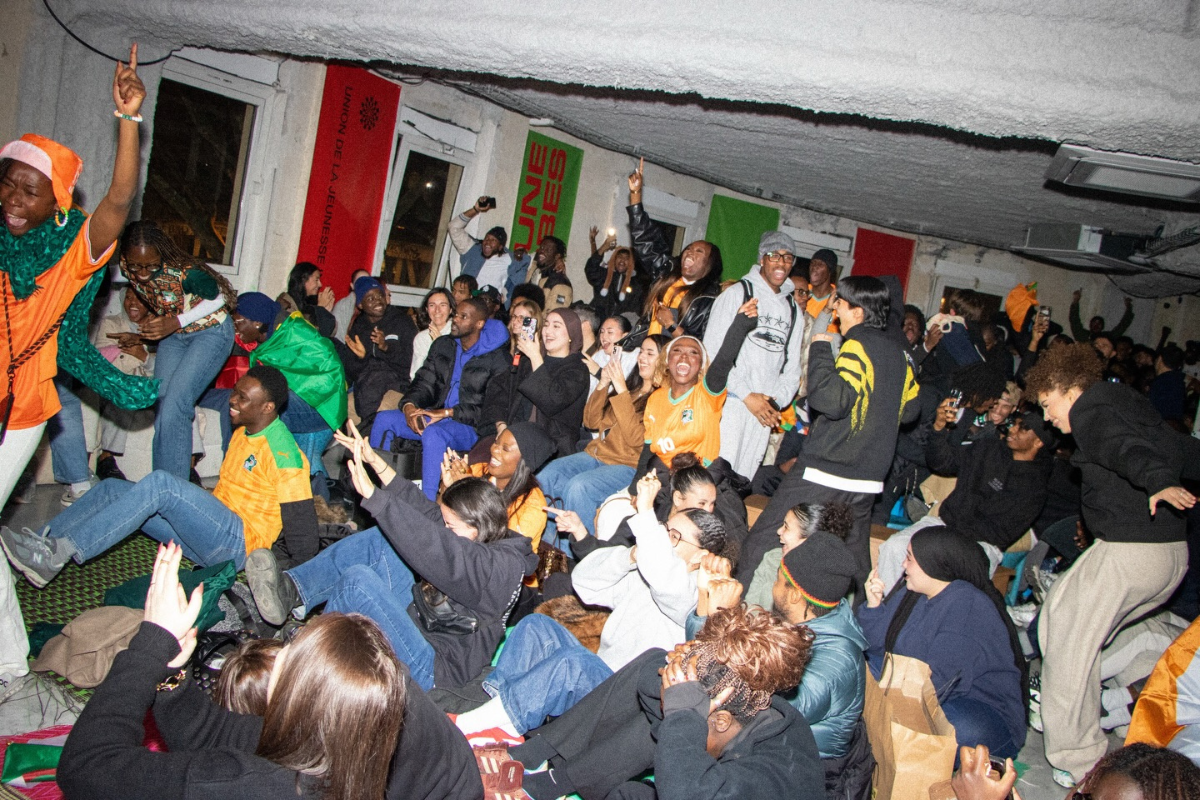
“Recognition” is now an omen for the oncoming dilution of authenticity, of events becoming inaccessible to the very neighbourhoods that built them. But the most interesting cultural work in Paris will always engage with the worlds still being actively made by the architects inside of them. A useful example can be found in La Goutte d’Or, where community organiser Mamoudou Camara spent years building a grassroots, neighbourhood-led version of AFCON, Paris AFCON, that began informally through social media and word of mouth and has grown into an annual summer football tournament in Square Léon, bringing together 24 teams representing diasporic communities across the city.
When Jordan became involved, the significance of the partnership exceeded just visibility and clout, because a sustainable operation was worth more in every economy–Mamoudou knew this. “We wanted the Jordan France team to meet our community first and foremost, but let us manage the rest,” he said in conversation with Dazed MENA last year.
Then came District 23, with the indomitable Youssouf Fofana selected as creative director, as Jordan Brand’s attempt to undo notions of extractive sponsorship into embedded support for the 18th’s existing cultural ecosystem. The project transformed the former Tati Barbès department store into a six-week community hub curated by Fofana, also founder of lifestyle brand Maison Château Rouge, centring infrastructures that already shape the neighbourhood like basketball courts, youth mentorship, design education, food cultures, art, local organisations and diasporic social networks. This took form through keeping local courts active and open during a summer of disrupted public space, a summer school for young creatives teaching design and technical skills as well as pathways into creative industries, the Diaspora Renaissance exhibition linking African, Asian and Latin American artistic practices, and celebrating neighbourhood food spots and grassroots organisations. Barbès itself became the symbolic nexus of all the worlds that live inside Paris.
Alongside District 23’s wider programming, the former Tati Barbès space also hosts Tatinho, a daily football and cultural gathering every day at 2–4 Boulevard Marguerite de Rochechouart. More food, more music, and this year, excitedly marks the first inclusion of a Brazilian team alongside the Paris Africa Cup of Nations. On top of this, Nike Paris’ tennis activations with Midnight.sp0rts fold barbershops and nail salons into the same spatial zones. There is everything for someone in Paris’ June.
What makes these initiatives special is their ecological investment, moving beyond the surface image of the football cage or La Haine-coded Paris, toward the deeper social conditions, friendship, mentorship, youth networks and shared public space that actually matter. A rhizome cannot be manufactured from above. Through connection and repetition, through walking the same routes over and over, through friendship as a site of taste-making, culture lays claim to a ground.
It is into this density that this Dazed MENA project, in collaboration with Nike’s five ambassadors, arrives, each reconnecting with a friend during the final week of June. Energised by Fashion Week, FDLM, Paris Africa Cup of Nations and the countless smaller gatherings orbiting them, we follow Killason Killa, Athena Mothership, Osama Chabbi, Hanan Al Badri and Rohan Gholestani as Paris becomes a meeting point where old friendships are renewed, and new stories begin. In a city as creatively generative as Paris, it goes far to keep your ears close to that soil and nourish what’s already, very clearly, in bloom.
So, is it that Paris is a cultural lighthouse in this period, or is it that a cultural lighthouse is made in Paris? I think it’s the latter. And if you look closer, there are fingerprints on what is made in Paris, fingerprints whose DNA traces to all corners of the world. This lighthouse doesn’t stand alone: it couldn’t, no matter what anti-migrant narratives run rampant. Every month of the calendar, but most unmistakably, every June, for a few fleeting weeks, we see whose hands are keeping its light on.