
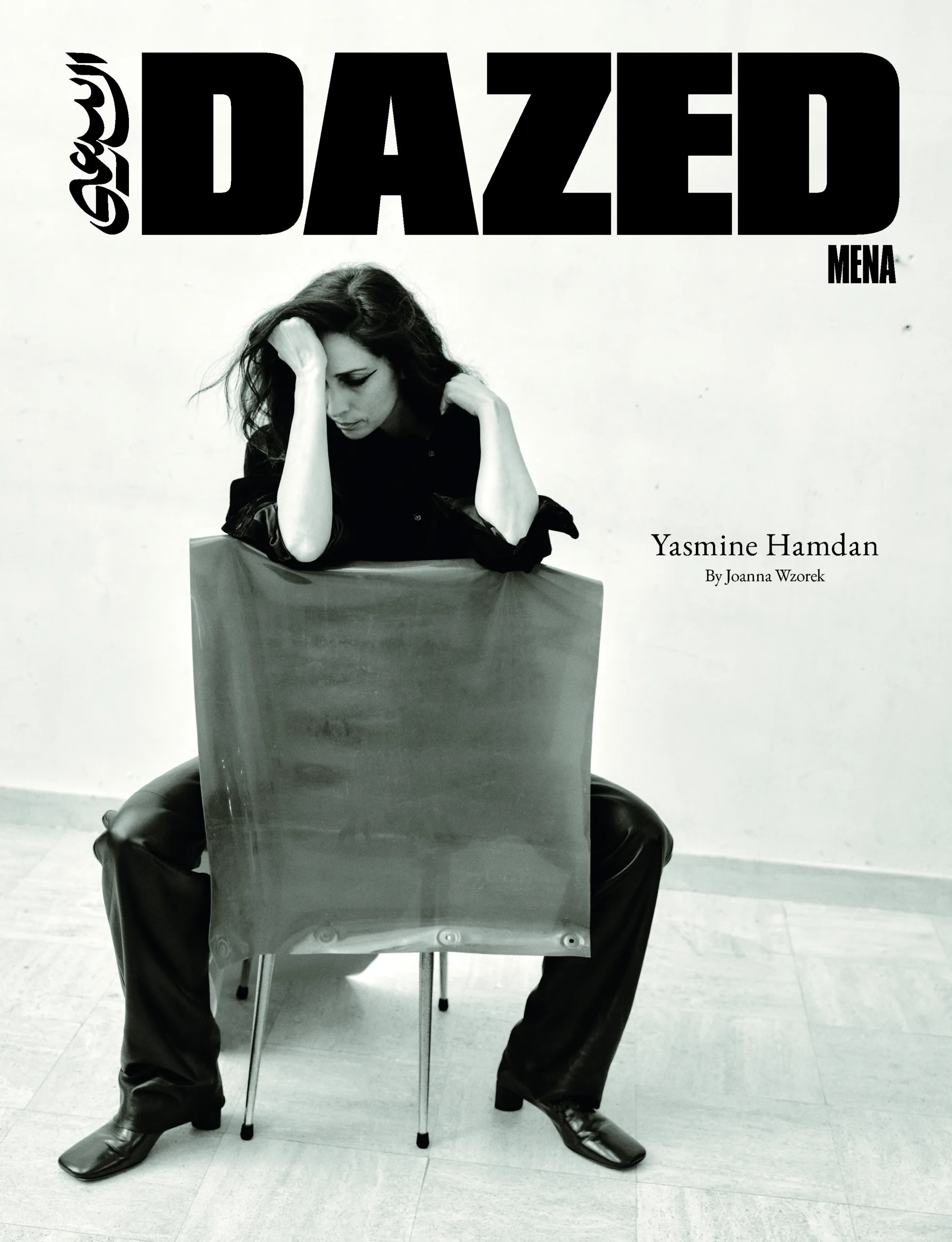

Text Fady Nageeb | PHOTOGRAPHY JOANNA WZOREK | STYLING OMAIMA SALEM
Originally published in Dazed MENA Issue 06 | Order Here
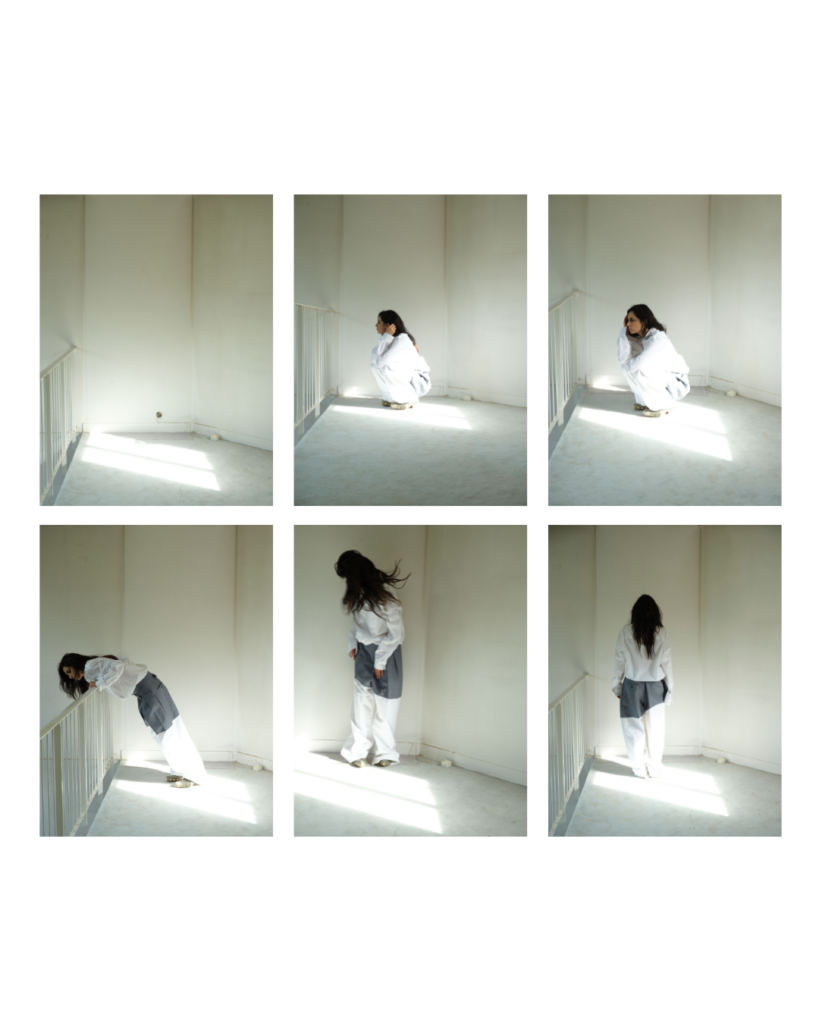
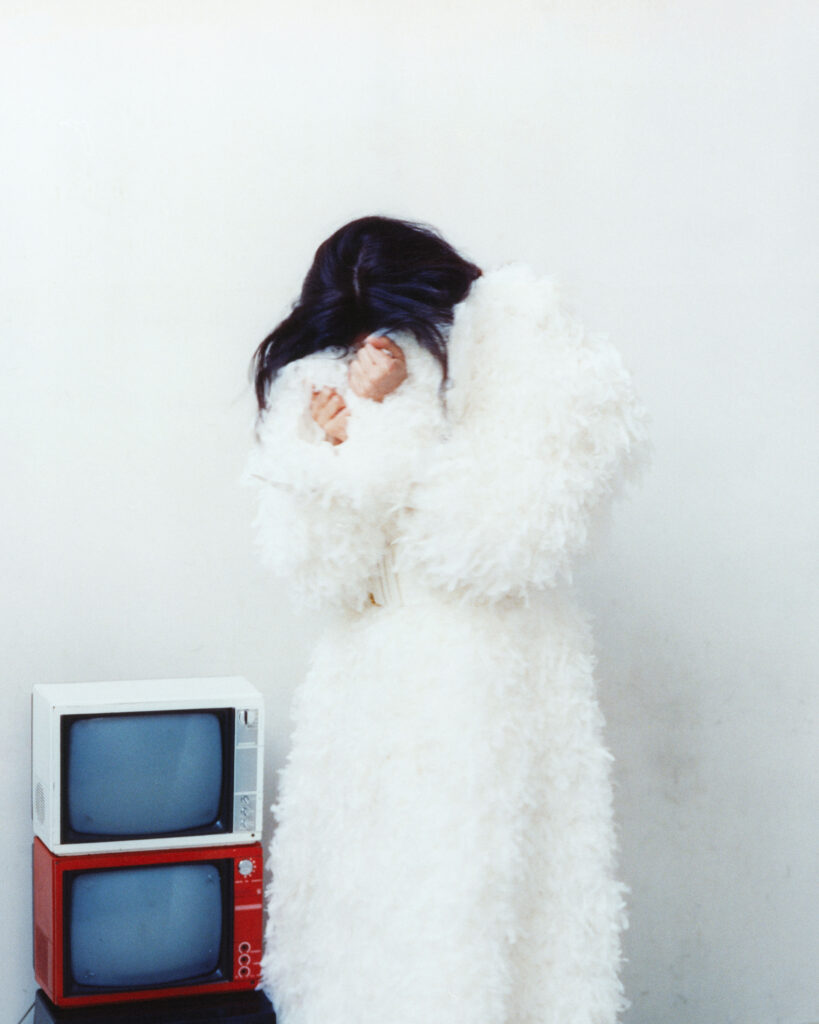
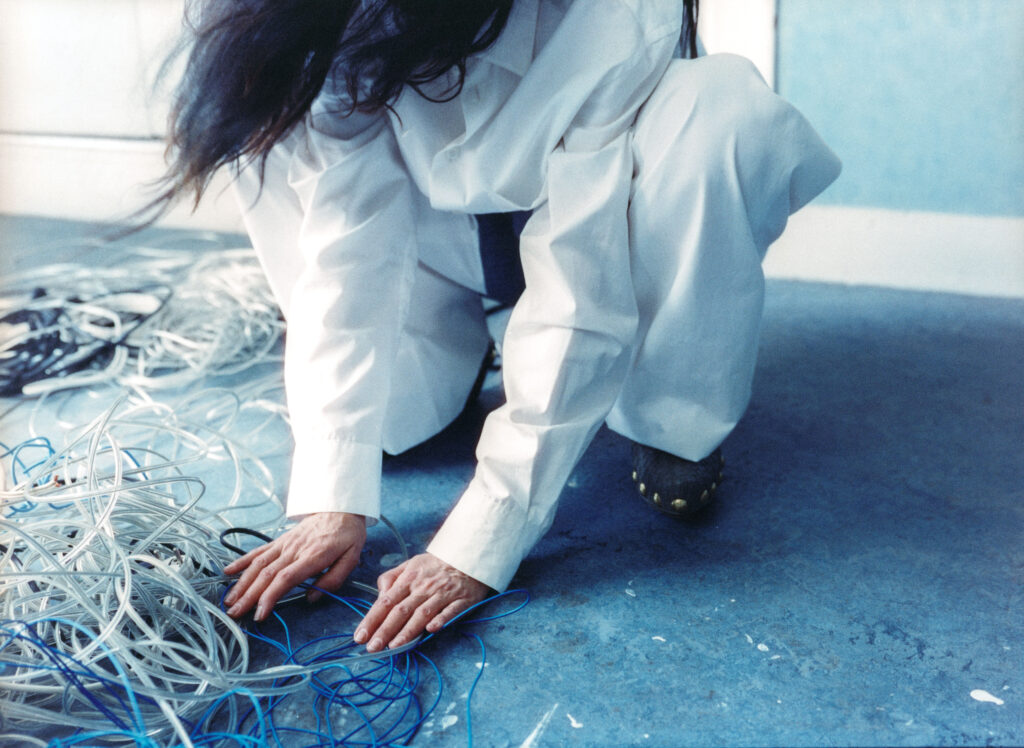
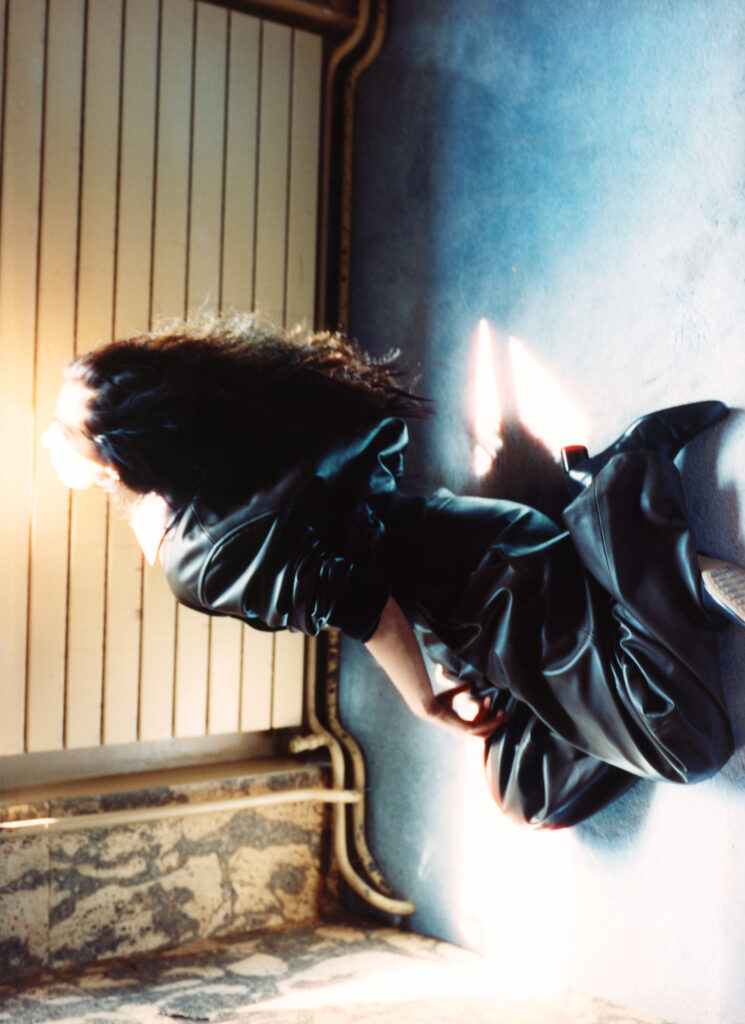
It’s going to be impossible to write this without geeking out, I think to myself, digging out my old laptop in my childhood home in Alexandria. By some small miracle, I get it to start and boot iTunes, only to be confronted by a Hed Kandi Ibiza compilation. Okay, maybe algorithms aren’t all bad, I begrudgingly admit.
There’s a reason I’m subjecting myself to this auditory trip down memory lane: I want to revisit my Top 25 Most Played, almost to prove to my teenage self that I am worthy of writing this. And to no surprise, there it is, “Shouei” by Yasmine Hamdan smack in the middle of my playlist.
I remember the summer of 2015 vividly. My first heartbreak at uni, my emo-boy solo trips to Sinai camps, those uncomfortable encounters with dreadlocked zionists trying to convince me that we should share the peninsula, and just the deepest tan one could wish for. It feels like I’ve neither tanned nor listened to music as deeply since. I still know Yasmine Hamdan’s Ya Nass record like the back of my hand—the multitrack chorus on “Samar”; دندنات وهمسات كل الدلال the faint gasps for air on “Shouei” before she says نفسك قصير, the building arpeggios throughout “Aleb” that feel like hovering but never quite taking off. And just how many times I wondered whether the line ديك الحبش سلطانه مات on “Bala Tantanat” was a saying in Lebanon or her own mind.
Now, this can’t be a rogue obsession. Ask anyone who’s had a teenage year in the 2010s about Yasmine, and I’m willing to bet the first image that comes to their mind is her in that dark, smoky Tangier club singing “Hal” in Jim Jarmusch’s Only Lovers Left Alive. Mind you, I didn’t even know the American filmmaker or Lebanese singer-songwriter when I saw the film back in 2014, but I remember being blown away by how much more there was to this.
I could tell that Yasmine wasn’t some new face; her cameo wasn’t the work of some restless talent agent propping up their next industry plant. If anything, this felt like she was some well-kept secret that I wasn’t quite privy to yet. I remember going down a research rabbit hole immediately after finishing the film, with indie electronic pop duo Soapkills coming up first. Zeid Hamdan? She had a band with her brother? That’s so cool. You don’t see that often anymore. 1997? How is this the first time I’m hearing of them? She worked with Mirwaïs? No way, Guy Ritchie’s ‘Snatch’ might be my favourite movie soundtrack of all time.
That might have been the single most taste-defining spiral I’ve gone down. Yasmine was a world opener; I spent the following year immersing myself not only in her music, but also Zeid’s. Incidentally, he’s not her brother, a fact still worth clarifying decades on. It wasn’t long before I, like many others I’m sure, had built up this idea about Yasmine as this elusive yet towering figure that had years and years of experimentation on the bands we saw emerging in real time—Mashrou’ Leila, El Morabba3, and Cairokee included.
After all, her concerts were fewer and further between, and her social media presence was always conservative at best. The six degrees of separation theory never became evident as I grew increasingly involved in the industry through different avenues. This all fell apart practically during the first ten seconds of Yasmine hopping on our call, apologising for oversleeping because her cat Shadia (yes, named after that Shadia) disrupted her sleep. There was no dry intro, no grand Parisian backdrop, no “I need to head out soon”. And after only five minutes of small talk, she was the one consoling me about how I feel every time I visit my hometown, weighed down by how much it’s changed and how much is gone. “Listen, even Lebanon is always a surprise for me,” she said. “And every time I go back, it always has something to give me. Even when it’s… apocalyptic, I return with something.”
This line immediately fell into place for me when she started detailing the story of her arrival in post-war Beirut in the early 90s, ironically only because she was fleeing Kuwait during the Gulf War. Yasmine described finding herself in a city that was not only foreign to her, but also foreign to itself in several ways. “You arrive at this place that is half destroyed, and you don’t know why. You feel like you’re inheriting something quite heavy, somewhere between hope and despair, because it’s the end of the war,” she explained. “But still, you have all these scars in the city and so many questions that cannot be answered. People wanted to move on, so it felt like the city was amnesic. At that moment, they had lost some connection to the past, you know?”
Arabic music essentially nonexistent at the private school she enrolled in. In fact, singing in Arabic was considered so passé that her classmates preferred listening to old romantic French songs on Radio Nostalgie Liban instead. Enter Zeid and his rock band, Lombrix. The artist and producer, who had also returned from living abroad, had already started making music. Yasmine did a stint at Lombrix as a vocalist before they disbanded, giving birth to Soapkills.
The duo recorded their first album Bater (2000) entirely in a mix of English and French, except for two tracks. Was the entire project just an experiment at that point? Absolutely, but more importantly, Yasmine on vocals was a choice—a choice of life as she put it. “When I met Zeid and started singing, it became a way for me to exist, to make decisions, invent, decide who I wanted to be and engage with a larger world. It was clear to me that I was entering into something. And the minute I decided to sing in Arabic, it became extremely serious to me.”
Yasmine still remembers the precise moment she made that decision, a story nothing short of a movie scene (a peak Lebanese one, at that). “I was at the old B 018 club, and it was very late, around 4am—after-after-after hours. It was almost empty, but I was still there for some reason. I remember the DJ put on “Ya Habibi Taala Alhaqni” by Asmahan, and I became very emotional because I realised I grew up on this music, on Egyptian films. And it all made sense suddenly. I started wanting to look for this woman.”
And so she did, spending countless hours digging through Beirut’s old record shops and delving deeper into music from the 30s and 40s, consequently uncovering a much more overlooked epoch in a city hellbent on moving forward. Soapkills went on to release its second album Cheftak in 2002, and Yasmine’s deep dive had evidently paid off from the first track. The album opened with “Aranis”, a track inspired by كله نظيف، كله ظريف, a song by iconic Lebanese ballad poet and singer Omar Zaani.
Repackaged in a trip hop formula, “Aranis” was a much more relevant commentary on the rapid
and performative ‘modernisation’ sweeping through Lebanon at the time, as it followed more than five decades later. Cheftak also marked Soapkills’ first fully Arabic-language release. The album included the quintessential “Tango”, a cover of a 1940s song by Lebanese singer and actress Nour El Houda, who retired notoriously early from an illustrious career in cinema in the late 50s. The duo’s discography would culminate in its third and final release Enta Fen in 2005. Here, they’d crystallise their formula into an 11-track album, borrowing from Mohammed Abdel Wahab’s immortal poem for Umm Kulthoum for the title track and, once again, going beyond the obvious ‘golden age gems’ with Nawfal Elias’ poem “Souleyma”.
Perhaps what stood out the most about Soapkills as a whole is how the duo navigated their identity in their music compared to what we’re seeing today. At a time where identity is increasingly playing a static role in music from the region and its diaspora, often in the form of literal speak about Arabness, Yasmine was using her art to actually work through it instead of shouting about it from the rooftops.
“When I talk about identity, it’s not about being Arab or Lebanese. It’s more about trying to understand what this bond is, where I belong. I have some answers, but they’re not conclusive. And it was never really communitarian,” she said. “Today, because of everything happening, there’s more of a community hoopla, which is also nice. But I never belonged to cliques. It was a very solitary quest, linked to my identity as an Arab woman artist. I was really trying to give myself tools to navigate.”
Relocating to Paris not long before the 2006 war in Lebanon, Yasmine used that time to find her footing while working alongside her partner, renowned Palestinian filmmaker Elia Suleiman. Three years later, she released Arabology under the project Y.A.S. in collaboration with producer Mirwais Ahmadzai, best known back then for his Grammy-nominated work with Madonna.
While perhaps one of her shorter-lived projects, the Y.A.S. experience left Yasmine with two clear outcomes, the first being a desire to experiment with a wider range of musical styles and dialects from across the region. Arabology album had visible Khaliji, Iraqi, and Palestinian influences, a pattern she went on to repeat in later releases. Secondly, it pushed Yasmine to pursue more autonomy. “You know, with Soapkills and with Y.A.S., I was like the main dish, I’d say. I was very central to everything, but I was also shy about it,” she explained.
“I’ve always worked with men, and there’s always a relationship where there’s a power dynamic. Because you’re a woman, and because you have an intuition that can be completely different, you’re not always in harmony. There’s also a form of competition sometimes. So I was like, ‘Okay, from now on, I’m the boss.’”
Not long after the Y.A.S. release, Yasmine rather spontaneously ended up performing three songs at the Marrakech Film Festival, where Elia was jurying. In the crowd was Jim Jarmusch, who struck up a conversation with her afterwards, outlining a scene he had in mind for his upcoming vampire movie, set to be shot in Tangier.
It would take Yasmine a couple of years to complete her first truly solo endeavour, Ya Nass. “I didn’t want to rush. I never want to rush,” she reflected. “I don’t have the ambition to manufacture music. It’s a process, it’s a journey. When you start working on something and you don’t know what’s going to come of it, it has to take the time it needs. I’m against readymade recipes.
While I could spend another thousand words gushing about Ya Nass and the role it played alongside that scene in Only Lovers Left Alive when it comes to shaping a generation of independent music listeners across the region, I realise I’d never really stopped to consider what it felt like for Yasmine herself to release such a defining debut solo album. She went on to describe, rather hilariously, how the album paved the way for her escape from “this ghetto called world music”.
“There weren’t many people doing what I was doing. It wasn’t a trend, there wasn’t a community. When I arrived in Europe, there was a colonial mindset that wanted me to sing Arabic the way they were used to listening to it. For me, the ‘world music’ box was a racist and reductive denomination, so the challenge shifted when I came to Europe.”
With this added perspective, it’s even more impressive how she managed to pull off the escape. In many ways, that record represented every core element of Yasmine’s work up until that point in a much more confident, autonomous package: a nod to Abdel Wahab and Soapkills with “Enta Fen, Again”, another Omar Zaani rendition in the track “Beirut”, and even an homage to Kuwait on the title track as she revisits poet Fahd Rashid Bursili’s يا ناس دلوني درب السنع وينه
For the first time in her career, Yasmine wasn’t searching for a place within music. She had already uncovered one. The question became what she wanted to do with that freedom. The answer would emerge four years later in Al Jamilat. The record’s origins can be traced back to a friendship that Yasmine had struck up while touring behind Ya Nass with Sonic Youth drummer Steve Shelley. Through him, she spent five days recording at a studio alongside a rotating cast of musicians, returning home with a wealth of new material and, by her own admission, no clear idea of what to do with it.
Named after Mahmoud Darwish’s poem “Al Jamilat”, an ode to womanhood in all its complexity and contradictions, the album found Yasmine expanding her sonic universe once again. To help shape the material, she turned to a cast of collaborators drawn from the worlds of experimental rock and contemporary composition. Shelley helped shape the album’s distinctive sound, as did guitarist Leo Abrahams, producer Luke Smith (known for his work with Foals), and multi-instrumentalist Shahzad Ismaily.
Al Jamilat also feels like the first record on which Yasmine became fully comfortable acting as a director rather than just a collaborator. “I learned a lot from working with them, and we still laugh about it today because we co-produced the record together, the three of us. I always use very abstract words. I’d say, ‘I want more warmth in this sound.’ We’d then realise that warmth is 21ºC for him, but 40ºC for me. I talk about things like dust, these very abstract notions. I like abstraction because it gives the person in front of you the freedom to interpret it in their own way, and then it becomes a back-and-forth.”
Released at a moment when Lebanon was grappling with political paralysis, from a two-year presidential vacuum to the mass protests triggered by the 2015 garbage crisis, Al Jamilat found Yasmine engaging with those anxieties more directly than ever before. Tracks like “Balad” and “Douss” wrestled with questions of belonging and disillusionment, bringing some of her innermost questions to the surface. The record was still teeming with well-rounded earworms, from “La Ba’den” (complete with a music video directed by Suleiman) to “Choubi” (a nod to “Wahch” with Soapkills).
By most measures, Al Jamilat should’ve marked the beginning of a new chapter. The record had given Yasmine something she had struggled to find during the Ya Nass years: an established solo project, a stable live band, a touring rhythm, and a body of work that continued to evolve night after night on stage. For years, she carried those songs around the world. Yet somewhere along the way, another feeling began to creep in. “It was a mix of things,” she mused. “I think I was going through an existential crisis. I was also going through an existential crisis regarding the music industry.”
The exhaustion wasn’t simply the product of years spent touring. If anything, Yasmine spoke about that period with a certain fondness. What she found progressively difficult was the machinery surrounding the music itself. As the industry became more dependent on visibility, metrics, and constant self-promotion, she began to question her place within it. “I was starting to realise that we were heading more and more towards objectification.”
In many ways, it echoed tensions that had followed her throughout her career. From her earliest days with Soapkills, Yasmine had resisted easy categorisation, pushing back against the expectations placed on Arab artists and refusing to be packaged as a digestible cultural export. But by the late 2010s, those pressures felt harder to escape. Success brought larger audiences and bigger stages but also came with a growing expectation to remain visible, productive, and legible at all times. What had once felt like a space for experimentation and self-discovery was beginning to look undeniably transactional. The result wasn’t writer’s block so much as a crisis of purpose in a now-algorithmised industry.
Yasmine found herself questioning not only what kind of music she wanted to make next, but also the conditions under which she wanted to do so. The timing hardly helped. As Yasmine stepped back from public view, Lebanon entered one of the most turbulent periods in its modern history. The October 2019 uprising was followed by economic collapse, the pandemic, and the Beirut Port explosion. What started as an intentional 12-month hiatus in 2019 grew longer.
Even as Yasmine slowly got back into the rhythm of creating in 2021, it was almost from a place of refusal—a refusal to conform, to be rushed, to be dictated. “I didn’t want to rush anything. I didn’t want to have plans. I didn’t want to be productive. I didn’t want to conform to anything. I wanted to connect to the essence of why I’m doing what I’m doing and why I want to continue doing it. It’s really a spiritual and existential question. And you don’t answer it in one day.” The pause was not a retreat from music; it was a refusal of the terms under which she had been asked to make it.
“People would ask, ‘What are your plans?’ It made them anxious when I’d reply, ‘Nothing.’” The answer, she discovered, wasn’t waiting on the other side of some music business masterclass by a former major label exec. It emerged through smaller acts: reading, meditation, long conversations, slowing down, and learning to sit with uncertainty rather than rushing to resolve it. “If it doesn’t come out of necessity, then I don’t want to do it. I wanted to have a more honest relationship with myself and a more straightforward relationship with people. I wanted to connect with people without this burden of being a public person.”
Looking back, Yasmine acknowledged that period less was a rare luxury only a few could afford: the opportunity to ask questions without feeling compelled to answer them. “It was great to slow down, to step away and just feel free. To doubt everything.” This vulnerability is, to me, the most striking and central sentiment of her comeback LP, I Remember I Forget. The album succeeded in transforming inexplicable and deeply rooted anxieties, fears, and even pleasures into something said aloud—not just with words but through music and textures. It’s five years of some of the most sacred, solitary, obsessive, and ultimately vulnerable thoughts put into an album.
Tracks like “Hon” feel like an existential stare at the wall, while tracks like “Shadia” (yes, her cat) evoke the kind of intimacy you can only have with yourself through a pet staring back at you like you’re crazy. “I didn’t want to wear any masks anymore. I wanted to just embrace my insecurities, work with them, and continue. This work, this idea of continuing, has always been an obsession for me. How do you continue with everything happening? How do you continue with the pain?” You slow down.
During the making of I Remember I Forget, Yasmine worked in complete solitude for nearly two years, without even her partner listening to a single loop. Blocks on certain tracks were resolved by watching a Tuareg music performance, speaking to a taxi driver in Beirut, or reading a poem. “An idea can be a very fragile thing. You have to protect it. Before you confront it with the outside world, you have to do your best to push it as far as it can go. Then, you have to share it when you feel comfortable, whether with another person or another pair of ears.”
Towards the end of our conversation, I found myself thinking less about Yasmine’s career and more about how it couldn’t have existed any other way. How many artists can truly afford to find the space where they are most fragile today? To spend years following an idea without knowing where it leads? To disappear without a plan?
For nearly three decades, she has resisted being rushed by labels, genres, audiences, and an industry increasingly obsessed with visibility and constant output. Yet every chapter of her story seems to arrive at the same question: How do you continue? Maybe that’s why her work has endured. In a world obsessed with certainty and instant gratification, Yasmine has spent nearly three decades doing the opposite—following questions wherever they lead, from Asmahan’s voice at 4am in a Beirut club to Omar Zaani’s poems and, most importantly, deleting Instagram whenever the f*ck she wants.
Originally published in Dazed MENA Issue 06 | Order Here
Hair ROGER CHO at ARTLIST, makeup ADRIEN PINAULT at BRYANT ARTISTS, set designer FREYA WENTWORTH, production VICTORIA at LOCK, printer MARIA DARKROOM, talent YASMINE HAMDAN