
 Posted in
Music,
Posted in
Music,
Sound and structure: Devon Turnbull in conversation with Wondercabinet
Text Selma Nouri
In an era dominated by algorithms, sensational headlines, and endless internet slop, it’s hardly surprising that the average person now spends six hours and 40 minutes a day online. A 30-minute scroll slips quietly into 90 and, when human tragedy is wedged into an infinite feed, disengagement rarely feels like an option. We are compelled to document, to bear witness, to speak out. How can we ‘switch off’ when so much still demands our attention?
The question, then, is not whether we should look away but how we can recalibrate our focus in an environment designed to exhaust it. Rather than withdrawing from images entirely, we must turn towards alternative cultural forms, underground mediums that feel less extractive and more embodied. The key is not to see more but to listen differently—perhaps the solution lies in sound.
Despite operating from opposite sides of the world, this idea has long been advanced by American artist and OJAS founder Devon Turnbull and Palestinian architects and Radio alHara co-founders Elias and Yousef Anastas. Through radio, public installations, and curated listening rooms, they demonstrate the radical power of sound not only as a source of personal relief but also a force for collective resilience.
Unlike visual media, they argue, sound carries a distinctive capacity to slip past imposed constraints, inviting listeners to imagine freely, think critically, and connect through empathy rather than appearance. Precisely because it is untethered from the visible, listening operates across temporal and spatial boundaries, conveying meaning where words fail and resonating through ambience or breath whenever language falls short.
Whether sitting with a composition in one of Turnbull’s OJAS Listening Rooms or tuning in to a Radio alHara broadcast, audiences are encouraged to enter parallel imaginative and emotional spaces. In these moments of focused listening, cultural and geographic distances narrow as superficial distinctions begin to dissolve. Together, Turnbull and the Anastas brothers suggest something simple yet profound: if we close our eyes and listen more closely, we may finally realise that more unites us than divides us.
Elias Anastas (EA): Hello!
Devon Turnbull (DT): Good morning, guys! It’s morning on my side, at least. How are you?
EA: Doing well! Devon, I’m not sure if you remember, but Yousef and I met you very briefly many years ago at the Lisson Gallery in New York.
DT: Yeah, of course. I do remember! We’ve spoken on and off over the past few years.
EA: Yeah, we should finally have you come over to Palestine.
DT: Of course, one day. It would be such a pleasure. I mean, this is a really cool-looking studio you’re calling from. What do you do there, exactly?
EA: We’re architects, we began our architecture practice in 2012 and, early on, the use of stone became a central focus of our work. Here in Palestine, we inherited an Ottoman-era law that required most buildings to be constructed in stone. Over time, however, its use gradually shifted, and it lost its role as a structural, noble material. That shift inspired us to establish a material research arm within our practice, where we could critically explore and rethink how stone is used today.
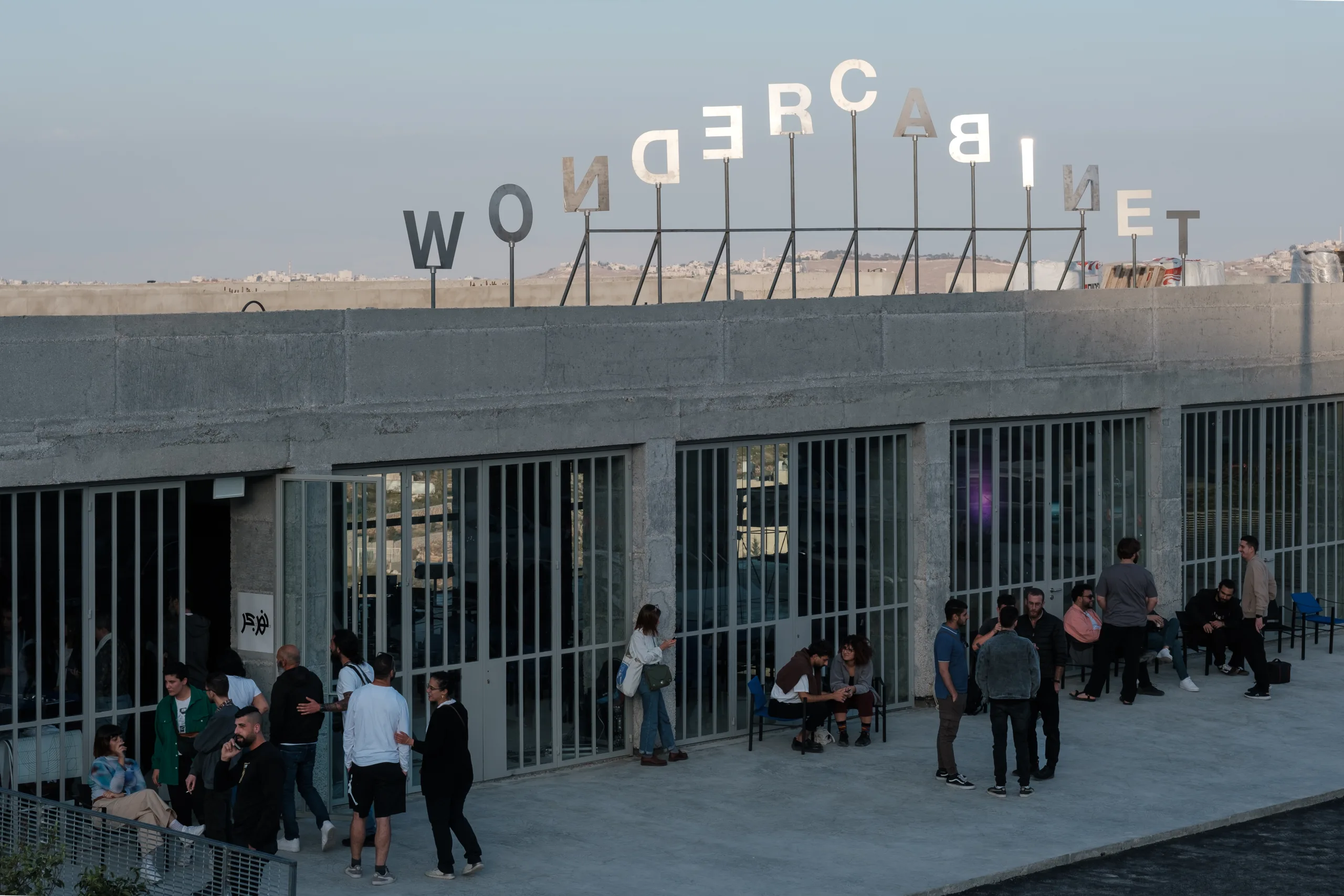
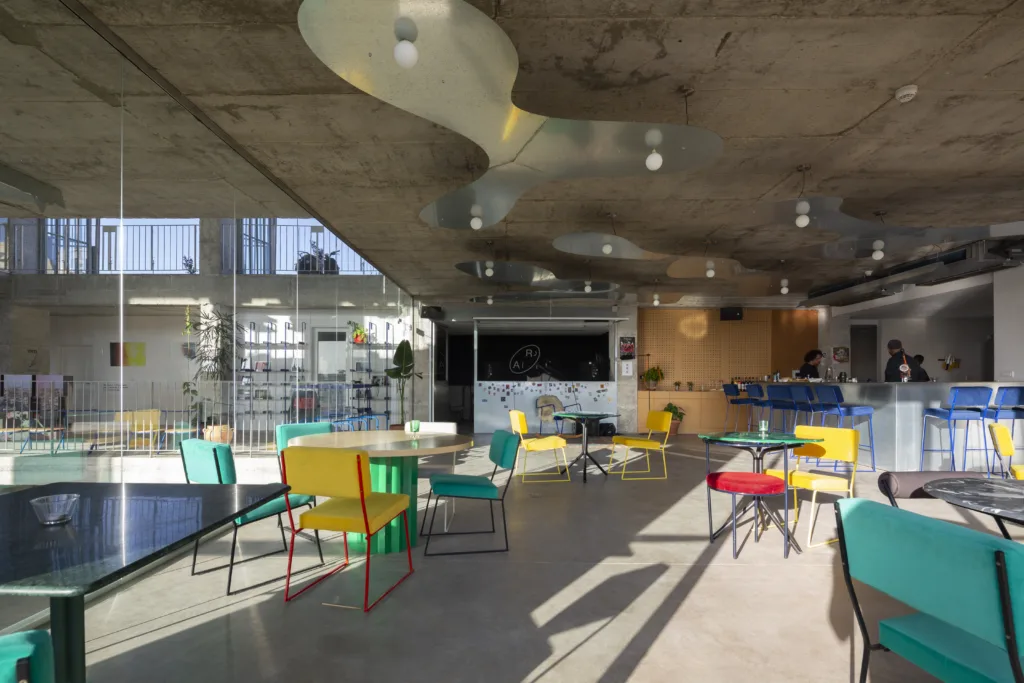
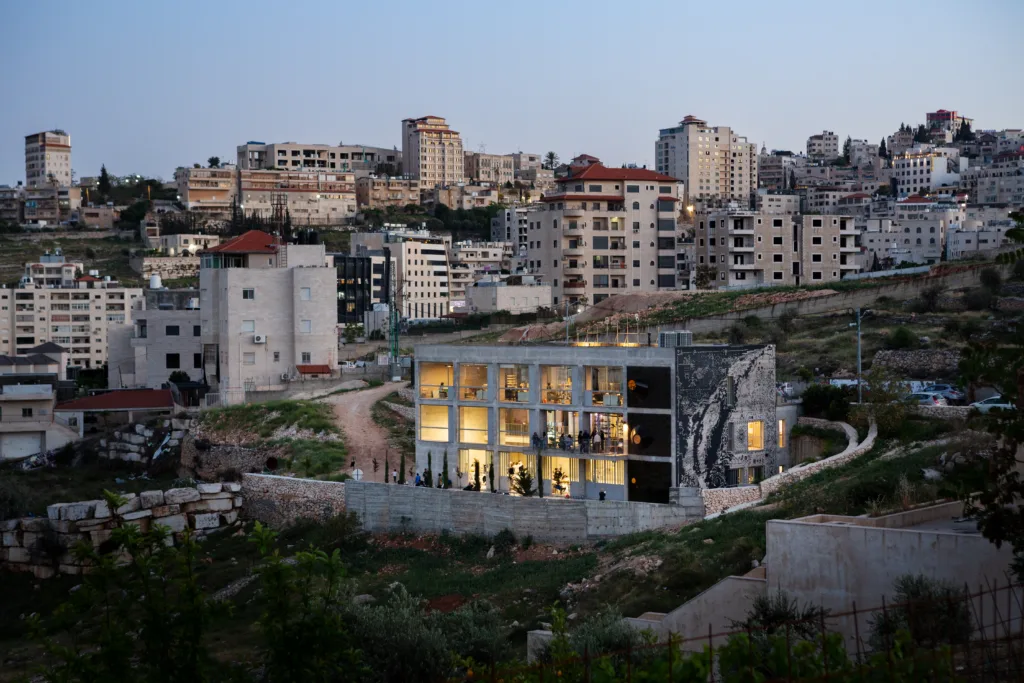
We also co-founded an online radio station called Radio alHara in 2020, which quickly became an important part of our work. And more recently, in 2023, we opened Wonder Cabinet, the space I’m speaking from now. It functions as our office as well as a cultural platform. We host artists-in-residence, run a multiuse bar, and house the radio station here. Although Wonder Cabinet launched just a couple of months before the start of the genocide, it has remained very active.
DT: I can’t even begin to wrap my head around what the implications of that are, but thank you for the important work you’re doing.
EA: Thank you.
Selma Nouri (SN): Although you’re based in different parts of the world, your work speaks to one another in such interesting ways. Devon, on the OJAS website, you have a line that reads: “Struck sound is said to give pleasure. Unstruck sound leads to liberation.” I would love to linger on that word ‘liberation’ because, Yousef and Elias, your work also feels deeply rooted in this idea. In 2021, you even founded the Sonic Liberation Front in response to the expulsion and ethnic cleansing of families in Sheikh Jarrah. In what ways can sound, especially unstruck or uncensored sound, operate as a source of liberation?
DT: What you’re referencing on the website is a passage from the Bhagavad Gita. I was raised in a Hindu community in America, so I put it up there quite a long time ago—before it carried the immediate context most people would read into it today. Still, I believe it applies in the same way. The term ojas is Sanskrit for ‘life vitality’, a concept often encountered in Ayurveda, so I’ve always interpreted that passage as a sort of spiritual liberation.
More broadly, I’d like to think of my work as universally inspiring, and whatever small measure of spiritual relief or liberation it can provide should be available to anyone. That’s why I often go to great lengths to create objects and experiences that are accessible to the public. It’s also why I rarely include lyrics in the music played in the listening rooms. My intention isn’t to deliver a specific message or guide anyone’s perspective.
EA: Just to align with what Devon has been saying: there was an overwhelming flood of information and imagery online in 2020, when cultural institutions worldwide opened their archives. Suddenly, we were exposed to an immense amount of content. It was incredible, but also extremely overwhelming. What felt so liberating about Radio alHara, and the sonic medium more generally, is that while it can be very precise, it allows far more freedom in how it’s received. There’s a kind of sub-layer of fiction operating beneath the surface.
Take the Sonic Liberation Front. In May 2021, families in Palestine’s Sheikh Jarrah neighbourhood were being forced out of their homes. The idea was to use the radio’s environment, the community that had formed around it, as a way of responding and protesting through music. Sound became a means of digging into history and tracing the memories embedded in the very places where the radio was being broadcast as an act of resistance.
At the same time, something powerful emerged from the act of collective listening. Through the radio’s waves, we were all rejecting injustice, but this felt profoundly liberating because sound allowed the experience to exist beyond a single, fixed perspective. It didn’t prescribe how we should feel or think. Instead, it opened space for each listener to interpret and absorb the content in their own way.
SN: That’s really interesting. I feel like I have a sense of how each of you might respond, but I’m curious to hear where your perspectives diverge. Through different mediums, all three of you are engaged in the project of democratising sound. Some would say that’s an inherently political act. Do you agree?
DT: For me, it’s explicitly apolitical. There’s already so much that is political in the world today, and I don’t want to be exclusionary. I mean, that’s the whole point of democratising something—to make it accessible. So, yes, I intentionally keep politics out of my practice.
Yousef Anastas (YA): I understand what Devon is saying. I completely understand it, but I think his work is infrastructural and for it to proclaim itself as apolitical is, in my view, a political act in itself.
DT: You know what, I agree. I would agree with that.
YA: I’ll take an example that isn’t related to radio. As Elias mentioned, we’ve spent a lot of time studying stone construction and building techniques. Over the years, we began to trace connections between methods across different regions and historical periods, which reveal forms of transmission and exchange that challenge the conventional narratives of architectural history.
In the old city of Jerusalem, for example, there’s a cupola atop the Church of Saint Anne, built by the Crusaders. Historical evidence shows that they incorporated the construction techniques they encountered locally. A few years later, a nearly identical cupola appeared in the south of France, challenging conventional narratives that often credit the Crusaders alone with the art of stone building. What this shows is that techniques don’t move in a linear fashion. It’s about democratisation.
Similarly, we noticed a parallel phenomenon in our work with radio. Sounds emerge from hyper-local contexts all over the world, yet striking parallels or analogies often appear between them. This creates a powerful network—art that is deeply rooted locally, yet connected globally. Realising that someone thousands of kilometres away is ‘speaking the same language’ in an artistic sense can be profoundly empowering, and the radio nurtures this connection in multiple ways.
There’s no strict curation, for starters. You might tune in at 10am for an experimental set, followed by a chef’s show, and then something entirely different. A listener who came for the cooking segment could suddenly find themselves immersed in experimental music that they’d never encountered before. In this way, the radio excludes no one and functions as a kind of infrastructure, a public space of sorts. And like any other public space, you can’t control everything that happens, but that’s precisely its beauty. It unites people.
DT: Yeah, sound is one of the most powerful unifiers. In that sense, you could say that it’s political, but for me, that’s the beauty. Music, in my life, has always been the strongest tool for building community and connecting with people at clubs, at concerts, in record stores. It doesn’t matter. Even in school, you might make friends from completely different walks of life and discover you both love the same artist—just like that, a friendship is formed without thinking about differences in background. That kind of unification is what truly fuels my desire to make my listening spaces public.
In fact, when I was younger, I spent a lot of time in activism, from the WTO riots in Seattle to writing graffiti on the streets. Growing up in such spaces, you develop strong feelings about how information is consumed, who gets to speak, and at what level their voices are heard. As I’ve gotten older, though, I’ve come to see that the real power of music lies in its ability to push back against that dysfunction—to create connection, to bring people together.
SN: Building off that, in a moment of constant visual saturation, how is sound fundamentally different from visual media, especially in the way it moves through time and space? Do you think sound has a stronger or more lasting impact on memory and psychology?
DT: I think the physicality of sound waves is so different from the way we perceive colour or text. We feel sound, and that’s really important. That’s why I make these sound systems that are as tactile as possible, so you can feel the texture and frequency. Also, most people can remember things with music far more easily than without it; there’s something very real and psychological about how harmonious frequencies affect our brains. That’s why music moves people in profound ways. In some cases, that power can even be a little dangerous. In my own work, though, I aim to make people feel good. I believe practices like singing or sound therapy can be incredibly healing; I’m not someone who participates in kirtans or sound baths, but reverence for music is at the heart of everything I create.
YA: Yes, I think this idea of intimacy is deeply connected to sound—how we can imagine spaces through it and how we can relate to different spaces through the sounds they carry. Sound has a way of placing us somewhere, of shaping our sense of space from the inside out. You get less of that with images. Something very structural in our work is that, in the context of Palestine, almost everything becomes a documentary. Whether through activism, journalism, or art, so much is recorded.
For example, most Palestinian films are documentaries for two main reasons. The first is obvious: given our political realities, there’s an urgent need to document as a form of both preservation and resistance. The second reason is more subtle. At times, we fall into the trap of internalising the expectations placed upon us—projecting the goals of others onto ourselves and feeling a constant need to document. Sound, I believe, offers a way out of this trap. It allows us to fictionalise the landscape and reclaim the right to imagination.
While they’re often tied to truth, fiction is also a form of truth. It’s a mode of expression grounded in practice. For instance, about two years ago, we launched a project called Sounds of Places. It’s essentially an artist residency built around this exact idea: creating a shared imaginary of a place through sound. Artists stayed in the Cremisan Valley, just west of Bethlehem, for several days, observing and recording its sonic environment before developing sound installations placed within the landscape itself. What’s interesting is that once you hear the sound of one place, you begin to connect it to other places as well. Sound creates bridges. Unlike images, which can become too specific, sound can be incredibly precise while still leaving room for imagination.
EA: What stands out really is the fluidity of sound as a medium, how it moves compared to other forms of artistic expression. Take the example that Yousef mentioned; through sound, unexpected analogies emerge between people living in very specific contexts and struggles. Even in entirely different conditions, they can relate to other places – or one another – through sound’s ability to activate fiction and feeling. Sound becomes the tool through which people can project their own imaginaries, offering perhaps the most expansive sense of freedom for those constrained by more physically or materially limiting contexts.
SN: That’s really interesting. I’m especially curious about this idea of escapism and alternative imaginaries, and how those ideas shape your work. Devon spoke about sound as a form of wellness. Yousef and Elias, I could be wrong, but I don’t think I’ve ever heard you describe your architectural practice or projects like Radio alHara explicitly in those terms. I’m curious, is wellness something you consciously consider when developing projects around sound or architecture in Palestine? And more broadly, how does that connect back to fiction and the creation of alternative imaginaries?
EA: I mean, simply building under the current conditions in Palestine is a de facto form of wellness in itself. The act of constructing something, insisting on staying or inhabiting a place, carries a restorative dimension. When we begin to imagine a space, one of the first questions we ask is: how can it be inhabited? And the way we do so is shaped fundamentally by the conditions, constraints, and opportunities of the space. Atmosphere becomes central to this process. The environments we create are not only physical, but also sensory. Sound, in particular, is one of the primary textures that can fundamentally transform a space, completely reshaping the way we experience it.
YA: Yeah, I agree. In our context, there’s also a constant demand for transparency. We have to be clear about everything—every word we use, every sound we produce, every image we create. And that expectation can become a form of censorship. In that sense, I believe the radio acts as a refusal of that demand. It resists the need to project a fixed image onto something that seeks to exist free from imposed representations. It allows for the expression of a different kind of imaginary, one that can resonate with new and alternative imaginaries, elevating sonic practices to a form of content capable of connecting people across cultures, geographies, and struggles.
EA: In fact, from the very beginning of the radio, we included a chatbox on the web portal. It’s just as essential as the play button itself because it serves as a reminder that you’re listening collectively, not alone. It creates an opportunity to connect with others and take part in a shared moment. This relates directly back to the idea of wellness. During the lockdowns, when isolation was at its peak, the radio became a way to re-establish connection and recover a sense of unity, even while physically apart. And this function extends to any context of isolation, migration, or displacement. For me, radio inherently offers this possibility; it creates a shared space even under conditions of extreme distance or separation.
SN: One question that I have for all of you then is, considering all the atrocities and deepening polarisation unfolding globally, what feels more urgent right now: the creation of sound or the act of listening?
DT: I don’t want to overstate the value of a listening practice, but of course, it’s a difficult question. After all, without recorded music, there’s nothing to listen to. The performance, or the masterpiece that ultimately becomes the recording, is essential. At the same time, though, music itself feels timeless to me. I don’t listen to much contemporary music, which is simply a personal preference, but I do think there’s an age component to that.
When I was younger, I felt a constant need to have my finger on the pulse of whatever was happening in music at the time, especially through the 90s. At that stage of life, when you’re figuring out who you are, the music of the present feels especially important. It helps shape your identity. But something shifted in my early thirties. I started to feel that I had spent a significant portion of my listening time – which is finite – on music that, in hindsight, wasn’t necessarily great. It was simply relevant at the time.
That realisation gradually changed my relationship with listening. I found myself returning to the great composers and works that have endured rather than holding onto that earlier longing for constant novelty. Take Coltrane’s catalogue; I guarantee most people haven’t listened to even 80% of it. Yet, we’re often preoccupied with chasing the next release without realising how much extraordinary music is already out there. Algorithms are interesting in this context. They can introduce new listeners to older work in unexpected ways—but I realise this is a complicated answer. Maybe, in the end, the key is just to listen.
EA: I agree. For me, the act of listening is incredibly important, especially in the context of the broader global crisis we’re living through. It reminds me of a project we feature on the radio by a UK-based collective called Soundcamp. Its work centres on designing microphones that can be placed outdoors, in almost any environment and under any conditions, to capture and transmit the natural sounds of a specific place.
What makes the project so compelling, though, is that the live audio becomes a starting point for real-time conversations. People gather to reflect on what those sounds might reveal about the spaces and circumstances from which they emerge. The sounds themselves can be anything from a pipe leaking in Shanghai to a protest for Palestine in London. The goal isn’t just to hear them, but to listen actively and engage collectively, so yes, I agree with Devon—under the current conditions, listening itself can be a deeply active practice.
SN: Devon raised an interesting point about algorithms. With the rise of social media and the broader commodification of sonic and cultural production, some might argue that we’re seeing an overproduction in what could be considered low-quality output. It feels like everyone is a musician, designer, or creative director these days. In that context, I wonder about the potential drawbacks of democratising culture through social media. Has this shift affected people’s tastes? Has it influenced our collective ability to distinguish between what might be considered high- and low-quality production in creative fields?
DT: Wow, this one’s… big.
SN: Sorry [laughs].
DT: No, I like the question. It connects interestingly to the last topic we were discussing. After having spent some time intentionally listening myself, I’ve started to reflect on how, in the age of social media, the issue isn’t necessarily that people talk too much. It’s that there’s such a strong pull to produce, to profit, to contribute to the noise—and far less incentive to truly listen. Especially now, in an age where gatekeeping has disappeared, much of the foundational training has been lost.
When I was younger, the path to sharing your own ideas felt longer, more intentional. You had to earn the right to immerse fully in your craft. There was a learning curve that demanded deep engagement with a culture before you could create within it. Back then, you might walk into a record store without buying anything. Your initial goal was simply to tap into the culture. And when you could only afford a single record, choosing it required careful consideration. From there came the longer journey: playing the music for yourself, absorbing it, and eventually sharing it with others. This process fostered a sort of disciple tradition, a practice that is increasingly rare.
Without that period of immersion, it’s harder to appreciate or respect what’s being produced. Nowadays, people come across something and immediately start contributing to it without taking the time to really engage with it first. I probably sound like a jaded, grumpy old dude saying this, but I can’t help wondering what the long-term effects will be. Democratisation is central to my practice, but to a certain extent, there still needs to be some form of gatekeeping to create clear paths for teaching. You can’t fully democratise architecture, for example, because you don’t want people building structures that might collapse. Is that a controversial statement?
YA: [laughs] You know, there’s a great concept called ‘architecture without architects’ and, today, it feels more relevant than ever. Much of contemporary practice is driven by real estate interests rather than architecture itself. In that context, architecture without architects is powerful because it returns building practices to local communities, empowering them to create functional, beautiful spaces rooted in tradition and necessity rather than profit.
In fact, this ties directly to what we were discussing earlier. At Radio alHara, we almost never turn anyone away from playing a set. You don’t need to be an expert. If you send us something, chances are we’ll play it. The only condition is that it should be music you’d actually listen to at home, so not a club set but something that genuinely reflects your own environment. In that sense, the radio becomes a way of sharing domesticity. And that domestic quality, I think, acts as a pushback against the flattening effects of the algorithm.
The algorithm is powerful in certain ways, but I don’t believe it can ever completely flatten the diversity of sounds and sonic interests worldwide. If you walk into a carpenter’s workshop, he’s often listening to music that sits entirely outside the algorithm’s register on his radio—music chosen not because it was recommended but because it belongs to that space, his rhythm, and the texture of his daily environment. At the same time, through the radio, we get proposals from all over the world for potential shows and programmes.
Just the other day, someone from the Arab diaspora reached out with the idea of producing a show on “obscure” Arabic music. But what does that really mean? What feels obscure to one listener or audience can feel completely ordinary to another. In the end, everyone understands music within the context of their own environment. And sharing that domestic aspect can be one of the most powerful ways to resist the algorithm. It can’t compete with that kind of intimacy.
DT: Actually, something interesting about the algorithm is the fact that Aphex Twin has had more plays than Taylor Swift over the past couple of weeks. Honestly, that’s insane to me. I’ve been an Aphex Twin fan since high school. Just yesterday, I learned that a copy of Drukqs that I bought from a record store in London when I was 19 or 20 is now worth around US$2,000. It’s just been sitting on my shelf, and I had no idea.
I’m not trying to justify the algorithm, but it’s fascinating to see how people are discovering music in completely new ways. What’s particularly interesting is that if a track starts to trend, regardless of whether it aligns with the music industry’s priorities, the algorithm can still amplify it. Traditionally, record companies controlled what people could access, whether in stores or on the radio, and FM radio mostly just repeated the top 40 over and over. So, the fact that a 30-year-old Aphex Twin record can now outpace Taylor Swift is pretty remarkable.
YA: Wow, I didn’t know that.
DT: That’s wild, right?
SN: In that case, do you think underground movements and subcultures still exist, or have they largely been absorbed by social media? With algorithms making niche artists and interests easier to find, more people are returning to vinyl, new hi-fi listening spaces are emerging, and radio platforms are gaining popularity. Yet what each of you is doing still feels distinctly subcultural. What do you think is fuelling this renewed interest, and do you see these movements as a response to something larger?
DT: We all live in a connected world. But for me personally, the reaction came early, back in the days of music sharing and Napster culture. I noticed that music was starting to feel too virtual, not tactile enough. I wasn’t really feeling it anymore. There’s a physicality to music that gets lost when you’re only using a streaming app or an invisible wireless speaker—the kind of ritual, almost seance-like experience of listening disappears.
I think that’s part of what’s fuelling this renewed interest in vinyl. Even people who don’t own a record player are collecting records, proving that people still crave a tangible connection to music. Of course, if you close your eyes, there are methods of streaming that can be incredibly high quality, and headphones can deliver deeply moving experiences. But there’s something different about creating a cultural space that fosters a kind of shared attention and encourages a genuine reverence for music. That return to physicality and ritual feels especially important today.
SN: Yousef and Elias, I’d love to hear your take on this. It seems that the revival of an underground movement like Radio alHara has been shaped, in many ways, by politics. Would you agree? Do you think the current political climate is driving this renewed interest in underground scenes, or does it feel more aligned with what Devon was describing?
EA: That’s a really tough question. One of the things that has shaped the radio over the years is that it was never fully planned or rigidly programmed. We built the project using whatever resources and infrastructures the internet offered. I wouldn’t say, for example, that the radio wouldn’t exist without Instagram or social media. At the same time, though, we were constantly bending and redefining the rules of those very infrastructures to create something that still felt deeply underground.
For example, with the infrastructure of Radio alHara, traces vanish almost instantly. You hear something exactly when it airs, and then it’s gone. There’s no replay, no archive. That ephemerality of something accessible only in the moment actually reinforces this underground setup. It resists permanence and easy circulation, preserving a certain cultural intimacy that can only exist in the underground—one that refuses to be flattened by algorithms or drowned out by noise, one that resists erasure.
YA: I agree. For me, it’s not a question of whether underground movements and subcultures exist. They’re a necessity. They’re the driving force pushing politics and culture in directions that either haven’t been explored or diverge from what’s expected. Without some form of underground culture, there’s no real evolution.
That’s why subcultures feel so vital right now. Underground movements can manifest in many ways—in the content itself, in how it’s presented, in the format, or in any gesture that breaks existing barriers. What’s considered underground in one place may look completely different elsewhere because context shapes everything. But wherever it emerges, that impulse to challenge, shift, or move differently is essential. It shapes politics. And it allows culture to evolve, to grow and transform everywhere.