
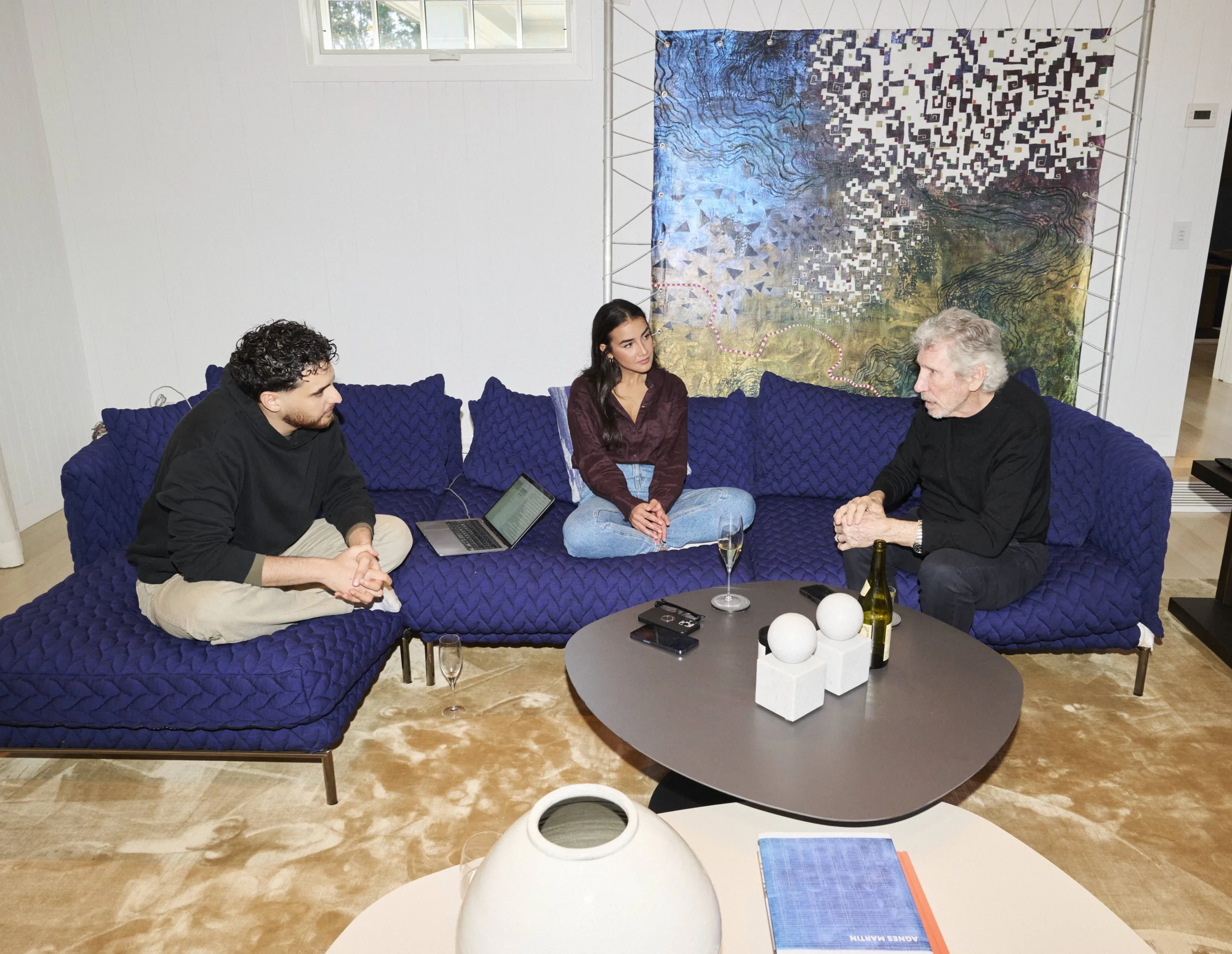
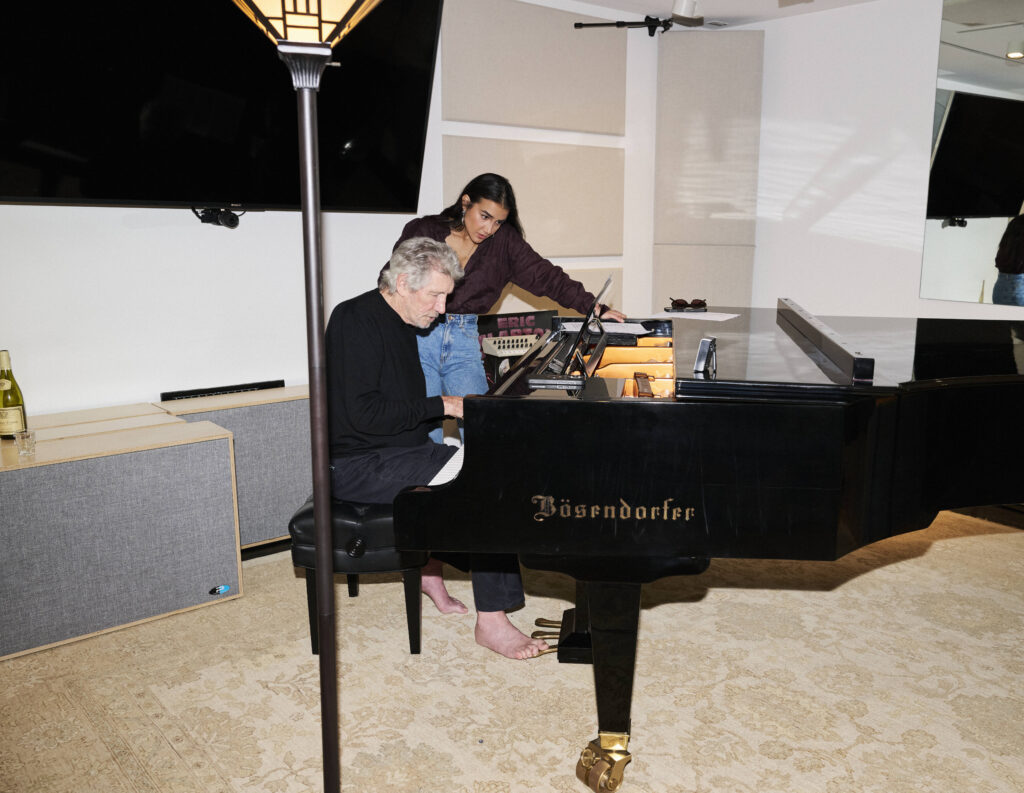
 Mohammed El-Kurd, Mona Miari, and Roger Waters. Photography by David Barron
Posted in
Feature, Mohammed El-Kurd
Mohammed El-Kurd, Mona Miari, and Roger Waters. Photography by David Barron
Posted in
Feature, Mohammed El-Kurd
(un)Comfortably Numb: Mohammed El-Kurd interviews Mona Miari and Roger Waters on their collaboration for Palestine
Text Mohammed El-Kurd
We’re driving east on the Long Island Expressway toward Roger Waters’ home when my
phone begins buzzing with news alerts: Israel is bombing Lebanon. Of course, the
headlines are filled with obfuscations and mutilated with passive voice, but what is
taking place is unambiguous: the Israeli Occupation Forces are trying to reoccupy and
even annex a huge part of the country, but this endless colonial expansion and insatiable
lust for land falls on deaf ears, for the most part. I find myself asking a question I’ll carry
into the conversation ahead: what can music actually do in the face of genocide?
It’s the question that seems to have brought Roger Waters and Mona Miari together,
too. The two first met on a now-defunct documentary project and quickly discovered an
artistic chemistry. What eventually emerged from that meeting is a reimagining of
“Comfortably Numb” (one of the most recognisable songs in rock history) recast nearly
49 years after its original release as an elegy and an indictment, set against the ongoing
Israeli genocide in Gaza. Directed and shot by David Barron (USA), with Gaza cinematography by Suhail Nassar, Director of Photography (Gaza), the video premiered at SVA Theatre in New York earlier this year and will be released on June 17th.
The reimagined “Comfortably Numb” does not move at the speed the music industry
currently demands. Its length and tempo feel almost like a provocation, a deliberate
refusal of the brevity and velocity imposed on today’s artists by streaming metrics and
shrinking attention spans. Miari, for her part, is clear-eyed about the pressures she
navigated to get here. “I could have easily been brainwashed into wanting to become a
commercial artist,” she tells me.
There is, by now, no shortage of art responding to Palestine. Some call it a renaissance
of sorts. Others note that much of it has tipped toward the reductionist or the
consumerist, work that reaches for symbolism and aestheticisation where explicit
declaration is needed. What distinguishes this collaboration is its resistance to reductionism, and an orientation towards the future. Both Waters and Miari seem committed to something slower, something less interested in virality. Both artists are also obviously interested in cultivating a sense of futurity—during our conversation, Roger is offering me his vision for the future, excited by the prospect of a unified global majority in the face of Zionism. Mona offers a similar reprise toward the end of the song, resolving the
tension that held the listener to account. At a moment when Palestinian and Lebanese
people have been systematically condemned to futurelessness, the insistence to refuse
the artistic recipes of the past might be just what we need to move forward, at least in
the realm of cultural production. The following conversation has been edited for length
and clarity.
Mohammed: How do you write a song that tackles genocide while remaining
culturally sensitive? How do you avoid making trauma porn?
Mona: It’s beyond challenging. Of course, in the midst of a genocide, you don’t think
‘Oh, I’m gonna make music to save the world.’ That’s bullshit.
Mohammed: Yeah.
Mona: For quite some time after October 7th, I was not able to even perform, because
to me, music and art didn’t seem like the right tool to fight genocide. There was a
turning point where Palestine became a trend, especially online, during [the 2021
uprising in] Sheikh Jarrah. At the time, I felt that social media was being used for good.
But after October 7, it became confusing because a lot of people started taking advantage
of the fact that Palestine was trending. For me as an artist, that was very sensitive and
uncomfortable, because this is my homeland, but music is what I do for a living.
Roger: Palestine is what? Trembling?
Mohammed: Trending.
Mona: Deep down, of course, I do believe in the importance of being vocal in your own
way, especially with your art and music. But I just couldn’t create, I couldn’t do
anything. Up until a point where I sat down and the words were flowing. Roger and I
were on the same page. He would say whatever he’s feeling and I’d respond as someone
carrying so much helplessness and pain and rage.
Roger: That’s why it’s good—the fact that it’s a conversation. When I got a vague
inkling of what she’s singing about, I thought, “I’m gonna have to write some new
words.” I sat down with the legal pad and a biro, and scribbled out, “I hear your pain
from New York City,” and then fiddled with the text to make it rhyme. I do as much as I
can to understand the translation of her bit of the conversation, then I write my next
piece, and I send it to her. And then she does her next verse—a real response in a real
conversation with some old bloke in New York who used to be a bass player.
Mohammed: There’s a distinction between artists who rely heavily on symbolism,
identitarianism, and vague language in their art, and artists who are politically involved.
Both of you have faced backlash for your political stances but remain unabashed. And
the conversational format of the song helps it avoid exploitation or vagueness. It’s
honest and explicit.
Roger: What Mona and I say in our song is: it’s time to draw a new line in the sand,
time to clean the slate and go back to ’48, before the settlers stole the land. You’ve got
away with it for 150 years. But it’s over. It was a terrible idea. The whole Zionist project
was the worst idea anyone has ever had. And it’s now come to its end. But unfortunately,
it has not ended, and they still have nuclear weapons. Would it surprise any of us if one
of them went off?
Mohammed: Yeah, they have the Samson option. A suicidal option.
Mona: The song is meant to be a wake-up call for whoever is Comfortably Numb. It’s a
testament to the fact that we’re not okay with this.
Mohammed: With you, Mona, that disruption of numbness happens sonically as you
go from one form of verse to the next. There’s a lullaby at the end. There’s also a nod to
Rim Banna. You’re dropping references for an engaged listener. How did this variety of
melodies and images come about?
Mona: My first verse is more haunting, more dark. I’m offering a strict truth. “This is
what happened. Take it or leave it.” Then as we move into the chorus part, the chords
there are major chords, so there’s some sweetness to them. This is when I start singing,
“Ever since I was little, I dreamed of freedom,” and the song becomes sweeter and more
nostalgic. It’s an attempt to emphasise that “we are the light after darkness”, and those
lines were absolutely inspired by the chord progression, which is sonically brighter and
uplifting.
Mohammed: And how did the lullaby come about?
Mona: We had originally planned to end [the song] after Roger’s last verse. But I
wanted to make room for all the stories of slaughtered babies and all the moms that
don’t get a chance to say goodbye or even smell their kids for one last time. I called
Roger and told him “Why don’t we honour martyrs and their mothers?” The lullaby is
me imagining what that conversation between the mother and the child might look like,
somewhere in the sky where it’s not interrupted or disturbed. It became the climax of
the song.
Mohammed: Were there any moments in the creative process that you clashed or
found that you had to convince each other of different perspectives?
Roger: No.
Mona: No.
Mohammed: Not at all?
Roger: There were moments of difficulty, but only because I don’t speak a word of
Arabic. I had to work my way through it, just listening to what Mona sang and listening
to her explaining the lyrics to me. So my difficult bits would have been later on, sitting
with the blank legal pad and going, ‘What the fuck am I going to do now?’ My talent is to
free myself from all of that — the expectations — and just go ‘Is that a lullaby?’ And
whatever I wrote at the end, we’re singing [it] together, so that’s magical.
Mona: But something that also eased the whole process was how naturally both of our
voices aligned. Roger comes from a rock background and I trained across diverse global
musical traditions. For two artists coming from such distinct backgrounds, and
especially as this is a dual project between a male and a female, that kind of smooth
alignment isn’t common.
Mohammed: This collaboration bridges your radically different positions, whether in
terms of power, cultural proximity to Palestine, or your generational difference. This means a lot of different instincts are involved. One impulse is to create an exhibitionist
song, another is to try to make it persuasive. There might be an instinct to make the
project feel as intimate as possible, as if it’s made for “us” (I don’t just mean
Palestinians, I mean people of conscience). How did you resolve all this tension?
Mona: Roger and I had the same instincts, for the most part, despite coming from
different cultures. My instinct and my duty is to be as honest to myself as possible.
Communicating the home one carries doesn’t need to be sophisticated or complicated.
One doesn’t need to get all the references to be compelled by the music. It doesn’t
matter whether the listener is familiar with the part of the lullaby that I sing, “Mahlaa
hamam al-dar,” which many Palestinian grandmothers sang. What matters is that music
is a universal language, and it moves people, whether they understand the reference,
and whether they speak the language or not. I didn’t feel the need to persuade with the
song, and I couldn’t possibly be in solidarity with my people, because I am my people.
So I wasn’t really concerned with industry trends or what is commercially viable. But I
want to hear your answer as someone who listened and watched the video. What do you
think?
Mohammed: Well, unfortunately, we write a lot of our songs and books and movies,
with the sniper standing over our shoulder, with the settler standing inside our heads,
meaning we tend to self-censor, or overly romanticise. But I think you resisted these
tendencies.
Roger: To listen to you two talking today is great for me. To hear you talking about
Mona’s writing, and the lullaby and Palestinian poetry—just because I recognise the
names Ghassan Kanafani or Mahmoud Darwish doesn’t mean that I know anything
about Palestinian poetry or literature. It’s just that I’ve picked up a few things.
Mohammed: How does this new version of Comfortably Numb, differ from the
original? Do you see it as a reinterpretation or a complete recontextualization of the
song?
Roger: Well, the original is a conversation between a doctor and a wasted pop star.
This is a conversation between an old English Block in New York and a young
Palestinian woman. It’s a conversation between two activists. So they’re completely
different things.
Mona: How is this emotionally different for you, Mohammed?
Mohammed: A point of comparison is that the original is a song about a certain genre
of forgotten people—drug addicts and alcoholics and whatnot—and the dispossessed
and the homeless and the starved, whom the reimagined version is about, also fall into
the category of the forgotten and the erased. Anyone can take the original Comfortably
Numb and apply it to the Palestinian context or the Black American context. That’s the
power of interpretation.