
 Photo by Peter Robinson
Posted in
Feature, Ali Bin Nasser
Photo by Peter Robinson
Posted in
Feature, Ali Bin Nasser
The Tunisian referee who witnessed Maradona’s Hand of God and never apologised for it
Text Mohammad Abunuwar
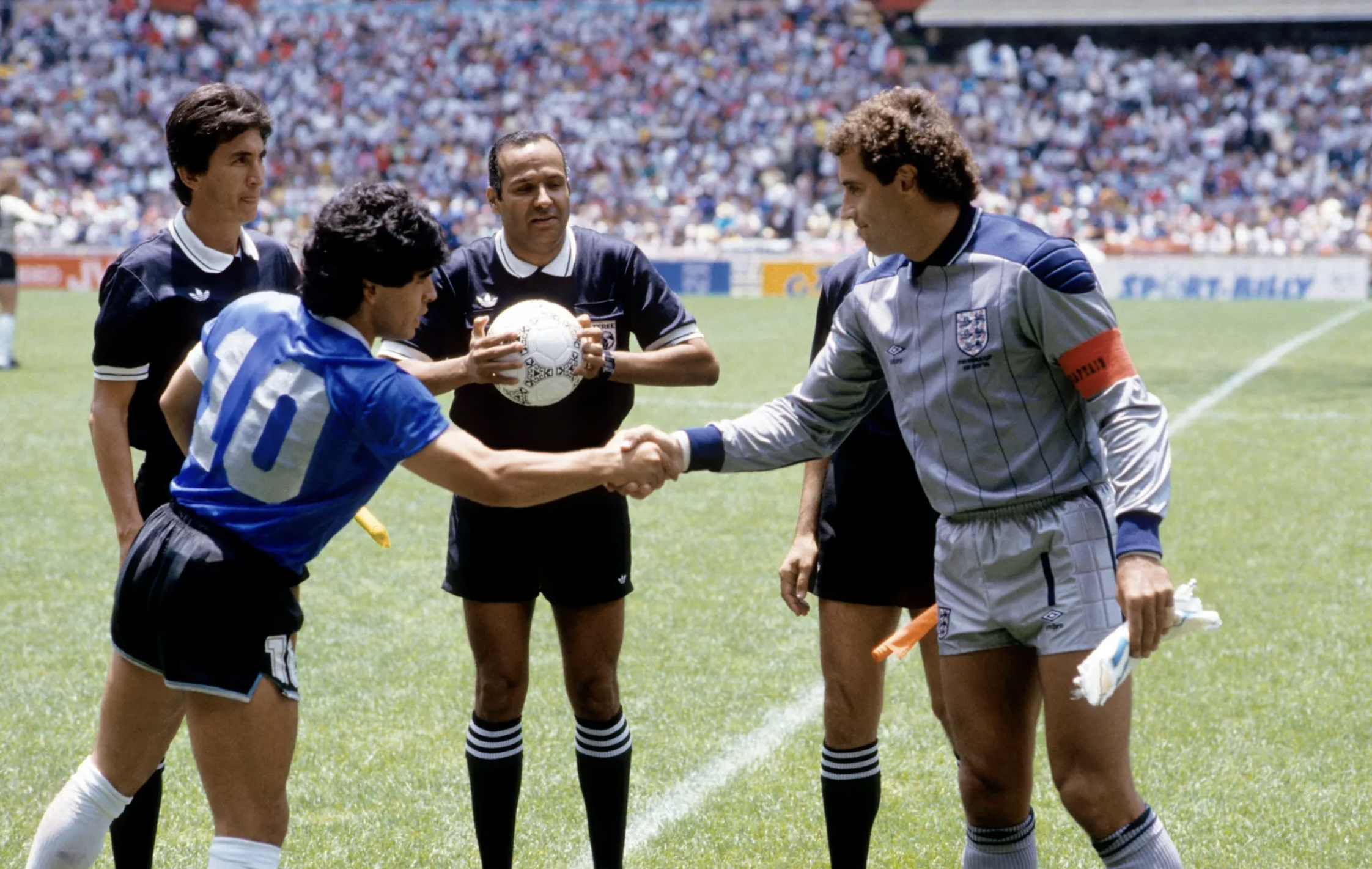
Ali Ben Nasser was the first Tunisian ever to referee a World Cup quarter-final. Most people have never heard of him. The ones who have known him as the man who let the most famous handball in football history stand, pocketed the match ball, and flew home to Tunis when the tournament was done.
England vs Argentina: The Beef
1986 World Cup, quarter-finals, England vs Argentina, Mexico’s legendary Estadio Azteca. Four years removed from the Falklands War, in which Britain and Argentina had sent soldiers to die over a patch of South Atlantic islands.
The Estadio Azteca holds nearly 115,000 people, and on the 22nd of June, every single one of them was watching the same man. Diego Maradona, twenty-five years old, 5’5″, captain of Argentina. In his autobiography, Maradona later wrote: “Although we had said before the game that football had nothing to do with the Malvinas War, we knew they had killed a lot of Argentine boys there, killed them like birds. And this was revenge.”
In the beautiful game, fun little inconsequential competitions do exist. This was not one of them. Sometimes we are treated to spectacles that will forever be ingrained into history, and sometimes those games are fueled by a hatred where all the motivation a player needs to run a little harder, play through an injury, tackle a little more aggressively, or see bloodshot red isn’t anything more than the sight of the other team’s jersey. That’s what this game was.
“Beef is oil prices and geopolitics Beef is Iraq, the West Bank, and Gaza Strip Some beef is big, and some beef is small But what y’all call beef is not beef at all.”
— Yasiin Bey, “Beef”
What would you call a game that took place on the biggest stage of all, four years after the two countries kicking ball were at war with each other? This game was always going to be beef.
The Fist
51 minutes into the game, still tied 0-0, English defender Steve Hodge misplaces a back-pass and lobs it up near the penalty spot. Maradona and goalkeeper Peter Shilton rose for it together, both facing away from Ben Nasser, both turned toward Bulgarian linesman Bogdan Dochev on the far side. What happened next lasted less than a second. Maradona’s left fist connected with the ball, it went into the net, and Maradona ran off celebrating like a man who’d just walked out of a bank he didn’t rob.
Ben Nasser felt something wasn’t right. “I didn’t see the hand, but I had a doubt,” he later told AFP. “The English defender had the ball, sent it back, and Maradona was in the air with Peter Shilton, and they were both facing away from me. They were facing my assistant, Bogdan Dochev.” He glanced over. Dochev was already walking back to the centre, flag down. Ben Nasser blew his whistle. One-nil Argentina.
The England team erupted, threw a fit, and complained, but this was before VAR. Without review, it was just the head referee’s word, and it was final.
Four Minutes Later: The Goal of The Century
Four minutes later, Maradona made the whole argument irrelevant.
He picked up the ball inside his own half and began to run. About 70 meters, past five England players, around the goalkeeper and jellied it into the net. This particular goal went on to be known as the Goal of the Century.
What the replays don’t always capture is Ben Nasser running the play in real time, the first Tunisian ever to referee a World Cup quarter-final, tracking every step, making the calls that made the whole thing possible.
“He took off from midfield, and I was shadowing him closely,” Ben Nasser said. “When you’re refereeing someone like Maradona, you can’t take your eyes off them. They tried to take him down on three occasions, but his desire for victory kept pushing him forward. Every time I would shout ‘advantage’ until he reached the box.”
England tried to foul him three times. Ben Nasser called advantage on all three and let Maradona rip. Had he blown his whistle on any one of those fouls, the Goal of the Century wouldn’t have happened.
He knows this. In a 2020 BBC interview following Maradona’s passing, he was quoted: “I’m proud and honoured as a person and as a referee for having played a role in that historical achievement. Had I whistled for a foul in any of the first three contacts, we wouldn’t have witnessed something that magnificent. That advantage I gave is one of my proudest achievements.”
He understood exactly what he’d witnessed and where he stood in relation to it. When the final whistle blew, Ben Nasser walked off with the match ball under his arm. FIFA had ruled that referees would keep the ball after each game. He put it in his house in Tunis, where it would sit for the next 36 years.
My Eternal Friend
Twenty-nine years after Mexico City, Diego Maradona traveled to Tunisia. He was there shooting a commercial, but he went to see Ali Ben Nasser first. The meeting was at Ben Nasser’s home, an afternoon of stories and signed gifts.
Maradona wrote on the shirt: Para Ali, Mi Amigo Eterno. “To Ali, my eternal friend.”
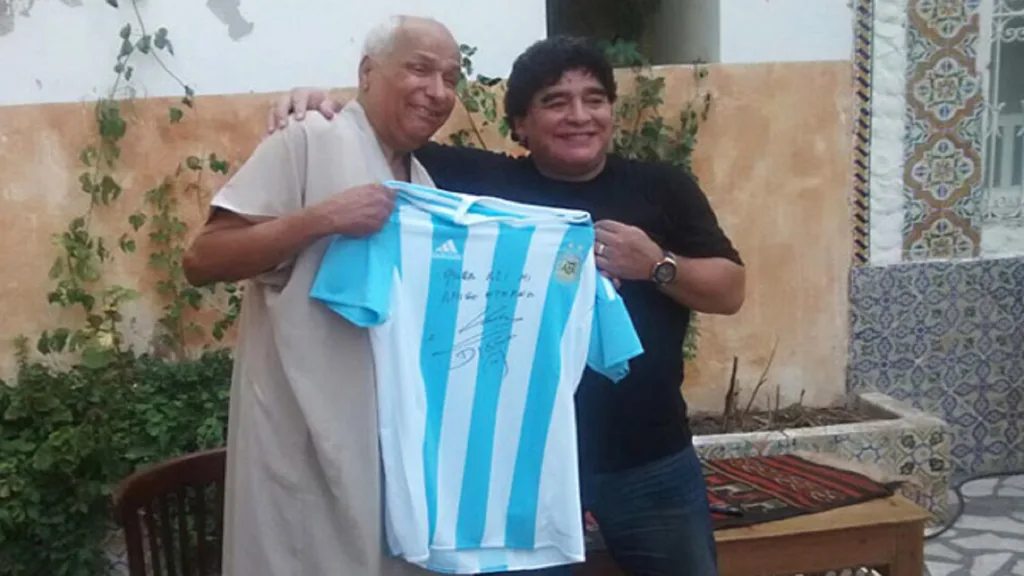
Ben Nasser told him: “It wasn’t Argentina who won the World Cup that year. It was you, Maradona.”
Maradona replied: “Without you, I would not have scored the goal of the century.”
Two men in a room in Tunis. Signed shirt on the table. An understanding between them that needed no further elaboration, no scores to settle, no version of events to agree on. Just two people who’d been in the same room when something historic happened and both knew exactly what it was.
When Maradona died in November 2020, Ben Nasser called him a “genius” and a “football legend.” He said: “As a referee, I did not allow myself to close my eyes even for a second when following him, because he was capable of anything.”
The Bulgarian linesman Bogdan Dochev never met Maradona and spent the rest of his life blaming everyone else. “Diego Maradona has ruined my life,” Dochev said before he died. “He is a brilliant footballer but a small man.”
Dochev chose bitterness. Ben Nasser chose a Tuesday afternoon in Tunis with a legend of the game at his kitchen table, and the choice says everything you need to know about how two men can live inside the same moment very differently.
Everybody Ate Off The British
In November 2022, four days before the World Cup in Qatar kicked off, the white Adidas Azteca ball, the one Maradona punched in, the one Ben Nasser watched him dribble past five men with, went under the hammer at Graham Budd Auctions in London. Bids reached £2 million but the ball failed to meet the reserve price. Negotiations continued, and in February 2023 it was sold to an anonymous buyer for £1.4 million.
A Tunisian man sold the most famous ball in football history and walked away with one point four million pounds sterling. The ball that England have been crying about for forty years, liquidated by the referee they blamed for losing it.
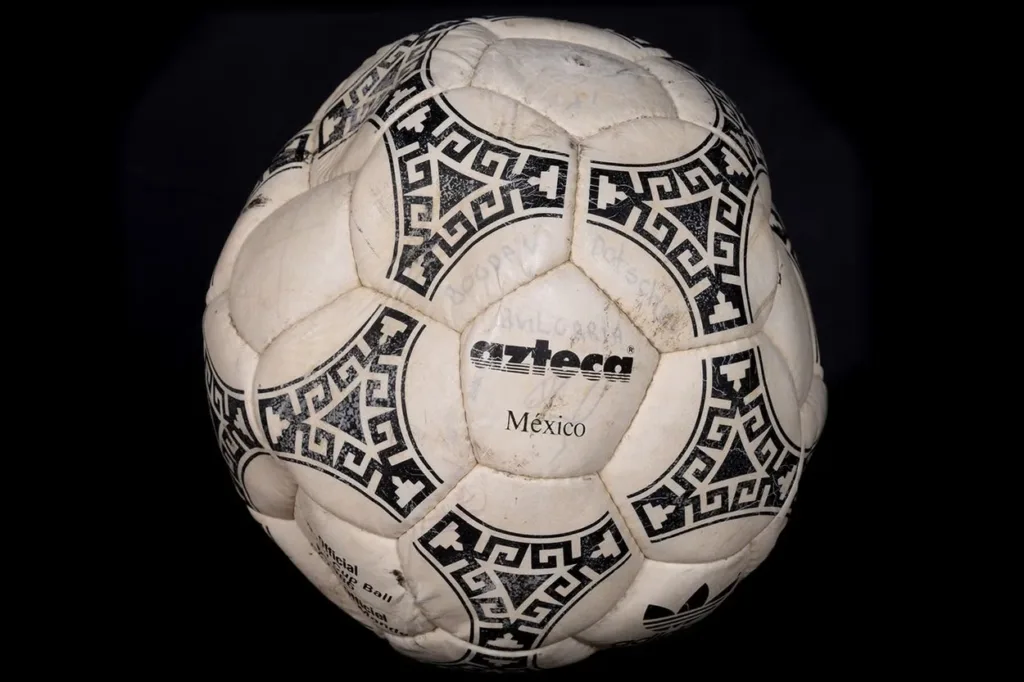
At the end of it all, everybody ate off the British. Maradona went on to win the World Cup that tournament, carrying Argentina all the way to the final and lifting the trophy. Ben Nasser got a friendship with one of the greatest players who ever lived, a signed shirt that sits in Tunis, and million plus pounds sterling collected in London. The only people who left empty handed were the ones who’ve been loudest about it ever since.
Keep Politics Out of Football
The instruction only appears when the politics are coming from the wrong direction. Nowhere is that clearer than the 2026 World Cup happening right now on American soil.
Omar Artan, a Somali referee and the CAF Best Male Referee of 2025, was set to become the first Somali official ever to referee a World Cup match — then he was denied entry at Miami International Airport and FIFA confirmed he would be unable to officiate. Iraq’s forward Aymen Hussein was detained for hours at Chicago O’Hare, his phone searched before being allowed in. Iran’s entire squad has been forced to base themselves in Mexico, only crossing the border to play their games before returning. Fans who spent thousands on flights and tickets have had visas denied or revoked days before travel. FIFA, the same body that hands out yellow cards for undershirts, said in a statement that it is “not involved in host country immigration processes.” Neutral, as always, in the most convenient possible direction.
Then there is Haiti, whose fans cannot even enter the country their team is playing in because of a blanket travel ban. Haiti qualified for this World Cup for the first time in 52 years, ending a drought that spanned generations, qualifying on the road because ongoing gang violence made playing at home impossible, and doing it on the 222nd anniversary of the Battle of Vertières, the decisive battle that ended French colonial rule and made Haiti the first Black republic in history. Their kit manufacturer, inspired by that anniversary, designed a jersey with imagery from that battle stitched into the hip. FIFA banned it on the eve of the tournament, ruled it “political,” and forced a redesign. A nation celebrating its own liberation, told to cover it up before kickoff.
Maradona understood this. He didn’t just play football, he made his position legible everywhere. He had Che Guevara tattooed on his arm and Fidel Castro’s face tattooed on his leg, calling Castro his “second father.”
Palestine was where he was most consistent. In 2012 he declared himself “the number one fan of the Palestinian people,” adding “I support Palestine without any fear.” In 2014, during Israel’s bombardment of Gaza, he released a statement saying “what Israel is doing to the Palestinians is shameful.” In 2018 at the World Cup in Russia, he declared “In my heart, I am Palestinian.”
And when asked about the Hand of God, he recounted what he told his teammates in the dressing room straight after the goal, on his TV show La Noche del 10: “Those who steal from a thief are entitled to 100 years of forgiveness. And the English had done a lot of things to us.” Not the admission of a man who stumbled into politics, but the statement of a man who had already decided whose side he was on and spent his entire career being consistent about it, on the pitch, off it, in every room he ever walked into.
In 2005, Didier Drogba grabbed a microphone in a changing room in Sudan and told his people to lay down their weapons, his speech and Ivory Coast’s World Cup qualification helping convince both sides to hold a ceasefire. In January 2008 at AFCON in Ghana, Mohamed Abu Trika scored against Sudan, lifted his red Egypt jersey, and revealed a white undershirt with four words: “Sympathize With Gaza.” FIFA gave him a yellow card. The Arab world gave him front pages. And then last month Lamine Yamal waved a Palestinian flag during the Barcelona La Liga champions parade.
Ali Ben Nasser never made a speech. He never gave an interview about geopolitics. He just blew his whistle when he needed to and kept it in his pocket when he didn’t. He was just happy to witness the beautiful game. But the beautiful game doesn’t exist outside of the world, it lives in it, and Ali Ben Nasser has never once lost sleep over June 22, 1986, and he has never once been asked to apologise. Neither should he. He has nothing to apologise for.