
 Posted in
Fashion, Fashion
Posted in
Fashion, Fashion
Misfits in bloom: Aya Jallad’s embrace of tough skin
Text Zein Karam
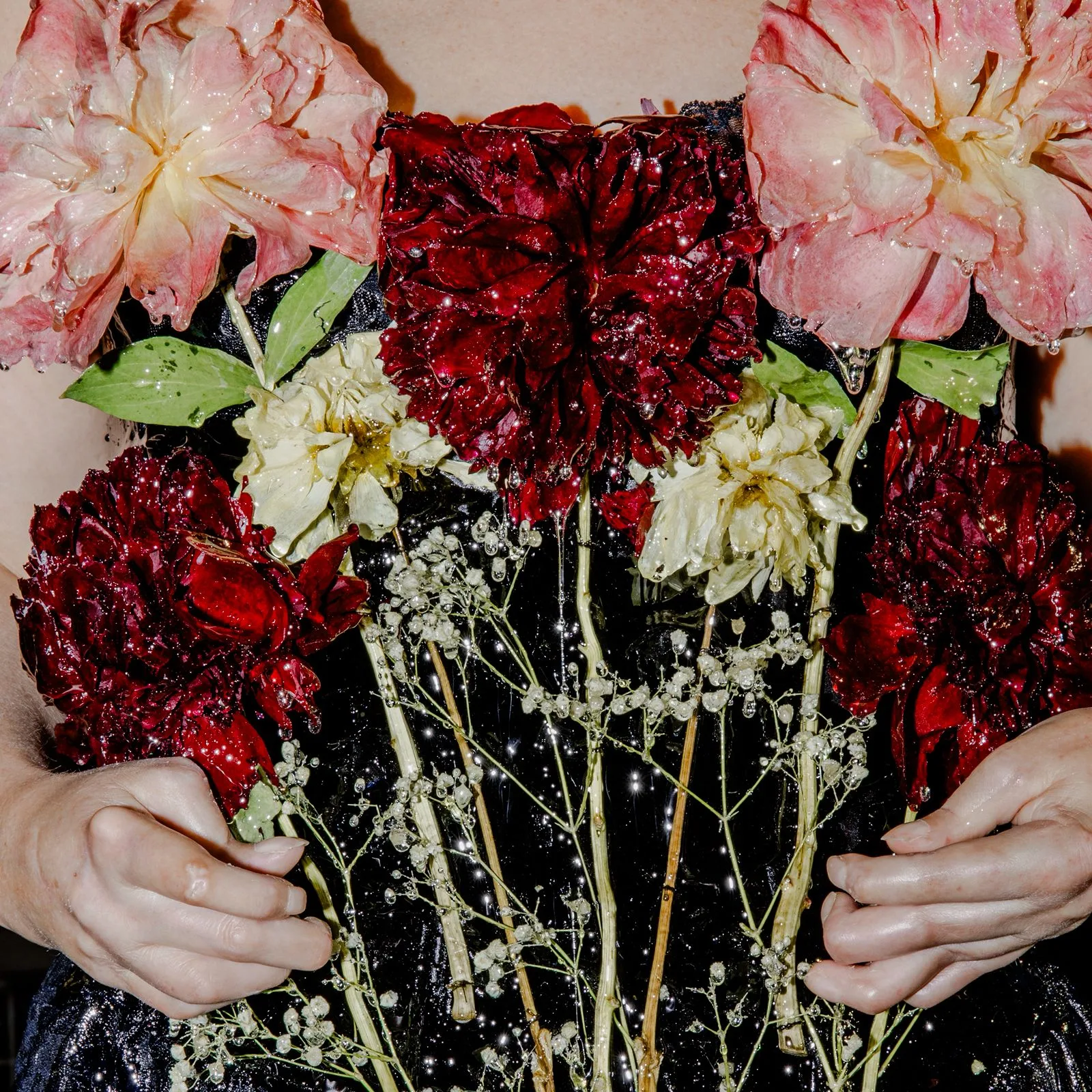
A new addition to our overstretched lexicon is Wabi-Sabi, a Japanese aesthetic and philosophical worldview centred on the beauty of imperfection, recently popularised via a TikTok sound from an episode of King of the Hill. For Aya Jallad, founder of Odd by AJ, Wabi-Sabi is not a trend but a part of her brand ethos. Creating clothes that embrace asymmetry and flaws, Jallad leans into cracks and creases rather than disguising them. Working with real flowers dipped in resin, she relinquishes control over the medium, placing trust in process and outcome. Paired with her upcycled corsetry, the result is a body of work that glistens, refusing to be skimmed over.
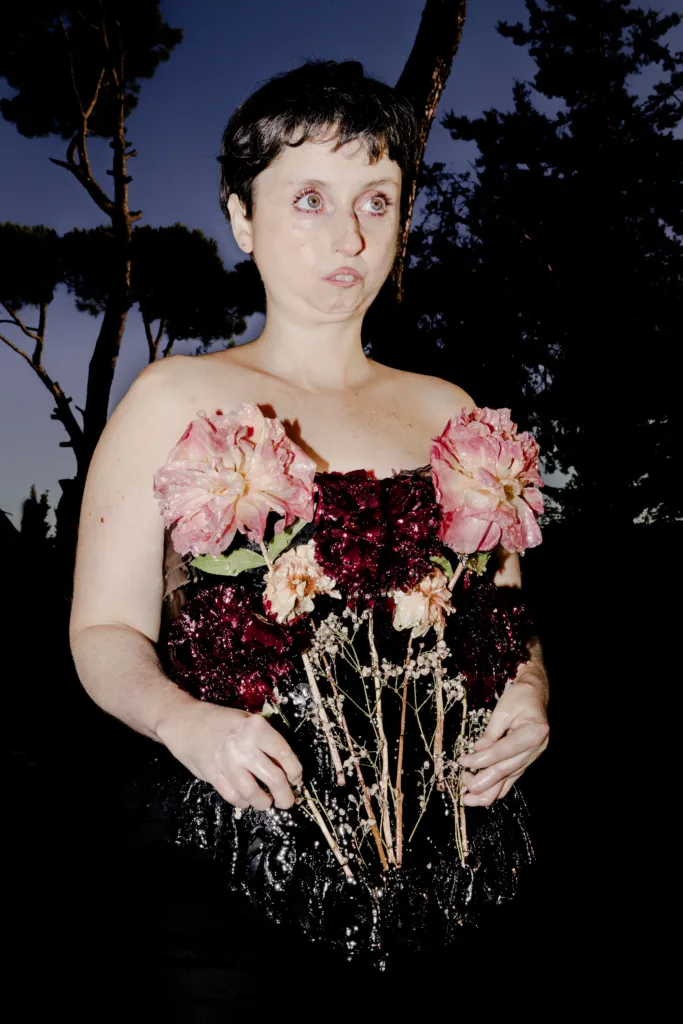
I hesitate to call these garments at all; they are closer to pieces, works of art. Existing in an era where artificial intelligence descends gracefully into a slopmachine, Odd by AJ insists on the value of touch, weight and material presence. Though brought beautifully to life through Myriam Boulos’s photography, the work insists upon an IRL experience. The images from her latest Damaged Beauty collection tease rather than satisfy, beckoning you closer, asking to be experienced. Hovering in the space between art and fashion, Jallad’s practice is shaped by her lived struggle. We spoke to the designer about the ideas, materials and tensions that underpin the brand and the pieces themselves.
ZK: Why ‘Odd’?
AJ: “Odd” represents a departure from the conventional. In a world that often demands perfection and symmetry, I’ve always been drawn to the beauty in the unusual. My brand is a celebration of the “misfit” materials and ideas—the things that don’t quite fit the standard mold but carry a much deeper, more authentic story.
ZK: How did you get started in your fashion journey?
AJ: All my life, I dreamt of becoming a fashion designer. Even after being diagnosed with a rare autoimmune disease at the age of 15, that dream never wavered. I remember when I was young, I used to experiment with my Barbies, dressing them in leftover birthday party balloons and tissue paper. Looking back, I was already unconsciously experimenting with unconventional materials without even realising it.
However, over the years during university, I felt limited and restrained. I was forced to follow things “by the book” and by the rules. At the time, not being able to explore the experimental side of the fashion world felt like it was oppressing my creativity. But looking back now, I realise there was nothing wrong with following the rules; that period was essential because it helped me master the technicalities and the discipline I needed. It wasn’t until years later, during the Covid pandemic, that everything changed. Being stuck in a room with nothing but your imagination allowed it to flourish truly. That is when I discovered the world of upcycling and realised how deeply connected it is to who I am as a person: someone who has been damaged, but has been given a second chance in life.
ZK: When did you decide to take it to the next level, professionally and personally?
AJ: The turning point was my Scleroderma diagnosis. Personally, it forced me to confront my own fragility. Professionally, I realised that my work could be more than just clothing; it could be a visual metaphor for my survival. I decided to take the brand to the next level when I committed to using my designs to spark conversations about beauty, health, and resilience.
ZK: What made you want to use resin as a medium? Especially since it isn’t an easy medium to work with.
AJ: “I chose resin because of its duality—it starts as a liquid and cures into something hard, glossy, and unyielding. This mirrors the physical experience of my skin affected by Scleroderma. It is a meticulous and difficult medium to master. The process actually begins long before the pour; I have to carefully dry the real flowers to remove every trace of humidity, otherwise, they would lose their colour or rot inside the piece. Once dried, I use techniques like pre-wetting the petals and de-gassing the liquid to ensure a crystal-clear finish.
This technical struggle is part of the art—it represents the effort required to preserve beauty within a protective, hard shell. However, even though I try my best to preserve the original colors of the flowers, I still see immense beauty when they start to fade or shift in tone over time. That transition is also part of the symbolic meaning of ‘Damaged Beauty’—acknowledging that while things change and lose their ‘original’ vibrance, they gain a different, more profound kind of grace.”
ZK: Upcycling is integral to your process. What makes you use pre-loved corsets as opposed to tailoring from scratch?
AJ: Pre-loved corsets have a “past life”; they’ve already held someone’s body and heard their stories. By upcycling them, I’m giving a discarded “skeleton” a new skin. It aligns with the theme of ‘Damaged Beauty’—taking something seen as “broken” and proving it still has immense value. However, I am not opposed to tailoring from scratch using deadstock fabrics. Whether I am reviving an old garment or using leftover luxury textiles, the goal is always to create without contributing to overproduction.
ZK: What was the inspiration for your latest collection?
AJ: ‘Damaged Beauty’ is a direct visual metaphor for my experience with Scleroderma—a rare autoimmune disease involving the overproduction of collagen, which causes the skin and connective tissues to thicken and harden. In my work, the hardness and glossy finish of the resin literally reflect the hardening of the skin I experience. I specifically use real, once-living flowers to symbolise the inherent fragility of the human body and the beauty that remains protected within that vulnerability. By encapsulating these real flowers in a rigid, “frozen” state, I am showing what it feels like to live inside a body that is becoming its own armour.
ZK: Your pieces exist on a fine line between art and fashion. How do you personally view them? And what would you like them to convey?
AJ: I view my pieces as sculptures for the body. They are meant to be felt, not just seen. I want them to convey that beauty and strength are often forged within restriction. During my process, I work on making the pieces feel restraining to mirror the physical reality of my condition. However, with every piece I create, I evolve technically; I focus on ensuring that while the corset feels like a rigid, protective armour, it remains wearable and comfortable in strategic areas. It’s that tension between the “armour” and the soft human form that makes the work complete.
ZK: Do you think all fashion should be wearable?
AJ: Not necessarily. Fashion is a spectrum. Some fashion is meant to protect us, some to identify us, and some—like my pieces—are meant to challenge us. If a piece makes you feel something or see the world differently, it has fulfilled its purpose, even if it isn’t “comfortable” in the traditional sense.
ZK: Your brand has been around for 10+ years now. How have you seen it evolve, and where would you like to see it go?
AJ: It has evolved from a focus on pure aesthetics to deep, conceptual storytelling. In the future, I want to continue pushing the boundaries of material science. A major goal is to create collections designed for people with disabilities. I want to create clothes that make them feel sexy and confident, while being easy to wear independently. This fosters a sense of freedom and autonomy, which is what we, as people living with disabilities, crave most.
ZK: Will you ever stray from corsetry, or do you find that it is now part of the brand DNA?
AJ: Corsetry is definitely the foundation. It represents structure, restriction, and form—elements deeply tied to my personal story. However, I am very open to creating pieces that aren’t necessarily corsets. I have already developed a collection of upcycled couture pieces inspired by mythical creatures, where I used fabric manipulation to show that even withered, aged things can be beautiful. While the “corset” remains a powerful symbol of resilience, I see the brand as an evolving exploration of how unconventional materials can tell stories beyond a single silhouette.