
 Posted in
Fashion, basel adra
Posted in
Fashion, basel adra
Resolute: The sneaker championing Palestinian Tatreez
Text Kamin Mohammadi
In Palazzo Corgna in Città della Pieve you feel the weight of centuries. Sixteenth-century frescoes adorn the ceilings: mythological figures, gilded cornices, the particular grandeur of a Umbrian noble house doing its best impression of eternity. On Saturday 13 June, beneath all of that, a line of sneakers sat on a long table. Deep burgundy suede, cream leather, dusty sage, each pair inlaid with a strip of tatreez, the Palestinian embroidery that is older than the frescoes surrounding it.
The event was hosted by Livia Giuggioli Firth, sustainable fashion expert who spent more than two decades interrogating the fashion industry’s practices. Presented by the mayor, it was the Italian launch of Resolute RGL – a brand that describes itself simply as hand-embroidered sneakers, co-owned by the Women’s Weaving Cooperative of Masafer Yatta.
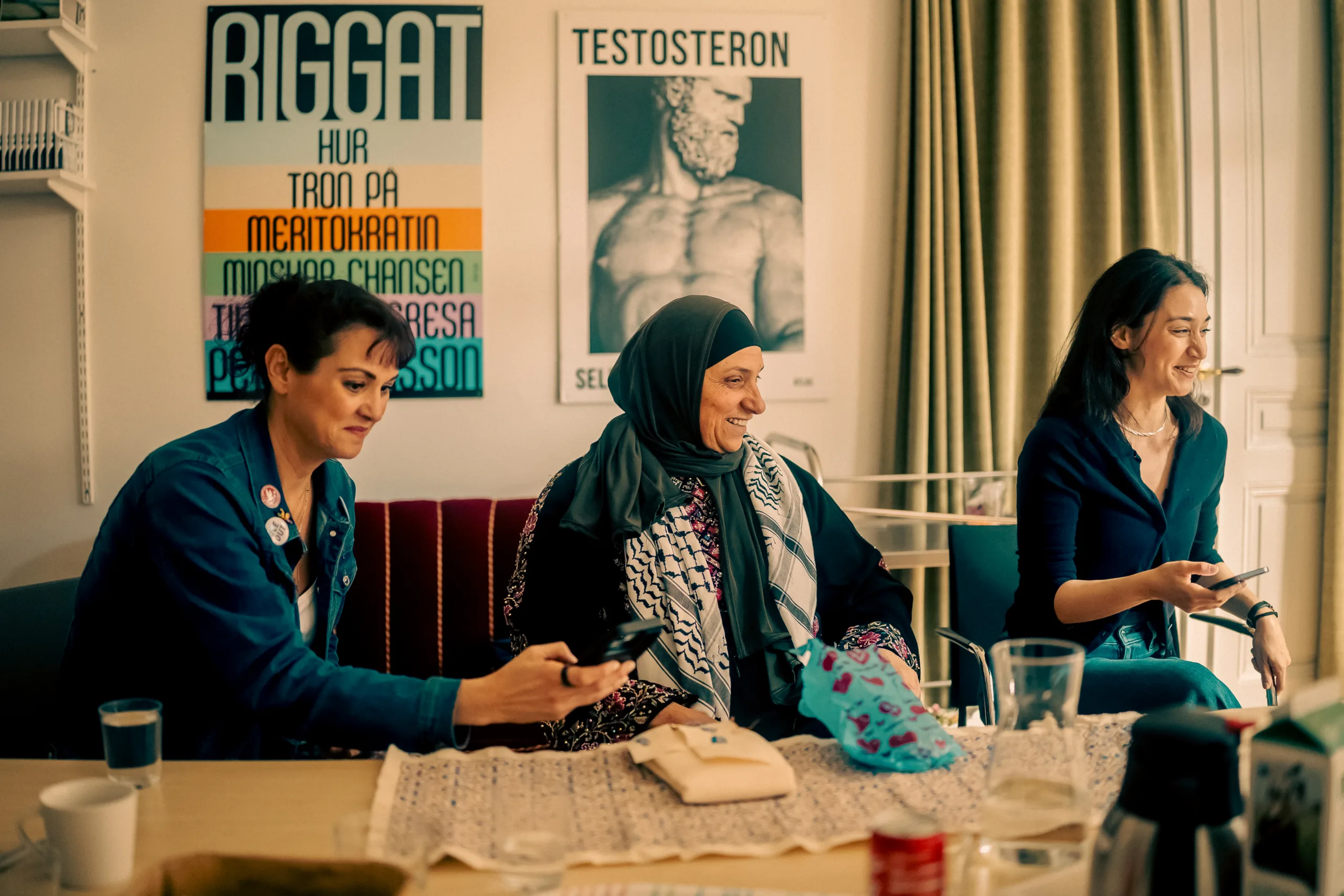
Basel Adra, the director of No Other Land, the Oscar-winning documentary about Masafer Yatta, his home village in the West Bank, was there in person. His mother Kifah, who founded the cooperative in 2003, starting with three women in a single room in the South Hebron Hills, was not. His niece Sanaa was not either. After visiting Stockholm Fashion Week all together, they were then denied a visa extension of two days to come to Italy. They joined on a screen instead while Basel spoke about what his mother built, and why.
Over the intervening years, Kifah built a decentralised network of around 250 women stitching tatreez at home, each panel taking between fourteen and twenty-four hours to complete by hand. It began small deliberately, from one metre by one metre panels scaled down to smaller pieces so the women could easily work at home without being detected. Because for these small communities living among settlers, everything, Basel said quietly, is dangerous.
Resolute RGL is the commercial architecture that carries this work into the world. The women are not suppliers. They are majority shareholders. Because one of the things the occupation imposes is a sense of worthlessness. That these women, their labour, their knowledge, their three-thousand-year-old craft, amount to nothing. Resolute exists to correct that. Each shoe sold is a direct refusal of this devaluing narrative.
Tatreez itself travels through generations woman to girl, pattern by pattern. The motifs know their geography: the wheat ear from Bethlehem, the cypress from Galilee. At Kifah’s house, the women still gather to choose which patterns go forward. The cooperative traces its lineage to Inash al-Usra, founded in 1965 by Sameeha Khalil in al-Bireh, the first to pay refugee women for their embroidery and catalogue what might otherwise have been lost.
Basel, sitting in this magnificent frescoed room, wearing the shoes his mother’s hands helped make, talked about culture as survival. Where you support culture, he said, you support life. And for every woman who becomes financially independent, the ripples pulse out to the family, into the community, into the area and so on.
The shoes are beautiful, and the craft matters. Because beauty is not just decoration. It is what gets the tatreez onto a table in Umbria, onto the feet of Joan Baez, into a conversation that might otherwise never happen.
Kifah and Sanaa watched from a screen. The frescoes watched from the ceiling. The frescoes have survived five centuries of history. Tatreez has survived longer. The occupation can control movement, deny visas, close borders – but it cannot unpick what is already stitched into the soul.
Resolute RGL is available at here