
 The Insurgence of Ghibli Winds (2025) by Tewa Barnosa
Posted in
Feature, Dazed MENA Issue 05
The Insurgence of Ghibli Winds (2025) by Tewa Barnosa
Posted in
Feature, Dazed MENA Issue 05
Exorcising the ghosts of the region
Text Hadi Afif
I was asked to start this piece with an analogy that would help readers en masse understand the argument here: film photographs of Beirut continue to circulate on social media every other month, designated by regional publications under something along the lines of “photographers redefining [insert something about the city’s visual culture here]”. Fairuz, most definitely, is swelling in the background. Civil War-era residue against post-1990 architectural litter. Cracked concrete and fishermen bathed in sunshine. Poverty branded as… something else.
The same iconography resurfaces every quarter: think plastic chairs (a motif that has re-emerged with a vengeance in recent years despite never really leaving), the elderly (photographed without consent), street vendors (also photographed without consent). It’s a visual world that I can personally conjure in detail, by memory. Revelation!
There is a lot to be written about our obsession with nostalgia, particularly in popular culture, which is where so much hauntology discourse has historically resided. Big Culture in the ‘region’ – publishing houses, biennials, citizen Instagram archives, self-appointed cultural epicentres – has mastered the rhetoric of rediscovery. The golden age resurfaces on demand. A modernity that was “ahead of its time”. A Beirut that “once was”. A Cairo that “used to be”. A Tehran that “could have been”. Cluttered and suffocating, the archive is Big Culture’s favourite moodboard.
In the spirit of offering a concrete example, it doesn’t take much digging to find a pop culture remnant of this obsession. Egyptian singer TUL8TE’s latest single cover for Seneen is a cut-and-paste ode to old cassette designs—pastiche on steroids, if anything. And that is simply one example from the tip of the iceberg at the time of writing. The past haunts us with a golden age that was never fully realised, and a potential future we cannot even begin to imagine. So many questions arise. What do we make of the present? Are we passively watching the future being written? Why is our understanding of the past so incredibly monolithic and singular?
If this loop feels familiar, it’s because we are living inside what French philosopher Jacques Derrida, borrowing from Hamlet, once described as a time “out of joint”. Writing in Spectres of Marx, he coined the term ‘hauntology’ at the moment when ontology, being and presence, fails him. Reflecting on media and the production of public reality, he describes systems that are neither alive nor dead, neither present nor absent, yet continue to organise political life. Hauntology puts a name to this ‘condition’ as a mode of existence where images and ideologies persist as ghosts, reminders of promises that never materialised.
Derrida’s intervention was also a response to political scientist Francis Fukuyama’s post-Cold War thesis, written in the wake of the Berlin Wall’s fall, which claimed that liberal democracy marked the “end of history”. Not the end of events, but the exhaustion of ideological alternatives to western capitalism. For Derrida, declarations of historical finality are nothing new. Mid-century thinkers had already announced the end of philosophy, Marxism, even humanity itself. Such endings, he wrote, had become “our daily bread”. The problem is not that history ends then, but that its promised futures keep failing to arrive, lingering instead as spectral expectations long after they have been declared over. A reassuring statement for the reader.
Since 1989, the “end of history” has been invoked ad infinitum—not necessarily in Fukuyama’s optimistic breath but under the darker pretext that the subsequent neoliberal hellscape will quite literally end the world. Derrida’s musings on spectres and misaligned time thus become more relevant and, ironically, timely. It is here that the late cultural theorist Mark Fisher extends the hauntological thread into the late-capitalist timeline of the 2000s and 2010s. In Ghosts of My Life: Writings on Depression, Hauntology and Lost Futures (2014), he describes a popular culture constantly stuck in the past, summoning and rehearsing it infinitely. A stagnation rather than a lingering. A variation on hauntology in the Derridean sense. From UK music to television, Fisher diagnoses a present endlessly scavenging the debris of lost possibilities, an inability to imagine not a future but any future at all.
While the White Man blogosphere of the 2000s and 2010s was saturated with discussions around hauntology, the framework now feels exhausted. It is in this context that researcher Matt Bluemink introduced a hopeful alternative to the cancellation of the future in the early 2020s: anti-hauntology. Writing in the long shadow of Fisher, he argues that anti-hauntology is not a denial of history but as practice that refuses to linger in past forms, instead forging new combinations and trajectories that resist hauntological repetition. Across his essays in Blue Labyrinths magazine, he identifies practices that attempt to force new futures into being through intensity, artificiality, and transformation. Musical artists like Arca and the late SOPHIE do not mourn lost futures. Instead, they overwhelm the present, insisting on invention even when it arrives distorted.
As tempting as it is to (personally) dive into a textual analysis of the sonic and aesthetic universes of the artists referenced in Bluemink’s writings, they remain firmly tethered to a western archive of ghosts and lost futures. And that is provocation enough to take the hauntology/anti-hauntology framework and explore how it manifests in an Arab (or rather regional) context. After all, it would only be fitting to make that mental leap not only because the theory itself is rich (albeit flimsy, admittedly), but also because mental leaps are how frameworks enclosed within Eurocentric epistemologies are expanded.
In writing about Arabic hauntology by way of Habibi Funk Records, Alessandro Sbordoni distinguishes it from its western counterpart, which often folds into nostalgia for exhausted capitalist futures. This is what makes our nostalgia machine so revealing. In the Arab context, the haunting that peaks its ghostly head is from a ‘modernity’ that never fully arrived, repeatedly interrupted by colonialism, war, and displacement. It is involved with speculative presents as much as speculative futures.
Offering up concrete examples, Sbordoni points to the work of Palestinian producer Julmud as one such rupture. Much like Bluemink’s examples from the western anti-hauntology canon, his sound refuses the hauntological reflex by assembling new sonic temporalities through abrasive digital production, forcing futures that have not yet arrived into the present. Similar musicians that can be added to this canon are Lebanese rapper Billy Tstrk, whose Bladee and 2010/2020s Swedish SoundCloud rap-adjacent sound brings a fresh temperament to Arabic rap. Meanwhile, other examples include duo Kiss Facility whose Egyptian-Emirati frontwoman, Mayah Alkhateri, sings over jittery electronic production from Salvador Navarrete to Egyptian artist Nadah El Shazly’s quirky sensibilities. While all these examples are distinct and cannot easily be lumped into a single category (although taxonomy is tempting), they broadly work within a loose framework of ‘Arabic anti-hauntology’.
Hauntology has been extensively mapped through music and film, but theory alone does not move the world. To interrogate notions of hauntology and anti-hauntology in broader strokes, it becomes necessary to go beyond existing analysis in order to examine artistic practitioners who treat the archive as raw material to subvert. In this spirit, Arabic anti-hauntology is a mode of cultural production that insists on generating new presents and futures that are not dependent on mourning or grappling with the ‘postcolonial’ as if it is a condition that has arrived. If it is to be active and generative, the region’s anti-hauntology must neither aestheticise absence nor revel in nostalgia. Instead, it ought to confront the materiality of events that are routinely framed as over or archived head-on. The present is the primary site of struggle and innovation.
Popular culture’s penchant for nostalgia is as reflexive as it is a marketing decision. If we are constantly looping the past as an aesthetic commodity, what does it mean to invent under conditions where history never resolved? The issue isn’t that we can’t let go of the past. It’s that we were never given a stable present to begin with. And while western theory debates stagnation or escape, the region’s nostalgia machine points to a deeper well of thought, one that can’t be hacked around but has to be descended into.
Right now, across the region, the present is being violently shaped through occupation, war, and displacement in Palestine, Iran, Sudan, Lebanon, and beyond. Under this zionist war order, the cultural reflection of nostalgia can trickle down into political sedation or, worse, helplessness in the face of great adversity. A golden age is always easier to beckon towards, materially, than a present and future that still has to be fought for. The late Palestinian revolutionary Walid Daqqa articulated this time dilemma with devastating clarity: “I do not want to return to the Palestine of the past… When Palestine becomes romantic, the Right of Return becomes utopian, and this romanticisation of return distances us from return itself. I want to return to the Palestine of the future.”
The four artists that follow work from atop these shaky grounds. Their practices are direct extensions of a regional condition historically shaped by colonial violence, unresolved histories, and a present with no closure. Refusing the aestheticisation of absence and the romanticisation of ruin, their modus operandi resists the ghosts of the past in favour of something more expansive to the political imaginary. This is a material analysis of artistic practices that go beyond the limits of pretentious intellectualism on one hand, and the throes of popular culture on the other.
Firas Shehade
“ We are the most filmed people in the world. We are filmed from every direction. By reporters, journalists, filmmakers, satellites, AI scanning… We are literally stuck with our own images… How do you mediate an idea without using those images?” – Firas Shehade (Palestine, b. 1988)
Firas Shehade’s practice sits right where the introduction of this essay lands, in the gap between presence and absence. Between the archive as “dead history to start with,” as he describes it, and the stubborn fact that the dead, the martyrs, never stay in the past. The artist describes his childhood in Eastern Saudi Arabia as a time spent gaming and watching Hollywood sci-fi films like Alien while the adult voices around him spoke politics, the Gulf War unfolding in the background. That double exposure, he explains, instilled in him a certain sensibility, a way of seeing that reveals the underbelly of dominant narratives.
For example, he refers to what Edward Said calls “double vision”, the ability to read dominant cultural products against the grain, to recognise how “underground resistance” narratives – echoing the realities of Palestinian armed resistance – could be read into fictional Hollywood media, especially when you’re watching from the refugee camp. “It’s not appropriation… it’s actually seizing back what is yours because all [it] is actually inspired by our own histories,” he explains.
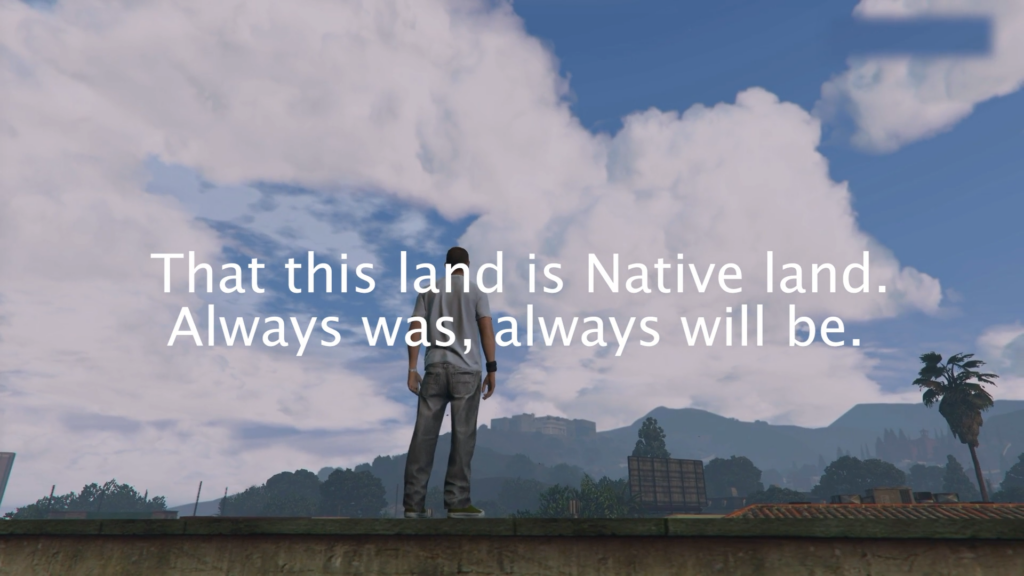
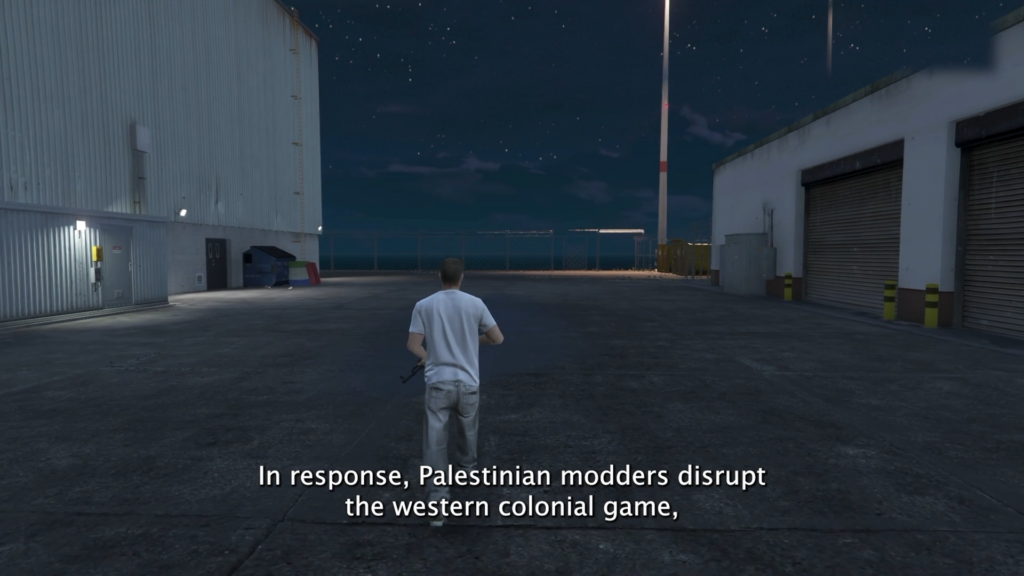
Shehade’s concern is not the image of Palestine per se, but the conditions under which the Palestinian becomes visible and consumable. In his account, what haunts Palestine isn’t primarily lost futures, it’s the continuity of dispossession as lived time: “We are living the Nakba every day. This is our life.” His three-part film series Like an Event in a Dream Dreamt by Another uses Grand Theft Auto V’s Los Santos as a mirror image of Palestine—not because Los Santos resembles it in any way, but because the open-world game becomes a rehearsal space for things that are impossible for the Palestinian today. All three parts are built using gameplay footage from a modded and glitched GTA V, accompanied by a narrated script that changes from chapter to chapter.
The first part, Rehearsal (2023), commissioned by Singapore Art Museum, explicitly frames this as an act of worldbuilding under colonial rule. Palestinian GTA modders and players have transformed the online game into a political geography. “In the game, the player creates a persona that can do things most gamers in Palestine can’t do. A better version of the player. With access to freedom of movement, education, wealth, and connection to the community,” the narrator reads. The police, modified to resemble Israeli occupation soldiers, are met by digital natives who gamify death as an act of transgression, re-enacting invasions on Jenin and resistance in Nablus (both labelled as such on the game map). This hyper-real image of Palestinian reality becomes a training ground not for Palestinians to rehearse virtual death but to decipher whether they were ever allowed to live in the first place.
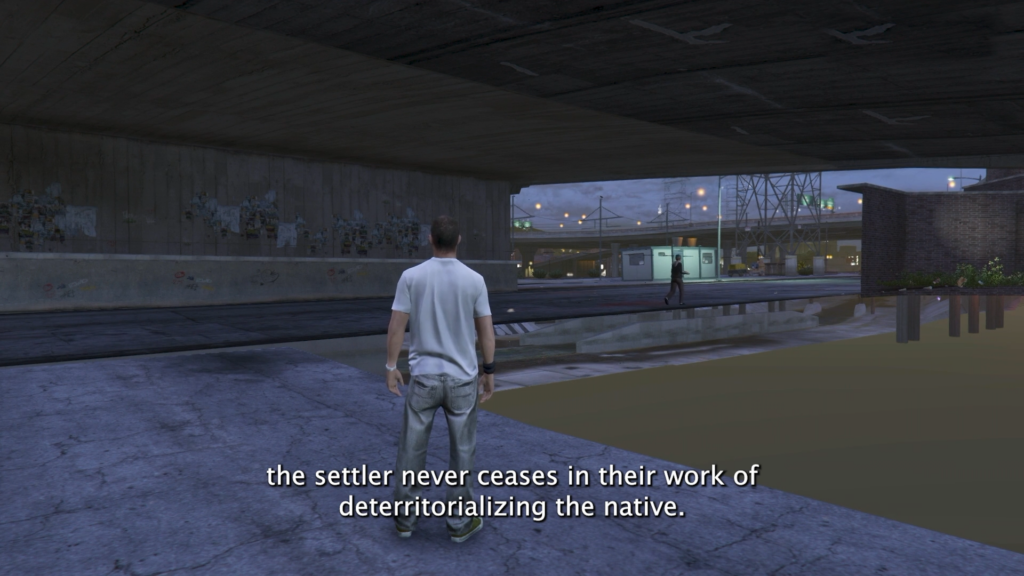

Shehade’s anti-hauntological impulses become a method of resistance in the second part, Insomnia (2025), which was commissioned by the 14th Mercosul Biennial. It starts from a condition that is brutally material, a sleeplessness imposed by the occupation’s constant hum of drones, the body kept awake as a form of governance. From there, the film turns the game engine into a counter-infrastructure, a place where Palestinians are no longer trapped as non-player characters inside someone else’s narrative logic. The film’s insistence on tracing colonial violence from Turtle Island to Palestine inside Los Santos maps all these different temporalities as structures that must be glitched, hacked, and abolished. “While the west debates the ‘end of history’, Gaza offers a clear response: ‘The future is now, old man.’” There is no lost future here.
The last part, Dreamcore (2025), commissioned by the second Munch Triennale, continues this train of thought, hacking GTA V to make the world visibly unstable as a way to “imagine another world for colonised people”. You enter the blind spot of the developer, the coloniser. It’s a potent allegory for what it means to live under architectures of control, to endure them and learn their weak points and exploitable errors. A rehearsal of resistance inside a system built for someone else’s fantasies. Power only holds as long as its logic is obeyed. To dream is to stop playing the game the way it is ‘meant’ to. Shehade doesn’t mourn a lost future. He exposes how visibility itself becomes a trap, and how invention must happen inside systems already rigged against you.
Ali Cherri
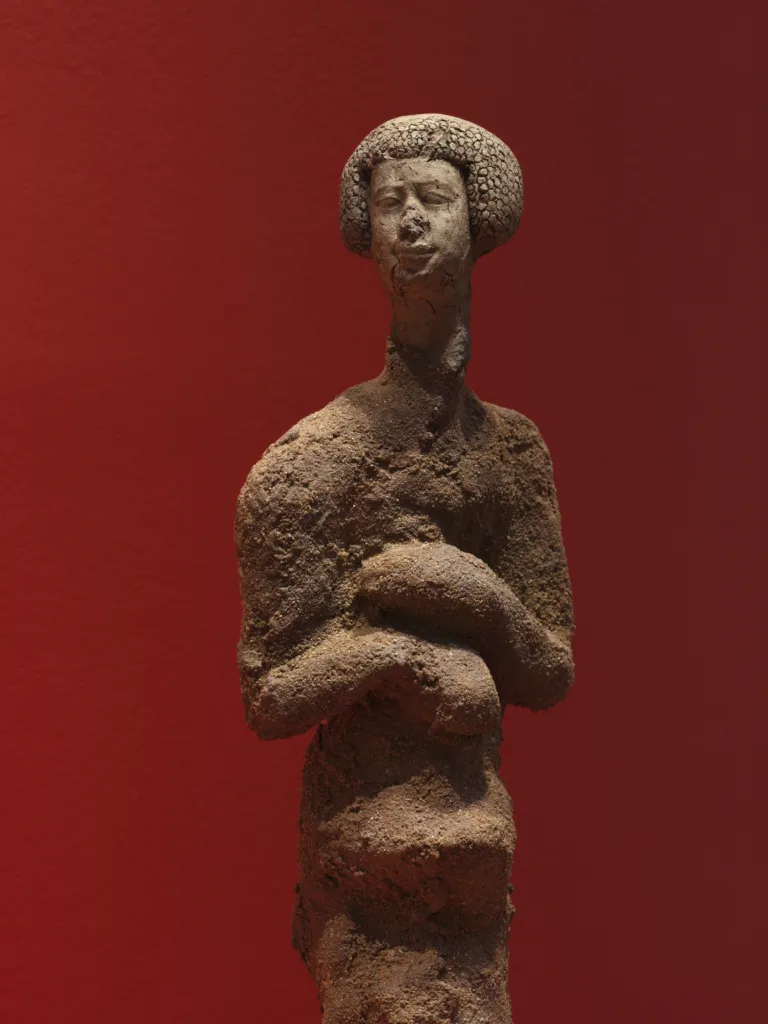
bition at Bourse de Commerce – Pinault Collection. Paris, 2025. Courtesy of Aurélien Mole /
Pinault Collection.
“ I consider myself as a smuggler [of sorts]. I’m just smuggling [low value materials] into a museum in order to keep them safe. Once they enter, they acquire value. Museums have to take care of them. They have to restore them. That already adds another layer to the narrative of the work.” – Ali Cherri (Lebanon, b. 1976)
Ali Cherri is an artist and filmmaker whose work across sculpture and moving image approaches hauntology as a material condition, exploring what happens when the past is reduced to debris, only to be reused and reconfigured. Born in Beirut in 1976, a year into the Lebanese Civil War, his practice is personally marked by histories of violence. In his work, history is fundamentally unresolved.
“A crisis is an unresolved relation with the past,” as he puts it, particularly in societies shaped by war and occupation, where the production of a shared historical narrative is futile. In the rubble, Cherri finds freedom (even “inventing fictional pasts” more importantly): “There is not a monolithic past… there’s almost like a total mess… and that leaves you with the possibility of picking what you want from the traces of the past.”
In Twenty-Four Ghosts per Second (2025), presented at Bourse de Commerce in Paris, the artist occupied the museum’s display cases and availed the building’s circular architecture to produce “ghostly flashes between reality and fiction, past and present”. Archaeological fragments, sourced from auction houses and antiquities markets, were combined with Cherri’s own sculptural interventions to form half-asleep chimeras, surreal bodies that appear as witnesses to several material temporalities. These grafted figures present a reckoning with the manipulation of historical artefacts and the past in general. “The grafts I make… constitute a form of solidarity between bodies that have been shattered, fragmented, and violated, and which create a community by being fused together,” he explains.
The artist is drawn to the “outcasts of history”, weak bodies and objects deemed too damaged, compromised, or low in value to enter the museum archive. Material authenticity is besides the point. “I have no interest in archaeology,” he affirms. Unfixing objects from the grip of archaeological time helps him revalue them, renegotiating their meaning altogether. The spectre of the past is thus made unrecognisable.
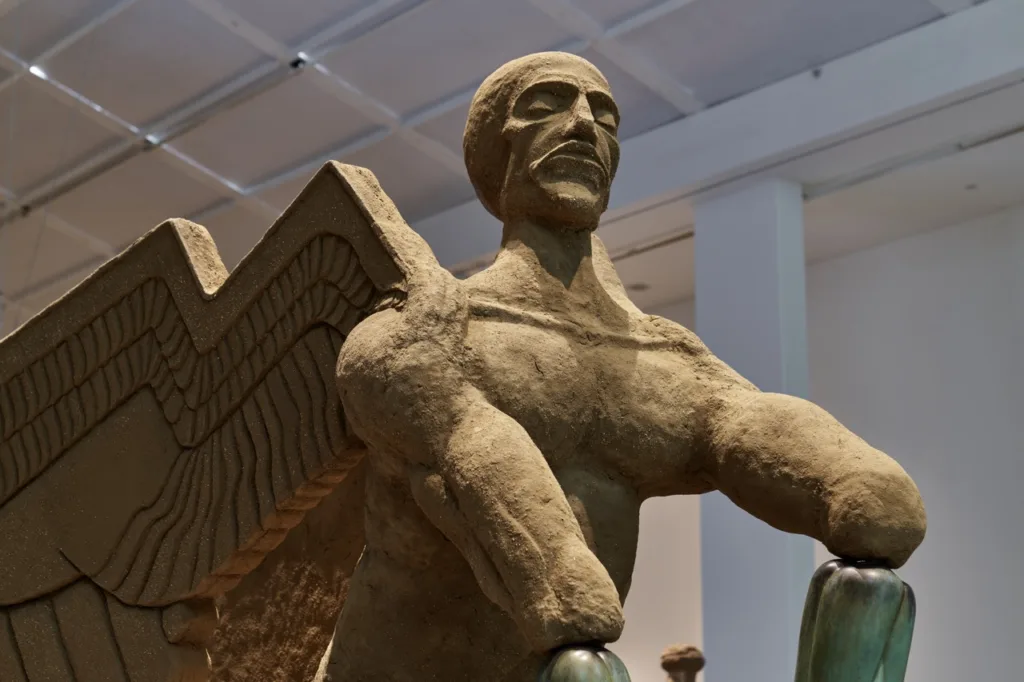
This material politics also comes into play in How I Am Monument (2024), where Cherri stages a confrontation between mud and bronze, two material signifiers charged with civilisational and ideological weight. Mud, a primordial substance tied to creation myths across ancient civilisations, appears in fragile bodies that allude to narratives of the early world. Bronze, historically reserved for heroes and regimes, enters the work to be corroded, damaged, and devalued. His large mud-and-bronze sphinx, part of the Vienna Secession exhibition, gloriously embodies this contrast: a figure that looks vaguely mythic yet monumental, on the verge of collapse. A true weak body.
That impulse between ruin and creation is given a cinematic articulation in The Dam (2022), filmed in the area surrounding Sudan’s Merowe Dam, where the construction of Africa’s largest hydropower plant displaced tens of thousands of people and submerged cultural sites. The film follows Maher, a brickmaker whose days are spent shaping mud by hand and firing bricks in a kiln as radio broadcasts relay the unfolding 2019 Sudanese revolution from afar. At night, Maher secretly constructs a monumental mud figure in the desert, a creature-like form that seems to absorb both his labour and the violence sedimented in the landscape. As political unrest intensifies, his isolation and delirium deepen. On several allegorical and literal levels, the film insists that building and ruin are inseparable processes. And on a larger scale, it possibly questions the role of art in times of turmoil.
The Dam is more ‘relevant’ today than ever, documenting a moment connected to the current genocide of the Sudanese people. In that sense, Cherri’s work has always resisted being historical. A very early work, Untitled (To the Lebanese Citizens) (2006), produced during Lebanon’s 2006 July War, captures the Israeli army’s interception of a radio station to transmit an audio message addressed directly to the Lebanese people. Nearly two decades later, Israel’s territorial encroachment in the country reaches another unprecedented tipping point, as these same tactics resurface in more violent and technologically advanced forms. In Cherri’s work, histories of violence never end—they continuously exist in the present tense. In a cultural landscape yearning to package the past into a digestible golden age, Cherri drags debris into the present not to preserve it but to undo the fiction that the past ever existed as one tale.
Bahar Noorizadeh
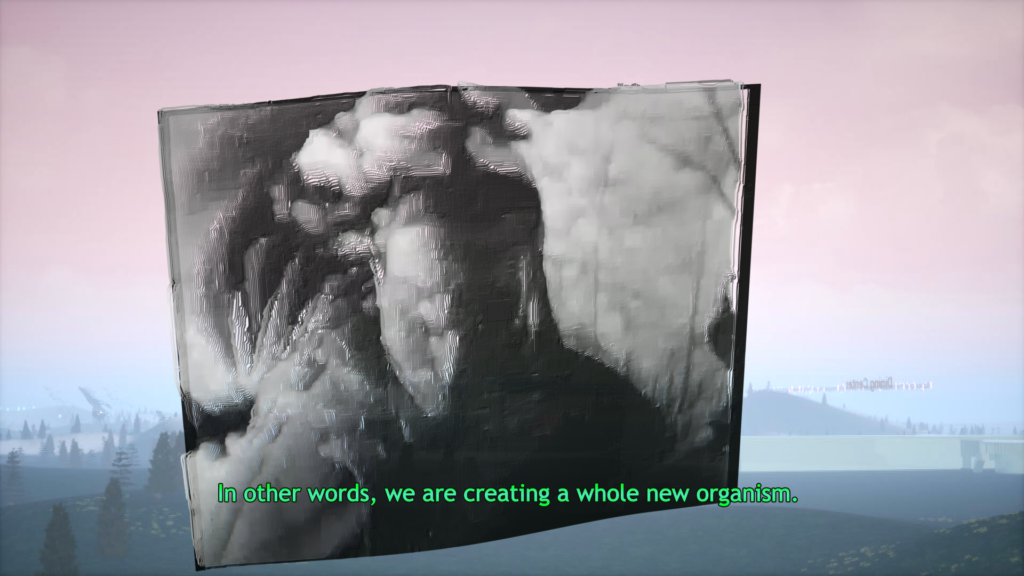
“My engagement with temporality in these works sits in this tension point between the determination of this historical time and the question of agency… But also coming to this conversation from a [financial perspective], finance is very much about holding onto a sense of the future for the sake of keeping this future somehow investible.” – Bahar Noorizadeh (Iran, b. 1988)
Bahar Noorizadeh is an artist, writer, and filmmaker whose work interrogates speculative futures, derivative politics, and the material infrastructures that make ‘the economy’ menacingly ubiquitous. She extends that inquiry through Weird Economies, the online platform she founded to trace economic imaginaries that run alongside, beneath, and sometimes against the imposed financial arrangements of our time.
Through her work, she returns to unfinished pasts and follows them forward, asking how unrealised designs, abandoned models, and contingent histories continue to exert pressure on what can still be imagined today. “Right now, my practice sits somewhere between the academic space, the theoretical space, and art practice,” explains Noorizadeh. Editing is central to that approach. “I see myself more as an editor,” she says, insisting that there is always “a performance of time” that she wants embodied by the piece, depending on what she is trying to arrive at. The approach in itself feeds into the intention of the work, and vice versa.
This temporal logic offers a throughline across her expansive oeuvre. Seen together, and through different approaches, these works form a sustained investigation into how time is extended, managed, and withheld, but more importantly, how political agency is increasingly influenced by contracts that arrive from both the past and the future (literally, in some cases).
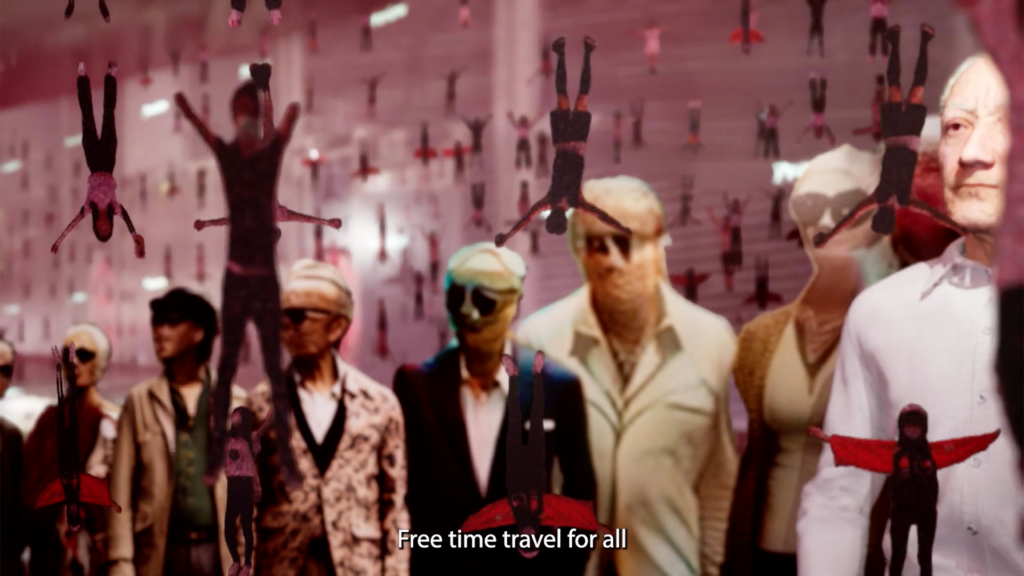
Free to Choose (2023) is an operatic sci-fi set between post-crash Hong Kong in 1997 and a speculative 2047. The film follows Philip Tose, an ex-CEO of an insolvent company who travels to the future to borrow a lump sum from his older self in order to rescue his crashing business. Credit makes the future’s presence more obligatory and essential but only as a collateral for its own sake. Young people campaign for “free time travel for everyone”, the untrustworthy and the discredited of a corrupt credit system included—the people who could not pay off their time credit. Operatics aside, there’s a bleak comedy to the premise. Upon arriving in the future, Tose is greeted by a time travel agent: “I’m not past-phobic, don’t worry.” The joke lands because, here, the future’s aversion to the past is merely logistical. The past disrupts a market system only designed to predict.
On an equally absurd level, Teslaism: Economics After the End of the End of the Future (2022) is conceived as a third-person racing musical game. The film follows Elon Musk and his self-driving Tesla (his “lover, life coach, and oracle”) speeding towards a shareholder meeting through a hyper-gamified Berlin. He is going to announce the end of the end of the future. “Any active effort to end things contains an anticipatory continuation. The only way for things to end is for them to fade away. The fade withholds the extension of time. It’s a way of taking control of how things extend and how you want them to extend,” he says in conversation with his creation. “Well the point is, here at Tesla, we’ve managed to control the end of the future. Losers try to find their way into others’ consensual futures, but the visionaries, they create storytelling machines for people to play with.” Time is extended to keep investment alive.
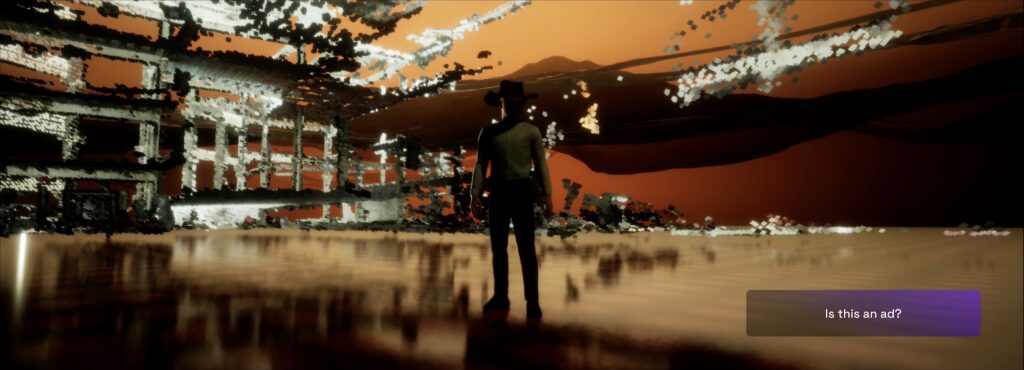
“There’s a helplessness that needs to be acknowledged these days,” Noorizadeh tells me. “Our political agencies at this moment… it feels like everything is set for you. Everything is slightly predetermined.” Perhaps, then, the proposition is that the most radical action possible in a system that monetises its own extension is a refusal of continuity. Otherwise, we’re stuck in a doomscroll, watching the same object on the screen for the rest of eternity. At least that’s how Noorizadeh describes it.
This concern with extension deepens historically in The Red City of the Planet of Capitalism (2021), a video installation revisiting Disurbanism, a short-lived Soviet ideology that proposed the destruction of the city altogether in favour of something more human. Developed by Mikhail Okhitovich and Moisei Ginzburg in 1929, the avant-garde movement argued that the modern city’s hierarchies were beyond reform and therefore to be dismantled and redistributed across a fully networked landscape. The film’s voiceover reads a letter sent by Ginzburg to Le Corbusier, the emblematic architect, rebuking his reformism: “You do all this because you want to cure the city… We in the USSR are in a more favourable position. We are not tied by the past.” Built from a handful of surviving sketches and rendered into speculative 3D space, the film breathes life into the unrealised imagination of the Disurbanist fantasy.
That same idea of suspended possibility is explored in After Scarcity (2019), a sci-fi video essay on Soviet cyberneticians who saw computation as a tool for centralised economic and informational planning and management rather than the free market. Tracking attempts to build a fully automated planned economy via the 1960s OGAS (a proposed centralised Soviet computer network project designed to manage the social economy decades before the modern internet), the film passionately declares that digital capitalism was not the only possible outcome. “The internet, as we know it, is not an organic offspring of globalisation and technological progress,” the narrator reads. “Just as it is difficult to imagine a post-capitalist future, it is equally absurd to imagine a past unspoiled by capitalism.”
Noorizadeh’s films repeatedly return to the contemporary feeling that time is being set in advance—politically, economically, and aesthetically. This conversation unfurled against the backdrop of ongoing protests and brutality in Iran at the time of writing (and outright war at the time of editing), an inescapable undercurrent that bled into the exchange. The frustration was palpable on both ends of the line. “I’ve been thinking about the idea of counter-revolution for the past few years and, suddenly, everything is making sense. It’s a particularly counter-revolutionary time across the planet,” she reflects. In that sense, her work doesn’t offer a new future to believe in per se. Instead, it poses a somewhat overwhelming question: How do we reclaim agency over time when the future is already collateral?
Tewa Barnosa
“Building up since the 1910s until the 1940s, [a lot of the history] of the concentration camps in Libya was almost fully erased from both Libya and Italy’s side during certain periods of time. When we talk about the archive in relation to the concentration camps, there’s a lot of testimonies, mostly oral testimonies. And I think most of the Libyan memory of that time is based on oral literature and music and poems… poetry is very essential.” – Tewa Barnosa (Libya, b. 1998)
Tewa Barnosa works in the long aftermath of war, investigating how violence is rehearsed, aestheticised, and normalised across time. Working across video, sound, performance, games, and objects, she treats the archive as a site of and for proxy narration. The raw material moves between video and military image banks, early computer graphics, and RPG video games, but most importantly, Bedouin and Amazigh oral literature and poetry woven into a body of work that centres generational knowledge and spotlights the faults of the archive in the process.
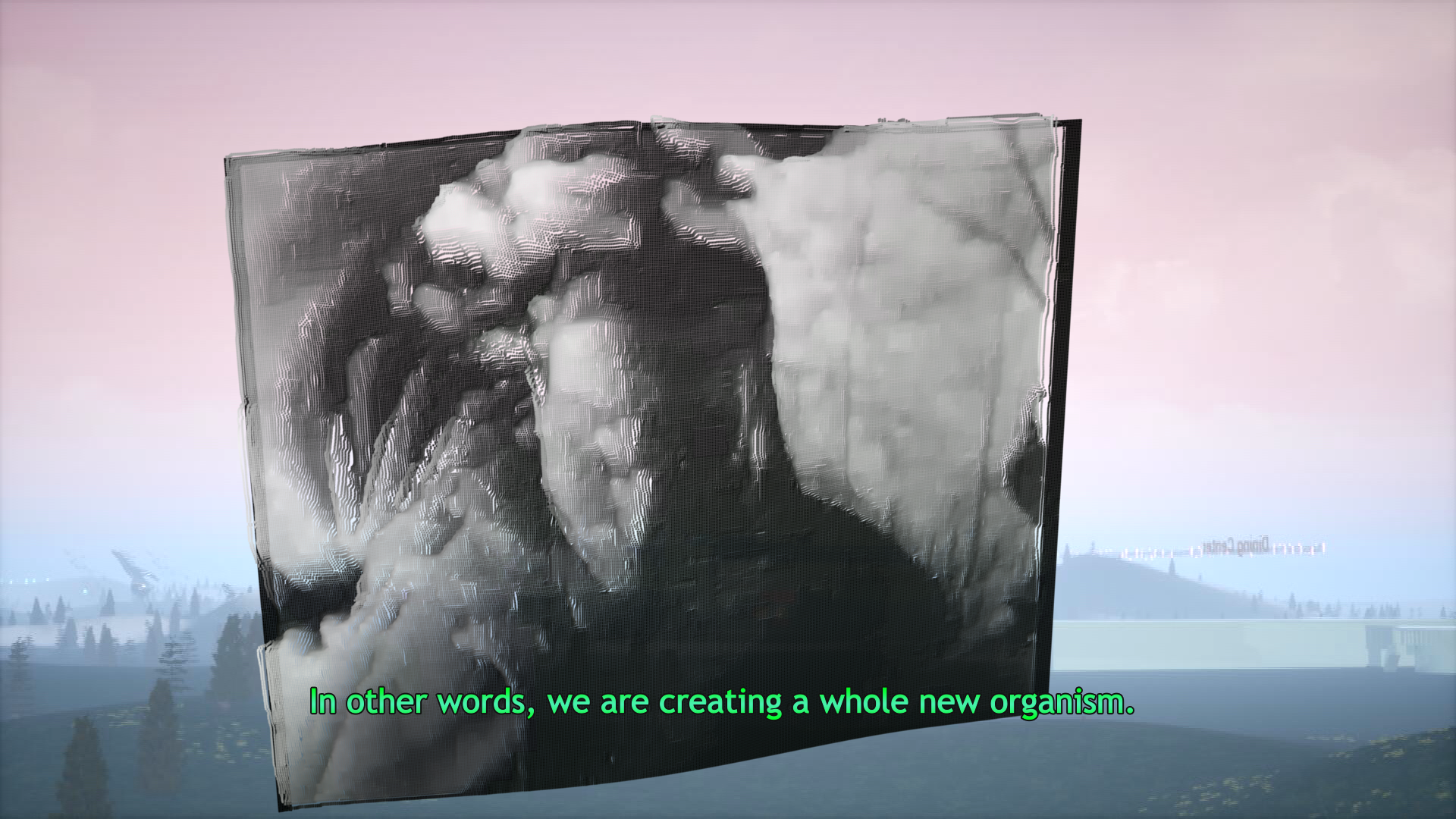
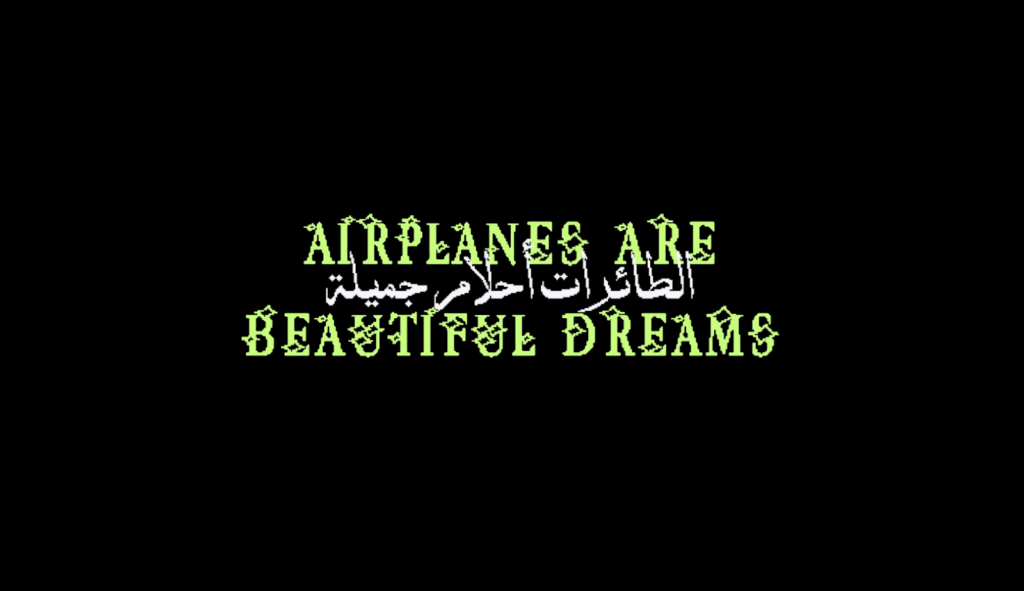
In The Insurgence of Ghibli Winds (2025), the first chapter of her ongoing Warlab trilogy starts at the inception of modern warfare: the moment an Italian pilot dropped the first aerial bomb in history over an oasis in Libya during the Italo-Turkish War of 1911. The film traces the emergence of a colonial industry built through “wheels and wings”. From that act, Barnosa flattens over a century of imperial violence into a continuous timeline, moving through Italian fascism, the concentration camps of the 1920s and 30s, and American air rehearsals in the 1980s. The film jumps between the military archives and early videogame graphics from 1980s American propaganda video games simulating aerial warfare over Libya, where pilots are tasked with destroying imagined nuclear plants along the country’s coast. Working across different timelines and media, a frenetic narrative is formed throughout the film, illustrating how western violence constantly resurfaces as simulation and spectacle across modern history.

Barnosa inserts two sequences that cut sharply through the film. In one part, she inserts a sequence from Studio Ghibli’s The Wind Rises (2013), in which the main character Jiro dreams of meeting with Giovanni Caproni, the Italian aircraft engineer who developed Italy’s first aircraft in 1910 and, consequently, many multi-bomber planes of World War I. In another, the Ghibli wind, an elemental force revered in North African poetry, converses with Caproni. “Airplanes are beautiful dreams,” the engineer insists. “That was Miyazaki’s dream, not mine,” the wind replies. “Yet airplanes are colonial dreams”, one frame in the film reads earlier on. Voices from the concentration camps call upon hot desert winds to blow away the colonisers’ aircraft. These exchanges do not separate myth and technology, working to unravel the inner workings of imperial spectacle. History, in Barnosa’s hands, changes interfaces and temporalities, yet continues pushing forward regardless.
Barnosa’s penchant for temporal compression appears again in In Yesterday’s Forecasts (2025), a performance that merges the story of Silphium (a plant once endemic to the Libyan region of Cyrenaica and documented as the first recorded human-induced species extinction) and the mass extermination of Libyans under Italian fascism. Discovered after ancient floods and overharvested into disappearance, Silphium later reappeared as a fascist emblem. The visual artist stages this entanglement through recitations, soundscapes, and visual worlds conjured up from archival fragments, grounding the performance in surviving Tamazight and Bedouin poetry—almost in a way to say that extinction is not final. Symbols re-emerge, time re-emerges, and tradition re-emerges even after the supposed end.
This idea of relentless transmission is also explored in Written to Not Remain (2024), a video installation built from a personal photo archive of graffiti across post-revolution Libya in the 2010s. The tags, jokes, accusations, and silent protests are treated as ephemeral testimonies of western-manufactured wars following the 2011 Arab Spring. Barnosa translates this archive into a virtual reality simulation, recreating the tags inside a digital environment where protest persists silently. The simulated wall becomes a living, mutable interface that outlives the walls of Libya.
Perhaps the most compelling aspect of her work is the insistence that past atrocities and collective trauma not only continue, but will also continue to re-emerge in mutated forms, reappearing through games, simulations, myths, and media infrastructures that continue to shape political reality the same ways in which oral histories are passed down in parallel. By flattening centuries into a single operational present, her work challenges the fictions of ‘post-colonial’ resolution. What Barnosa ultimately confronts is the many ghosts of history as a persistent system, ones that must be summoned and exorcised constantly. What violence must be confronted when we refuse closure?
***
If hauntology names a time that is “out of joint”, then what these four practices offer are tactics for surviving inside that misalignment. Derrida gives us the language. Fisher diagnoses the stagnation. Bluemink proposes an exit through invention. But none of these frameworks fully account for what happens when the future was never promised to mourn in the first place.
Hauntology aestheticises paralysis. Anti-hauntology risks overselling invention as the way out. Our history was never handed to us as a complete inheritance, which makes Big Culture’s nostalgia machine more palatable but absolutely not useful. The artists here do not offer clean futurism or techno-optimism. They treat time itself as material, working inside the rift to disembowel it. The takeaway is that history cannot be hacked away completely. The problem is much less philosophical than it is material. Occupation, war, and displacement double as both our heritage and our very aggressive present. They remain life-threateningly active and unfinished. Anti-hauntology, as a stance, is generative but hardly a manual. It does not guarantee escape. To treat it as praxis with guarantees may be optimistic, even dubious. But perhaps that uncertainty is the only honest position left. When histories refuse to end and futures fail to arrive, certainty retreats into aesthetics. We see it everywhere, so if we are constantly told we are at the end – the end of history, the end of modernity, the end of the revolution – then where exactly are we supposed to begin? And more urgently: who profits from a world where the future never arrives? Where fingers point, that is the enemy.