
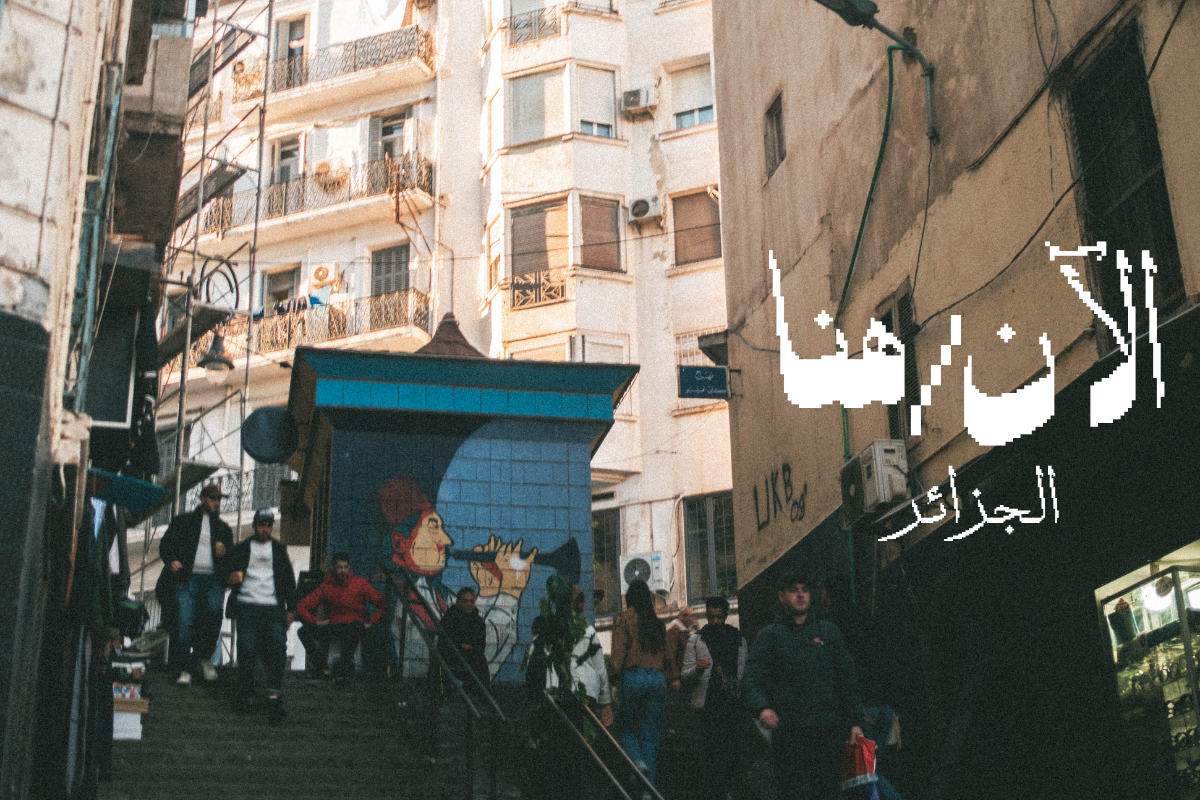
 Photography by Cornawy
Posted in
Feature, Algeria
Here/Now: Algeria — A generation between inheritance and self-definition
Text Hamdi Baala
When COVID hit in early 2020, Algeria was witnessing weekly protests all over the country. The Hirak, the largest popular uprising in decades, started a year earlier. Similar to the other Arab Spring movements that started in 2011, the demonstrations succeeded in creating political pressure that toppled former president Abdelaziz Bouteflika in April, 2019, and continued to demand systemic change that would bring about democracy, social justice, and political freedoms.
The millions of marchers, most of whom were young, defied a protest-banning de facto state of emergency that had been in place since the beginning of the 1990s civil conflict. The act of reclaiming public space liberated creative energies and encouraged initiatives. From political groups and platforms to media outlets and cultural collectives, a generation rediscovered its voice.
The movement had culminated in a stalemate where the vitality of the protests could sustain itself, but how could that vitality be transformed into actual political agency to bring about change? Debates around this question became heavily polarised as radically opposed views on identity and belonging dominated discussions when the pandemic, coupled with a mounting crackdown from the authorities, brought the marches to a halt. The streets fell silent, and political discussion soon followed, but the underlying concerns continued influencing the collective consciousness. The creative energy found a home in studios, rehearsal rooms, and workshops, where young Algerians began to shape new relationships with their roots and origins, to question modernity and their place in a rapidly changing world, and to build communities and create new avenues of self-expression.
For photographer Celia Bougdal, the return to origins is literal. She turned to photography as a way of navigating personal memory. Her first project led her back to her childhood home and to the unresolved grief surrounding her grandfather’s death. Walls, trees, letters and abandoned rooms became vessels of remembrance. Later, in a series of contrasting day and night photographs taken during a period of depression, she foregrounded the tension between social appearance and private vulnerability. Celia’s work insists that authenticity begins with confronting one’s own history. In revisiting family space, she reclaims intimacy as a form of cultural grounding.
Visual artist Abdou Salah, known as Lokher (“The Other”), also approaches authenticity through introspection. Born in Algiers in 1998 and trained at L’école Supérieure des Beaux Arts, he constructs surreal universes in which bodies fragment and landscapes dissolve. At first glance, his vivid palettes and dreamlike compositions seem detached from tradition. Yet his search is rooted in a deeply personal negotiation with perception, shaped in part by his colourblindness. By intensifying saturation to see colours as others do, he found a method in his limitation. His recent series reflecting on home and belonging situates surrealism not as escapism, but as a way of probing emotional inheritance. Lokher’s canvases suggest that authenticity may lie in embracing one’s singular lens.
Questions of transmission shape Houssem Boulifa‘s photography. Born in France, he grew up leafing through family albums that connected him to a homeland he had experienced only through images. Working exclusively with film, he embraces the slowness and unpredictability of analogue process as a metaphor for memory itself. His photographs of Fantasia horsemen, neighbourhood football matches and scenes of pilgrimage attempt to build bridges between memories, places and lived experience. Positioned between France and Algeria, halfway between insider and observer, Houssem builds an evolving archive that treats heritage as everyday continuity.
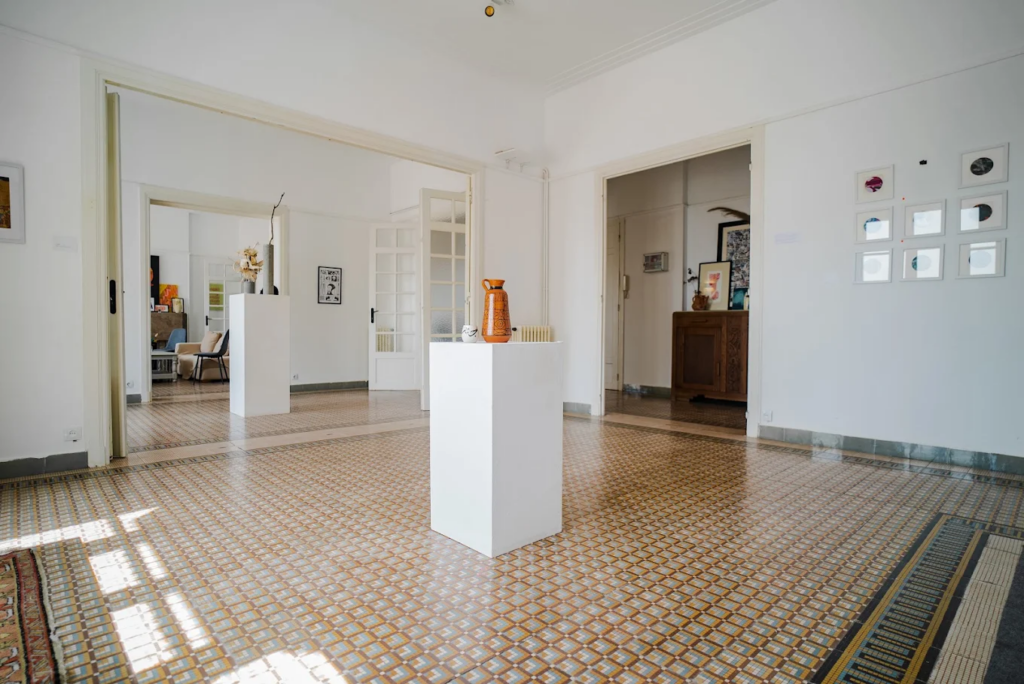
Visual artist and designer Fouad Yahiaoui, better known as Fwad, turns to architectural, culinary and vestimentary heritage. His sculptural series, referencing Haussmannian façades, Mauresque ornamentation, and informal “fawdawi” housing, examines how built environments encode layers of history and inequality. Using reclaimed materials from the Casbah, he anchors contemporary design in actual fragments of the past. His exhibition “Anemoia,” exploring nostalgia for times never lived, reflects a broader generational impulse: a desire to reclaim authenticity in a world perceived as flattened by globalisation. Through XBM Studio, the independent space he co-founded, Fwad also works to create platforms where local narratives can unfold on their own terms.
Even skateboarding, long seen as an imported subculture, has taken on local inflexion. Abdelbasset Ameuri, who began skating in near isolation in Tipaza, now mentors a growing community and helped shape the creation of a skatepark on Algiers’ seafront. For him, riding through city streets is a way of reinterpreting urban space. The pavement, stairs and railings of Algerian cities become sites of creativity rather than constraint. What was once marginal is now part of the fabric of local life.
Together, these trajectories reveal a generation more concerned with substance than spectacle. As the decade unfolds, Algerian youth continue to reinterpret their heritage and forge new, creative relationships with their roots and the world in light of global, radical changes. Through memory, images, sound and movement, they are re-rooting old mediums and anchoring newer ones in their own tradition, insisting that authenticity is continually reimagined.
In the coming weeks, Here/Now: Algeria will delve deeper into each of these stories through a series of video and written profiles exploring the people, spaces and ideas shaping contemporary Algeria.