
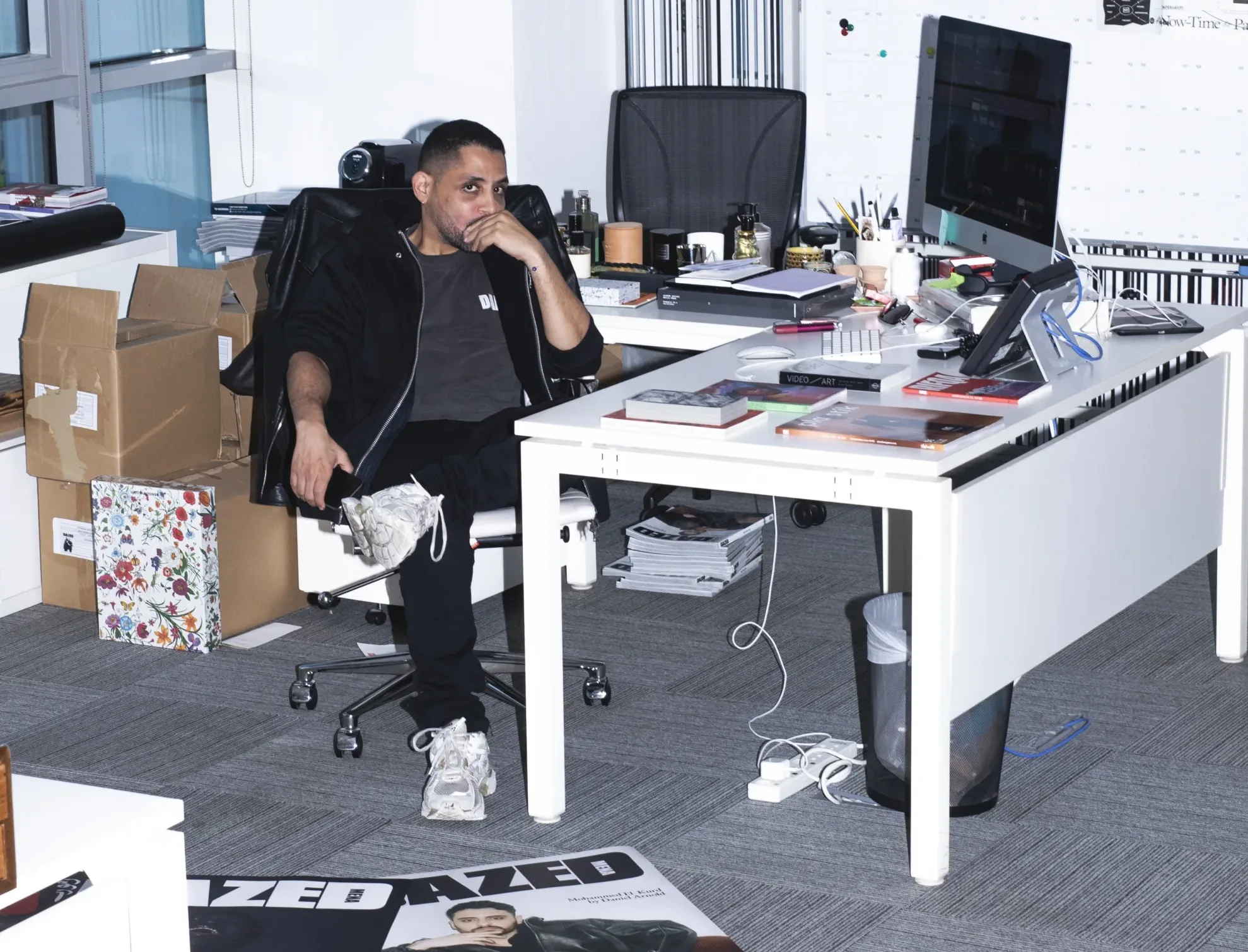

Text Ahmad Swaid
The present moment does not wait. It strikes without warning like a hot flash of silver, demanding to be seen. Sharp, penetrating, unyielding. It cuts through the static of what once was, piercing straight through the foil to release what has long been held back.
For some time now, I have grappled with my position, working in an industry that continues to play an active role in silencing and manufacturing consent for the erasure of truth–of Gaza, of Palestine–on a vulgar scale.
The past several years have exposed the depth of this complicity: the ingrained bias across our media systems, the bureaucratic red tape that props up a settler-colonial project, the lurid bargaining that follows even when silence is no longer tenable. I’ve sat in enough boardrooms and been on the receiving end of too many suits who negate or negotiate: “Yes, you can speak, but not too much.”
Truly, enough is enough. It is time we reckoned with our proximity to power and how we choose to wield our privileges. Each of us in the industry must face the truth that our editorial decisions are not abstractions. They are material, with very real consequences.
Throughout this summer, I, alongside two members of my team, deputy editor Sarra Alayyan and creative producer Fatima Mourad, worked on a story in collaboration with journalists on the front lines in Gaza. One of them was the late Mariam Riyad Abu Dagga, who was murdered in a targeted airstrike by Israel on 25 August. Her killing by the IOF was broadcast for the world to witness.
Weeks earlier, she agreed to be photographed by Ahmed Younes for our cover, alongside journalists Hind Khoudary, Nour Swirki, Shrouq Al Aila, and Renad Attallah (who recently made her way out of Gaza to the Netherlands). This was the first time all of them had consented to having their respective images taken for the media since 7 October.
We didn’t realise this would be Mariam’s last portrait, or the weight we now carry because of it. In full transparency, we struggled with how to move forward; what was once meant to be an urgent editorial had now become evidence.
With the permission and blessing of Mariam’s family, we share her portrait and words with the world as a testimony, an act of preservation, and, most importantly, a crucible. As Mariam Barghouti, who interviewed Mariam, writes in Eyes of Truth, “Refusal to publish is its own violence.”
Silence is political. Every omission and negotiation is a form of violence. To ignore the genocide is not an editorial preference; it is a political decision, managed through suits and privilege.
I will not apologise for the volume at which this issue speaks. Not for the specificity of its address. Not for saying no to the absurd logic of zionism that is rampant in our systems. Not for calling the media to account. Not for insisting that the lives of our brothers and sisters be cast permanently as “political”.
Ultimately, we will no longer falsely atone, nor pander to caricatures of ourselves, not now, not ever. This is the spine of Hardcore, NOW!–to take the present as it is, and meet its harshness with equal hardness, shouldering its burden even if it leaves us with more questions than answers.
Put more sharply, in Arab tongues, hardness carries a different weight: صلب. Something solid, unbending. Unbroken. It is the refusal to yield. We’re seeing this en masse now. Communities are demanding attention and taking action worldwide. From Tokyo to Amman to the United States, we explore the global youth mobilisation for Gaza, featuring contributions from Maen Hammad, Ruba Abu-Nimah, Palestinian Youth Movement, Darío Karim Pomar Azar, Tamara Turki and more.
This same spirit of reclamation extends beyond protest into art, music, and image-making, where history is being repossessed. Throughout this issue, we turn to five principal artists who embody this notion: neorealist and Magnum-signed photographer Sakir Khader, Kuwaiti artist Monira Al Qadiri, award-winning visual artist Liz Johnson Artur, Uzbek photographer Hassan Kurbanbaev and Egypt’s biggest pop star Wegz.
In Born After Empire, we explore youth in Uzbekistan through the lens of artist Hassan Kurbanbaev. Rising to prominence with his series Logomania: Owning the World at Half Price (2019–present), Kurbanbaev revisits how we see power in the 21st century by focusing on the pervasive presence of bootleg luxury brands in everyday life. His photographs reveal that bootlegging is not mere imitation but a powerful act of cultural reclamation and an assertion of identity in a world shaped by empire, exclusion, and rapid globalisation. For this special story, Kurbanbaev teamed up with Dazed MENA Fashion Editor Ali Ammar, exchanging fake D&G velour tracksuits for real Christian Dior Fall 2025 and replacing counterfeit Supreme slides and pseudo-Versace interiors with Balenciaga faux-fur and real Versace prints, styled on a cast of youth from across Tashkent. Bootlegging is, paradoxically, the most real thing we have, and in essence, remixing Kurbanbaev’s Logomania is probably the most bootleggy thing we could have done.
Where Kurbanbaev recycles, Monira Al Qadiri transforms myth and futurism into new forms. I first encountered her work several years ago in Dubai; later, through friends, we were introduced and fell into the spectacle of her interdisciplinary universe. From self-created puppets to iridescent, larger-than-life objects to chrome-like figures recalling science fiction, Al Qadiri is a futurist and the pre-eminent pop artist of our times, sculpting the politics of oil, gender, and Gulf mythologies with the same remix logic that J Dilla or Ghostface Killah use when sampling history and myth. Photographed by CHNDY, who had met her a decade ago on his first-ever trip to Japan, where she was once based, the two artists engage in an exchange of play. In Monira Al Qadiri is Mad About It, the Berlin-based artist speaks to Selma Nouri, and we present a “catalogue raisonné” of her archives and work.
Elsewhere, Egypt’s finest, Wegz, once the storming kid on Cairo’s streets, now sits unbothered on his throne, refusing the narrow script his imitators and competitors frame around him. Fame and numbers came quickly and continue to come fast: “I’m growing, opening my mind to things. Some things don’t bother me anymore, some things bother me more. I judge less, I’m more accepting. I take people and things as they are. I’ve started realising my place in the world,” he says to Omar Ghonem in View From the Top. A story set atop the Hilton hotel in downtown Cairo and lensed by none other than Omar Kafrawy– a longtime surveyor of Egypt’s subcultures and underground scene. Here, his lens catches Wegz as Pacino, Gandolfini and Liotta. Icon and outlaw, saint and sinner, a rap monarch draped in the contradictions of the city that made him.
“The right to protest – for people to express whatever it is they need to express – is a luxury considering the times we live in”, says Liz Johnson Artur, the award-winning legacy photographer who turns her lens to supermodel Aweng Chuol in the streets of South London, the setting of this aptly-titled mixtape. Several days before, Artur told me about a memorial slab in Kennington Park, two kilometres from where we were planning to shoot. The structure that commemorates the victims of the 1940 bombing during World War II reads, “History, despite its wrenching pain, cannot be unlived, but if faced with courage need not be lived again.”
Throughout our conversation, Artur and I spoke about the importance of shooting a story in London, especially during a summer when demonstrations for a decolonised world have been taking centre stage. Documenting Blackness for the past 30 years, she weaves photography, fashion and presence, reclaiming how the gaze shapes Black life and Black stories, which have been so pivotal in the interconnectedness of the movements we are seeing today. In that spirit, from Artur’s lens runs a silver thread to Sakir Khader’s work.
While Khader’s neorealist photography might feel detached at first glance, it is unflinchingly real, reflecting a harsh and urgent reality. Since meeting at the Tate Modern a few years ago, we’ve collaborated on projects that celebrate a variety of artists and activists. Here for the first time, he is photographed for a cover as we celebrate him with his grandmother, Najmeh (“star” in Arabic), in Amsterdam, by Eva Roefs. “My grandmother Najmeh is the proud sister of one of the first shuhada who died while defending Palestine…That fighting spirit has always been in our family,” he tells writer Farah-Silvana Kanaan.
Khader’s black-and-white images sit like silver, capturing horrors the world would rather ignore. And while I’ve learned much from Khader and his story, the most enduring lesson he teaches us, anyone who encounters his work, is that it is no longer enough to bathe in illusions, softened symbols, and borrowed language masquerading as diplomacy.
This is a September issue that gathers the fragments and flashes that have brought us to this very moment, and raises the question: where do we go from here? We refuse theatre, and instead, we embrace what has long been absolved, turning silver to the stories that have often been negotiated. In whatever silver lining we might have in this very moment, all we can hope for is that it brings us into a golden age.
Hardcore, NOW. Forever and Always.
Ahmad Swaid, Editor-in-Chief