
 Posted in
Film & TV, Nakba
Posted in
Film & TV, Nakba
Annemarie Jacir reflects on Palestine 36, Wajib, and Mohammad Bakri’s legacy ahead of Reel Palestine appearance
Text Eman Ibrahim
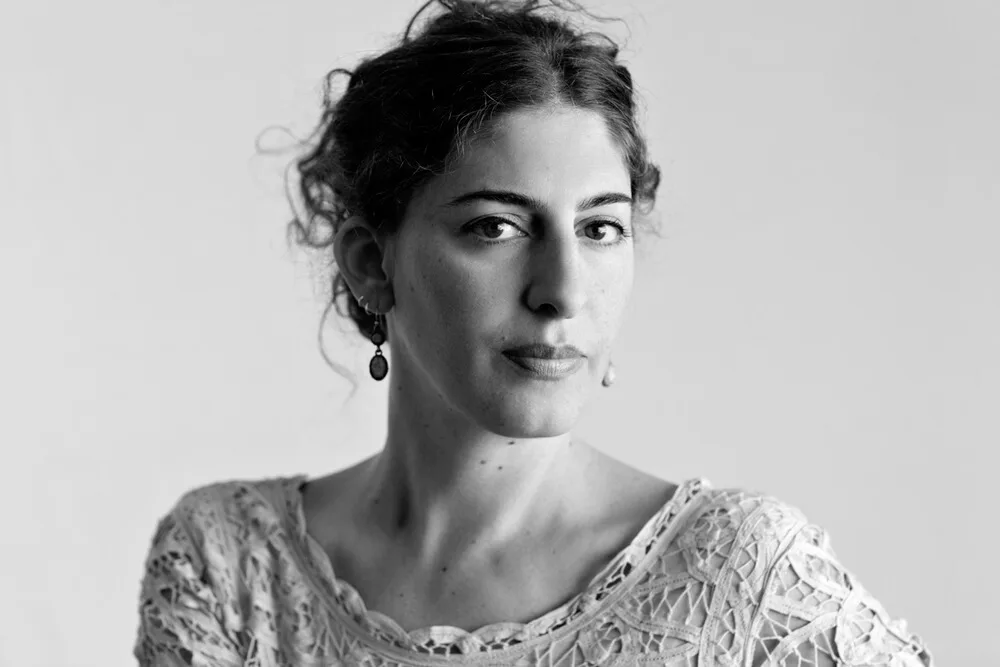
In many ways, tracing the career of Annemarie Jacir is akin to tracing the history of contemporary Palestinian cinema itself. A dignified, commanding filmmaker, she directed the first Arab short to ever play in the Official Selection at the Cannes Film Festival (2003’s like twenty impossibles), she was the first Palestinian woman to write and direct a feature film (2007’s Salt of This Sea) and all four of her features were selected as Palestine’s official submission to the Oscars in their respective years. Jacir is set to appear at the 12th Reel Palestine Film Festival at Cinema Akil, running from January 23rd to February 1st; two of her films, Wajib and the Oscar-tipped Palestine 36, will screen during the festival, followed by a masterclass taught by the filmmaker on January 25th.
This current awards season, a historic one for Arab and Palestinian cinema, is decidedly new for Jacir. Palestine 36 was shortlisted for the Best International Feature Oscar this December, marking the first time a female director representing Palestine in this category is shortlisted for the Oscars. Jacir, along with her team, went from the red carpets of film festivals straight into an awards campaign, organising screenings for Academy voters, travelling abroad for Q&As with Hollywood actors – a process Jacir describes to me as “bizarre”: “Our team, we always bring Palestine to the red carpet with us, because it’s like…I’m not there to celebrate. I’m happy, I celebrate that we managed to finish this film under the most difficult circumstances. But there’s no celebration happening. I think it’s very important to keep that in mind that none of it really means anything.”
Running parallel to the campaign is the film’s official release in theaters worldwide, across the US, UK, and Palestine, as well. “We did our premiere in Gaza. Yesterday we were in Haifa and Jerusalem, and Nazareth, and all the shows are selling out.” It’s the audience reaction she deeply cherishes: “A woman wrote to me that her father, who’s a Nakba survivor, never talked about this period of their lives, all of this trauma that we’ve lived. And she said [since] he watched the film, he’s been non-stop. The whole family is gathered around him, and he’s suddenly speaking for the first time, all this stuff coming out that they’ve never heard. I’m getting a lot of those kinds of responses, which is the most beautiful thing I could imagine.”
As indicated by the title, Palestine 36 takes us to a Palestine before the Nakba, when British colonial rule and increased Zionist immigration began to strip Palestinians of everything they held dear. The Palestinians revolt, and Yusuf, city worker by day and villager by night, swings between the upper and lower class amidst escalating chaos. A decade in the making, and worlds away from Jacir’s previous work, the project was no small undertaking. “It was the most difficult thing any of us have ever done,” she says. “And it took so many years to make this film, in terms of the financing, and then we spent one year on the ground, preparing the shoot. We restored that old village. We planted crops. The crops failed. We planted more crops. We built the tanks, the bus, we built the weapons.”
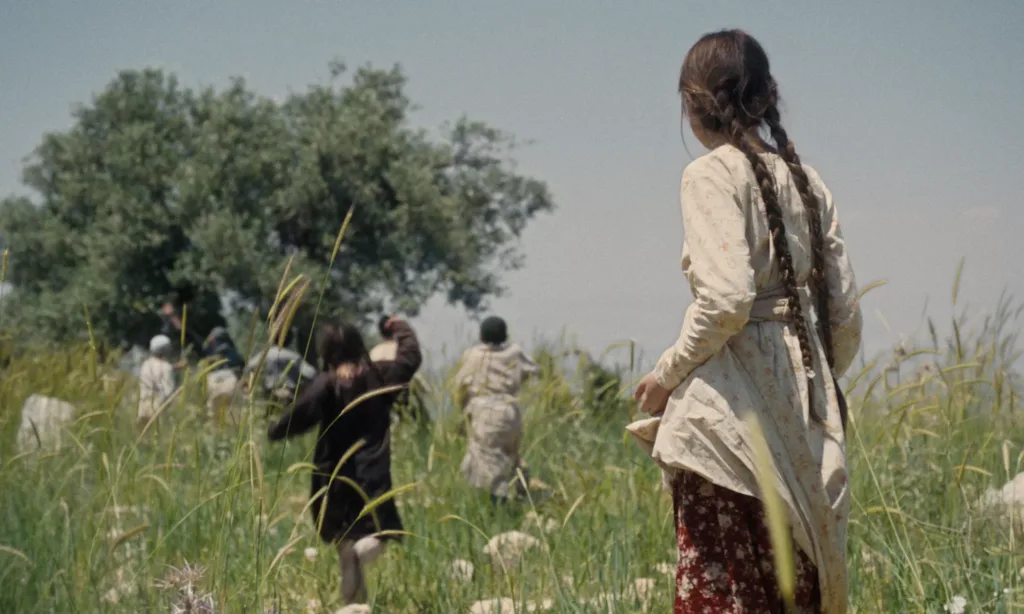
Shooting was scheduled for October 14th, 2023 in Palestine, but after October 7th, everything fell apart. “We lost everything. And the genocide had begun as well, and it was like, who cares about our film? Life has become something else. What should have taken three months became almost two years, with stopping and starting five times. It was a financial disaster. It was an emotional disaster. It was a political disaster, I mean, everything, and every day was like that.”
When discussing Palestinian history, emphasis typically lands on 1948, but the decision to center 1936—the British occupation’s quiet spread of Zionist ideology, the start of checkpoints, land registration, wall-building—and getting a glimpse into what Palestine was like before the Nakba, is as equally illuminating as it is mournful. “I think it’s important that we talk about the past, and not in a nostalgic way, and not in a way that’s dwelling on it, but in a way that helps us move forward,” Jacir says. “I mean, what we’re living in Palestine today is not so far from Palestine 36. But I celebrate the survivors of ‘36, of ‘48, the survivors and the martyrs. And I think it’s a film that honours that story.”
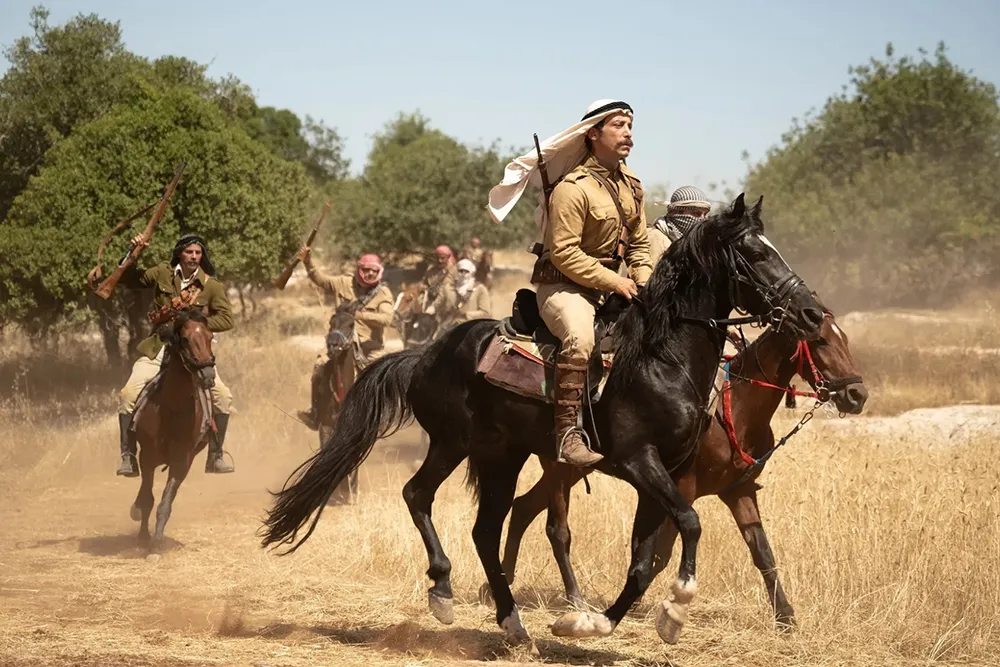
Seamlessly woven into the vibrant, narrative sequences of the film are stunning archival images, photographs so striking and crystalline that they almost seem fabricated. They’re not. “Every single scene in the film was represented by an actual photograph, or two or three photographs of that scene that we put together,” Jacir states. Working closely with her production designer, architect Nael Kanj, Jacir sought to make the film as authentic as possible, from the costumes to the sets. “We know the villages, but we don’t, because all the villages have been destroyed. So there was something really interesting when thinking about the architecture of the village.” Jacir had depicted destroyed villages in her films before, but now, she says, “it actually has to be a living village, before destruction, before Nakba, who we are, what we looked like, what we wore. Nael knows very well how old Palestinian homes [were built], and so when we restored the village that we were supposed to film in, Nael approached it as an architect.” Farming terraces and family homes were built with traditional materials, and every crevice of the set became a proponent of time-travel.
The scale of the story did not simply extend to time period and setting, but also the sheer amount of interconnected characters. “This came to me as an ensemble. It’s a story about a mass revolt, about many people…these main characters were sort of linchpins, you know, with Yusuf going between city and village, Father Boulos and Kareem, Afra and her mother. They may never meet, but they all have a connection to each other, and sort of pass each other at some point in the film.” Jacir says. The characters, portrayed by both Palestinian and British actors, ultimately exist to highlight the land they stand on. “Palestine is the main character. It’s the thing that holds them all together. They’re normal people, and life changes them, history changes them, politics, and then they make a choice about what they’re going to do. That intimate decision making, that you make under a much bigger moment, was the story for me.”
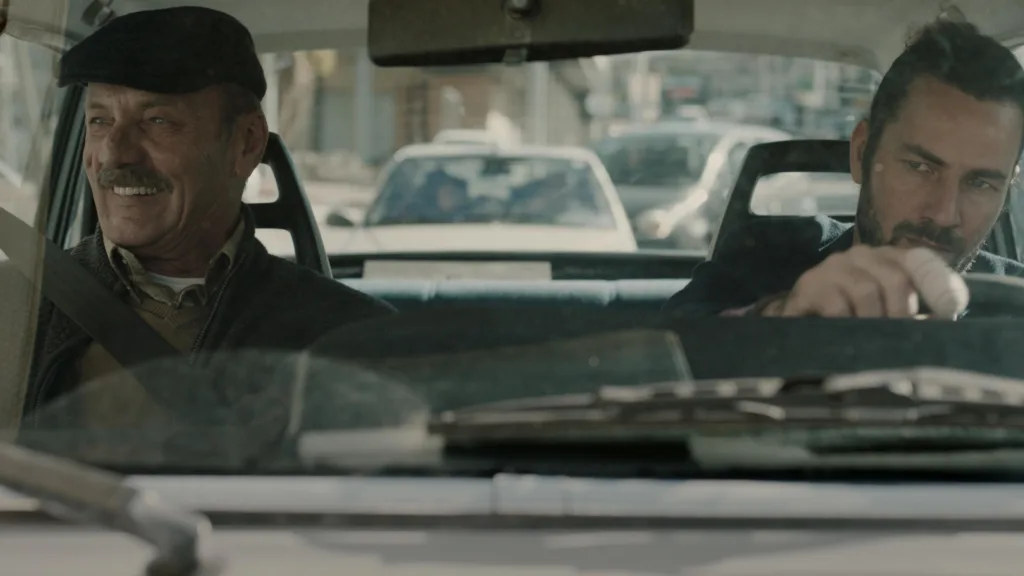
Such intimate character writing has been a staple of Jacir’s filmmaking since the genesis of her career. From the romance in Salt of This Sea, the displaced mother and son in When I Saw You, and the complex father-son relationship depicted in her 2017 film, Wajib. Set in modern-day Nazareth, the film follows Abu Shadi and his estranged son, Shadi, as they travel door to door, inviting old friends and odd acquaintances to their daughter/sister’s wedding. In a brilliant stroke of meta-casting, Wajib casts Jacir’s longtime collaborator Saleh Bakri as Shadi, while Abu Shadi is portrayed by his father, the late great actor, filmmaker and playwright Mohammad Bakri. Bakri, who passed away this December at the age of 72, was one of the most iconic figures in Palestinian cinema, from starring in regional and international films to directing daring documentaries like 2003’s Jenin, Jenin, his resume spanning nearly five decades.
The weight of Bakri’s body of work and image initially prevented Jacir from casting him. “Saleh and I, we started together—he was Shadi. Always. Mohammad was not Abu Shadi for me,” she admits. “There were a couple things about him that…well, Mohammad, he’s incredibly confident. He’s an alpha male. He walks in a room, all eyes are on Mohammad. And he walked with pride, I mean, even when you look at Jenin, Jenin, how he’s walking, you see it physically in him. The character of Abu Shadi is very different. Abu Shadi is a broken man. Mohammad is anything – was anything but a broken man.” But after struggling to find the right fit, Jacir decided to make the call. “I finally was like, you know what? Let’s talk to him. I called him, I said, ‘Mohammad, I’ve got this role, I’m not sure, I would like to talk to you about it, but I’m just being honest with you, I’m not really sure.’ And he was like, ‘Where have you been? I’ve been waiting for you to call me, I’ve been waiting for this phone call!’”
“We had coffee, and then I saw that he would be amazing. And to put him and Saleh together in a film for the first time would be really special. Also dangerous, because it hits close to home, I mean, how it is with family, there’s stuff underneath, layers of stuff. But I’m so happy we worked together. He became Abu Shadi.” At the world premiere in Locarno, she recalls, “Saleh, Mohammad and I were outside of the theater, people were congratulating us, and they were asking where the person who played Abu Shadi was. And I was like, he’s right here! They were like, ‘You’re the guy?’ He was there with his leather coat, and he was, you know, he was Mohammad. It was like they couldn’t even imagine it was the same person.”
“And I pushed him a lot. I wanted him to break out of that good looking voice, you know, his voice is incredible, and he knows how to use it. I don’t want that sexy voice. We gotta break that. I have to break, break, break you. He told me once, he said, ‘You know, I’ve only ever had one director work with me in the way that you did, which was Costa-Gavras,’ which was a huge compliment.” She remembers his constant professionalism: “He always showed up to everything early, every rehearsal, every meeting. He would sit there and have his coffee and wait for his turn. He never pulled any diva stuff. He was an artist. He was like a child, open to everything, he was absorbing and doing. And that’s not easy to do, to peel those layers away and be open to the world. And he definitely was.”
Preceding the Special Screening of Wajib at Reel Palestine is Jacir’s masterclass. Having taught at the universities of Columbia and Bethlehem, and mentored various filmmakers throughout the years, the event has Jacir putting on more familiar shoes. “I think it’s important to take away the magic part of what we do. What we do is not so special, [it’s] because of a lot of hard work and perseverance. Being able to hear what it takes and to be honest, or just demystifying everything about what we do is really critical. We make these films, we spend years and years finding whatever support we can financially to make the film. It’s nothing, though, without trying to connect with the audience and be able to screen it. And the fact that Reel Palestine devotes their work to that is really critical.”
It’s clear that Jacir would love nothing more than to shine her bright light onto future generations of Palestinian filmmakers. “It’s becoming increasingly more difficult for Palestinian filmmakers that are here on the ground, living here, to make their films. I hope that we see more of those films and that there’s more support for those filmmakers. Especially those that don’t have the privilege of knowing rich people that could fund their film, or of going to film school or being able to speak English or French. Especially in this world today, where it’s so much about promotion and self-promotion, it’s easy to lose sight of the artists. So that’s my hope. That we hear more from those generations, and the next generation.”