
 Posted in
Film & TV,
Posted in
Film & TV,
Cross-sectioning the slop: Notes on Internet Cinema
Text Hadi Afif
When I tried explaining this essay to friends and anyone curious enough to ask, I realised that the world of internet cinema isn’t as vast as I had (rather naïvely) imagined. Maybe because not everyone logs in the same level of daily screen time? If you Google the term, you’ll probably be met with discourse around “is the internet killing cinema?” and “can the internet be cinematic?”. But that’s not entirely what this text is about. It is also not an attempt to pander to cinephile forums populated by self-proclaimed movie buffs who believe cinema’s peak is bygone either (but the answers are no and yes, respectively).
There are many ways into the internet cinema. For me, it was Palestinian artist Dana Dawud’s Open Secret, a curatorial internet cinema programme that surfaced in early 2024. Organised autonomously by the evergrowing Open Secret network of artists and internet friends, it is manifesto-less, letting the work speak for itself—and no two screenings are alike. Each stop in Tehran, Dubai, Jeddah, Beirut, Milan, Montreal, New York, Perth, and beyond has brought with it a different set of films or new iterations of earlier ones. As the context and conversation shifts, the programme does too.
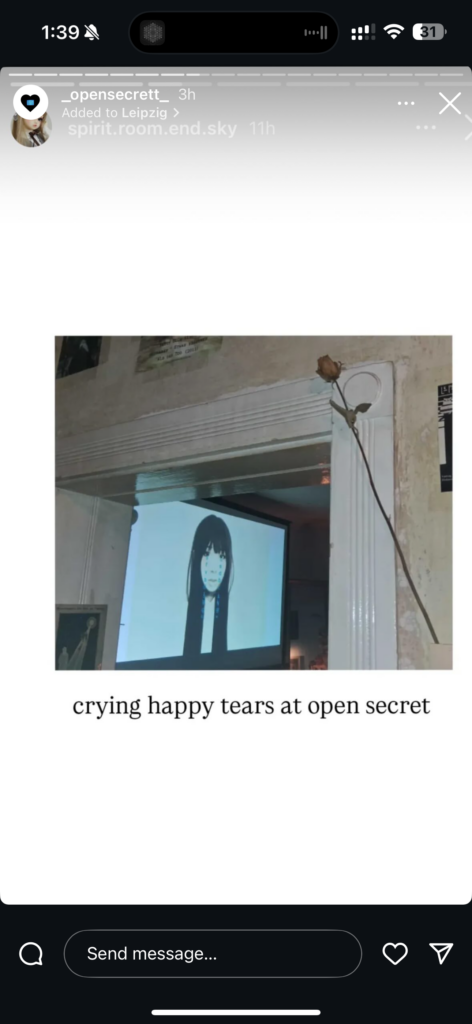
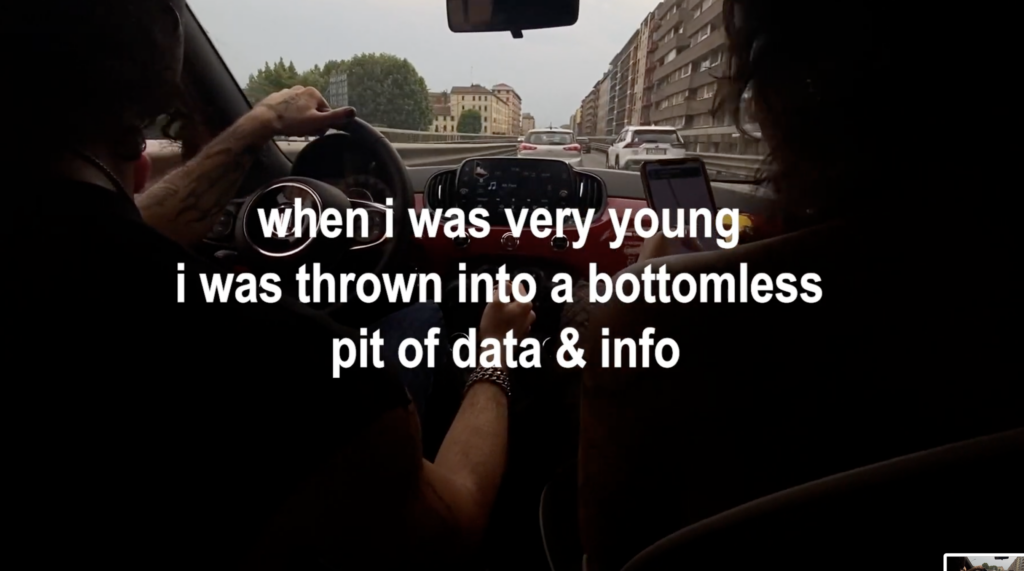
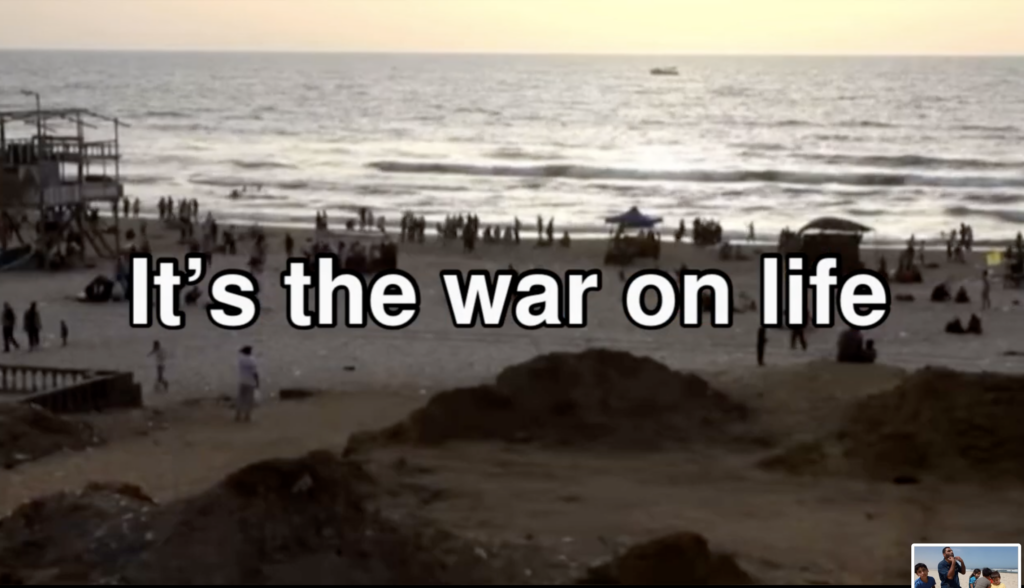
Out of this framework emerged Dawud’s own Palcorecore (2023), an emotionally resonant film born from the CoreCore wave on TikTok from the year prior. Commissioned by artist Onty and the OnMyComputer platform for the New York CoreCore symposium, it became my first internet cinema watch, later feeding into Becoming Press’ seminal Dialogues on CoreCore & the Contemporary Online Avant-Garde alongside other works discussed at the symposium.
To understand the ethos of Open Secret, one has to go through several layers of internet history, film history, and rabbit holes of Instagram Stories and coded metalanguage. In parallel, interrogating the notion of internet cinema requires working backwards to trace its lineage, which on its own is a tricky endeavour—but definitely worth the effort. But first, one thing should be established: the claim for ‘ownership’ over internet cinema is futile because the internet itself refuses any canon.
“The poor image tends towards abstraction: it is a visual idea in its very becoming.”
– Hito Steyerl, In Defense of the Poor Image (2009)
In her 2009 essay “In Defense of the Poor Image”, German artist and filmmaker Hito Steyerl talks of poor images – the compressed, the torrented, the bootleg – as popular images, created to be seen by many and dissolving the boundary between audience and author in the process. Her argument reframes the low-res as a liberated form of the image, travelling faster, circulating wider, and mutating more readily. These precursor discussions sat within a broader turn-of-the-century discourse on the impact of internet 2.0 on cinema and the moving image more broadly, a moment when the rise of user-generated platforms, the proliferation of video-capturing mobile phones, peer-to-peer file sharing, and streaming sites fundamentally altered how images were produced, distributed, and consumed. It was in this context that media scholar Chuck Tryon coined and made the first traceable mention of ‘internet cinema’ in his 2007 essay “New Media Studies and the New Internet Cinema”, announcing his interest in studying the “digital everyday” as a subject and the internet’s infrastructure as the foundation for a new cinematic framework.
The moving image’s departure from traditional cinematic infrastructures into the decentralised space of the internet became a focal point in everything labelled under “new media” academia. Although adjacent ideas of collectively authored (and radical) cinema had already been anticipated decades earlier by the likes of Cuban filmmaker Juan García Espinosa through his pivotal, albeit “controversial” essay “For an Imperfect Cinema”, published in 1969. “It is no longer a matter of replacing one school with another, one ‘ism’ with another, poetry with anti-poetry, but of truly letting a thousand different flowers bloom. The future lies with folk art… Art will not disappear into nothingness; it will disappear into everything,” he concludes.
Espinosa’s provocation was that cinema’s power should not lie in auteur control, but in the collective and participatory contributions of people. In this sense, his “imperfect cinema” anticipates the undeclared ethos of internet cinema, where the power of a moving image is not in its mastery, but its circulation through the creative agency of the many. The flowers of the algorithm blooming.
Fast forward to 2021, when Hamid Naficy writes about internet cinema’s rise to prominence during the 2009 Green Movement protests in “Internet Cinema: A Cinema of Embodied Protest”. Protesters shot videos on mobile phones and digital cameras, edited them quickly or remixed them with other clips and uploaded them to blogs, YouTube, and social media platforms, bypassing layers of censorship and official state media. Echoing earlier internet cinema readings, much of the Iranian-American filmmaker’s essay explores how the internet enabled ordinary citizens to become producers, distributors, and consumers of moving images.
At one point, Naficy (very) briefly applies Peircean semiology to the viral video of 26-year-old Neda Agha-Soltan’s killing, an event whose capture and dissemination on the internet galvanised opposition to the Iranian government. He identifies it as embodying all three of Peirce’s sign types simultaneously: icon, index, and symbol.
| Sign type | Piercean Definition | Agha-Soltan Video Analysis |
| Icon | Sign that resembles or imitates its object. | The video directly shows Agha-Soltan’s death, visually resembling the actual event. |
| Index | Sign that has a direct causal or physical connection to its object. | The footage serves as physical evidence of the protests and the violence that occurred. |
| Symbol | Sign that is linked to its object through cultural convention or shared meaning. | The video came to represent the Green Movement and the broader democratic aspirations of Iranian protestors. |
Now that the online world has been naturalised, Tryon’s “digital everyday” has become the everyday. And the easiest way to grasp this shift is through Dawud’s words in the supplementary Open Secret Zine: “Being online is unremarkable, it’s not special… we are already post-post this stuff.” So, looking at the content of internet cinema requires an analysis similar to Naficy’s, one that blends semiotic understanding with internet logic and form.
“Instead of producing signification, these signs trigger an action, a reaction, a behaviour, an attitude, a posture. These semiotics have no meaning, but set things in motion, activate them.”
– Maurizio Lazzarato, “Semiotic Pluralism” and the New Government of Signs (2006)
Gilles Deleuze’s time-image finds its kin in internet cinema, where the familiar arc of set-up, action, and resolution is abandoned for moments to simply ‘happen’—visuals and sounds that hit the viewer as sensation before they register as meaning, should they even do so. In a way, that is the crux of internet cinema. There is nothing being said per se, but there is a lot to be seen and felt.
This notion is evident in the earlier CoreCore-esque internet cinema works that emerged online post-2021, some of which have landed in the Open Secret curation. Redacted Cut’s RNG series (2023-ongoing) comes in two volumes (thus far), each averaging at around an hour and 15 minutes of internet found footage and audio superimposed ad infinitum. Onty’s Ultra-Core Anxiety 2023 (2023) follows a similar logic, creating what could be best described as a curated doomscroll that spans 50 minutes. On paper, you could guess that the ‘themes’ of these films revolve around loss, loneliness, surveillance paranoia, ecological dread… but the themes are only felt as a kind of residue. They’re never really spelt out. A flood of signifiers not anchored by any signs, not referring to any specific ‘thing’.
In “The Fourth Secret of Internet Cinema”, published on Ultra and later expanded in the Open Secret Zine, Onty – who doubles as an intellectual figurehead of internet cinema – muses on the interplay between meaning, form, and meaning within form. In internet cinema, the themes are present but never clarified; they simply go “without saying.” The weight falls on how it is made, its edits, its rhythm, and its deliberate ambiguity more than on what it literally depicts. It resists explanation and works through eliciting affect (emotion) instead.

To grasp its force, you have to read its formal logic. Internet cinema is not art about the internet—it is the internet, more so mimicking its own logic. It does not just show images of collapse, it enacts collapse through its very form, embodying the post-post conditions of showing collapse. This is the clear distinction they make between art about the internet (post-internet) and internet art (post-post-internet). In this way, the sign’s traditional categories become obsolete. Post-CoreCore internet cinema works fall under this same line of thinking, but generally rely on more generative elements.
Dawud’s Monad+ (2024-ongoing) blends webcam footage, projection mapping, and a very ambivalent narrative about “blurring experts” and “blur” as currency. Each screening recontextualises the piece, reshaping its meaning and experience with every iteration of the film. Safiya Hawwa (FKA Xafya Lovecraft) WunschZwei (2024) plays out like a meta video vlog, its text-on-screen unfolding like intimate love letters. Marble Index’s Selected Interviews (2024) follows conversations among house party guests, stitching together snippets of discussions on various topics from maps to Carmela Soprano, the sharp-tongued wife of mafioso Tony Soprano in TV series The Sopranos. Mischa Dols’ Comedy Special (2024) layers voice notes dissecting “the image” over a torrent of found-footage internet clips. Poorspigga’s Please Don’t Skip (2023) stars her virtual avatar in a relentless plea to the viewer: “Please don’t skip.” Between the repetitions, it drifts into lines like, “If the interrogation of absolute beauty is the interrogation of its very humanity, then I hope when you look into my vacant eyes and misaligned lips, you see nothing human left.” The result is quite endearing.
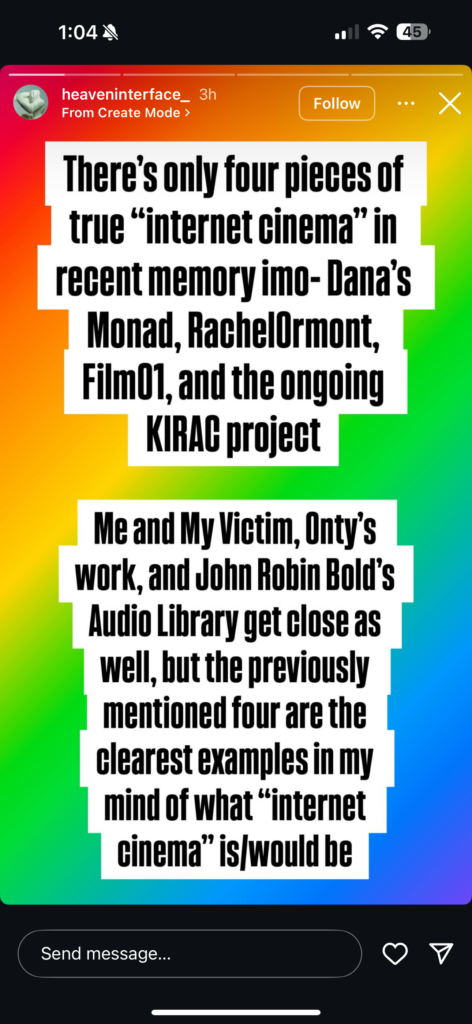
The Open Secret curation is vast, and the examples are numerous. Talking about what these works are ‘about’ is taxing in its own right, given the aforementioned discussion. There is nothing that really binds all these works together under the umbrella of internet cinema except the style of making them in relation to the internet—the references plucked from it, the way they’re scaffolded together, and so on. However, there is an argument to be made about the radical nature of internet cinema outside its rejection of traditional cinematic form.
“Woe to those who, to the very end, insist on regulating the movement that exceeds them with the narrow mind of the mechanic who changes a tire.”
– Georges Bataille, The Accursed Share: An Essay on General Economy (1949)
There is a lot of merit in seeing internet cinema’s novelty (for lack of a better word) in its asignifying nature—as in, its ability to superimpose imagery without referring to anything particular. But internet cinema’s sharper edges also manifest when it navigates the space between the signifying and the asignifying, between the push and pull of making sense.
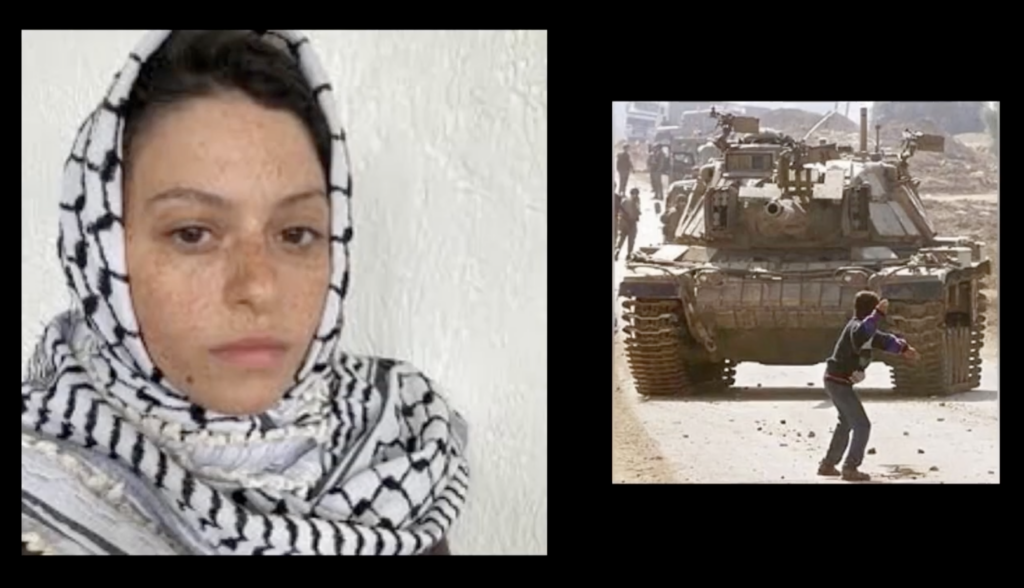
This is where it stops being simply a set of works derived from the infrastructure of the internet and, instead, becomes an active process of shaping meaning out of its chaos. Palcorecore is a prime example, particularly in its relation to the ongoing genocide in Gaza. Its power lies in its archival impulse: drawing on visual motifs of Palestinian resistance, stitching them into a dense fabric of imagery that hints at narrative without fully articulating it. The intention is, however, crystal clear.

Zein Majali’s much less referenced Propane (2023) operates in a similar part-archival space. It teases coherence without ever giving it fully, keeping the viewer in a state of partial understanding. The work’s archival footage of British intervention in the region is charged with signifiers of colonialism and resistance, exploring the “the fetishistic power dynamics of western intervention in the Middle East over the past 100 years, almost to the day”.
These works operate by keeping signs in motion and refusing to let them crystallise into fixed symbols. Meaning is only provisional. It emerges and slips away through hyperimposition, a term coined by curator duo Y7 to describe the process in which (visual) units are saturated to a point where established semiotic boundaries dissolve entirely. This instability mirrors the logic of the networks that produce these works and inspired its creators, but the narrative is easier to pin down.
For all intents and purposes (and at the risk of citing more theory), the term ‘internet cinema’ hasn’t arrived from nowhere. It comes from a long line of other “new age cinema” and video-art movements that preceded the term’s takeover. Artist and digital culture theorist Lev Manovich’s Soft Cinema installation project was an imagination of cinema built like code. Instead of a fixed reel, a film could be modular, made of fragments stored in a pool and assembled by software. Each screening could be different, generated according to rules and algorithms. “The projection of the ontology of a computer onto culture itself,” he writes in his 1999 essay, “Database as a Symbolic Form”.

Internet cinema takes that experiment further by projecting the ontology of the internet itself—the difference is scale and context. Soft Cinema played with modularity and database aesthetics as artistic experiments. Internet cinema enacts them as the conditions of online life, our everyday habits of scrolling, archiving, recombining, and reacting. To call it a continuation is accurate, but insufficient.
While earlier new-media musings anticipated the ethos of online imagery, internet cinema captures its lived reality through real-life application, casting a wider net on what could be considered part of the ‘genre’. And very importantly, while automations and algorithms shape the way the internet is presented to us, internet cinema often involves a human hand that refracts and reworks this logic—a very intentional curatorial presence, let’s say. A process of meaning-making that is distinctly human. Maybe an affirmation that a machine can automate logic, but cannot curate affect? A ChatGPT-era affirmation that “a person made this”.
It is inherently hard to write about and make much sense of a practice that supposedly rejects meaning in its DNA. Earlier avant-garde movements like Lars von Trier and Thomas Vinterberg’s Dogme 95, for example, defined themselves by a manifesto. It came as a rebellion against big-budget, effects-driven cinema, including a “Vow of Chastity” that dictated: no artificial lighting, no non-diegetic music, no sets, no superficial action like murders or weapons, and the director must not be credited. The aim was to “purify” cinema by stripping it down to its raw essentials.

Internet cinema, in many instances, operates in that rudimentary space, but contrastingly has no vow, no rulebook, no centre to pin down. It just is, maybe to the traditional film bro’s dismay. Debating whether it’s really cinema misses the point entirely. That said, the culture writer’s itch to make sense of its ‘urgency’ is as futile as it is important. If numbers are any indicator, #corecore’s billions of views on TikTok point towards a proliferation of that leg of internet cinema in a massive and culturally impactful way. So long as the internet exists, it will breed internet cinema. Will it go mainstream? Unclear. But internet cinema has already gone viral, despite the majority of its viewers not actually realising that they are consuming it. If you’re online, you’re in it.
Put in George Bataille’s terms, the internet itself is a general economy of excess, an overflowing storehouse of ‘neutral’ information without meaning. One way to think about internet cinema’s core operation is that it draws from this surplus, the internet’s raw material, and creates temporary meaning through signifying and asignifying processes. Meaning not as a final product, but as an act, as a process. Both a true reflection and response of the condition of being perpetually online.
Perhaps this is internet cinema’s most radical gesture—not rejecting meaning, nor fully embracing it, but revealing it as something unstable and inseparable from the excess that spawns it. A manifest of the user’s endless rehearsal in making sense out of its chaos. Personally, I am not comfortable making any conclusions whatsoever, but if there’s one way to approach it, I would start here. “Internet cinema exists,” as Onty describes in the first secret of internet cinema. Maybe one of the central questions of internet cinema, then, isn’t “what does it mean?” so much as “what can be made out of too much?” And to what end?