
 Posted in
Film & TV, Film
Posted in
Film & TV, Film
Glassblowing, Ghibli and a whole lot of ‘jugaad’: The journey behind Pakistan’s first hand-drawn animated film
Text Shaurya Thapa


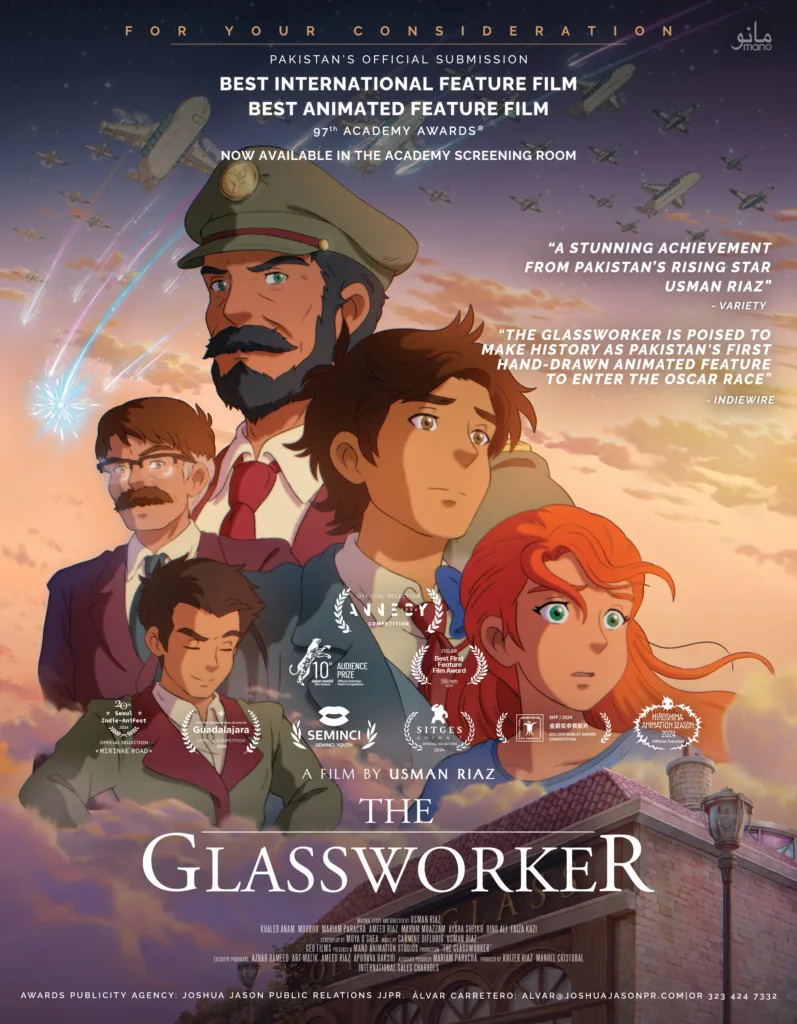
For Usman Riaz, The Glassworker is more than just a film. By now, his native land of Pakistan and the rest of the world have already lauded the 35-year-old for crafting the country’s first-ever hand-drawn animated feature film, one that was even selected as Pakistan’s official entry to this year’s Oscars.
But for the Karachi boy-turned-New Yorker, the anime-influenced epic drama is also a decade-old project born out of crowdfunded demos, meticulously-illustrated storyboards, a diverse ragtag crew from Pakistan and beyond, a studio started from scratch, and a whole lot of jugaad.
An everyday term among Urdu, Punjabi and Hindi speakers of the South Asian subcontinent, jugaad can be roughly translated as a makeshift solution that often stems from improvisation and limited resources. “This whole film was jugaad. And I did not think I would spend one-third of my life dreaming about this project.” Riaz chuckles over a Zoom call, looking back upon how production and distribution took him ten years in total.
While he single-handedly drew every storyboard for The Glassworker, a team of Pakistani animators from his own studio, Mano, and outsourced artists helped bring his long-gestating vision to life. Describing the process as walking through a revolving door, Riaz adds, “Some people would come in for a few years, contribute and then leave. Then, others would come in. Just in Pakistan alone, maybe 70 to 80 animators worked on the film over a span of seven years.”
Set in a hybrid world rooted in European and Pakistani cultures, The Glassworker plays out as a moving coming-of-age journey for dreamy-eyed hero Vincent Oliver, a prodigious glassworker (or sheesha gar as the Urdu translation goes) who often spends his younger days in his father’s workshop.
Blending coloured minerals with sand inside sun-scorched furnaces and then blowing air through pipes to sculpt the molten byproduct into vivid shapes and sizes, Vincent is a master of his craft, albeit in a time of military upheaval when a colonising military relies on his family’s glassworking magic to create “quicksilver rectifiers to power amphibious crafts” (weapons of war in simpler terms).
With Vincent also falling for the villainous Colonel’s violinist daughter, Alliz, the glassworker must choose between his family’s artistic legacy, his heart, and his service to the nation. And to add a touch of magical realism, Vincent is also shadowed by a friendly djinn (supernatural spirits in Islamic mythology created from “smokeless fires”).
The film’s many cultural influences and plot threads perhaps stem from Riaz’s own Renaissance Man approach. He didn’t just sit on the director’s chair and oversee the animation for his directing debut, but also co-wrote the story and co-composed the film’s enchantingly romantic piano-driven score. He even lends his voice to some of the hilarious, wrinkly characters like the singsongy Principal Bhatti in the Urdu release.
An academic background in fine arts from Karachi’s Indus Valley School of Art and Architecture and later a musical sojourn in Boston’s Berklee College of Music might explain his multi-hyphenate tendencies. It was his musical skillset that initially led him to a global fellowship under the TED Conferences in 2012.
But with animation eventually turning into his forte, Riaz used the TED stage as the earliest breeding ground for his glassworking passion project. Come 2016, Riaz even managed to show Hollywood bigwig Steven Spielberg a few storyboards on his iPad Pro at one such conference. But the road to transforming his iPad scribbles to a fully-funded feature film was still a long walk from there.
A Kickstarter campaign followed, with Riaz uploading a brief teaser. In retrospect, the character designs of that 2016 clip look less defined and detailed, but Riaz had been persistent since then with his vision for a story around old-school glassblowing, a craft that he had been fascinated with since he witnessed the Italian Murano glassblowers in action. His scholarly demeanour on the video call is broken as he takes a childish trip down memory lane, recalling how he used to be obsessed with glassblowing videos and documentaries when YouTube first started in 2005.
But as romantic and intimate a craft as traditional glassblowing and sculpting can be, it is also a niche and labour-intensive trade, much like hand-drawn animation.
Kickstarter helped Riaz raise nearly $116,000 but the jugaad continued with his mother selling off her father’s house, and Riaz and his wife Mariam Riaz Paracha moving in with his parents to cut costs. Mariam would go on to be involved with The Glassworker as producer and art director. Before crowdfunding and international investment gradually increased, one of the family business’s abandoned office sites was also converted as the base for what would become Mano Animation Studios.
Named after Riaz’s childhood pet cat, Mano comes across as Pakistan’s small-scale answer to a 2D animation giant like Studio Ghibli. In fact, Ghibli played a serendipitous role in helping the Karachi newcomer jump into the deep end and start a studio even before his first film.
Back in the day, one of Riaz’s TED Talks in Tokyo won over a Studio Ghibli event manager, who invited him to visit. And what followed, Riaz describes it as “stepping in Willy Wonka’s chocolate factory.” The studio’s great auteur Miyazaki could be spotted working on a short film but it was Miyazaki’s assistant who laid out the hard truths to a starstruck Riaz.
“He saw my storyboards and animatics and told me that I couldn’t make this the way I wanted to from the get-go, at least in Japan. I had to work in the industry, maybe spend six to eight years, before I would be in a position to direct anything in Japan, and that, too, not my own movie. Instead, he advised me to start my own studio.”
A big risk for a globetrotting newbie but one that Riaz took as “heavenly divine advice” from the Ghibli gods. In retrospect, Riaz jokes that maybe they wanted to get rid of him after his incessant fanboying. Whether or not the advice was genuine, it led to Mano and The Glassworker.
With the animated film finally released from Riaz’s sketchbook onto the celluloid screen, it’s easy for critics and audiences to view Vincent’s journey through Studio Ghibli-tinted lenses. The familiar beats are all there: anti-war discourse, the art versus life dilemma, and the djinns ticking off the supernatural spirits box.
Miyazaki’s wartime classic The Wind Rises is perhaps the Ghibli film that comes the closest to The Glassworker with its idealistic protagonist Jiro Horikoshi, who starts out as a passionate aeroplane designer and later gets involuntarily tied to the industrial military complex. Riaz never shies away from the Ghibli influences either, be it in the anime visual style or even the ambiguous dream-like ending which echoes the post-war Utopian fantasy from The Wind Rises’s third act.
“I have consumed Miyazaki’s work since I was a kid, so for me, I knew exactly what that ending meant. It means that you will not have all the answers, but you must keep living.” Riaz says, after touching upon his memories of discovering Kiki’s Delivery Service on a pirated VHS copy in Pakistan and watching Miyazaki’s pre-Ghibli works like the Switzerland-set anime Heidi, Girl of the Alps.
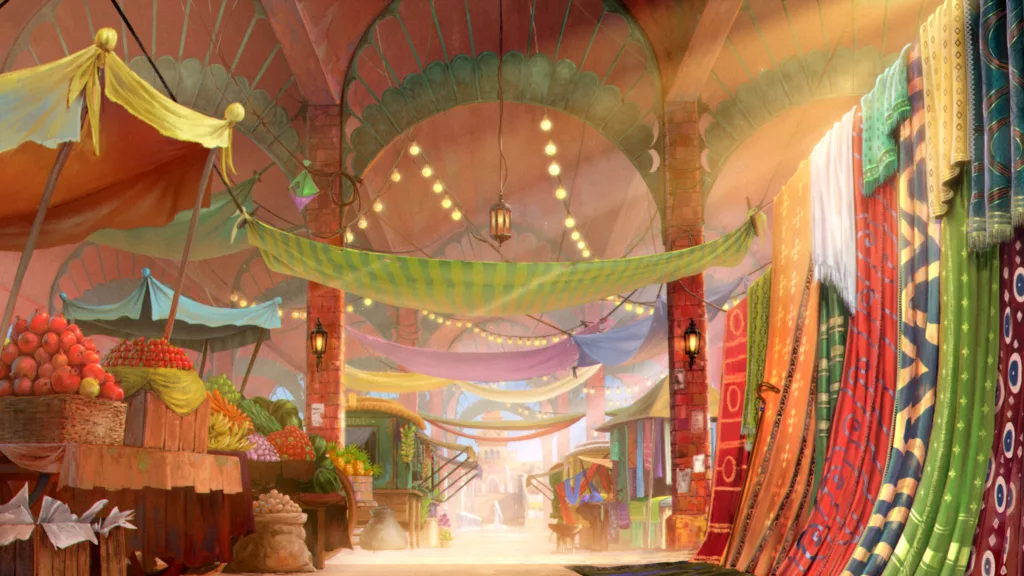
Despite the Ghibli glimmers, The Glassworker stands on its own merit as a splendidly immersive work of Pakistani animation, which so far has been dominated by a handful of 3D features. Released in both English and Urdu, the film’s multiculturalism is best exemplified by its protagonist. Vincent might bear an Anglicised name, but his upbringing and surroundings use a Western framework to zoom into more localised avenues. Despite the action unfurling in what seems like a post-World War European town, the cobbled streets are lined with open bazaars selling local sweets like sizzling gulab jamuns straight out of a syrupy kadhai (pan).
And even if Riaz insists that the militaristic subplots weren’t directly influenced by “real-world events”, the Colonel character drew inspiration from his maternal grandfather, who served in the Pakistani army. “Parts of the film were also inspired by the way I grew up in Karachi, hearing about the Pakistan-India conflicts, the War on Terror, and what was happening in Afghanistan. It was always the people who suffered at the end of the day.” Riaz adds. “So, how would it be like to see glassworkers in wartime, and how would they deal with all of the things that I was experiencing in Pakistan?”
The Glassworker, settling more for the personal than the political, might also have helped the film’s universal reception once it finally saw the light of day. Relating to every indie director’s bumpy ride from film festivals to mainstream theatrical distribution, Riaz summed up his experience as “walking in a desert, walking towards something you’ve seen on the horizon. It could be a mirage or an oasis.”
Following the Oscar submission and raves at the 2024 Annecy Film Festival (think of it as Cannes for animators), Riaz has managed to live up to the anticipation of delivering Pakistan’s first hand-drawn animated film.
Relocating to New York, Riaz tinkers with new ideas, while Mano has downsized for now to online hybrid work. The plan is to find a more sustainable model for his next film, one that perhaps doesn’t cost him a decade.
While he keeps his upcoming projects under wraps, Riaz evokes Miyazaki’s name once again to end the conversation. “I understood fully why Miyazaki says ‘I hate making movies and I’m not going to direct another movie.’ After I finished this one, I was like I made one and I feel this way. He has made several and he still returns. So I get it now.”
As Riaz maps out his second outing in the world of Pakistani animation, his late cat Mano might be meowing in pride somewhere in the heavens above…
The Glassworker is available to buy and rent in select territories.