
 Posted in
Film & TV, Egyptian Cinema
Posted in
Film & TV, Egyptian Cinema
“Life After Siham” quietly steals hearts at Gouna Film Festival
Text Chaima Gharsallaoui
“For the first time in the history of the arts, in the history of culture, man found the means to take an impression of time…We could define it as sculpting in time,” wrote the great Tarkovsky in his book Sculpting in Time: Reflections on the Cinema. In his latest film, Life after Siham, one could argue that Franco-Egyptian director Namir Abdel-Messeeh is also a sculptor of some kind. He holds time hostage to capture his mother, his father, himself and beyond.
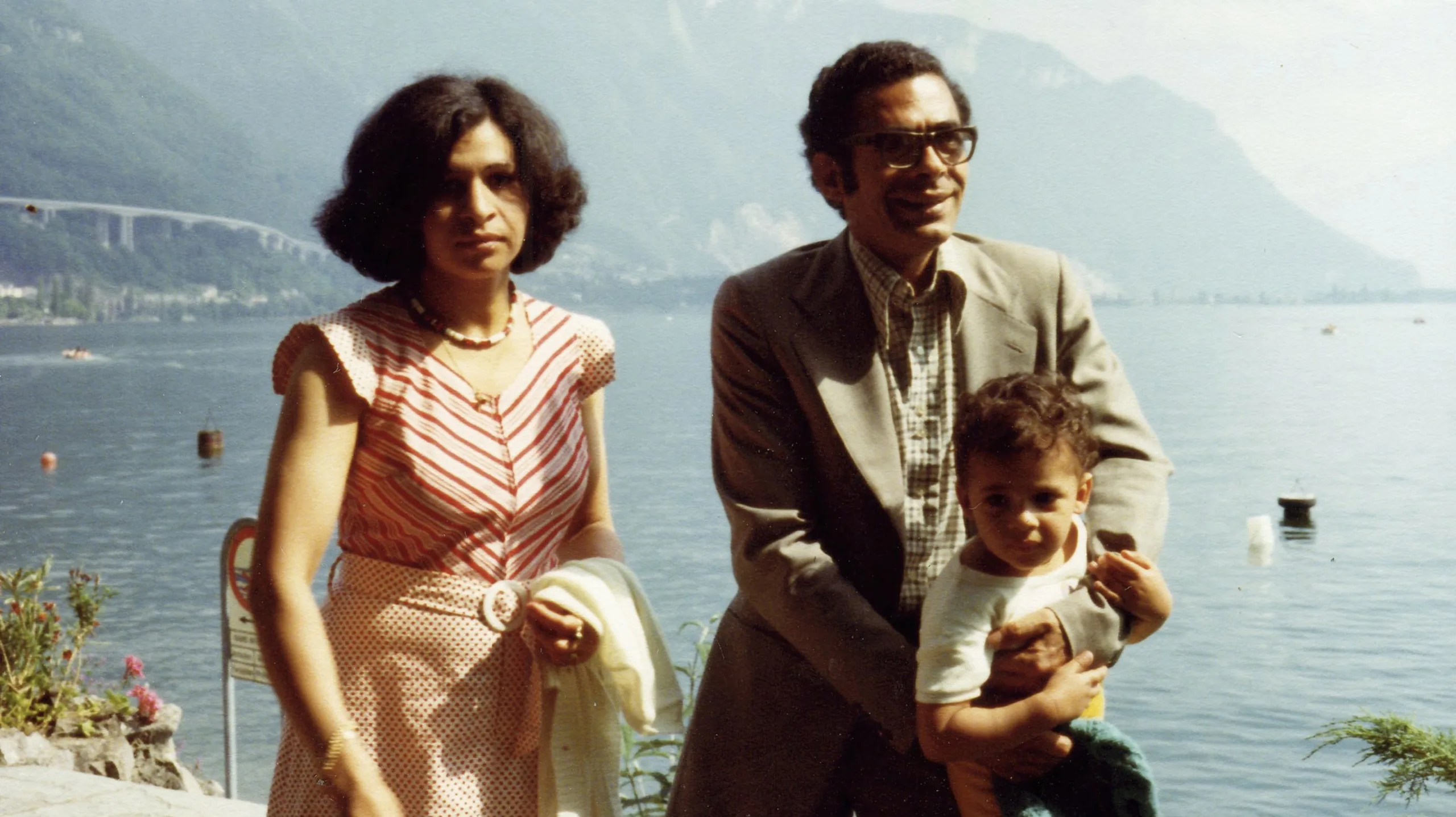
The film premiered in the ACID section of the 2025 Cannes Film Festival, and made its MENA debut in El Gouna Film Festival in Egypt on the 21st of October to an overwhelmingly positive reaction. Over several years, the director Namir Abdel-Messeeh collected family archives, revisited places tied to his mother’s memory, and reflected on his relationship with his parents. At first glance, the film revolves around his mother’s death. But beneath it simmers a more terrifying question: what is the remedy for memory?
To find answers, Abdel-Messeeh embarks us on a journey in time. The movie plays like a memory, in flashes from the past and present. We are sometimes thrown back to the 70s, in a Nasserian Cairo, where his parents met for the first time, with scenes emulating the old romantic movies with multiple nods to Youssef Chahine; and sometimes are propelled into a doctor’s office in present-day Paris. We are ushered back and forth, and sometimes even stuck in between moments, like somebody trying to recall something.
When his parents moved to France in the 1970s, they had to send him back to Egypt to live with his aunt because of dire financial resources. His aunt Enayat used to show him pictures of his parents so that he would remember. Her words were almost a premonition that he would become a director: somebody whose filmography almost in its entirety revolves around not forgetting (Toi, Waguih 2005; La Vierge, les Coptes et moi…2012 )
Abdel-Messeeh was faced throughout the film with the need to fictionalise his parents, to immortalise them, and to transmit their story, and his own; to his children and to the world, as fully as possible, without deforming or omitting anything.
However, memories can never be transmitted whole. Once we absorb them, they fuse with our imagination and our feelings. They do not follow a linear temporality; they are bent and pressured by emotion, moved by something other than the parameter t.
The director ends up creating a matryoshka of memories: memories nested within memories. He mirrors it with a brilliant mise en abyme of scenes reflecting scenes. Abdel-Messeeh’s directorial style is very transgressive: the camera, the clap, the audience, the editing screen; none of them are hidden, nothing is taboo. The film is almost a reflection of itself.
The camera in Life After Siham is very intimate, handheld, and sometimes intrusive. Namir used it to create a bold mix of fiction and documentary in the old dichromic sense. Within the documentary sections, he fictionalises by blurring the line between filmed reality and the reality of the hors-champs filmique.
He even went so far as to film the funeral of his own mother. His DOP and friend Nicolas Duchêne told him there was nothing left to film, but he insisted. Here lies the secret of the whole film: if the camera stops rolling, his mother, “his filmed mother,” disappears just like his real mother. It is a double death. He can choose to deny her actual death by keeping her ghost alive while the camera is rolling. A cut is a shot in the heart because grief settles; Siham is no longer.
In one scene, when asked about a script, Abdel-Messeeh replied simply: “What script?”. The film unfolds unscripted, like life itself: birth, love, death, words spoken too late, and time running out.
By talking about his mother, another character emerges: his father, Waguih. He also, like his late wife did for her own mother, films a video for his wife in which he says to her, “À bientôt”. There is a shattering of the fourth wall in this moment that I haven’t experienced before. He is talking to his late wife, but it also feels like he is talking to the audience, not only about the inevitability of death but also the inevitability of grief.
This grief was an incredible creative vector for Abdel-Messeeh, because through it, he liquified the time in the film and succeeded in ‘immortalising’ Wageeh, Siham and consequently Namir.