
 Posted in
Dazed MENA 100 2025, Dazed 100 2025
Posted in
Dazed MENA 100 2025, Dazed 100 2025
Dina Nur Satti: Meditating on History by Hand
Text Raïs Saleh
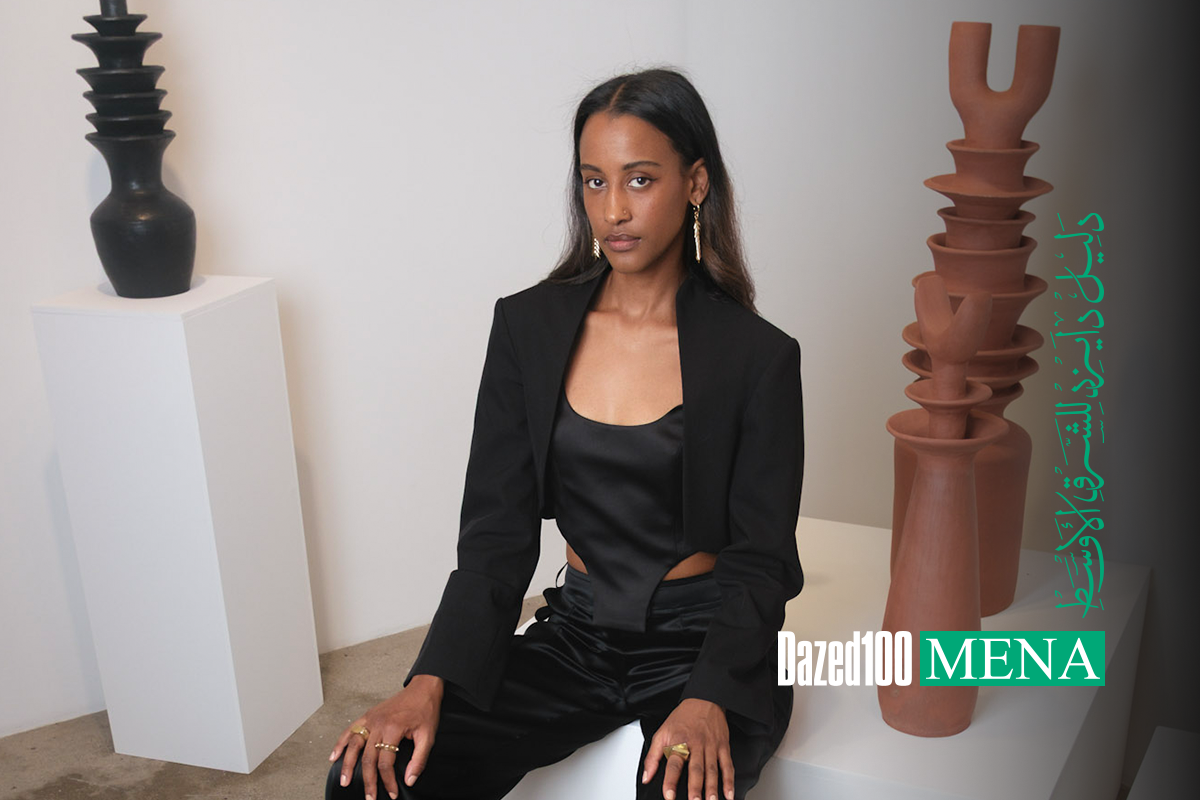
In Dina Nur Satti’s Brooklyn studio, the earth speaks aloud. Clay – soft, malleable, grounding – carries within it the weight of millennia. “My creative process with clay is very intimate,” says the ceramic artist. “I think of clay as a teacher and initiator. I often find that I have to do a lot of personal unearthing and cleansing of my own vessel before I can make work.”
Satti’s path to ceramics was anything but conventional—she never attended art school, for starters. Instead, her background is rooted in anthropology and African art history, disciplines that first attuned her to the stories objects can tell. “In university, I took a course on African art and was transformed by how much we can learn about cultures through the objects they left behind,” she recalls. “So when I started my ceramics journey, all of that research started to be infused into the work I was making.”
Born to Sudanese and Somali parents, Satti spent her youth moving across East and North Africa, her worldview shaped by the migrations and encounters that would later define her work. Today, her sculptural vessels explore ritual, transformation, and cultural memory through the most ancient of clay-building techniques: the coil. But in her hands, these coils aren’t merely structural. They are symbolic, each layer a meditation on continuity, on what is passed down and what is reimagined.
“Through my work, I hope to spark curiosity in people to start their own self-discovery journey and question the narratives they’ve been taught,” she explains. This ethos forms the core of her practice—one that is research-driven yet profoundly emotional, steeped in ancestral memory but unafraid of the contemporary.
Satti’s work often returns to Nubia, the region straddling present-day Sudan and Egypt. “The Kerma civilisation of Nubia had some of the earliest and most refined pottery in Africa,” she notes. “ I reference its shapes and tones in my work.” That connection took on new meaning this year through her collaboration on Sudan Living Cultures with the Petrie Museum of Egyptian and Sudanese Archaeology in London. The exchange programme invited Satti and fellow Sudanese artists Yasmine Elnour and Ahmed Akasha to respond to the museum’s Nubian collections.
The project, she asserts, unfolded against a backdrop of loss. “We are at a pivotal time in Sudanese history. There is mass human devastation, and we are now facing the acceleration of cultural loss as well.” Satti’s vessels, tactile and deliberate, have become both memorials and acts of preservation, and recognition has inevitably followed.
Earlier this year, several major American museums acquired her work, a milestone she describes with characteristic composure: “To know that these stories – our stories – are being held and cared for in spaces that reach beyond borders has been a major career moment for me.” Looking ahead, she is now preparing an installation for the upcoming Design Doha biennale in collaboration with Egyptian-Nubian filmmaker, Wael Gzoly.
The piece will explore Nubian home décor traditions from the mid-1900s, before the Aswan Dam submerged villages in their entirety. Through clay, Satti reminds us that to shape the earth is to enter into conversation with those who came before, and leave traces for those still to come.