
 Posted in
Dazed MENA 100 2025, Dazed 100 2025
Posted in
Dazed MENA 100 2025, Dazed 100 2025
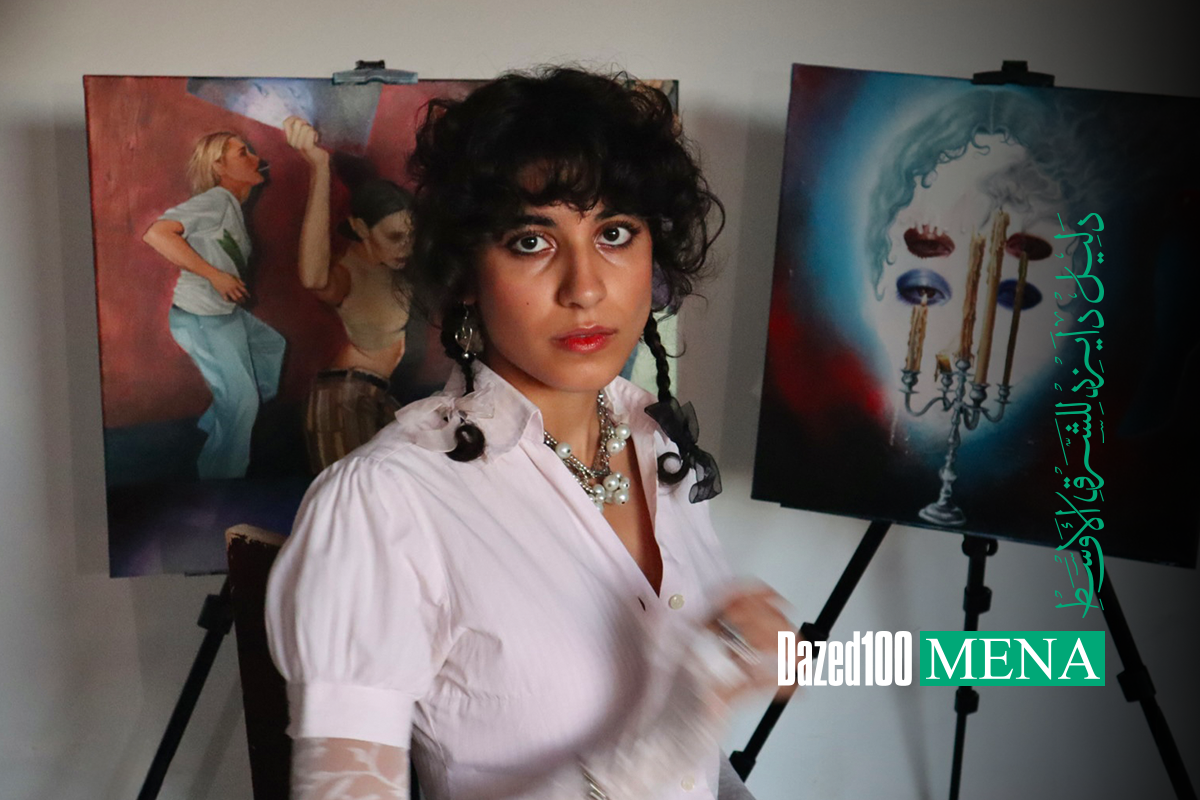
Mariem Akmal: Painting What Can’t Be Said
Text Raïs Saleh
Amid the orchestral chaos of Cairo – incessant car horns layered with the lilting call to prayer – Mariem Akmal is creating in a sacred quiet. “I’ve always felt an intuitive pull to paint,” shares the artist, more popularly known online through her Instagram handle @groovyw0rm. “It’s been an outlet for navigating my emotions and interacting with the world around me.”
Her canvases are full of those emotions but only through suggestion. Figures hover between human and animal, gestures remain unfinished, gazes dissolve into pattern. The paintings are vibrant yet heavy with silence, charged with the energy of something unsaid. For Akmal, painting isn’t just about what meets the eye. “I aim to create work that triggers before it explains,” she says. Indeed, her work resists tidy interpretation.
Born and raised in Cairo, Akmal graduated from the Faculty of Fine Arts at Helwan University, where she developed a fascination with the way colour and sound could interact. Today, that curiosity has matured into a practice that feels both deeply personal and outward looking. She describes her process as listening as much as painting—each piece beginning with a song, not an image. “Music is inseparable from my work,” she explains. “I title most of my pieces after the songs that inspired them.”
This synesthetic relationship between sound and colour gives her paintings a musical structure—rhythm, tempo, dissonance. Her brush seems to follow a score of her own making, translating melody into gesture. Artists like Rae Klein and Jenny Morgan might influence Akmal in a technical sense, but her vision is unmistakably hers, luminous and layered.
Held in Cairo last year, her first solo exhibition Parallels was pivotal. “I remember spending countless hours on the paintings,” she recalls. “And when I finally saw people’s reactions on opening night, it was incredible. Hearing each person’s interpretation made me realise how alive the work could become once it left me.” That evening cemented her belief that painting can be a language more truthful than words.
As part of a new generation of Arab artists, Akmal speaks with both clarity and conviction about the scene around her. “There’s a tendency to romanticise the past without fully engaging with the complexities of the present,” she observes. “I want to see more diversity in the region’s art scene.” Here, she references peers such as Ehab Ehab, Dina Jereidini, and Talal Al Najjar, artists redefining what contemporary Arab expression can look like—unafraid to inhabit the messy realities of today.
But Akmal’s work resists the weight of cultural symbolism. It’s neither didactic nor overtly political. It isn’t overtly Egyptian or Arab, either. Instead, her practice is a study in empathy, finding form for feeling and beauty in vulnerability. “Art is a natural extension of the human spirit,” she reflects. “It expands our ability to love, feel, and empathise with ourselves and others.”
Currently preparing for a duo exhibition in 2026, Akmal reveals that she is experimenting with larger canvases and immersive installations: “I’m leaning into incorporating more mediums and creating works that people can step into, not just look at.” Her work is, in many ways, a conversation—between silence and sound, solitude and connection, interiority and the world. And in that balance lies the quiet force of her practice. For Akmal, painting is more about listening to life than illustrating it.