
 Posted in
Dazed MENA 100 2025, Dazed 100 2025
Posted in
Dazed MENA 100 2025, Dazed 100 2025
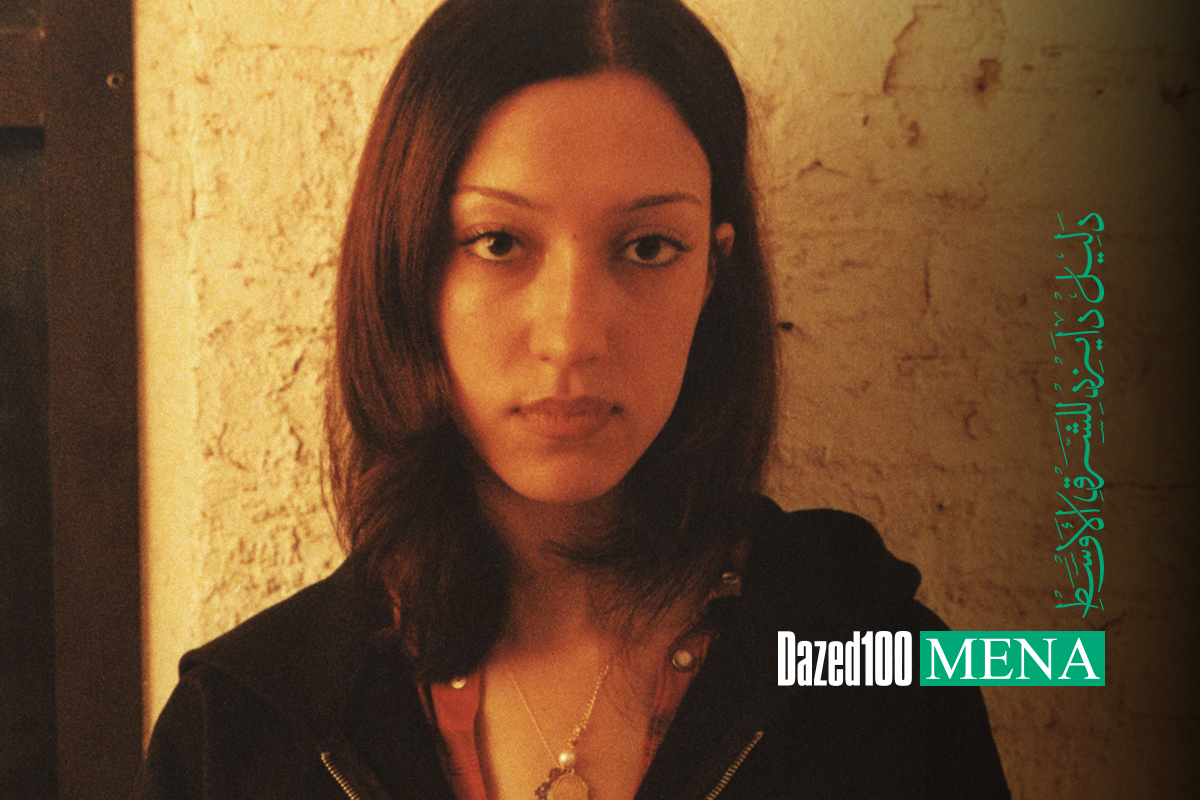
Tasneem Sarkez: Mapping Memory Across Worlds
Text Raïs Saleh
Poised between pop-inflected visuals and layered sociopolitical symbolism, Tasneem Sarkez’s paintings and sculptures trace the contours of belonging and displacement. “I became inspired by the feeling of engaging with the archive in a way that felt contemporary and accurate to my experience,” says the artist. “I’m eager to share those discoveries through art in order to make space for us in the conversation that is art history.”
Born to Libyan parents and raised between worlds, Sarkez, aged 23, channels the multiplicity of diaspora into a practice that is as rigorous as it is intimate. Her work, represented by Rose Easton gallery in London, has been shown internationally—Romance in Pittsburgh, Pennsylvania and to Miart in Milan, Italy included. It also sits in collections within the Metropolitan Museum of Art’s Thomas J. Watson Library and Forma in London.
But for Sarkez, recognition is less a destination, and more a moment of reflection. She recalls the night she learned that her artist book Ayonha had been acquired by the Met’s special collections. “I didn’t go to sleep that night out of the adrenaline that came with realising this object will outlive me,” she admits. “At the very least, I will leave the world with that.” That realisation, she notes, shaped her dedication towards pursuing the ideas of what the book represents within her praxis more intensely.
Sarkez’s art draws from a matrix of influences—Luc Tuymans, Ghada Amer, and the writings of Etel Adnan, Tayeb Salih, and Khalil Gibran. Yet her greatest source of inspiration may be the dispersed Arab communities that she observes and inhabits: “From Libyans in Portland to Little Egypt in New York, I’m especially inspired by pockets of Arab communities around the world. It’s interesting to see how expressions of Arab culture are spatialised globally.”
This global-local sensibility runs through her work. In one exhibition, she recalls watching a young Libyan girl trace Arabic letters on her painting, Good Morning. “I had a lot of family members come see the show and tell me they’d never been to a gallery before,” Sarkez reflects. “It engaged audiences in ways that felt both private and public, intimate yet collective.” These encounters, she suggests, reveal the potential of art to bridge unfamiliar worlds, to make visible what has long been overlooked.
“The translational abstraction of marginalisation becomes processed through art,” she explains. “It’s about challenging notions of representation and visibility as an Arab woman, to absolve our representation.” This balancing of aesthetics and ideology gives her practice its quiet intensity, with the beautiful and the grotesque coexisting in dialogue. “I hope my work can sustain in the cyclical engagement with memory as it pertains to the self but also at a cultural and political level,” she adds.
Next year, Sarkez will spend time in Tunisia as part of an artist residency with Selma Feriani Gallery, an opportunity to deepen her research into North Africa’s artistic lineage. “Tunisia has a very strong artistic culture. I’m excited to pursue research that comes out of my time there.”
Curiosity, fear, and hope—that’s what fuels her process, she says. And perhaps it’s this triad that defines Sarkez’s sensibility most profoundly as an artist who is unafraid to dwell in complexity, to question visibility and quietly expand the space for Arab narratives within contemporary art.