
 Posted in
Life & Culture, incels
Posted in
Life & Culture, incels
Psychosubcultures Vol 1: Looksmaxxing and the ghost of physical anthropology
Text Jeremy Tavitian
I must have been nine or ten years old when I posted my first selfie. It was probably taken in my bedroom on a Nokia 5800. Face-scoring websites like HotOrNot and RateMyFace were popular at the time. I was taught that looks mattered, and my pre-pubescent self felt the need for strangers to tell him if he was attractive or not. I scored low.
This started a spiral of digital self-harm. I kept posting more of myself. I was cute, disgusting, fat, skeletal, awkward, adorable, repulsive. This was 2008. Fast forward over a decade and a half, and the digital tradition of face rating is, unsurprisingly, far from dead. There are dozens of AI ‘tools’ that will gladly scrutinise every detail of your face, and Rate Me threads on Reddit are just as popular as they used to be.
The algorithm pushes for ritualised self-objectification. Overexposure to our faces, and the social value it holds, intensifies the sense that identity must be constantly verified through visibility and comparison, accelerating appearance even further into a continuous site of evaluation. In step, technocapitalism creates and absorbs our anxieties for profit, generating a demand for self-improvement as a palliative to individual and even collective ills. Not only does our digital culture see the body as a product to be optimised and controlled, but we’re also told to be the best version of ourselves.
It is in this context that looksmaxxing, the internet subculture dedicated to maximising physical attractiveness, was born. The community aims to be aspirational. It teaches men to “ascend”, to level up in terms of attractiveness. Looksmaxxers give particular importance to facial attractiveness, with face ranking and analysis being central topics on the forum. Users present transformation edits by ‘morphing’ their face or those of others to create attractiveness benchmarks.
I first stumbled upon the community through Syrian-American influencer Kareem Shami (also known as SyrianPsycho). With more than two million followers on TikTok, he is the self-proclaimed “godfather of looksmaxxing”. With pale skin, green eyes, an angular jawline, and a chiselled physique, Shami embodies a version of male beauty that we are taught by our algorithms to pursue. The influencer provides tips to maximise attractiveness: how to debloat your face, how to fix your nose, which peptides to use. He even provides one-on-one sessions and facial-analysis services. Another popular figure in the community is Moroccan-American looksmaxxing coach Jawad, who sells guides and mentorship services to change your hair texture, lighten your skin, or achieve a sharper jaw.
Jawad and Shami are part of a mutation in Arab masculinity and the emerging centrality of aesthetics considering idealised masculinity is typically associated with physical strength, economic power, and assertiveness. Beauty optimisation was perceived as a feminine exercise and therefore incompatible with manhood. Things, however, are changing. For example, the number of surgical procedures performed on men worldwide increased by 95% between 2018 and 2024, with the largest market drivers being customers from Latin America and the SWANA region. Male heightened beauty is becoming normalised to some extent, as also attested by the viral Iraqi beauty transformation videos.
In their introduction to Arab Masculinities, Konstantina Isidoros and Marcia Inhorn argue that, post-2011, heightened instability, decreasing purchasing power, and increasing female participation in the workforce have challenged the provider role historically associated with the man of the house. This is coupled with increasing exposure to western media and beauty standards through social media. Gender panic ensues, and men resort to other ways of communicating their manhood—grooming, bodybuilding, and cosmetic procedures included. It is against this backdrop that the looksmaxxing culture, exported from America, lands on Arab screens.
To understand looksmaxxing as an ‘export’, therefore, is to go beyond its mere circulation. It suggests the movement and embodiment of a hegemonic aesthetic ideology developed in continuity with a colonial legacy. Despite the recent media frenzy over looksmaxxing influencers like Clavicular, the community has been around for at least a couple of years, growing on Reddit and anonymous forums such as looksmax.org. It’s not just a couple of influencers making shock statements on TikTok; it is a fully fledged network that has developed its own lexicon and framework of thought. And the looksmaxers’ methods are not new, either. In fact, they just might be a couple of centuries old.
Caucasoid, Negroid, Mongoloid, Nordid, Mediterranid, Indid, Veddid, Sinid—the list goes on. The faces of looksmaxxing forums are compartmentalised into phenotypes based on typologies developed by racial scientists and physical anthropologists in the late 19th century. They are presented as objective categories based on “ancestry” and “regional traits”. In the forums, one can have access to several tools to situate themselves within a phenotype such as ancestry maps, AI phenotype guessers, and even personal looksmaxxing coaches. Its importance, according to some lookmaxxers, is based on its genetic determinism, with one user on looksmax.org claiming: “While plastic surgery can modify superficial features, it cannot change the fundamental genetic blueprint that defines more profound and permanent aspects of appearance.”
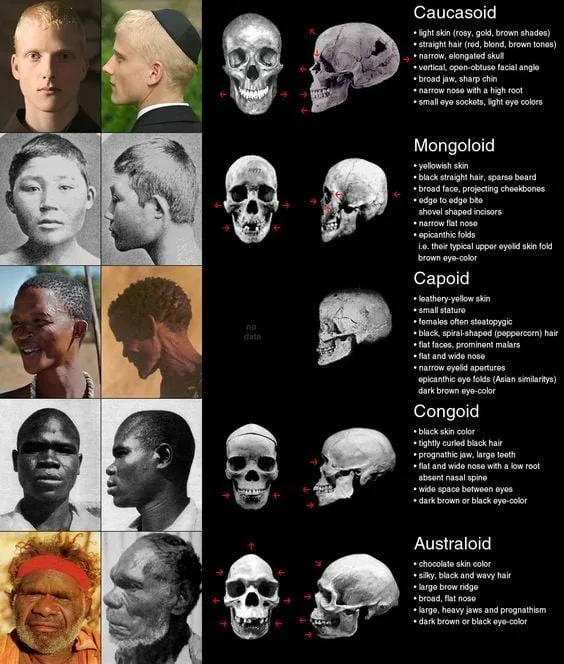
Elsewhere, another user mused, “A great example is people that have a Fresh off The Boat Sudanid. If you try to achieve the light-skin phenotype, you’re prone to looking uncanny, weird, and could end up looking like Michael Jackson.” Users are therefore encouraged to looksmaxx based on the restrictions of their phenotypes (“phenomaxxing”). This causes great anguish amongst some users, who are either confused about which supposed phenotype they are or doomed to face the reality of their assigned category. Some posts on looksmax.org are dedicated to criticising the features of a certain phenotype or race: “Nothing speaks more of an Arab trait than an overprojected radix. It is some of the most disgusting fallos to have.”
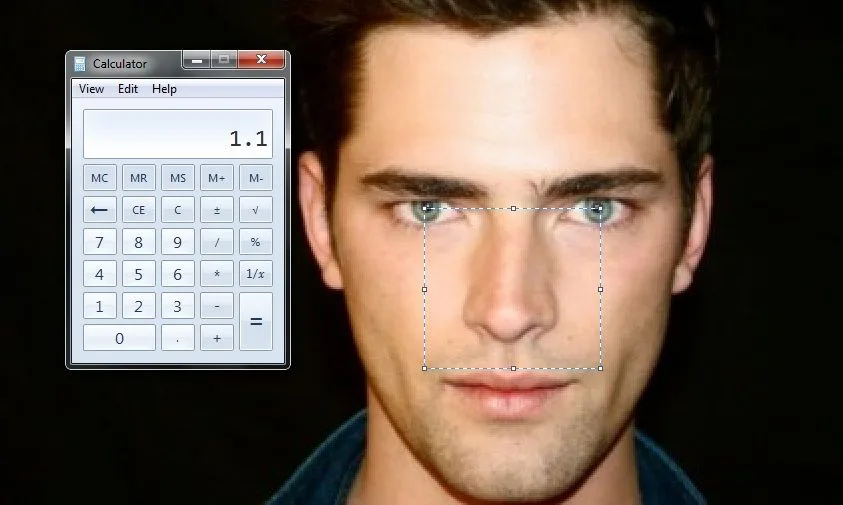
Such taximonies, directly pulled from the colonial archives, are presented on these boards as objective, with looksmaxxers breaking it down to a science. Indeed, there is a marked obsession with quantification for the community. The forums are filled with formulas, metrics, ratios, and benchmarks to calculate facial attractiveness: Balance Point Index, Harmony score, Dimorphism metrics, and more. Thoroughly detailed, these tools allow users to situate themselves within a “tier”, using weighted aesthetic scores assigned to each facial feature based on its perceived importance. And not a single bone or muscle is left out.
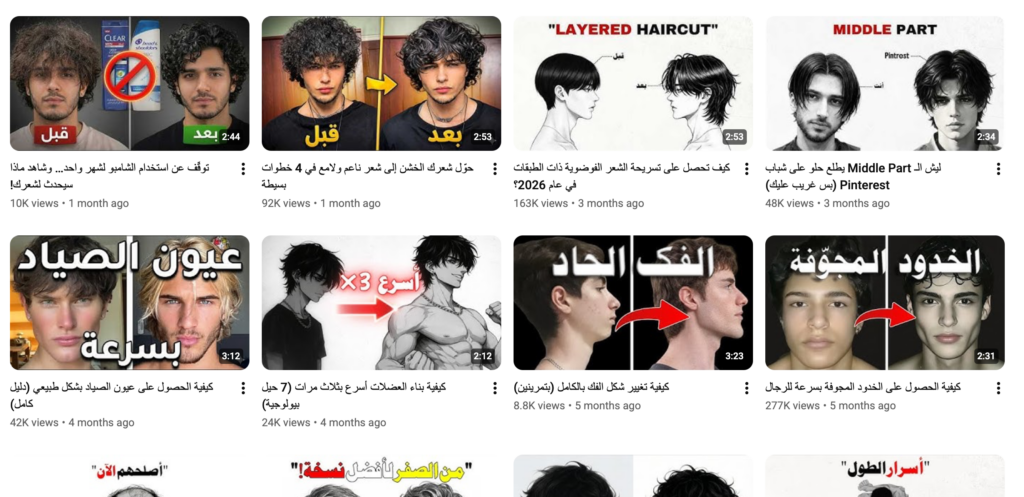
According to the formulas I found on looksmax.org, it appeared obvious that you must have an angular face. Broad mandible flare, clear contour, no lower-face fat masking, strong midface projection, sharp anterior depth, good orbital support, visible jaw edge, strong maxilla and mandible forward projection, long and tall ramus, sharp rear-jaw contour visible from the front, defined midface curve, and hollow cheeks, a 120° gonial angle, long ramus, and a non-tapering jawline paired with a proportional chin. You must strive for a masculine face. Your eye depth must be masculine. Your ramus length must be masculine. Your gonion outward growth must be masculine.
Taking it further, these evaluations take direct cues from craniometry, the study of skull measurements. In her article How the racist study of skulls gripped Victorian Britain’s scientists, Elise Smith explores the manifold ways in which science rationalised the preoccupation with the classification of beings in terms of “geographical origin” or sex. In other words, weaponising science as fact to justify the conquest of lands, peoples, and genders—a story now known well. Looksmaxxers have resurrected notions and metrics developed during that time, such as William Ripley’s Cephalix Index, the ratio of head width to length. As one looksmax.org user states: “If you have a brachycephalic skull, consider your life is over.”
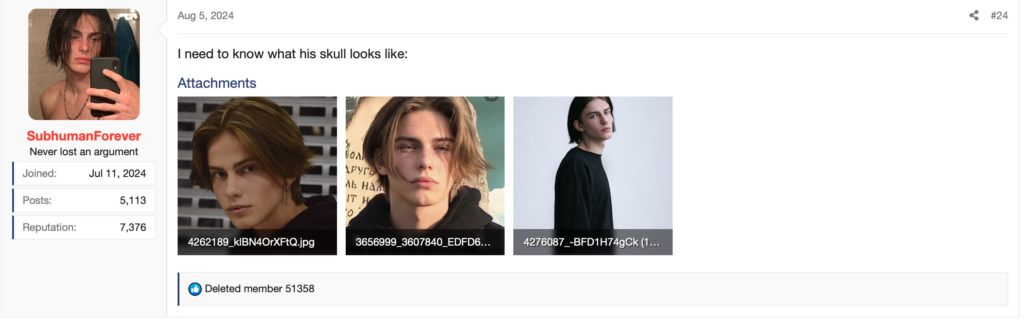
Much like a 19th century anthropologist correlates a certain skull shape with a lack of intelligence or higher likelihood to commit crime, looksmaxxers associate certain proportions and features with higher symbolic capital. In essence, looksmaxxing forums are male-only digital agoras in which users police each other’s masculinity. To be “ugly” is to be unmasculine, and to be a “Chad” is to achieve the ideal male form. Quantification reinforces a deterministic view of gender and race, where masculinity is reduced to static aesthetic traits rather than dynamic sociocultural constructs. By assigning numerical or pseudo-scientific significance to features like jaw shape or facial projection, users implicitly claim a natural dominance of “masculine” traits over “feminine” traits, and of whiteness.
Looksmaxxing is, in this context, a form of gendered biohacking. To “ascend” is to be able to optimise and maximise masculine capital through facial enhancements and therefore reaffirm one’s dominant position in social hierarchies. Yet, here lies the paradox of the skull. On one hand, users of looksmaxxing forums make harsh and deterministic claims regarding the attractiveness of facial features, using spurious reasoning to legitimise their claims. On the other hand, the face is also presented as a sculptable biological project; the community aims to be aspirational, providing tips and guidelines to maximise one’s attractiveness. For instance, have you ever thought of smashing your face with a hammer to enhance its shape and fortify your bone strength?
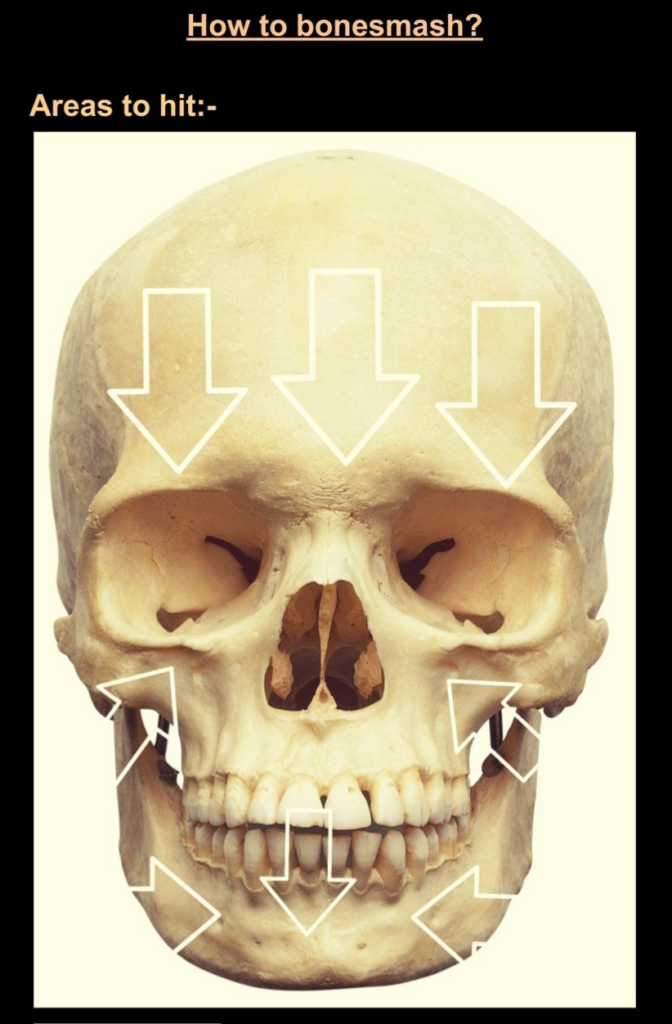
Most of the media attention around the looksmaxxing community and its influencers revolved around its methods of DIY facial enhancement. Take the example of bonesmashing, which invites looksmaxxers to repeatedly hit their facial bones to remodel their face. Another common practice is mewing, an oral technique that involves flattening your tongue against the roof of your mouth to train your jaw for definition. Much has already been said about these techniques’ inefficiency and, in some cases, danger. Less has been said about the symbolic value of these practices.
Take, for instance, one looksmax.org post about facial gym exercises in which a user expands on the importance of the jaw: “A sharper, more defined face appeals to human aesthetics because it signals strength, character, and vitality. We perceive these traits as more ‘primal’, more intrinsically human, forging a deeper connection to our evolutionary roots. Lions, foxes, and all feline predators show elongated, powerful skull structures shaped by constant pulling, tearing, and clenching. The mechanical forces of survival sculpt their faces into functional and striking forms.”
In 19th century western anthropology, degeneration theory suggested that the body had become historical evidence of civilisational decline. Influenced by a broader malaise about industrialisation and urban poverty around the end of the century, physical traits such as skull shape, stature, or perceived bodily ‘robustness’ were interpreted as signs of moral and cultural regression and determinants of deviance. This laid the grounds for palaeolithic idealisation and a romanticisation of primitive cultures, which were seen as pure and uncorrupted by modernity.
In the digital age of identity fragmentation and hypercapitalism, themes of degeneracy reappear in online discourse. Much can be said on our own state of malaise: instability, genocide, war, and the general disapproval of contemporary power structures have generated collective fatigue. We therefore long for a distant past. Think of the paleo diet, popularised out of the anxiety over processed food culture and industrial farming. It aims to mimic a diet similar to that of hunter-gatherer societies and therefore avoids any farmed or processed foods. The paleo diet is to food what looksmaxxing is to the face, a promise to be closer to what is the optimal human being, to be truly pure. Ascension is reached by embracing a primal aesthetic.
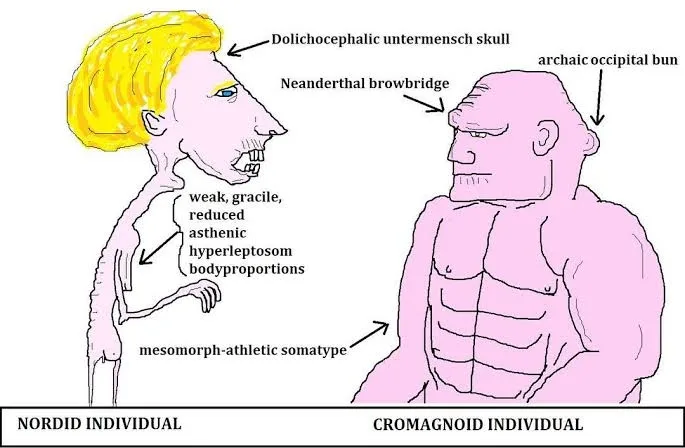
The promise of becoming more primal, more authentic, and more human recalls the regenerative myths that animated fascist aesthetics. Faced with perceived cultural decay, fascism imagined salvation through a return to origins, embodied in figures of physical perfection and vitality. Looksmaxxing similarly frames the body as a corrective to modernity, treating optimisation as a path back to an idealised human essence.
Rather than confronting the structural causes of alienation, inequality, or instability, both fascist ideology and contemporary self-optimisation cultures locate decline in the individual body and propose physical transformation as its remedy. What once operated through institutionalised regimes of power now circulates through decentralised communities. It resurfaces in fragmented form through metrics of appearance and desirability, romantic poetries of a time that has never existed, and taxonomies of human worth.
From our Arab perspective, it invites itself into our screens by exploiting our vulnerabilities in times of havoc. The development of the manosphere in our context – be it via the export of looksmaxxing, anti-feminist rhetoric, or far-right western influencers – gives our men a false sense of enlightenment and power. Despite its promises, embracing such models and lexicon (whether consciously or not) empowers discourses designed to subordinate us. The human remains a subject to be studied, quantified, analysed, mutilated, categorised, and therefore controlled.
True ascension can only be reached by breaking free from the shackles of our algorithms and deconstructing its agenda. If we fail to do so, the ghost of physical anthropology will continue to haunt our screens and remind us, quietly, that nothing has actually changed.