
 Posted in
Life & Culture, Archives
Opinion: In defence of archives for building a future of decolonial sovereignty
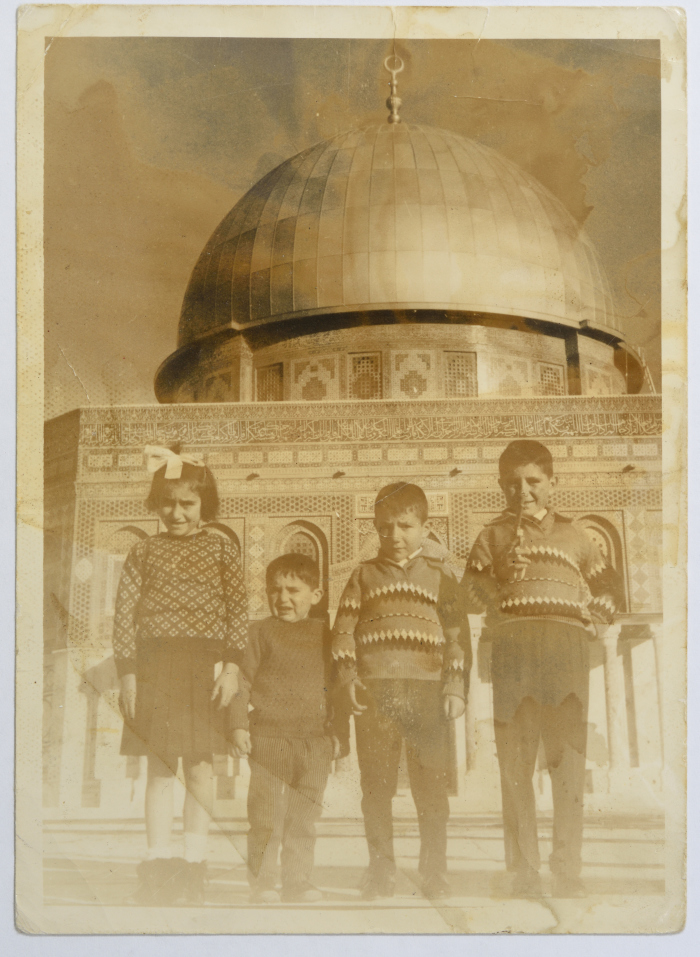
Text Marah Abdel Jaber | Image Palestine Museum Digital Archive
Over the past few decades, archiving has become an increasingly prominent mode of production among the Palestinian people. Although the practice is not new, Palestinian archival resistance has rapidly expanded in response to the zionist project’s expedited process of erasure and annihilation. This rise of a public archive that operates outside of the traditional authority of knowledge has come with extensive inquiry and challenge. For years, scholars and cultural workers invested in the question of Palestine have contemplated the interest in, efficacy of, and possibilities for archiving Palestine.
Facing Israel’s apocalypse in Gaza and unrelenting violence across the region, discourse among Arab communities is beginning to reject the archive’s critical contributions to liberation. Dazed MENA’s recently published article, “Archiving the Alive: Our obsession with the past and the urgent need for futurism,” exemplifies some of these disputes and the dangerously misinformed rhetoric that encourages this line of thinking.
The piece’s contention that archival resistance is “violence disguised as preservation” repeats the very colonial logic that it claims to dismantle and is an irresponsible evocation of futurism. The theory of futurism is inherently a historical recovery project. It relies upon the historical consciousness to succeed in producing a decolonial sovereignty. How can we imagine and create a liberated future separate from the memory of colonial violence? How do we return to Walid Daqqa’s “Palestine of the future” without identifying the faults of our past? Historic amnesia deliberately generates a cycle of brutality that is eventually applied by the oppressed against themselves. That is when the colonial project is completed, upon manufacturing a ‘savage.’
The cracks in this analysis come from a dehistoricisation of our present moment. We must reckon with the truth that we are not living in a spontaneously historical reality. We are experiencing a future that has been promised and predicted by the zionist project and revolutionary intellectuals, respectively. The West no longer maintains control over the narrative of Palestine/Palestinian’s as an apolitical entity. It never has. If we were, in fact, becoming “institutionalised,” as the article suggests, then there would not be a need to destroy cultural sites, suffocate university programs, imprison dissenters, and, quite literally, physically remove Palestinian’s, and their supporters, from countries allied with Israel.
This divorce of the archive and futurism fortifies the zionist Project’s penetration of the Palestinian national consciousness. We are not living in the past, but in disjointed futures. In the Palestinian case, specifically, Israel’s ongoing Nakba perpetually ruptures the national order, intentionally creating distinct demands for liberation among isolated groups. Genocide in Gaza; apartheid in the West Bank; suppression in Historic Palestine; bombing of refugee camps in neighbouring countries; imprisonment and state surveillance in the diaspora, and more, introduce separate visions of the future beyond occupation. This fracturing is the primary challenge to a unified front for liberation. To build a sovereign future, we must reject colonially imposed subjectivity and collectivise by confronting the tensions between each abhorrent condition of occupation.
We certainly cannot overcome fragmentation through a proposed futurism that rejects the past. Present archival practices don’t presuppose the inevitability of our eradication — they demand that we urgently intervene. The future has arrived. Suffocation of Palestinian life and liberation is not a distant nightmare, and it will continue so long as the global Palestinian nation refutes the history that both unites and distinguishes us. The writer’s analysis mischaracterises the root of the problem by assuming that the archive itself has stagnated international resistance. Archivalism is not hindering liberation. It is our failure to mobilise the archive that fosters division within the Palestinian nation.
In 2017, Brown’s Centre for Palestine Studies’ annual New Directions in Palestine Studies meeting contemplated archives and the politics of memory, asking:
“What does it mean for the colonised, the disenfranchised, and the displaced to produce narratives through archival and memorial practices? How are archives and memories produced, assembled, and mobilised in settler colonial contexts? In what ways are archives and memories sites of struggle and appropriation, and looting? How can we theorise archives and memory from perspectives critical of state-centric political configurations and conventional concepts of sovereignty?”
These questions don’t reject the value of archiving, but they raise the challenge that plagues resistance efforts — mobilising the past toward a future of decolonial sovereignty. The various papers and conversations that responded to these questions were aligned on two points: creativity and subversion. The decolonial archive, one which recognises and employs the power of material history, must be founded upon dissensus and evoke imagination. It uniquely operates as an assertion of the colonised’s own space/time, separate from the timeline instilled by the occupier via non-traditional authorities of knowledge. Resistant archives unveil the relationship between past, present, and future as fleeting and non-linear, a core tenet of futurism that directly refutes colonial conceptions of time. Through decolonial archival practices, we can both build and speculate on the future.
Consider Ghassan Kanafani’s famous proclamation that writing novels ignited his political commitment. His work was deeply concerned with the past, writing across tenors as a material historian at times and a creative novelist at others. Kanafani pushed his peers to consider what might become of the Palestinian nation based on how we reconcile our history. With this historical imagination, he prophesied the Oslo Accords and creation of the Palestinian Authority 22 years prior in his 1971 essay, “The Spectre of the Palestinian State.” In this same essay, Kanafani suggested an alternate, liberated route, but he identified historical tensions that were likely to persist and hinder resistance. Ultimately, his analysis was correct. Ghassan Kanafani accurately projected a future that arrived two decades after his assassination by identifying the fissures in both the Palestinian and Arab nationalist movements through his creative retelling of the past. His work exemplifies that we cannot arrive at a liberated future without deep consideration of the past.
The revolutionary intellectual Basil Al-Araj reinforced the necessity for a creative historical record in his essay, “Why do we go to war?”, asserting that the seemingly unthinkable answer was simply: romance. Al-Araj was critical of dominating academic retellings of the past, demanding that we re-imagine history in the magical, ethereal lens. Only then, he argues, can we arrive at the truth. Al-Araj states, “we need romance to continue our existence.” To survive, to fortify our place in the future, we need to imagine outside of the brutalist vision of colonial states.
We cannot relinquish our historical consciousness under the assumption that it keeps us tethered to suffering. It is through a romantic record of the past that we might arrive at the liberation dreamed of by our martyrs. The active explosion of public archiving across media forms forces us to ask, what might we achieve if we return to our past with a new perspective? Of course, we must remain firm that a decolonial archive does not memorialise history. To be truly subversive, to maintain the capacity to reject coloniality, the archive necessarily goes beyond the act of witnessing and demands action.
If we are archiving the alive, it is an appeal to save the living rather than assume their inevitable death.