
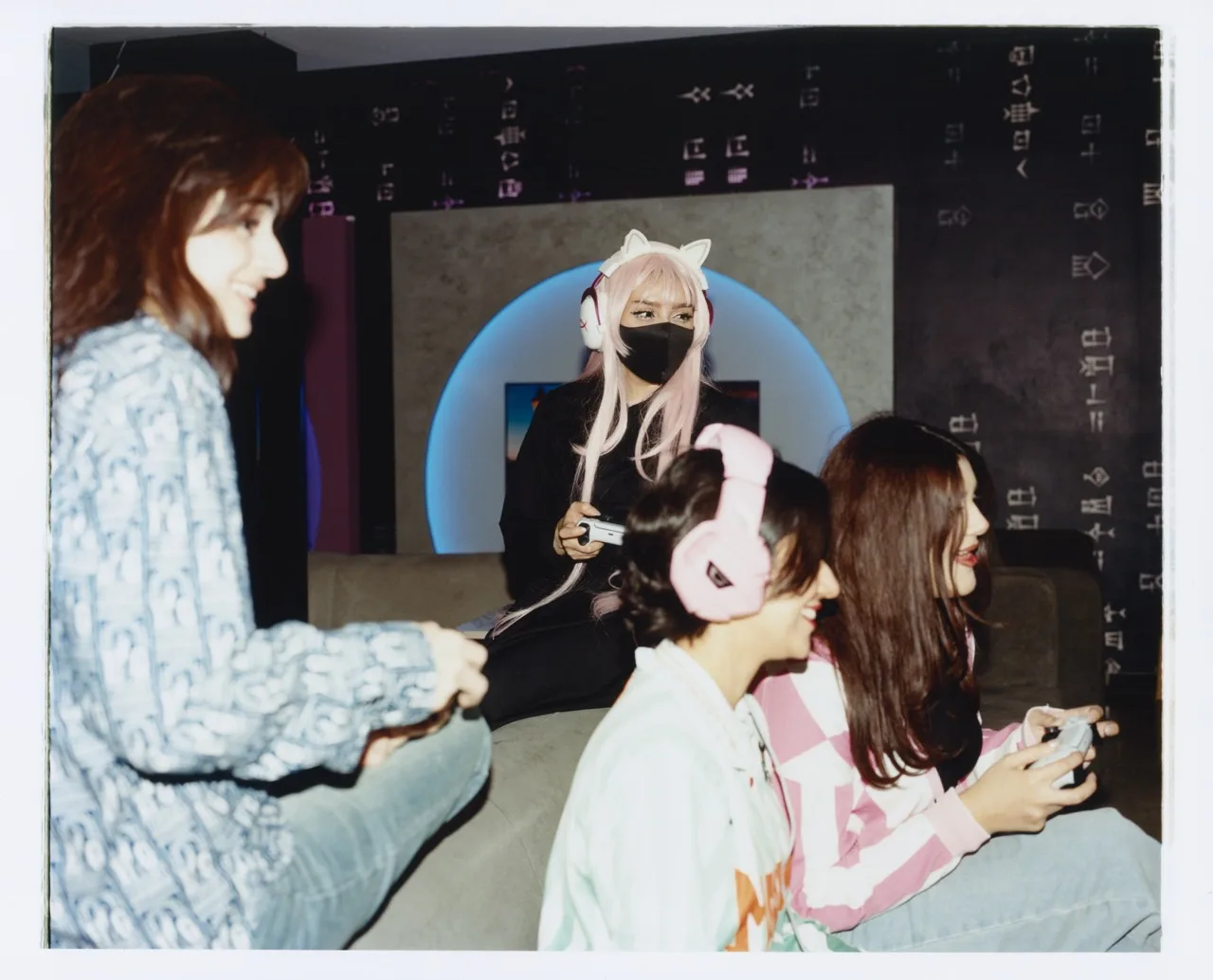
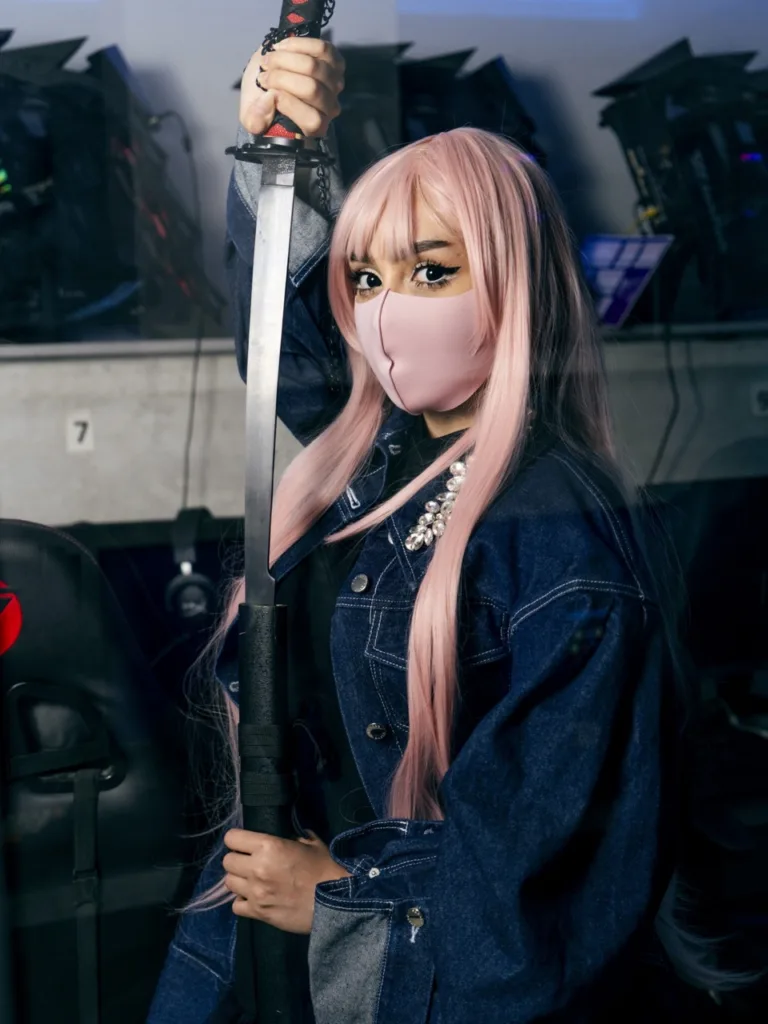
 Mary wears shirt, skirt COMME DES GARÇONS at THAT Concept Store, face mask STYLIST’S OWN
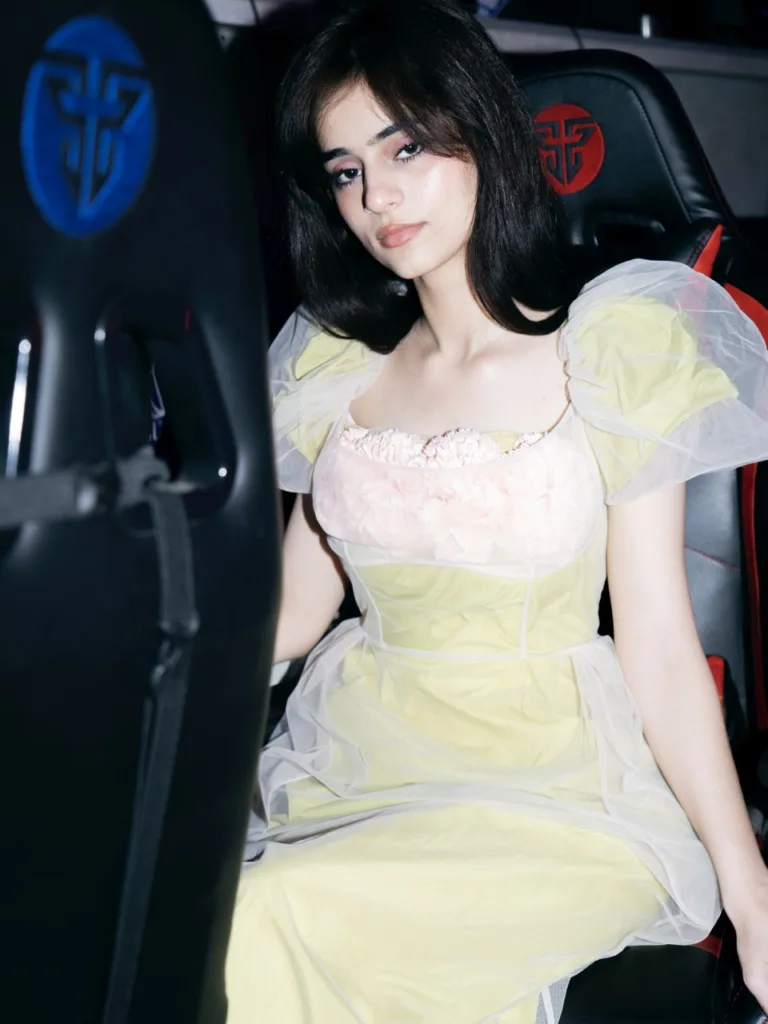
Luma wears shirt MOONLANDING, jeans THE ATTICO at Harvey Nichols - Dubai
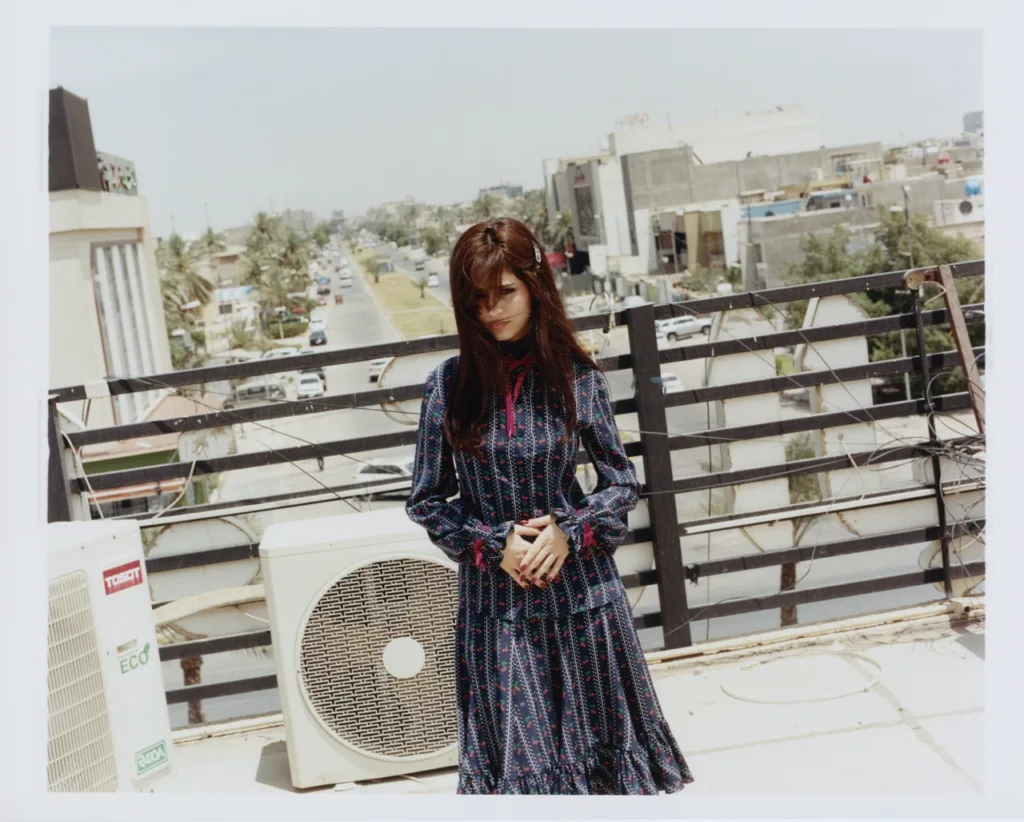
Mariam wears cardigan DIOR, jeans STYLIST’S OWN
Posted in
Feature, Dazed MENA issue 02
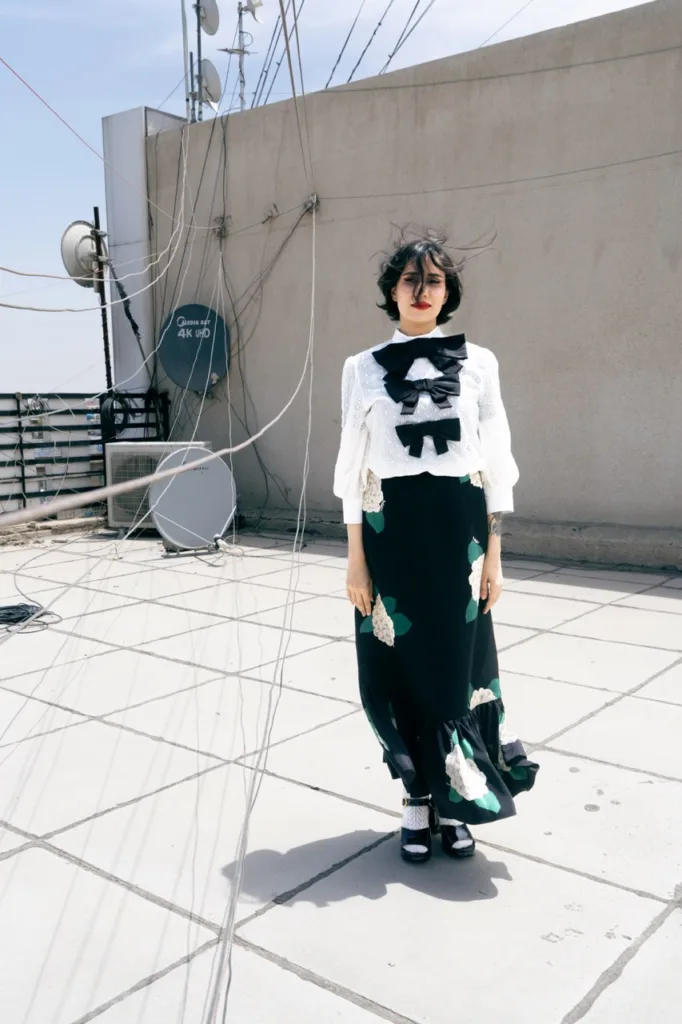
Mary wears shirt, skirt COMME DES GARÇONS at THAT Concept Store, face mask STYLIST’S OWN
Luma wears shirt MOONLANDING, jeans THE ATTICO at Harvey Nichols - Dubai
Mariam wears cardigan DIOR, jeans STYLIST’S OWN
Posted in
Feature, Dazed MENA issue 02
Virtually everywhere: Inside the rise of Iraqi Gamer Girls
Text YASMIN ALRABIEI | PHOTOGRAPHY CHARLES THIEFAINE | STYLING REEM AL AZAWI
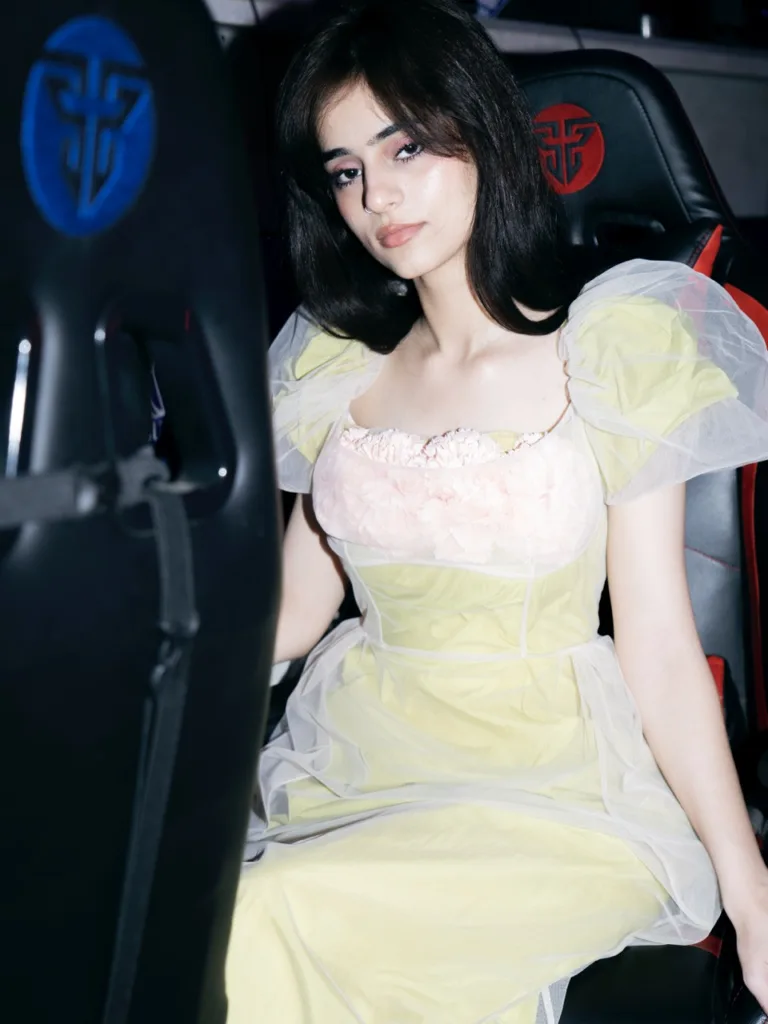

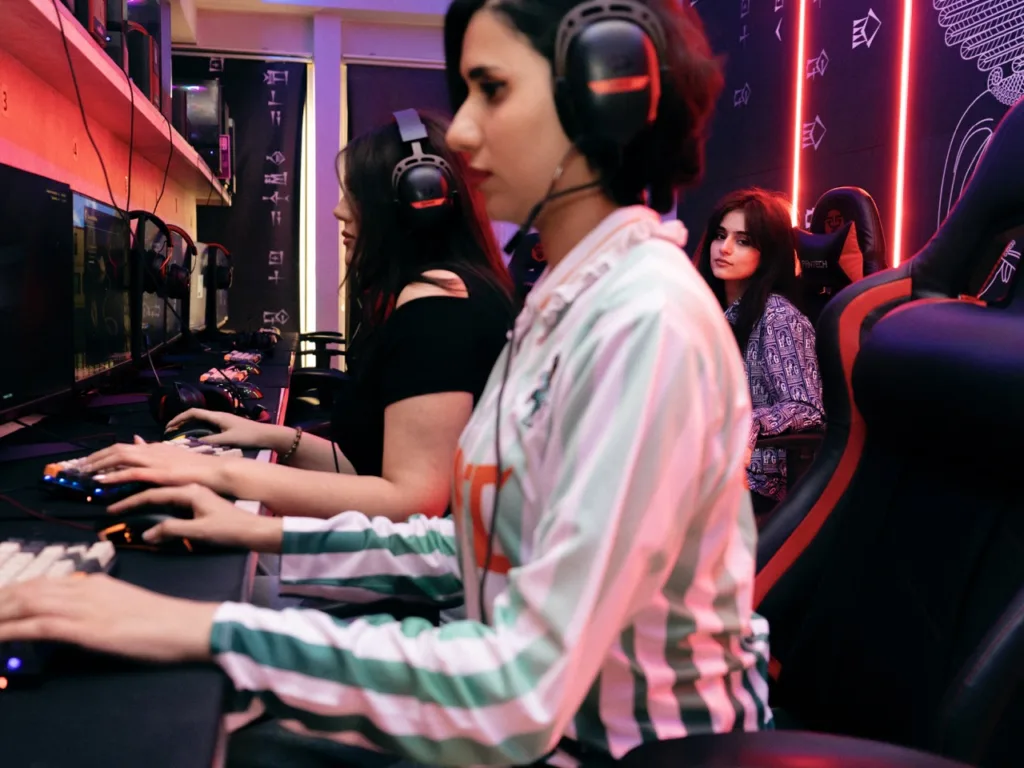


Luma wears shirt MOONLANDING, jeans THE ATTICO at Harvey Nichols – Dubai
Mariam wears cardigan DIOR, jeans STYLIST’S OWN
Gaming is a kind of ritualised self-mythology. It lets us test the edges of reality, imagine alternate outcomes, simulate risk, fail safely, and refine our instincts towards some imagined apex version of ourselves. It feels natural to our evolution, where our instinct to survive meets our impulse for play, making life not just bearable but worth living. In this way, worldbuilding isn’t just the design of realities—it’s a rehearsal for new modes of being. What is gaming if not a psychic gymnasium, where visionaries train under the weight of speculative futures?
And in this particular world, one that often thwarts agency, the virtual realm becomes a proving ground for the self. Not as we are, but as we could be. The avatar is not an escape, but a container for potential, where desire becomes legible in skill trees and branching narratives. Today’s gameplay variety becomes an archive of all the ways that players sculpt their futures at the intersection of choice and consequence, an allegory for life’s quiet truth that every decision made leaves a trace.
Enter Iraqi Gamer Girls (IQGG), a grassroots collective turned digital sanctuary that is rescripting the tired, misogynistic plots. At its helm is 28-year-old Asra Adnan from Najaf, whose sharp mind and quiet resolve combine with her unwavering belief in the power of sisterhood. In 2019, tired of the noise and hostility that clung to male-dominated gaming spaces – where even asking a question could lead to a barrage of kitchen jokes – she created a Facebook thread in search of what was missing.
Sadly, for all its talk of freedom and choice, the gaming world too often mirrors the biases of the real one, where womanhood exists in two modes: get harassed or rendered invisible. A non-player character (NPC) that adds ephemeral flavour to the side quest of the real hero. It’s reflected in the games as well as the community itself, from hypersexualised female avatars to the ambient aggression of online lobbies. It’s easy to understand why many women prefer not to reveal their gender while playing. In fact, research conducted by Reach3 Insights and Lenovo found that 59% of female gamers often avoid identifying as such at all, just to sidestep harassment.
“I wasn’t always comfortable playing with guys,” recalls Adnan. “They have their own, often aggressive and volatile way of communicating, and many don’t even want to hear a woman on their stream.” Within two days, five girls joined her Facebook thread. Those five told their friends. By 2020, IQGG had outgrown group chats and become a full-blown Discord server, connecting girls who wanted to compete and create on their terms.
As Iraq’s tech ecosystem flourishes, so does IQGG. “A few years ago, it was rare to see girls with full PC setups,” says Adnan. “Now, most of our girls have them.” Faster internet, cheaper tech, and expanded digital services have opened new portals, enabling real-time game downloads that once took days and seamless live streaming for better engagement. IQGG’s cultural relevance reflects this exciting growth, proving how grassroots communities can evolve with national progress.
What began as an instinct for care has since blossomed into a full organisation that arranges tournaments, trains esports teams, and even offers support beyond gaming. It helps members build portfolios, prep for job interviews, and find creative employment. “Honestly, I’ve never seen such a supportive group of people as the girls in this community,” Adnan says. “If one of us is feeling down, we go visit her. We send gifts. We’re a family.”
With sponsorships from Zain Iraq, the largest telecommunications provider in the country, IQGG’s next chapter is already loading. “When you truly love something, you don’t stop trying—even when it gets hard,” she asserts. “It’s not just a community. It’s a movement. Every tournament we’ve joined or hosted has been entirely by girls, for girls. They lead, they train, they design, they participate. Can you believe that we’ve never even relied on male photographers or writers? It’s all women. And it’s working.”
Gaming, she continues, is not only a safe and inclusive hobby, but also a powerful space for leadership and empowerment. “The esports federation here is still new, but with time and recognition, we can go far. I believe Iraqi girls deserve this space, deserve that chance.”
But IQGG isn’t an outlier. It’s part of a bigger pulse. The collective follows a web of esports orgs and pop culture pages, signalling its place in a broader Khaleeji-adjacent network of Arab women gamers taking up space. Yet, while the Gulf cements its status as a gaming powerhouse, Iraq still faces the burden of proving itself. As media and data hub Iraqi Innovators points out, it’s one of the youngest countries in the world, with over 60% of its population under 25. Development may be ongoing, but more than 78% of Iraqis are mobile internet users, swiping through Twitch, Steam, and Discord until it becomes second nature. And IQGG lives right in that tension, where global gamer aesthetics meet hyperlocal grit.
As the SWANA region’s gaming economy booms, it positions itself as a new frontier for game development and digital storytelling, and Iraq’s girls are ensuring their stories aren’t left behind. Valorant, for example, has become a cornerstone of competitive gaming worldwide—as over 200 girls registered for online and LAN tournaments, this tactical shooter is now the proving ground for a new wave of Iraqi talent. IQGG’s momentum is clear. It also trained and sent Mariam, Iraq’s first female esports champion, to compete at a recent Tekken tournament in Saudi Arabia.
This is especially refreshing because, for decades, virtual landscapes have not only reflected but also exaggerated the geopolitical fantasies of the west. The region – while one of complexity and culture – has often been dismissed as a scorched digital backdrop, a wasteland where war is perpetual and Arabness becomes shorthand for hostility. The narrative has always been clear: chaos lives here. While this feature doesn’t aim to dwell in critique, it’s impossible to ignore how such portrayals have dehumanised, othered, and infantilised entire regions—Iraq especially.
From Six Days in Fallujah to Call of Duty’s endless loop of crumbling minarets and broken Arabic, players are trained to read the region through the cultural semiotics of threat. Rayane Jemaa, the Tunisian creator of the Is This the Middle East? project recently spoke to Dazed MENA, confronting the violent Orientalism that flattens cities like Baghdad into blood-smeared maps, and people into voiceless NPCs. Yet, amidst this narrative erosion, a counter-archive is emerging. “I’m not interested in these games that just show us as those people in that desert,” says Adnan.
For her and her community, gaming becomes a site of reclamation and a way to write new oral histories in code and customisation. In challenging the industry’s dominant optics, IQGG offers a welcome redirection—one where the region is no longer a stage for someone else’s story, but the setting of its own unfolding mythos. I’m privileged to speak to another voice shaping this emergent scene: Luma Abdullah.
A Nasiriyah-based dentist by day and a published author by night, the 29-year-old switches avatars like armour, wielding a pen with the same precision she does a dental mirror. It started as Instagram reflections on complex game narratives and steadily evolved into a YouTube channel, then a self-published book series dissecting the philosophies behind story-driven games. Now, as Abdullah works on her fifth book – an in-depth study of the award-winning Elden Ring – her books are printed in Iraq and distributed across the Gulf.
She joined IQGG mere months ago, back in Ramadan, and is already overcome with pride at the incredible motion. “I always tell Adnan that she’s doing such a great job of providing a safe gaming environment and community for girls in Iraq.”
Abdullah’s insight also dismantles the lazy notion that Iraq is ‘lagging behind’. What many assume as an absence of skill is actually systemic marginalisation, a consequence of geopolitical bias and the burden of perpetual proof. “Everyone in Iraq, man or woman, faces challenges in the global esports industry,” she remarks. “The men have to prove themselves because they’re Iraqi. So for women, it’s literally ten times harder.” Her words expose the compounded obstacles faced by Iraqi gamers: exclusion from elite circuits and the regional and international scepticism that clouds their potential.
I, too, roll my eyes at these persistent assumptions about my country, even from within our own region. Iraq is often viewed through the grip of its tragic past, with its potential for creative futurity dismissed at every turn. We’re held captive by those who narrowly define possibility only through the lens of our history’s eclipsing shadow. This judgment is often quietly classed, rarely interrogated. “We all share the same struggles, but we’re leaving our mark,” adds Abdullah. She points to IQGG’s fierce commitment to cultural authorship, resisting the imposed tempo of western innovation narratives. Iraqi gamers are not following; they are reimagining the frontier.
Across our conversations, one theme surfaced again and again: a deep reverence for story-based video games. Unlike fast-paced online shooters focused on reflex and competition, these games reward patience, empathy, and immersion. Triumphs against your innermost adversary. “Any game that has a deep narrative, I like,” Abdullah tells me. “I care less about genre, and more about the story.” Adnan, with over 700 titles in her Steam library, says she’s drawn to cerebral characters like Geralt from The Witcher 3—those marked by mystery and moral complexity. “I like characters with emotional depth, with their own struggles. It reinforces the humanity of the self.”
She recommends The Witcher to me, personally. It’s a small but intimate gesture, a recognition of shared sensibility and a reminder that games, for them, are not about competition, but connection. Yes, it’s a simulated landscape, but so much is trained in that arena. In open-world environments and sandbox modes, players both explore terrain and sculpt persona. Beyond mechanics, loadouts, skill trees, and dialogue branches are, in fact, tools for narrative authorship. Here, the digital realm becomes both battleground and theatre: a place where the player refines their reflexes and their relational ethics. The HUD might track XP and achievements, but beneath that surface, another kind of levelling is taking place—one that maps a psychology-in-progress across a terrain of virtual possibility.
Mary Aljanabi from Baghdad, a prominent gaming influencer with almost 100k followers, also joins me in conversation. Embodying the way global aesthetics have become deeply personal within Iraq’s gaming spaces, the 27-year-old reveals, “I draw a lot of inspiration from East Asian cultures, especially anime. I’ve always loved it.” Her affinity for the sakura flowers of Japan, soft palettes, and serene anime motifs shape her gaming setup as well as inspire interior trends across Baghdad (even restaurant owners contact her for consultancy on the sakura forest room decor and gaming setup).
In many ways, her influence speaks to a wider pattern within the IQGG community: an interplay between hyperlocal and global references. As much as the girls trade in Arabic memes and Iraqi in-jokes, their avatars might be wrapped in cyberpunk skins or dressed in anime-inspired outfits. IQGG’s aesthetic textures, ranging from sakura blossoms to survival horror, stitches the global into the local, crafting a gaming language that’s both cosmopolitan and culturally grounded.
Honouring the multiplicity of women’s tastes, Adnan also makes it clear that IQGG isn’t bound by any performance of femininity. When I bring this up, she nods enthusiastically: “I personally love the colour black and goth styles. A lot of girls are into Japanese culture and anime aesthetic, while others connect with pinks, hearts, and flowers. There’s no one way to be a woman. We’re diverse. And IQGG reflects that.” Her words carry an often ignored and crucial point: the desire to go beyond socially prescribed femininity doesn’t necessarily mean rejecting it altogether. The result isn’t a flat opposition, but a vibe shaped by organic tastes, curiosity, and free will.
Frustratingly, for women of colour and culture – especially Muslim women – the battlefield is twice as big. They are tasked with combating misogyny within their cultural communities, as well as racism and Islamophobia from white feminist spaces. The latter has long weaponised the pain of women across the SWANA region as both retroactive justification and ongoing permission for their dehumanisation. IQGG’s unmistakably feminine aesthetic is not reactionary, but a product of volition. It’s not a statement, it’s a preference.
This is also demonstrated through other, more spiritual considerations. IQGG adapts its activity during Ramadan rather than pausing it, embedding gaming within the rhythms and rituals of the holy month. Streaming schedules are shifted to accommodate suhoor and iftar—even the UI reflects its calendar. “We made our tournaments with the designs and vibes of Ramadan,” Adnan explains. “We looked for games that matched the atmosphere, curated our schedules accordingly, even developed our own fashion games and outfits inspired by the month.”
By centring Islamic aesthetics and including Ramadan-specific health reminders for the girls throughout the month, IQGG challenges the often unspoken default of global gaming culture, which imagines the gamer as western, secular, and male. The collective offers a more expansive model, interwoven with local rituals, a frame through which cultural specificity can be amplified.
Irritatingly, however, as Aljanabi’s platform grows, so does the trolling. Mostly, it’s from men questioning her place in gaming. Similarly, Adnan echoes how lots of men react negatively when they see IQGG breaking the mould, signalling that its achievements are often seen as threats to entrenched power structures. Male supremacy ideology and the ‘manosphere’ that ascends from it are an increasing safety concern for women and, sadly, online spaces are the ultimate petri dish for such prejudices to proliferate.
Research shows that many incels feel confident escaping through video games and online environments, where prejudice is less likely to be challenged as they incite hatred against women. Their justification? That men are inherently more valuable, and women already experience prejudice from Chads and Stacys of the world outside. Video games themselves aren’t inherently to blame; prolonged immersion in male-dominated online spaces coupled with limited real-world interaction with women can feed a worldview where misogyny festers unchecked, gradually transforming insecurity into a far more dangerous ideology.
“There are so many girl gamers here that it should be normalised, not criticised,” adds Aljanabi. “I’m doing this not just for myself, but for every other girl out there.” With these women on the pulse, the path being forged for future gamer girls feels both resolute and radiant. Across my calls with each of the girls, it was moving to witness them revel in their knowledge: dissecting game plots, recounting tournaments, mapping characters with the ease of seasoned strategists. The joy and reverence with which they speak about their favourite legends is palpable.
But as they got lost in their worlds, it quietly became clear to me: the bravery, skill, and resilience they admire in these characters is merely a mirror. The gamer girls of Iraq are rewriting the code, changing the game in real time. I’m looking at the heroes. Their lives are a living quest, breathing life into myth itself.
Producer FATIMA MOURAD, local producer TIBA SADEQ, cast LUMA, MARY, DANIA, MARIAM, special thanks to ASRAA and SARAH