
 Posted in
Music, Artist
Kareem Lotfy prefers the margins: in conversation with one of Egypt’s most elusive artists
Text Omar Ghonem
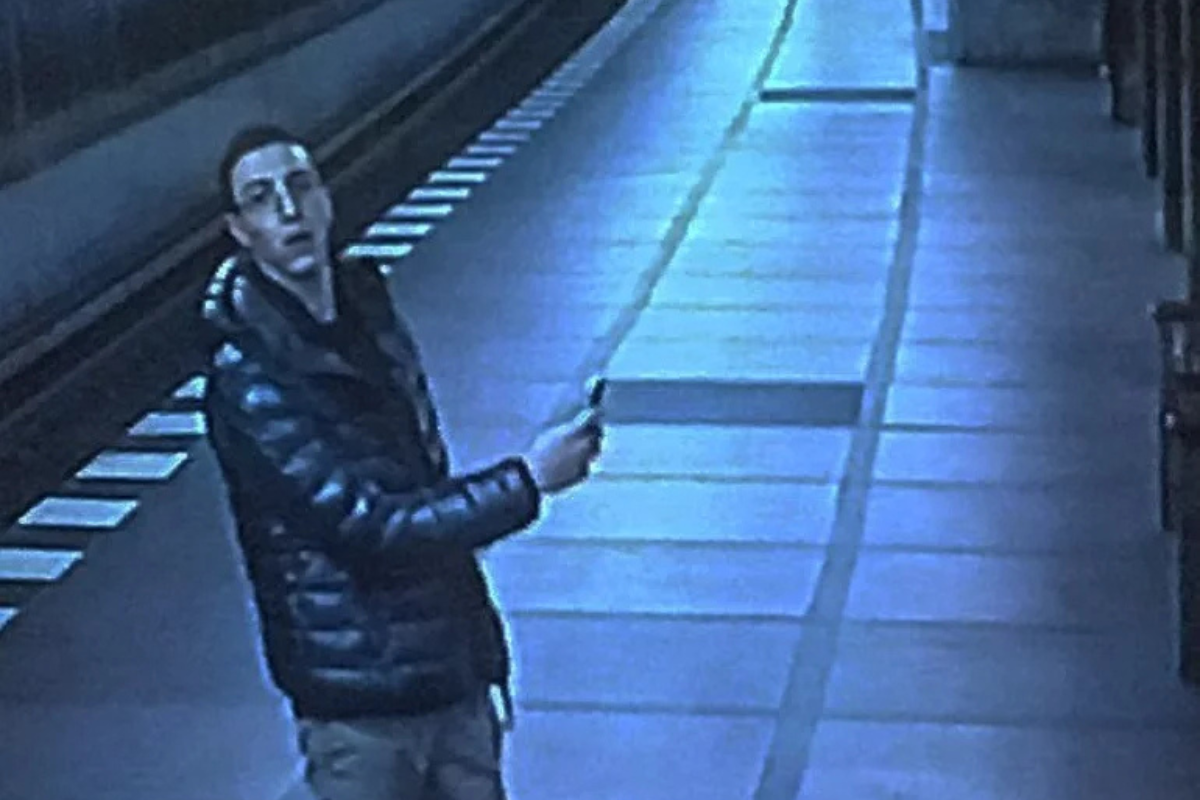
Kareem Lotfy is the kind of artist who prefers the margins. A veteran in Egypt’s electronic music scene and an accomplished visual artist whose work has circulated internationally, Lotfy has cultivated an acclaimed artistic career in Egypt and abroad without ever fully stepping into the spotlight.
Speaking from his apartment in the Netherlands, Lotfy approaches every subject with a measured, almost philosophical clarity. He speaks at length about art scenes, technology, artificial intelligence, Europe, family, and taste, almost everything except himself. During our two-hour conversation, whenever I tried to steer the discussion toward biography, he redirected it outward. Yet it is precisely this outward orientation that defines him.
Born in Cairo, Kareem Lotfy’s relationship with art began at a young age, and he never strayed from it as a central focus. He was so resolute in pursuing art to the point that, at fifteen, he left his home in Cairo and moved to Alexandria to enrol in the Faculty of Fine Arts. The move to Alexandria proved to be a decisive step that would later shape his trajectory. There, in the early 2000s, his path intersected with emerging art and music scenes just beginning to take shape in Egypt.
Lotfy’s experiments with sound and image began early in his university projects, where he and a group of classmates began making audiovisual projects. At the time, digital audio workstations and software like Photoshop were only beginning to spread in Egypt. As a result, many people were experimenting across both mediums simultaneously.
Kareem recalls that during this period, his path crossed with the early attempts of the Alexandrian rap group MTM, witnessing the first experiments in what would later become mahraganat, particularly through Amr 7a7a’s Fruity Loops revolution in the mid-2000s, as well as the birth of an emerging experimental electronic scene that he became part of. The gradual democratisation of music and visual production at the time, due to the spread of DAWs and graphic software, helped generate small, overlapping scenes that fed into one another organically.
“What happened then was that a small underground scene formed, but it wasn’t really connected to itself and wasn’t very linked to what was happening in the street,” Kareem says. “We started to think that maybe we weren’t actually that separate from reality. The impression was that we were kids influenced by Western aesthetics and trying to imitate them, but there were local aesthetics that inspired us, things full of noise and distortion that we see every day in the street and on TV.”
He mentions Halim El-Dabh, the Egyptian music composer who worked as early as the 1940s and is considered a pioneer in electronic music. For Kareem, even though there was a notion that many of their early attempts might have been imitating Western aesthetics, it is equally possible to see them as a continuation of earlier experimental traditions represented by figures like El-Dabh.
For Kareem, Alexandria remains the key source of art in Egypt, from Sayed Darwish all the way to Mahraganat. He attributes this role to the city’s scale and geography. “Alexandria has a heavy cultural depth concentrated in a small space, so you really feel it,” he says. “There’s also the geographical factor. The city is basically three main streets, so if you’re there, you’ll inevitably run into the people who are making art.” In Cairo, he adds, that depth exists as well, “but it’s spread across a much bigger screen, so the focus is weaker. In Alexandria, it’s very concentrated.”
Lotfy released his first full-length album, Dirty Zeyda, in 2008, an ambient-noise record that established the foundations of his sound. The album, released on the independent label 100Copies, marked the formal beginning of his music career. It was a career that would span more than a decade, though it was punctuated by sparse, often obscure releases. That obscurity, however, was less a byproduct than a choice. Lotfy deliberately kept a distance from the spotlight, largely succeeding in remaining in specific niches of the music world.
At the time, in the late 2000s, Kareem was part of two powerful emerging scenes in Cairo: the electronic music scene and the rising graphic design scene. Despite scarce resources, they organised exhibitions and events, and designed many of the era’s visual elements—posters, album covers, and commercial work. These scenes gradually attracted attention from outside Egypt, particularly from Europe, and were noticed within the broader Egyptian art world. Kareem recalls an event they held at the Mahmoud Khalil museum, where experimental electronic music and mahraganat were played, and the event was even sponsored by the Ministry of Culture itself. It seems like a fanciful idea now, but the scene was so active that it was impossible to ignore.
Both the music scene and his graphic design career frequently intersected. Through album covers and event posters, the two were never fully separate. At the time, there was a relatively homogeneous environment that brought together all these practices and different schools of thought – mahraganat, graphic design, and experimental music – into one unified sphere. This environment would later undeniably influence the music and visual language of a new generation in Egypt. For Kareem, his approach to sound and image remained quite similar: “It’s all about spreading elements on a canvas,” he says, adding that whether he’s making music or designing something, there are certain elements the two media share.
The January Revolution in 2011 changed almost everything. The emerging scenes were deeply affected, and a radical shift began in the medium itself. After the revolution, stages and exhibition spaces gradually moved into virtual digital environments, which in turn reshaped the creative process. Lotfy says this shift produced its own digital aesthetics, and the influence of the medium itself began to appear in his work. He compares the digital transformation of the early 2000s with the current moment of artificial intelligence, arguing that AI is also generating its own aesthetic language, one that is not original but often overly polished and ornamental.
“If an AI model is trying too hard to be ‘human,’ then I’ll be the opposite. If the model plays humanity, I’ll play absurdity,” Lotfy says. “The human mind is the only thing that can deal with absurdity.” For Lotfy, the primary danger of artificial intelligence is not that it will replace artists or jobs, but that it will shape public taste. The response, he believes, lies in producing forms of art that AI itself cannot fully understand or reproduce.
After the revolution, Lotfy moved to Europe on a scholarship to continue his studies in art, beginning a new chapter of his life in Berlin before later settling in the Netherlands. Living in Europe did not detach him from Egyptian or Arab realities, nor did he fully enter the familiar – often exotic – bubble of the Arab artist in exile that emerges in such contexts. One of the first challenges he encountered was the question of audience, a dilemma he believes many artists from the region face when relocating to Europe.
“When I first arrived, I was pushed into this category of being a Middle Eastern artist living in Europe, and the expectation was that I should be addressing the European citizen,” Lotfy says. “I tried for two years to deal with that, and then I realised it was pointless. He won’t understand me, and I don’t really understand him. Either I improve my work, or I speak to him through his own interests, but I don’t have to constantly present myself through the image he expects of me. It’s a very unhealthy relationship.”
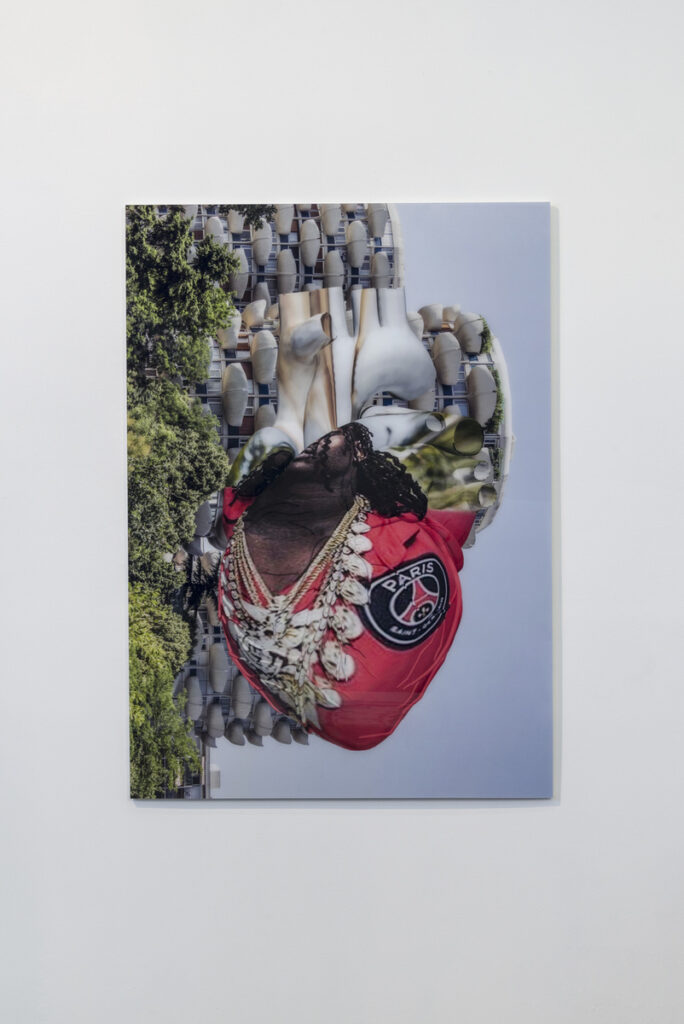
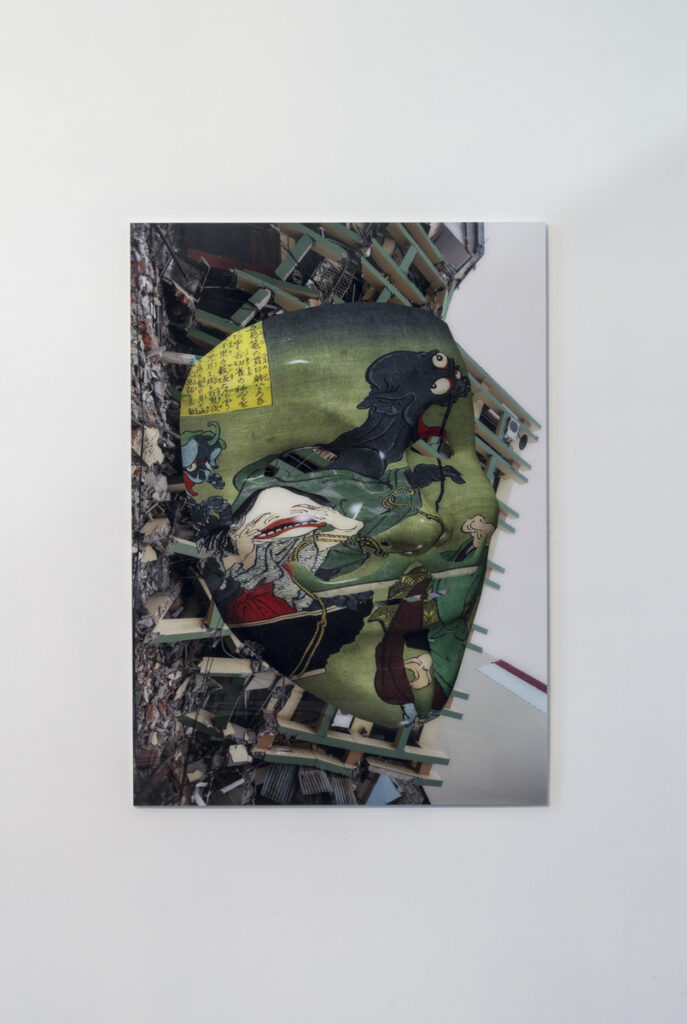
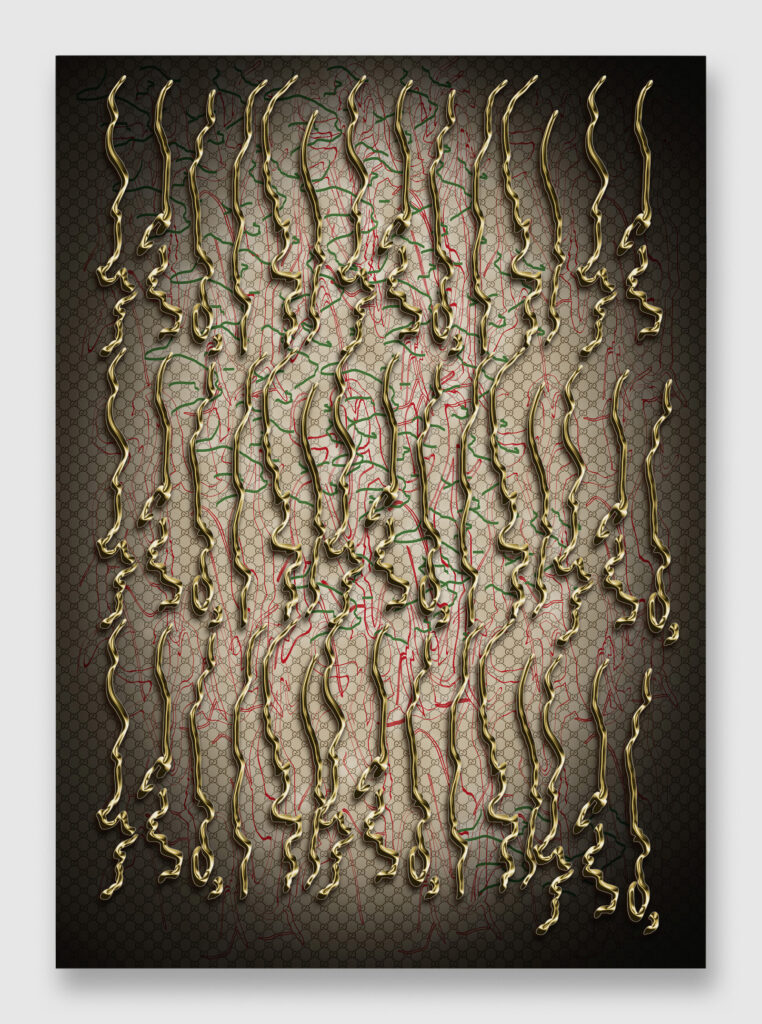
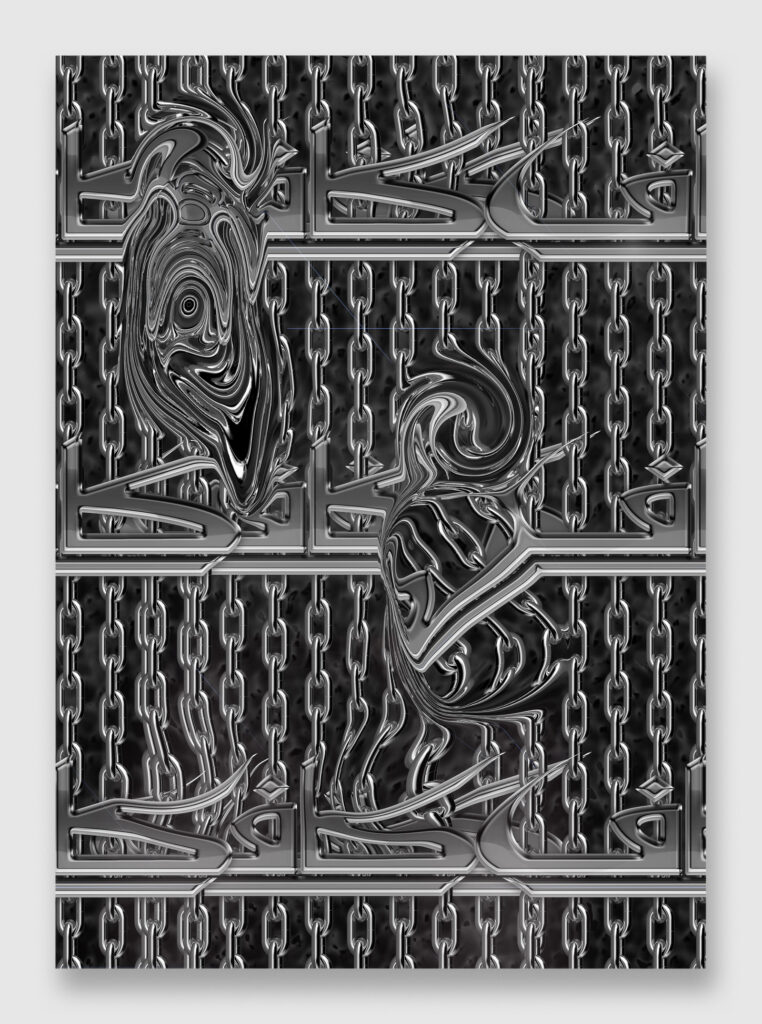
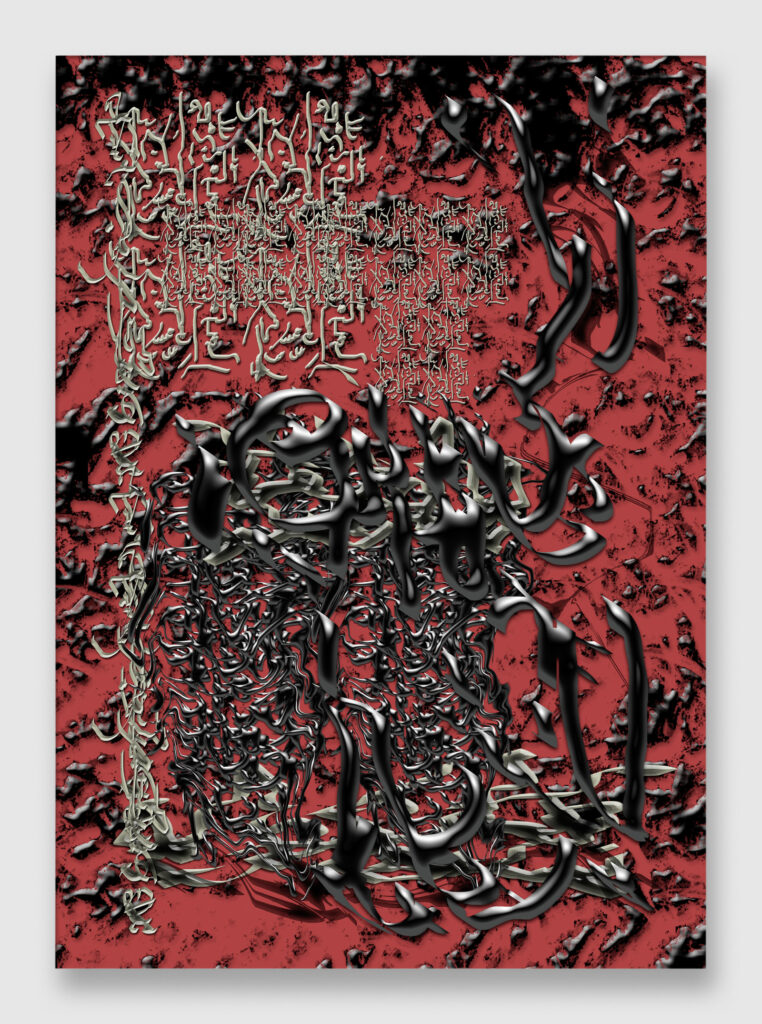
From that point on, Lotfy’s work in music and visual art began to move along different trajectories. While his musical releases became increasingly rare, his visual output expanded, and his style became more defined. Through various exhibitions across several European countries, collaborations, and major design projects, he developed a distinct artistic language, with his work shown alongside artists such as Sophia Al Maria, Meriem Bennani, Tala Madani, Jumana Manna and others.
Lotfy’s visual language is one that’s defined by restraint and spatial awareness. Much like his approach to sound, it is built on the careful distribution of elements within empty space, where composition depends less on density and more on balance, texture, and placement. His work often favours rough or degraded surfaces that resist the hyper-polished aesthetic of contemporary digital design, echoing the noise present in his music. Shaped by early experimentation with software like Photoshop and other digital tools, his visuals carry traces of early internet culture and lo-fi digital processes. At the same time, his approach remains highly conscious of context, responding to shifts in technology and media without fully embracing their dominant aesthetics.
Music, meanwhile, retreated into the background, something he continued to practice on a smaller experimental scale, far removed from what he sees as “the large machinery of the music industry”. His relationship with music, however, has remained complicated. Ironically, some of the moments when his name reached its widest visibility were connected to music rather than his visual practice.
One of those moments arrived in 2018 with the release of Ye by Kanye West. News quickly circulated that West had sampled Lotfy’s track ‘Fr3sh’, originally recorded for a German independent label. For most musicians, being sampled by one of the biggest artists in hip-hop would represent a breakthrough moment. Even without formal clearance, the exposure alone could translate into significant cultural capital. Lotfy, however, experienced it differently. Rather than treating it as an opening, he saw it as further confirmation of the instability of the music economy and continued shifting his focus toward design work, which he describes as a more straightforward environment.
“That made me confront a fundamental problem in the music industry: the money isn’t clear,” Lotfy says. “You throw out a net and wait. Maybe you catch a fish, maybe you don’t. Even if you get a million streams, you’ll earn an amount that wouldn’t cover a month’s rent abroad.”
Around the same time, while in Berlin, he met Ryuichi Sakamoto, the Japanese composer and one of the pioneers of electronic music. The conversation left a lasting impression. “He told me it’s difficult to be a musician and live off music alone,” Lotfy recalls. “Even he had to compose film scores to keep going.”
For Lotfy, this dilemma was never simply about money but about the conditions under which art can exist in the first place. Large systems of production – whether the music industry or the global art market – often demand a kind of expansion that reshapes the work itself, pushing it toward clarity, speed, and constant output. His instinct has generally been to resist that pressure, preferring instead smaller ecosystems where ideas can develop slowly and without immediate expectation. In that sense, the question of scale is not merely practical but also aesthetic: the size of the environment in which art circulates ultimately shapes the form it takes.
From the loose experimental circles of Alexandria in the early 2000s to the institutional frameworks he later encountered in Europe, Lotfy’s trajectory exposed him to very different scales of cultural production. Yet rather than adapting his work to fit each new system, he increasingly defined his practice in relation to them, treating scale itself as something to negotiate rather than pursue. The result is a body of work that moves across scenes and geographies while remaining anchored in the same principle: that artistic ecosystems, like living environments, must be carefully cultivated if they are to sustain anything meaningful.
“You can cut a beautiful flower from the street and bring it home. It will survive three days in a vase, maybe four, and then it dies. If I want it to stay alive in my house,” Kareem Lotfy says, “I have to plant it from the beginning and water it every day, otherwise it doesn’t belong in this space.”
Here, Kareem was talking about the temptation to replicate music trends locally, to produce a powerful copy that burns bright for a year or two before fading. But the metaphor stretches further. It reads like a quiet manifesto for how Lotfy has navigated nearly two decades of Egyptian experimental culture, global visibility, and the uneasy space between them.
Lotfy’s trajectory can be read as a reflection of the music scenes he moved through and helped shape. In many ways, the Egyptian artist embodies the different phases of those scenes: their fragile beginnings, their growth and consolidation, and, eventually, their drift toward the margins and into more unfamiliar territory.
The margins that Lotfy has occupied for much of his career are not a sign of withdrawal but a deliberate position. In an era where artistic visibility is often measured by reach, metrics, and constant exposure, Lotfy’s path suggests another model entirely: one where persistence, context, and autonomy matter more than audience size.