
 Posted in
Tech,
Posted in
Tech,
Opinion: The realm of imagination and the cosmotechnics that defeat the vision machine
Text Raza Tariq
Wars are no longer about skin, they are about silicon.
When the US and Israel launched an attack against Iran, and the IRGC unleashed a flurry of ballistic, cruise and hypersonic missiles onto the Middle East in return–the night I opened my exhibition on the theme of domestically imagined near-future consumer biohacking, surveillance and financialised tools “SAFEHOUSE DE S.W.I.F.T.I.E.”– I did not expect that future to be so instantaneously upon us. What we have watched happen before our eyes is the targets of war shift quietly from people to programmes – a shift in the logic of war, from territory to the predictive systems that map them. Digitally housed material futures are now being attacked before they materialise out of the e-womb. The data-composited baby is being bombed in the incubator.
The philosopher of technology Yuk Hui has a theory called cosmotechnics – the idea that the technologies a society produces are the product of its worldview. In other words, it’s cosmology that it projects onto the world. As Iranian drones named Shahed rain onto American air carriers named Abraham Lincoln, guided by Chinese satellite networks called BeiDou (an ancient Chinese astronomy term for the Big Dipper), sensed by Russian Electronic Warfare systems named Krasukha (a Russian literature trope), dodging Indian ICBM’s named Agni (the Vedic god of fire) we are watching the world’s varying cosmotechnics compete for primacy. Hui calls this cosmopolitics: “It is necessary to start imagining a new politics which is no longer a continuation of this same sort of geopolitics with a slightly different power configuration… We need a new language of cosmopolitics to elaborate this new world order that goes beyond a single (technological) hegemon.”
It’s clear we are watching two marked cosmopolitics emerge: a regime that melts girls’ schools alive, runs AI kill-lists of 37,000 people approved in twenty-second rubber stamps, tracks targets into family homes with a system called “Where’s Daddy?”, hacks and explodes pagers, internationally exports and trafficks children across networked islands and apartments. A regime that did not decapitate the leadership, but rather the cultural heritage of a thousand-year-old society. The Abbasid-era Jameh Mosque of Isfahan, the Qajar Dynasty Golestan Palace, and the UNESCO Sassanid-era Falak-ol-Aflak Citadel were all caught in the crossfire when firebombing the cultural heritage department, along with its archaeology and anthropology museums. Western Cultural Sites were not safe either; the cultural poles of the neoliberal megastate were also targeted. Bombed heritage sites included Claude, AWS Data Centres, a seeming abundance of Twitter bots, and the offices and cloud infrastructure of Google, Microsoft, Palantir, IBM, Nvidia, and Oracle, located across multiple Israeli cities and Gulf countries. The supposed eternal memory of a two-hundred-year-old civilisation, which remembers on RAM produced in the last year, is gone in an instant.
Two cultural technologies fight here – not countries. Not for control of the seas, but dominance over The Stack, a new geography Benjamin Bratton describes as a layered topography of Earth, Cloud, City, Address, Interface and User; not disconnected from the earth but literally embedded into its spewing mines and warming seas. The fight over The Stack manifests in two relationships with time: one side bombing futures, the other bombing pasts and presents. One side draws Jets that are no longer parked in the hangar, the other bombs their memory.
This cosmopolitical War, however, has been brewing for a long time. Since washing up on Europe’s shores in 700CE and assimilating as a native part of Europe’s spiritual apparatus, Europeans have long attempted to accept in part, interpolate, juxtapose, admire and ultimately reject Islam as its native son. Despite this, it’s well known that in The Divine Comedy, for example, Dante drew heavily on the Kitab Al Miraj – a compilation of Latin and Old French translations of the Isra hadith literature that had been circulating in 13th century Europe – as documented in Miguel Asín Palacios’ 1919, Islam and the Divine Comedy. If The Inferno and The Israa are competing premodern Spiritual Stack’s, then they no longer fight to ascend from the Alam al Shahadat (The Realm of The Seen) to conquer an Alam Al Malakut (The Realm of The Unseen) and ascend to the Alam al Jababrut (The Realm of The Divine). Instead, they fight the unseen to conquer the seen, to accelerate the becoming of their divine.
The solution to this cosmotechnic War is what Hui calls Technodiversity. As we enter the age of the Anthropocene – a new epoch of the earth coined by philosophers around the turn of the millennium – an era where manmade artificial objects populate and dictate the earth more than organic, natural objects, stopping the boat sailing out to sea becomes an impossible task. What Hui proposes, instead, is a diversification of technological, artistic and political production that responds to local histories and cultures – to beliefs – that challenge an ever-homogenising and singular technical organ.
In 2024, I found myself circumambulating one of Earth’s oldest technological organs, the Kaaba. A fully functioning networked Spiritual Stack of crowd control, sanitisation, sensors, biometric processing, spiritual poles and commercial portals. Simultaneously sacred and technologised. As I lost the lottery to secure a place on Ramadan’s last Friday, having hung out on my own since Fajr, I found myself leaving, giving up, defeated – walking away from the gravitational field of desire that clung to The Haram’s black-dyed silk skin. As I walked past various spiritual sites and checkpoints, I listened to a podcast with Adam Curtis where he said something that changed my life: “everyone wants to go back, but you can’t go back – the old ideas are dead – the big three; Capitalism, Communism and “Islamism” they’re over. The three powers that rose on their backs are either quietly peddling something new, or worse yet, don’t realise they are over, and are in a vacuum waiting to be replaced by something new.”
Now I believe, we are watching the birth of that: “something new”. Or in this case; something(s) new…
The Technodiversity that Hui calls for is rampant across the Muslim Stack. Digital and Physical Islamic Brainrot artifice; ¼ Zip Thobes produced in London, worn in Kuala Lumpur, meanwhile AI Children’s Islamic Songs produced in Kuala Lumpur watched in London migrate across shipping straits and underwater cables by the second. Somehow, we are instantaneously connected to the library of the universe, and yet we are stuck in its DVD section. Yuk Hui’s concept of Artificial Stupidity, a form of unliberating technical production, results in what he calls Digital Ecstasy an expansion on German Philosopher Martin Heidegger’s concept of Temporal Ecstasy — essentially ‘when you genuinely reach reels flowstate’.
Digital Ecstasy is the opposite of cosmotechnics. Muslims, as 2 billion of the earth’s constituents (and a member of Curtis’ ideological big three), seem to be defined by the Stack that hosts our server. Across the non-aligned powers, one could argue that Russia, China and Iran have actually mutated the ideas of the big three into discursive and reflexive composite superideologies. Communism with Chinese characteristics produces, on the one hand, homes that 19-year-olds can afford, and on the other, pre-fabricated simulacrums, hyper-copies of a copy of a copy of the memory of a picket fence.
It seems, then, that the old ideas have not died but have instead been reincarnated. Regimes that we once decried now fan the flames of the burning bodies that a bygone unipolar, nation-building moment allowed us to ignore, for the purchase price of our conscience’s satisfaction with a moral order at the expense of an exported disorder. The pragmatism of the age has killed the once idealist liberal’s imagination of the future. Gen-Z before reaching the age of 25 has gone from ten years ago hoping for a Luke Skywalker, to now accepting the steering hand of a compromise pick-me, love me for now-not forever Darth Vader.
But now there is nothing we cannot see. The veil is lifted, we are getting used to what we see but is what we see good for us and is it real? In the 80’s, the French philosopher Paul Virilio spoke of a future in which technology creates ever-shorter distances, resulting in a false day of speed that never quite arrives. An environment where all technology is subsumed by military apparatus, not that of guns and bombs, but information and speed packaged as communication. A destination where you can arrive at any time, and you never have to leave to get there. Where mushroom clouds puff into the sky, but no bomb detonates next to you (yet). The true nuclear moment, Virilio theorises, is the anticipation of the nuclear moment. A society of ultimate predictive marketised speculation also produces an infinite gaze onto the past. From our moment of absolute access, from the centre of the panopticon, we can see all of history, and anticipate all possible futures — and yet feel as though we can access none of them.
Alfonso Cuaron’s film Children of Men actualises what Virilio’s prophetic now would look like, a near-future London that looks exactly as it did in 2006. The city is a never-ending simultaneous cosmopolitan hub and warzone – realising itself in the urban landscape as continuous explosions and microdosed skirmishes that tread carefully so not to disturb commuter traffic. It is becoming clear that this vision of the future is now our today; cities occur as test sites for a new normal: a cosmopolitan simultaneity of taxi drivers and bakeries bustling under the shade of microdetonations and low-intervention drones striking pre-coordinated infrastructural sites a few neighbourhoods over.
For every eye watching and not ducking for cover, a worldwide participation by proxy. Eyes watching from the comfort of Birmingham or Michigan, perversely stuck to every moment. Saying: “we’re all gonna die” without dying. Experiencing all the cognitive inconvenience and none of the physical loss expensed on the tabs of South Lebanese mothers and Iranian Schoolchildren. An eternal moment of destruction for some, and yet a moment that never quite comes for others. Close-touch intimacy without climax.
The truth is, however, we are not impotent; we’re just in a loveless marriage. What Curtis perhaps failed to consider in his verdict are his own words: “everyone wants to go back, but you can’t go back”. There’s a quote by the American Economist Milton Friedman, which I think fills the gap in his sentence: “Only a crisis – actual or perceived – produces real change. When that crisis occurs, the actions that are taken depend on the ideas that are lying around. That, I believe, is our basic function: to develop alternatives to existing policies, to keep them alive and available until the politically impossible becomes the politically inevitable.” Curtis finishes his appearance with the quote from the late American Anthropologist David Graeber: “The ultimate, hidden truth of the world is that it is something that we make, and could just as easily make differently.”
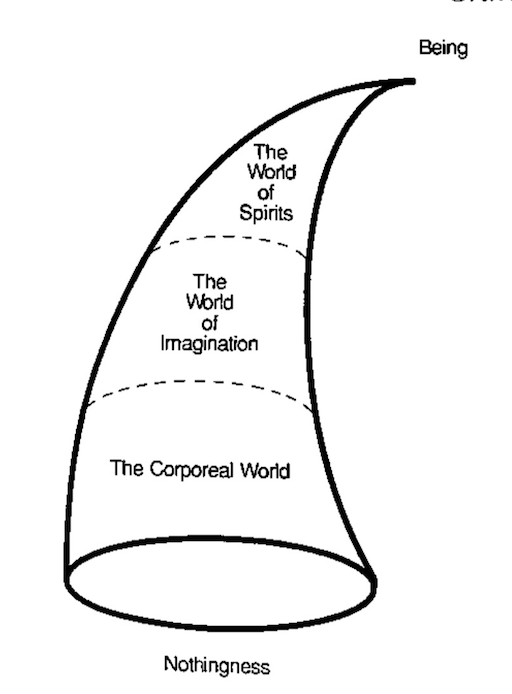
Here, I think the post-modern mind perhaps reaches for what it once discarded. Ibn Arabi’s idea of the Alam al Khayal (Realm of Imagination) is perhaps the transcendental device out of this Stack-loop inception we find ourselves in. The how to Graeber’s why. If we are living the present as a memory and spectators of a dream happening within a dream that we do not get to dictate, the ultimate techgnostic state of sedative simulation, then Ibn Arabi’s dream state is its polar opposite, radical cousin. The mediatory world between the corporeal and the sublime spiritual realm, the imaginary realm, is the place where humans have the most agency and greatest proximity to.
Our thoughts are closer to us more often than what we are actively imagining and perceiving. The realm of thoughts is not only where our ideas construct the world, as psychology tells us, but also where the world is constructed. The human being itself is endowed with an absolute agency, able to — at a moment’s notice — define and disrupt the fabric of time and steer it in a new course. Not only to build a reality in its mind but even to build its mind in reality. Ali Z. Hussain cites that Ibn Arabi says in his Futuhat Al Makiyya: “everything that we have deemed impossible and contradictory in the material world according to our rational mind, I have perceived as outwardly manifest, possible, existent and actual; in the realm of imagination”. The difference between Ibn Arabi’s Active Imagination and Virilio’s stasis-inducing Vision Machine is that in their dream we are the audience, in ours: we are the author.
We are not mere perceivers of our realities but affectors and sculptors of them. Our neural imaging is not merely a symbolic processing of the world, but an articulation of our collective souls onto it. The world is a coherent expression of our shared, interiorised, intangible experience. It is a product of our discontiguous imaginations*. Unlike the sensors we have littered across the Anthropocene and its Stack, we do not simply read signals and process data – we emit, and produce the reality that renders them legible. We need not mistake ourselves for our agentic creations. We are freshly reimagining the world every day. The only reason we see the same thing is because we are in the habit of rendering its image from our retinal contiguous photocopier, rather than processing new images on a discontiguous film.
The root word of imagination is image. In the final few of Children of Men, the story’s saviour, Kee, has birthed a child in an impotent world, smuggling it through a nostalgic hypersurveillance apparatus that seeks to seize any new future born before it can grow. However, the irony of the film is that in the end, the baby is smuggled under the eye of the world’s most expensive panopticon, under a blanket (sound familiar?). As much as the panopticon is externalised, its power only exists once internalised as an image. However, often, the front door is left unlocked. The cameras are on, but they are not watching us.
The beautiful thing about a moment where its architects are so focused on marching with speed to the future is that the present lies vacant. And if one did want to affect, or steer the future in a cosmotechnical direction, the thing about it is that: the future is only ever today, except tomorrow. Now, only occurring later. Unlike an image. The future reality lies yet unassembled inside the vast cosmic realm of imagination, which we can all travel to from inside ourselves.
For every rupture, repair is a moment of expressed human agency away. For every lost symbol and simulated reality, there is an image of now, not yet here. Visible; only to me, only to you.
دَوَاؤُكَ فِيكَ وَمَا تَشْعُرُ وَدَاؤُكَ مِنْكَ وَمَا تُبْصِرُ
وَتَحْسَبُ أَنَّكَ جِرْمٌ صَغِيرٌ وَفِيكَ انْطَوَى الْعَالَمُ الْأَكْبَرُ
Your cure is within you, though you do not feel it. Your ailment is from you, though you do not see it. You think yourself a small body, yet within you the greater universe is folded.
* This term is from William Chittick’s famous book The Sufi Path of Knowledge: Ibn Al-Arabi’s Metaphysics of Imagination