
 Posted in
Art & Photography, art
Posted in
Art & Photography, art
Dana Awartani on repair and craft
Text Sarra Alayyan
With the denizens of art flooding into Venice a few weeks ago, our feeds were buried under an avalanche of content, from Björk’s surprise performance in Bottega fibre glass to naked bodies atop jet skis; it was hard to focus on the art.
Still, 29,221 clay earth bricks filling a whole room in the Arsenale, arranged as intricate geometric mosaics, cut through the noise. In the Saudi Pavilion — curated this year by Antonia Carver — Saudi–Palestinian–Syrian artist Dana Awartani’s latest work, May your tears never dry, you who weep over stones, traces shared histories of craft and exchange.
Much of Awartani’s work, spanning painting, sculpture, performance and installation, negotiates cultural loss and preservation with frank poise, refusing the easy identifications that Western taxonomies of art tend to impose. Hers is a melange of different techniques, historical and contemporary, that inform a deeply engaged practice with materials as the conceptual joinery, preferring the depth of the surface and process over the compulsive need to always look underneath.
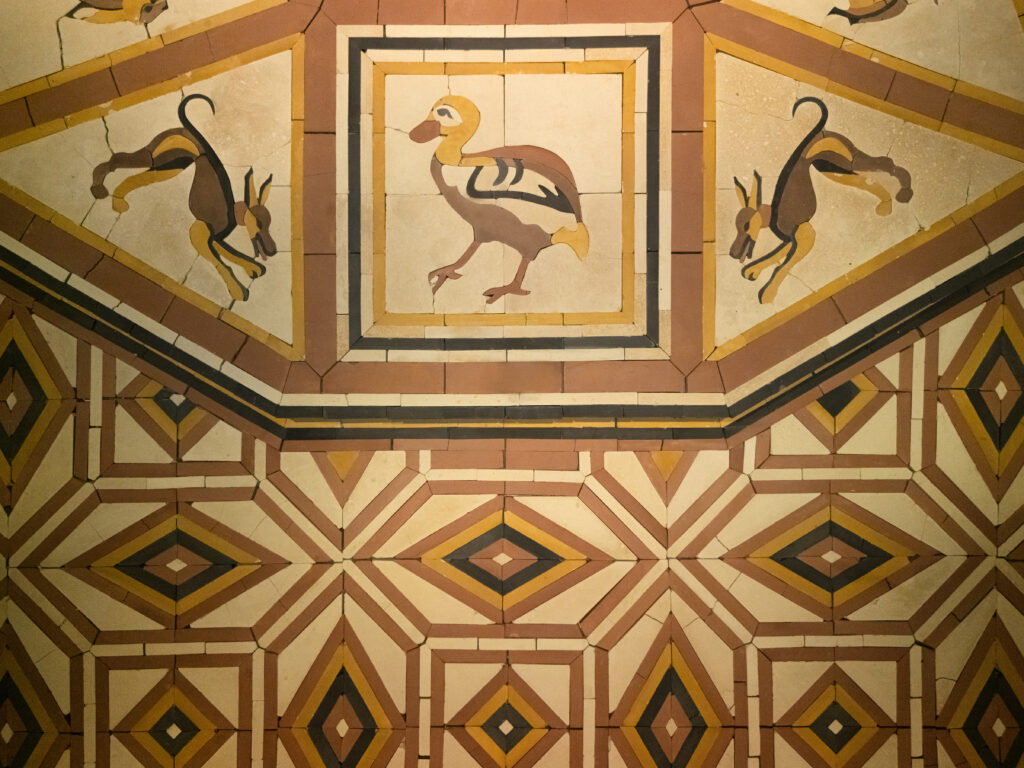
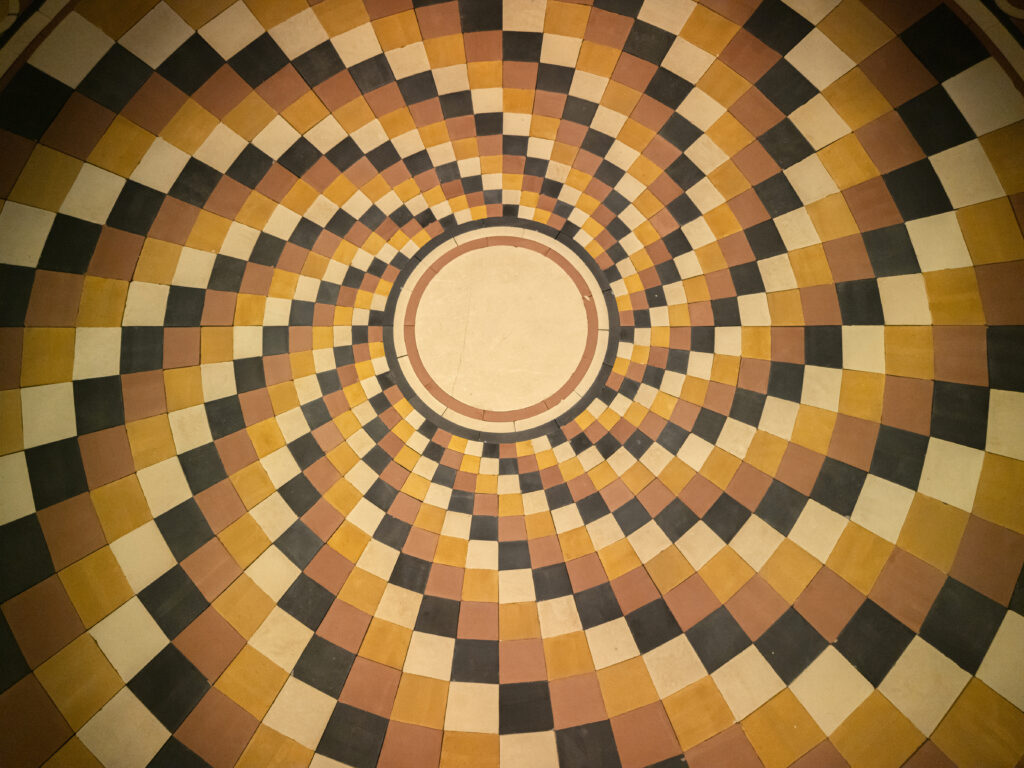
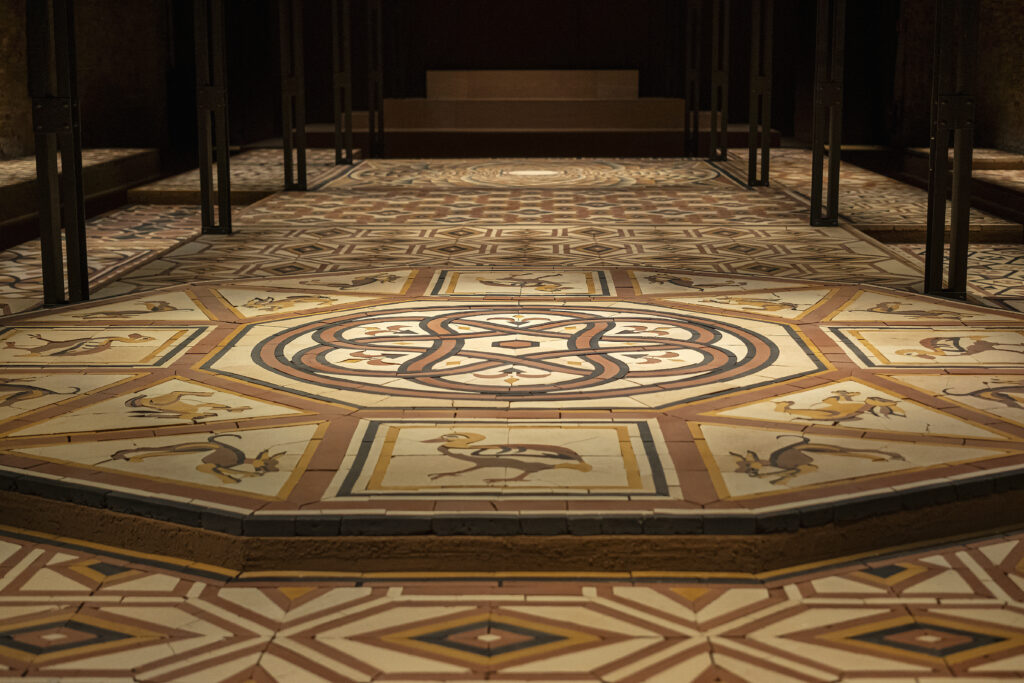
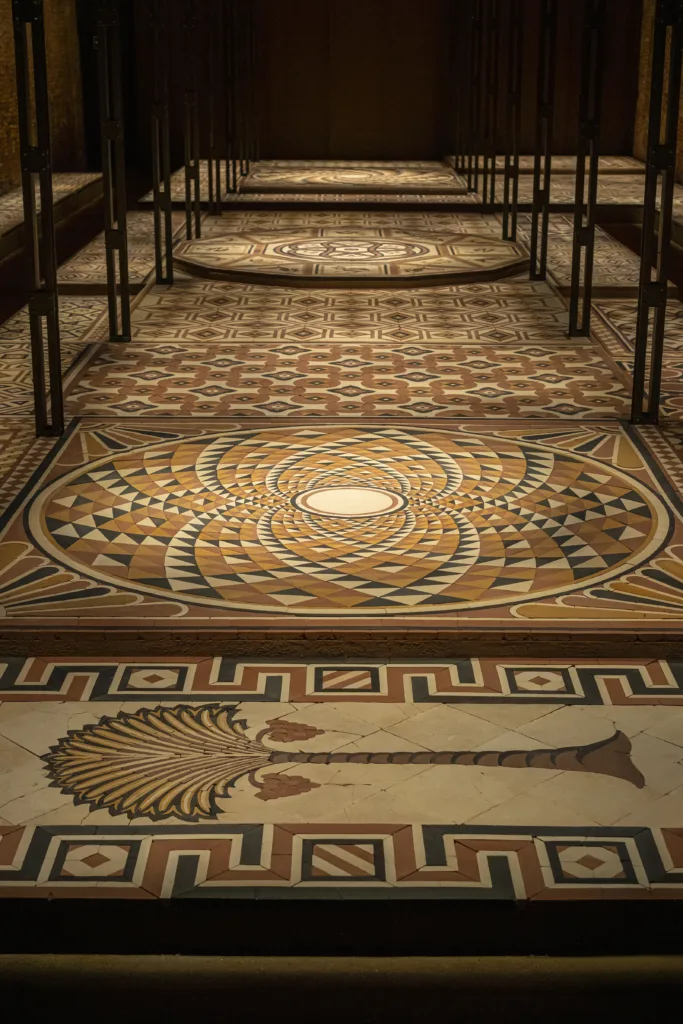

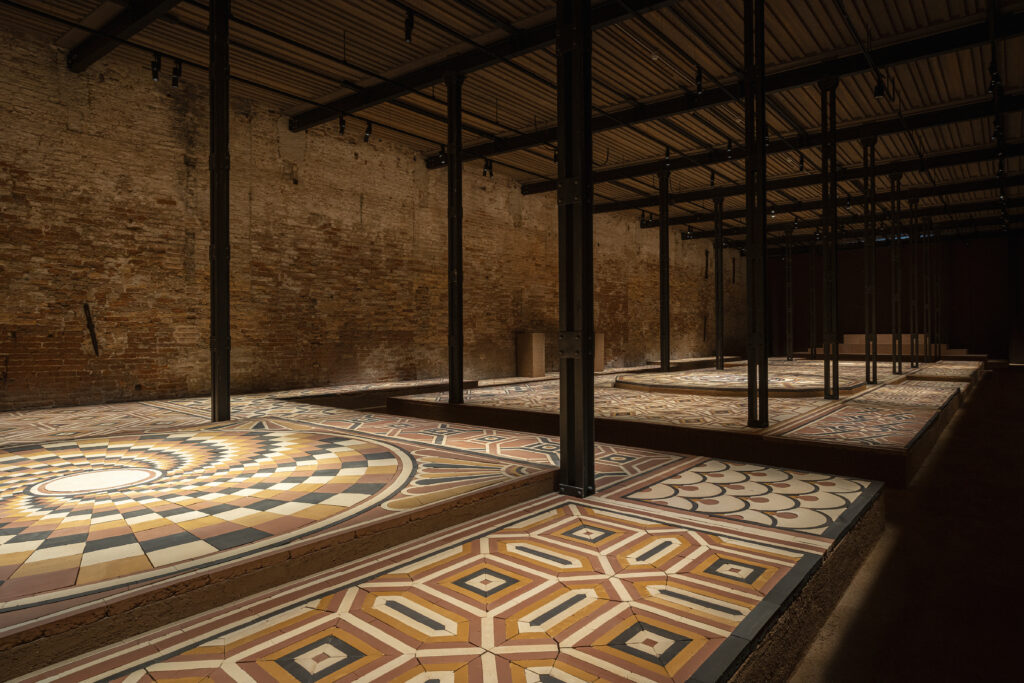
With recent works focusing on the destruction of heritage sites as a result of human violence, Dana deals with loss not by attempting to heal it, but by living beside it and remembering, questioning the pervasive ease with which we collectively forget. By reviving craft methods on the brink of extinction across the region, Awartani performs a double act of preservation: tending to sites and cultures targeted for erasure, while doing so through the very indigenous techniques that power seeks to wipe out. Here, she disallows the desire for certain political projects to wash one’s history away in favour of fabricating a false narrative on its rubble.
Speaking with her in the weeks leading up to the Biennale, we discuss her newest work, her relationship to craft, the politics of cultural destruction, the urgency of knowledge transmission, and the case for reorienting away from Western epistemologies, while exploring how what we presume lost might, in fact, still have life.
Sarra Alayyan: You’re about to start installing your piece at this year’s Venice Biennale. How are you feeling, and can you give us a sense of what to expect?
Dana Awartani: Yes, I can. The pavilion is site-specific and designed specifically for the pavilion’s dimensions, so it fills the whole space. It’s an immersive installation, and it’s documenting and archiving heritage sites across the region that have been destroyed historically and now. In particular, it includes sites in Gaza and Lebanon, and a lot of places that have been damaged in the past two to three years because of the war. It’s made out of clay bricks; if you’ve seen my previous work, it’s similar to the Standing by the Ruins series.
For this project, my starting point was looking at heritage sites that use traditional mosaic art, as I found the history quite fascinating. Originally, the first-ever mosaic was invented in Mesopotamia, in Iraq, and then moved to Europe, where the art of mosaics really flourished, and you see a lot of it, obviously in Italy because of the Romans, the Greeks and everything. In Syria and Palestine, we have a lot of mosaics because of Byzantine influences in the region – a lot of the patterning in these buildings in Bilad al Sham is patterns that you also see here in Europe; it’s a story of our shared heritage.
Every single monument I’m using in the pavilion that has been destroyed references a mosaic. I didn’t really want to do it in a way where it’s directly replicas or a map because I was really looking at the history of our region, where, before we were colonised, there were no borders. There were the cities, and there was freedom of movement and shared cultures. A lot of the time, when you see any patterns, geometry, styles, or mosaics, you wouldn’t necessarily be able to say clearly, ‘Oh, this is very Syrian’ or ‘This is very Palestinian’. It’s not like that; it’s shared. I wanted to replicate that idea of how we were as a region pre-colonisation.
SA: When we talk about the destruction of cultural heritage, especially sites, as you said, it’s not only a historical phenomenon – it’s happening now, whether in Gaza, Isfahan, or Muhaibib. How do you negotiate that collapsed temporality in your work, where violent ruptures in the past and present tense coexist?
DA: Throughout history, across Bilad al Sham, or in the Khaleej, some places have been destroyed and rebuilt, destroyed and rebuilt. Even if you look at heritage sites like the Grand Mosque of Aleppo, it’s not a stagnant building; when you see the minaret of it and the building, you can see the different cultural influences throughout history. When the Mamluks ruled, for example, they added an architectural design. When the Byzantinians ruled, they added mosaics.
I see a lot of these things as living. I specifically started the research off by looking at the sort of destruction that happened from Daesh and ISIS during the Arab Spring because that was really the first time I’ve seen purposeful cultural cleansing done due to religious fundamentalism. It started with that, but unfortunately, when I look at what’s happening now by Israel, it’s the same thing. It’s religious fundamentalism and a cultural genocide, in the same way that Daesh is doing. So, I’m looking at very specific forms of destruction.
Unfortunately, when I did the last Venice Biennale two years ago, I had to add on to an older work because of everything that was happening in Gaza. And now, with this pavilion as well, I’m adding to it what’s happening for Lebanon. If it were a couple of months ago, Iran would have been in there, too, because they are purposefully destroying ancient heritage sites.
For example, I think one of the mosques they destroyed in Iran now was older than the US, and it’s not just older than the US, it’s older than the US and Israel combined…It’s about people who have no care or respect for cultural heritage. Cultural heritage, for me, is not just very pretty to look at; it’s about a sense of belonging, and it tells our story and our history.
SA: When I think about cultural preservation, I often recall the notion that culture will reify if it does not move, if it is not transformed by those who steward it across generations to make it both their own. Your work seems to live here – in the negotiation with the contemporary and the need to animate, remember and grasp history to actively transmit knowledge. How do you approach this tension? Why is it necessary for cultural preservation to work this way?
DA: Absolutely, culture isn’t stagnant, especially in the visual arts or the traditional crafts. There are evolutions of it and everything. But I do feel that in the Arab world, there’s a huge disconnect between our history, our craft, our traditions, and contemporary art…I think specifically in the Gulf, there’s a disconnect from the past and the present in contemporary creative practices, and for me, it’s super important as it’s a way of understanding my own identity. Where are you from?
SA: I’m Palestinian–Jordanian with Iraqi heritage.
DA: Very similar to me. We live displaced from our home. I was born and raised in Saudi Arabia. I am Palestinian–Jordanian on my dad’s side, and my mom is Palestinian–Syrian, ethnically, but she’s Saudi. So where I’m from has always been a huge kind of question, because I’m Syrian, Palestinian, Jordanian, Saudi. Now I look at it as a strength: I come from many places, including the Khaleej and Bilad al Sham, and I can understand both perspectives. Through my art and when I went to the Prince’s School of Traditional Arts, I really learned about our history and culture. I was like, ” Wow, this is amazing and beautiful, and filled with so much theology and symbolism that it shouldn’t be something dead.” So I kind of use our traditional aesthetics in a way to talk about contemporary issues.
SA: Your education took a less-than-typical route – from graduating from CSM to then studying Islamic art in the region. What did you have to unlearn from a Western institutional education as you set about, perhaps, decolonising both your knowledge and your artmaking?
DA: Oh, totally. Actually, the unlearning happened during my master’s program at the Prince’s School. Sadly, we didn’t have art education in our region that teaches you the history of traditional crafts from Bilad al Sham, or the Khaleej at that time, although now it’s starting. When I first went to CSM, and I really do value my time there, because I was taught how to think critically, how to develop research, how to understand theories of art and stuff like that; but what was of very low priority in the program was how you made – the idea trumped the materiality…I didn’t really like that disconnect where production, materiality and medium are secondary to the idea. Also, when I was there, I think my advisors really struggled with how to advise me–there was just me and one other girl who were the only Arabs in the whole program. So they didn’t really know how to guide, which is fair enough, it’s a British university in London, but there was a limited idea of references to artists from the Arab world, there was Shirin Neshat and Mona Hatoum, and that’s it. And I was like, ‘Is that the only route I’m supposed to take? I either talk about suppression or exile, is that it? Is that all that is the Arab identity?’
I started reading Edward Said’s Orientalism, which was extremely formative for me about this gaze towards the Arab world. So then I ended up going to the Prince’s school, and the first thing they told me there was, ‘We don’t care that you’re a contemporary artist, you’re coming now as a crafts woman for two years, and you’re going to leave your ego at the door.’ The difference, they said to me, between traditional craft and contemporary art is that contemporary art is made by man for man’s ego, and traditional art is made by man as a form of worship for the divine.
So a lot of traditional crafts, I can say, at least for the Arab world, are rooted in spirituality. I love that so much, I learned so much from manuscript illumination, calligraphy, icon painting, making my own pigments, gilding, parquetry, and ceramics. It’s so abundant and so rich, and I questioned why it was forgotten. Why is it no longer used, and why is it stagnant and stuck in the past?
A lot of the people who graduate from the Prince’s school become very traditional craftspeople, continuing a craft rather than working in art. I wanted to combine both, asking how to incorporate the traditional with the contemporary. That’s always something that I try to do in my practice, and the main core element of it.
Also, when I learned much more about the actual craftspeople in our region, especially in times of conflict, it’s that they’re under threat and nearly extinct. When people are forcibly displaced from Syria, Iraq or Palestine, they cannot continue their trade. They come to Berlin, the UK, Italy, wherever, and they become refugees. Most of the refugees end up taking menial jobs to survive. I remember reading an article during the civil war in Syria saying that, before the war, the old souk in Damascus had over 20 workshops that just did traditional sadaf –mother-of-pearl inlay– after the war, there’s only one left. This knowledge of traditional crafts, which I learned about in Istanbul, is not something you learn in a book. There is no way you can sit down and learn from an online course or from YouTube videos; you need to sit with a master as an apprentice. It’s not even the traditional ways of learning, where you enrol in a one, two, or three-year course–you train with a master as an apprentice until they feel you’re qualified. It was a very humbling learning experience.
SA: That’s beautiful, it’s stewarding embodied knowledge from one generation to another.
DA: It’s an Eastern way of educating that we don’t do anymore, as well.
SA: Indigenous knowledge sharing is not fast; it’s intentional and often slow. As you said, it’s not meant to be linear or based on a rigid curriculum; it’s something that changes the way we think about time entirely.
DA: From a global context, another big reason I work a lot with craft traditions is that I see many solutions to the problems we have now in craft from an environmental perspective. Just one example, when I did my textile dyeing in India, I learned that one of the main pollutants of India’s rivers is chemical waste from textile factories. If you revert to using natural dyes, which we’ve done for centuries, you won’t have this problem of polluting rivers. The fashion industry also has a new trend now: slow fashion. Slow fashion is handmade, traditional crafts, right?
Mending is also becoming very trendy. But historically, our grandparents, they knew how to mend. My teta, for instance, when things were destroyed, she would not throw them away. She’d fix it. We lived in a way that was much more sustainable and sensitive to our environment than the industrialised sort of civilisation we’re in now, where everything is mechanised, and the human is becoming secondary to the machine…And then you see these really funny craft retreats for burnout people when you’re burnt out. Or how we all love watching home renovations, where people redo houses, and it’s seen as a way to relax and step away from the stressful world. That’s traditional crafts. As human beings, we need that connection with our hands. Living in a city like New York, for example, you’re in a concrete jungle – even contemporary architecture isn’t built for human beings. It’s built for capitalism.
But, still, in every single aspect of society and different things. There are always solutions in putting humans and the earth first. Even in Gaza, I remember seeing an Al Jazeera broadcast where, when there was no electricity in Gaza, how were they cooking? The women were building traditional clay ovens. So found objects. They used clay Earth, the same material I’m using to build ovens to survive. And another one I saw is that during the winter, the tents they lived in were not sufficient. Also, there was no cement, bricks or anything. So they were building, they’re building homes out of mud, earth, the traditional method of mud-earth houses. So craft can also save you, and as a form of resistance. Yes, Israel can cut off electricity, and put a blockade, but they can’t stop you from using the earth to build an oven, a house or whatever.
SA: It’s a form of autonomy.
DA: Yeah, and you see that across all cultures. Suffragettes in the UK used craft. They’d do patchwork to put up all their political slogans and walk the streets with them. Mahatma Gandhi did that to oppose British colonialism, too. He said, stop buying British cloth. Start weaving your own cloth – taking ownership of the craft was a way to economically cripple the British.
SA: I’m curious about this one strand that runs through a lot of your work, which is repair, as well as I think it’s inverse, which we touched on briefly, in destruction. This translates into both the materials you use and how you use them, and why. Can you first explain a bit more about what “repair” means in your work?
DA: It’s a huge theme, of course, unintentionally. I think, for me, it was really witnessing all this destruction on TV and feeling absolutely helpless, like there was nothing I could do to stop it. So for my work, especially, let’s say the Retta works, the fabrics, that is a very cathartic experience for me, it’s a way I can heal. I feel I am mending something.
So it’s very personal, and it’s very much like, what can I do? When I see this literally, what can I do? It’s a healing, kind of meditative experience for me, more than anything else, in terms of the textile pieces. But also, what I’m doing for the pavilion with the clay Earth, I want to show the sense of fragility in the work. Even though these bricks cracked, they’re rock hard as well when you sun bake them. There’s this balance between repair, fragility, and resilience in it, too. Ultimately, I think it’s just a matter of the consequences of what we’re going through. Destruction is everywhere. What can I do besides repair?
SA: Is there perhaps also a sense that repair is not necessarily there to retrieve loss in its entirety, but to live and work beside it?
DA: Yeah, and I do think of it as well as the recreation of something is a form of resistance to, in its own way. When people are trying to erase that and say it never existed, or it’s not correct. I think recreating these things and putting them on one of the largest platforms in the world says, “No, we are still here.” “You try to erase us, but we will rebuild.” And that’s true, a lot of the buildings throughout history that have been destroyed are being restored. I know that in Gaza now, I think they’re starting some restoration efforts. I mean, it was very difficult researching Gaza because of the blockade; we don’t know the full extent of the damage. The only references I’ve been using are UNESCO, who are doing a live update and archiving ground photos, and we will rebuild. But what’s just super sad about us and Lebanon is that these places survived so many invasions. They survived the Crusades, they survived all different empires, but not this occupation. It is a war crime, whoever you are, whether it’s the US, whether it’s Israel, whether it’s Daesh; the destruction of cultural heritage is a war crime under the Geneva Convention.
SA: Does nostalgia ever enter your work? And what role does imagination play – particularly in how you approach sites or traditions that have already been partially or destroyed?
DA: I think so unintentionally. I think I’m just in a fantasy land, I live in fantasy land in my head, where I do believe that even with the history of the Arab world that has always been destroyed and rebuilt, ups and downs, there is this kind of positive possibility. That said, learning about traditional crafts creates a sense of nostalgia. When you’re going to like museums, and you see the mother-of-pearl inlay, or the ceramics from Iznik tiles from Istanbul, to the woodworkers in Morocco, it’s living. It’s not dead, you see it in the buildings. I can just imagine the Craftspeople 1,000s of years ago doing it. It connects me to them by also doing the same technique. There is no change in it. And then when I collaborate with craftsmen, we don’t cheat. So I always embody that in our production process as well.
SA: From everything I’ve read, it seems collaboration is very much inseparable from your practice.
DA: A lot of the time, yes. I still hold on to the core of what I do, which is drawing and painting and stuff, but when it comes to sculptural works that I’ll do outside the studio, I don’t like going to a production house, a company, a factory; I go to craftspeople…In a lot of cases, I hire craftsmen full-time. So for me, it’s answering the question of how I can use the production grants I get for biennales for projects in a way that kind of supports and makes a difference?
SA: I love that. And you’ve partnered with many initiatives before, right?
DA: Yeah. One of the big, important ones for me was learning about the World Monuments Fund, which ran a training program for Syrian refugees living in Mafraq, Jordan. It’s on the border with Syria. So they fled, and there are thousands of them just living in refugee camps. So the World Monuments Fund trains refugees in craft. For example, if they wanted to train them in the art of stone masonry, the idea is that when they return to Syria, they can be the custodians of their own sites and learn how to rebuild them, rather than parachuting experts from the West.
SA: How can we approach building a network of knowledge transmission around craft and cultural preservation that can thrive beyond a single person or practitioner?
DA: You know, I really think it’s your mindset for people, because they have to want to do it. Craft is slow. Craft takes time, and in the world we live in now, slow and time is not conducive, especially as an artist. Unfortunately, artists, a lot of the time, are expected to produce on mass for the commercial market – to produce hundreds of prints, hundreds of this or that. I don’t work that way. Everything is one-off and unique. Nothing is really added because there’s also the ethical issue of not wanting to ask a human being to make me 20 of the same object. It kills their own creativity. It’s a commitment to work with craft.
Even in the fashion industry, it’s the same thing. There is an NGO called Mansoojat, which focuses on archiving and preserving traditional costumes from across Saudi Arabia. My mother is one of the founding members and from a very young age, I remember her dragging me to the meetings or if they needed a model. I grew up around that, but I realised, after learning from Mansoojat, that women wearing black abayas and men wearing a white thobe is not traditional.
Historically, every single tribe and region in Saudi Arabia wore very beautiful, colourful clothes, and you could tell where they’re from in Saudi Arabia, what their status is in the tribe, if they’re married, just by what they’re wearing. But obviously, when they homogenised the country, the tradition of the kind of tribal identity was erased. What Mansoojat does is actually to show that, no, we never wore black and white. If you look at traditional costumes from the south, they’re very similar to those in Yemen; they wear a futa. They don’t wear a thobe. If you look at the Eastern Province, a lot of the textiles came from India, so there’s a lot of gold, a lot of blue and red. When you look at the western region, it’s mostly yellows and greens coming from Africa. So the history of our traditional dress is very diverse.
SA: What, if any, is your favourite material to work with?
DA: I know I don’t have a favourite because I love the textiles, I love working with ceramics and clay, I do enjoy wood… I enjoy everything, but it’s different. I do love mostly the textiles and the clay Earth, but the textiles require very intricate, focused work. But then the clay Earth, because you’re working with the elements. With this pavilion, all of it is made of natural materials. There is nothing synthetic, metal, or anything in there. The material itself is clay Earth, which is soil from different parts of Saudi Arabia, because you’ll see the bricks have different colours. Usually, different places in the Kingdom have different kinds; the red clay is from Gasim. The white one is from here, the blacks from there. It’s just that: pigment and wood, nothing else. Also, this pavilion is made out of 29,221 bricks that we produced.
SA: How long did that take?
DA: Months. We were also battling the weather. We needed to do it in Riyadh as Jeddah is too humid and it doesn’t have the tradition of clay earth, so we had to produce there. But the problem was that it was winter, which was a huge problem – if it rained once, it would have melted everything, so we would sit every day checking the weather. Then, after it was the war, the shipment got cancelled so many times. So there were all these crazy circumstances that were out of our control that we had to handle during production.
SA: It must feel good to be there now – the finish line is in sight… How does it feel to be the first person really to represent Saudi Arabia from Jeddah?
DA: I’m super proud because I feel like I’m representing our artistic community, which is diverse and very similar to me, and where the past two editions featured one artist from the Eastern Province and one from Riyadh. So I’m glad that I have this opportunity, and also it’s an education for the wider public, because when people in the West think of Saudi Arabia, they think of a very homogenised identity when it’s not.