
 Photography Andy Guerrero
Posted in
Art & Photography,
Photography Andy Guerrero
Posted in
Art & Photography,
Buried Alive: Atmospheres of Incarceration in Allen-Golder Carpenter’s Sojourn
Text Linn Phyllis Seeger
Microclimates are localised climatic systems defined by distinct thermodynamic conditions in the landscape, terrain, and human or natural activities. These extend into various modes of human production, from the more personal architecture of one’s own life to cultural institutions. Cultural theorists Giuseppe Maino and Umberto Lucia from the Polytechnic University of Turin, for example, argue that museums and exhibition spaces comprise a particular category of such microclimates: in order to establish an environment for art to be preserved and enjoyed by visitors, the building’s temperature, air flow, and humidity must be rigorously monitored and manipulated. Within these climatic systems, art no longer operates as a mere cultural artefact, eliciting affective or intellectual responses. Art is turned into a “technical physical subject” which determines how energy is stored, circulated, or transformed in its immediate surroundings.
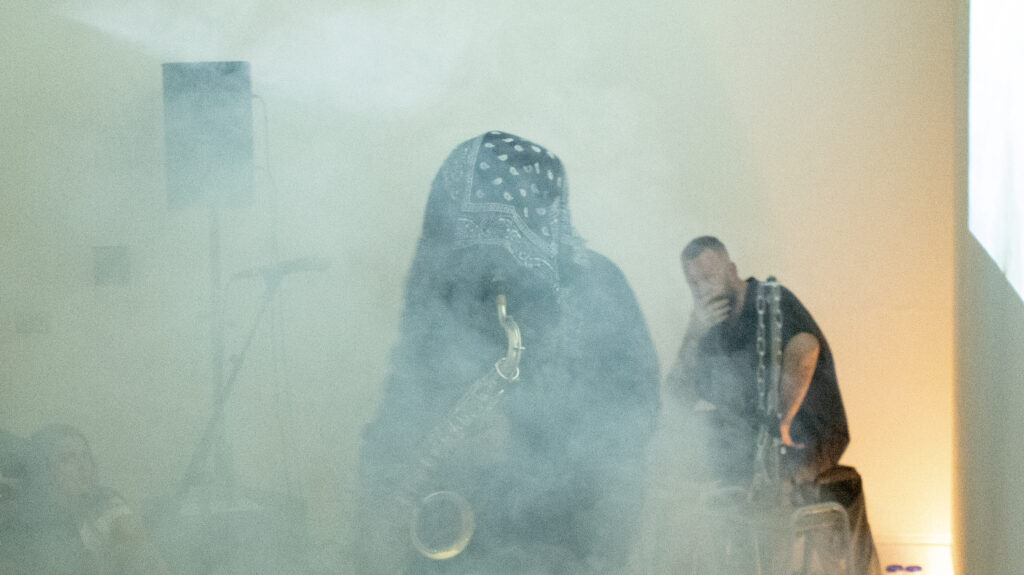
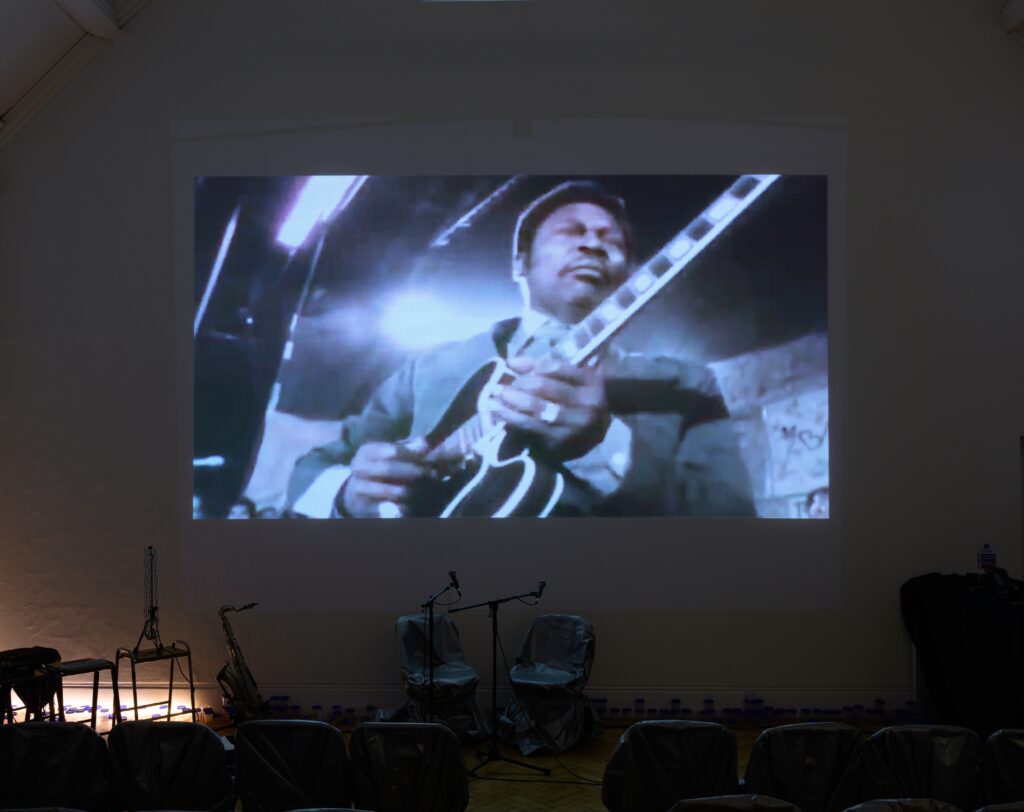
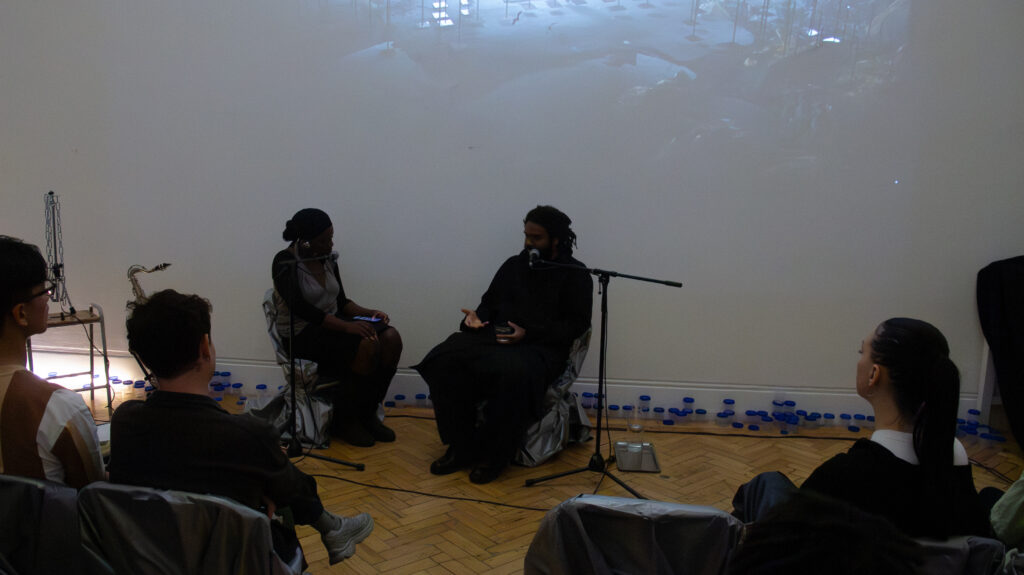
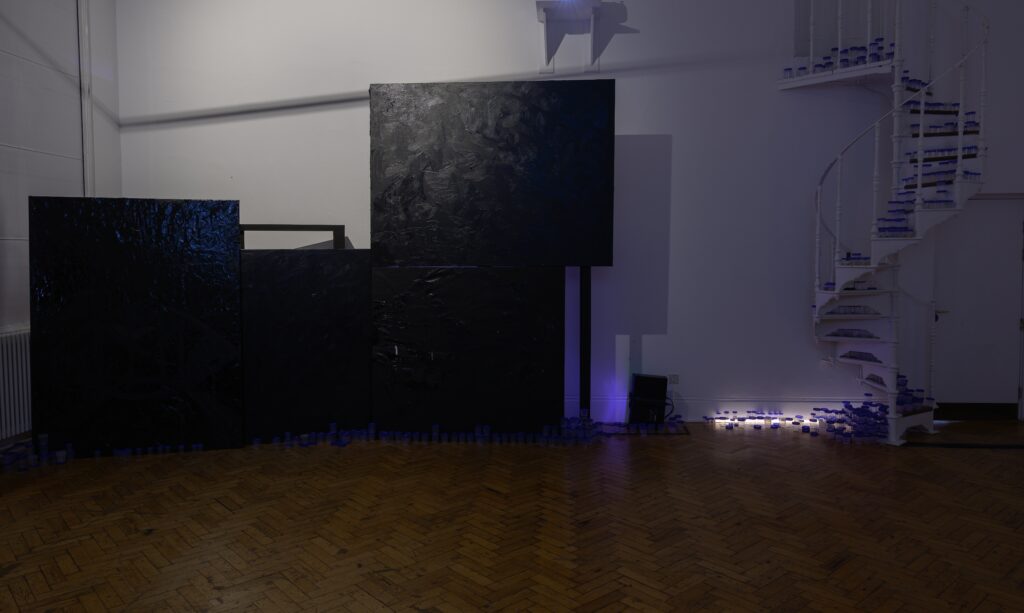
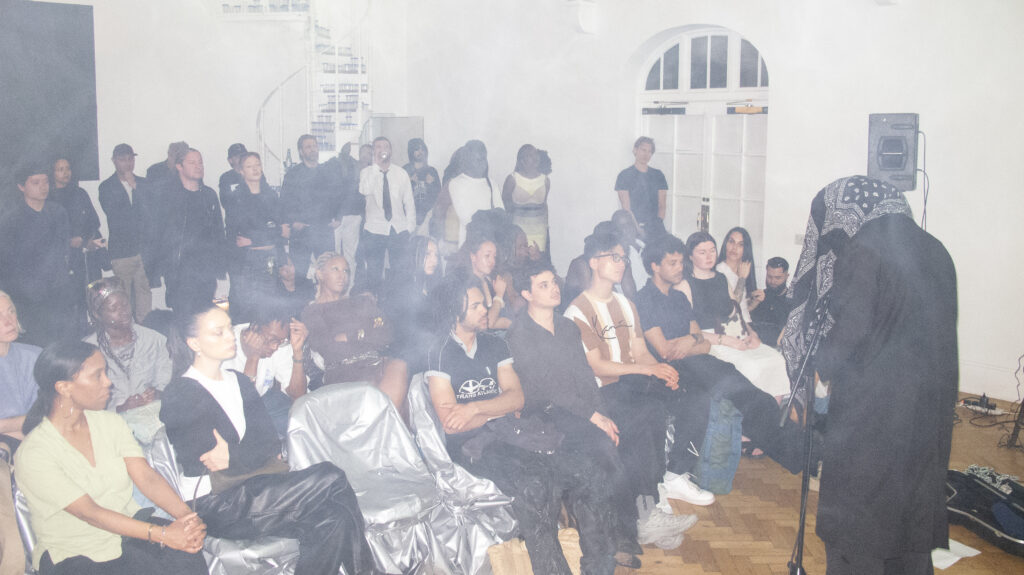

Allen-Golder Carpenter’s Sojourn, screened and performed at Camden Art Centre in April, did not only demand a certain atmospherical condition to be established for its preservation and consumption. Instead, it was the artwork itself which created a hyperlocal climatic system, altering the thermal and hygrometric state of the exhibition space.
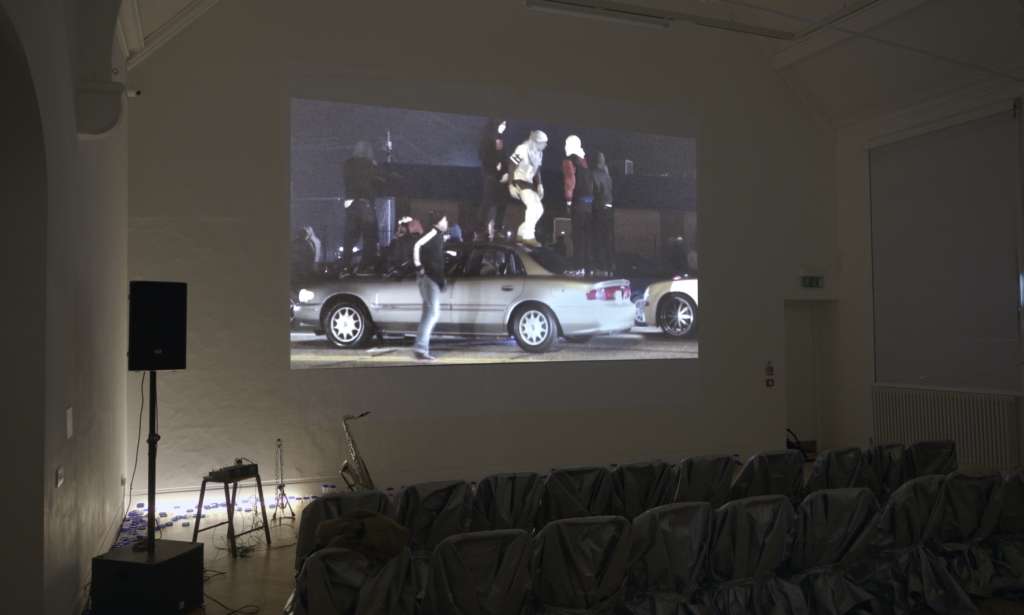
Staged as an iteration of his recent solo exhibition at Tick Tack in Antwerp, Sojourn was centred around a large-scale projection of Carpenter’s eponymous film. And yet, the event scheduled that night was by no means a screening. Reappropriating remnants and signifiers of state violence, pop cultural artefacts, and vernacular technologies, Sojourn set up an immersive, multimedia scenography that viewers were inevitably forced to become a part of. Sojourn allowed no severance between screen and auditorium. Living through the work as it unfolded and transformed the space for the duration of an hour was part of its very materiality.
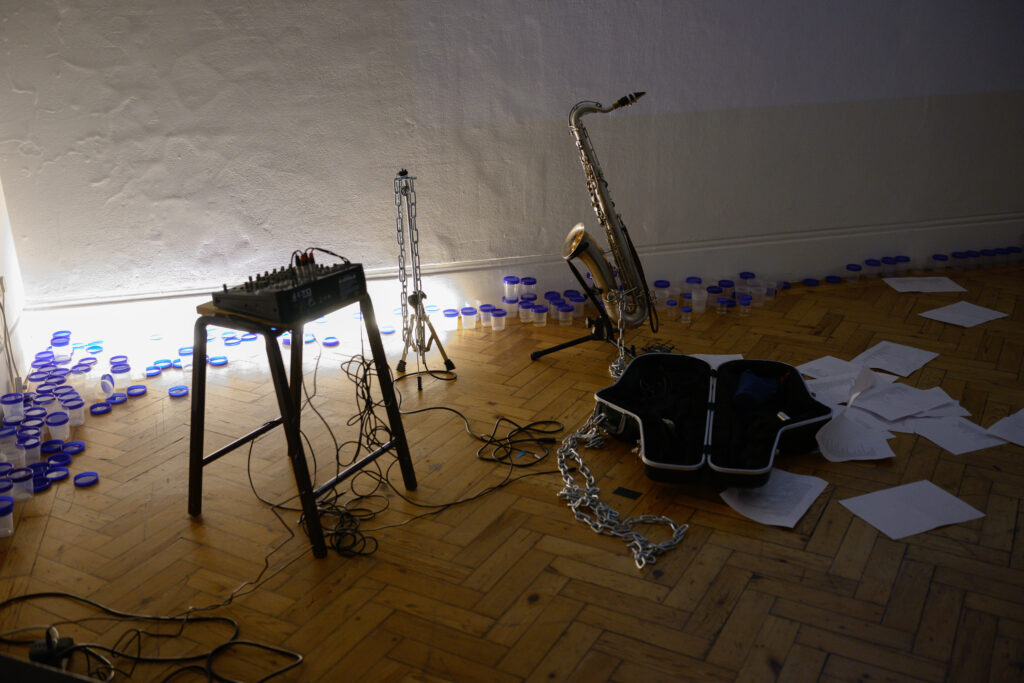
At the end of a warm day, sheltered behind closed windows in the upper galleries of Camden Art Centre in London, the synthetic environment of Sojourn revealed itself as a form of enclosure. Audio-visual motifs present in the film metastasised into the space, materialising as an interior landscape suddenly everted: urine sample pots, smoke machines, acrylic paint, duct tape, saxophone, projector, metal chains, canvas, tripod, silver tarpaulin, spoken word, chairs, cameras, LED screen, wood racks, human audience, phones. Populating the space as equal components of the work with no identifiable hierarchy of materials or media, each of these elements seemed purposefully deployed to affect the room’s temperature, humidity, sound, light, and mood. In consequence, despite providing narrative fragments and context through his film, Carpenter’s dominant artistic medium did not emerge to be moving image, nor painting, nor installation, but atmosphere conditioning.
Time and time again, contemporary state violence has been proven to operate not only through the assertion of physical force. Equally, it exerts power by establishing political climates in which marginalised groups and individuals are made to experience life as suffocating and unliveable. While spreading infectiously across demographics, geographies, and borders, these distinct socio-economic environments materialise as inescapable enclosures, incarcerating citizens within atmospheres.
In her seminal book In the Wake, Christina Sharpe defined “the weather” as constituted not by meteorological phenomena but by an absolute and pervasive climate of racial violence permeating Western societies. Sharpe’s terminology is analogous to the way in which Carpenter articulates the atmospheric conditions that facilitate civil death. They are equally determined, maintained, and altered not by single, temporary events but by interconnected conditions, substances, imagery, and sounds that permeate the larger ecosystem — such as the smoke density which increased steadily with the audience; canvases trenching the back of the space; metallic tarpaulin sheets wrapped around each seat, reflecting the surrounding light and trapping air flow; or bodies crowded together, illuminated by the dim glare of mobile screens, recording the work while inhabiting and altering its ecosystem.
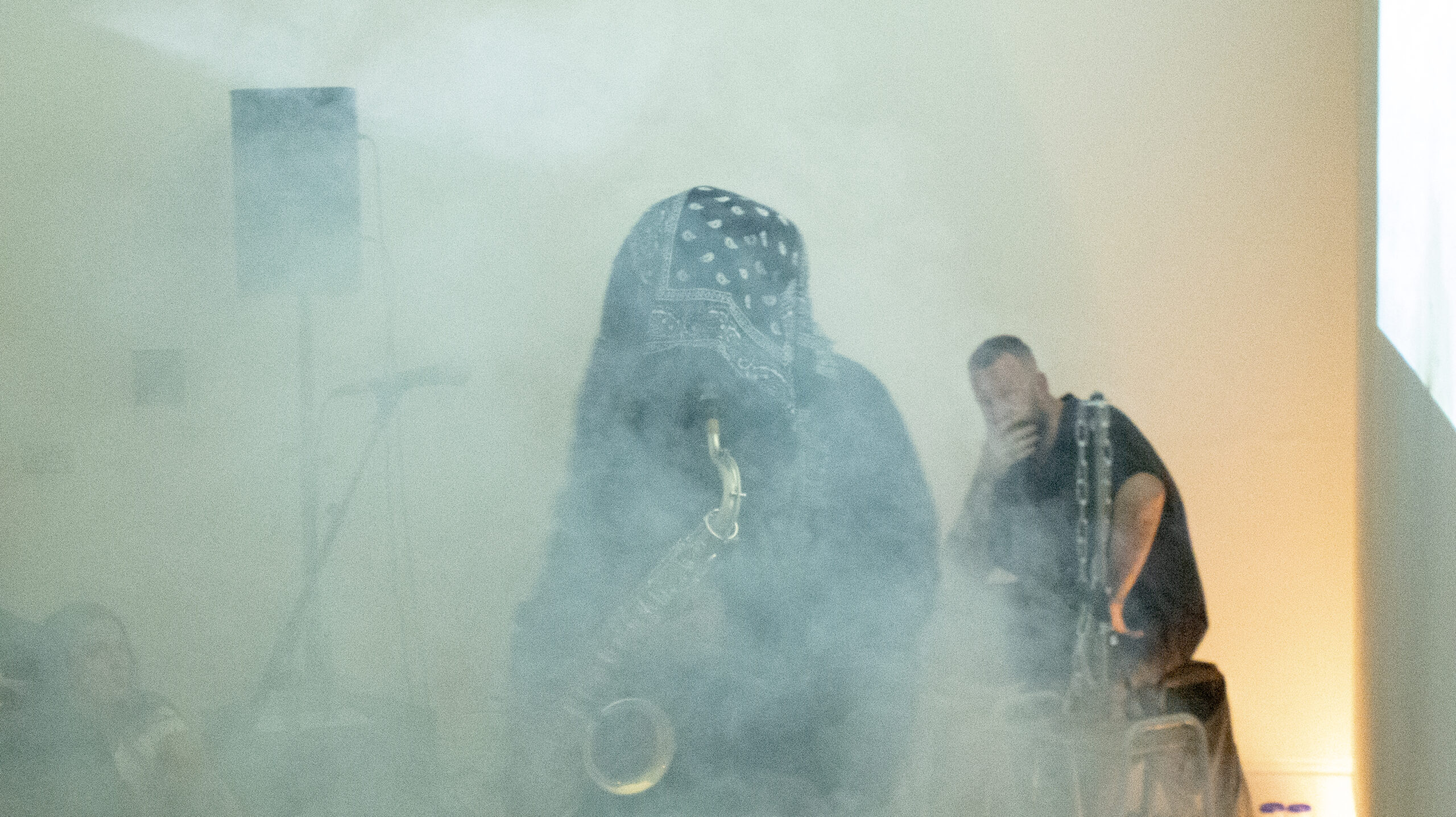
Standing out against the projection of Sojourn, face and head obscured, Carpenter was visibly suffering through an atmosphere of his own making. Sweating under his paisley scarf, he was simultaneously subjected, and subjecting the audience, to a microclimate in which no single event or item caused the pervading sense of confinement. Instead, the combined force of imagery, visitors, tear gas, jazz, night terrors, TikToks, urine, duct tape, and ICE whistles made up the atmosphere of the work, materially and conceptually.
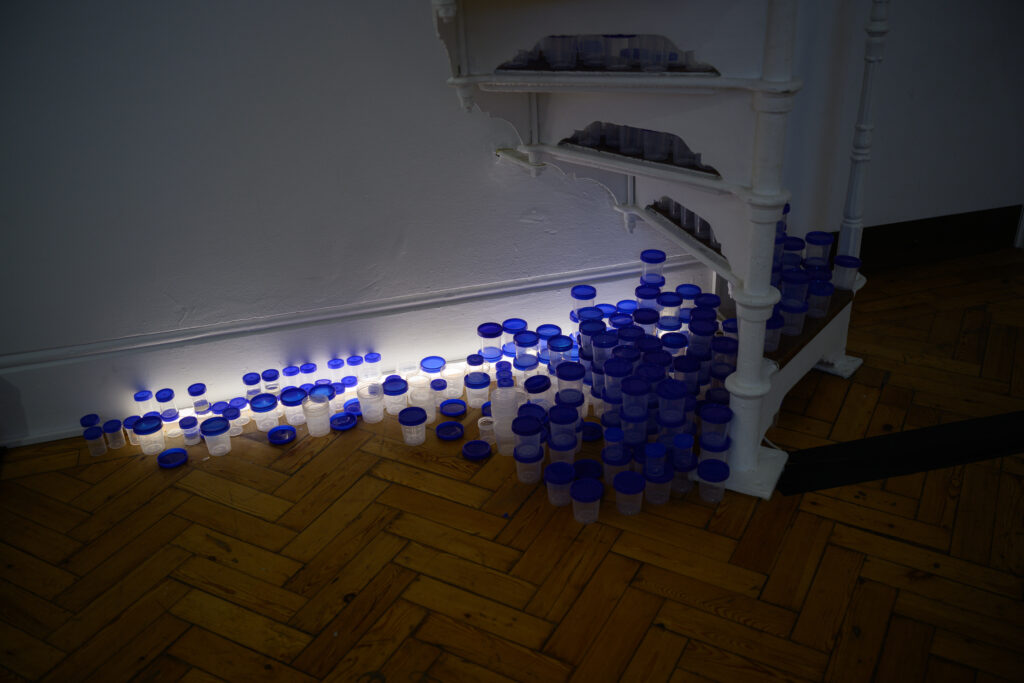
Alternating between playing the saxophone and reading what he described as poems, Carpenter kept pushing himself to his physical and emotional limit. Lyrical and livid, erratic and misaligned, the incessant stream of autobiographical fragments, half-finished motifs, and references were irreversibly cumulative. Some laden with fervour, some riven by grief, some diffuse and cloudy like the urine cups spread across the space. Each cup a monument, each poem an elegy to no one in particular, and everyone he’s ever known. All revolving around this single, unanswerable question: “How can I memorialise people in my life, parts of myself, parts of myself that have died, in interacting with this world that surveils us and politicises our physical being?”
Linn Phyllis Seeger: First, I’d like to ask you about the saxophone, your relationship with it. Did you grow up playing the instrument or is it something you just picked up for Sojourn?
Allen-Golder Carpenter: The saxophone is actually something that I’ve returned to. I learned to play in middle school band. I’ve always loved, and still love that instrument. But I never played it again after 8th grade. When I came of age and became an adult, I learned about jazz, jazz history, the philosophy around jazz music, and the saxophone became something that I really wanted to tap back into. My horizons have been expanding so much that I can actually produce interesting, unique new sounds with it outside of the age-appropriate sheet music. A saxophone is like a priest performing religious rites. It’s like a portal in history for me.
LPS: I was wondering if the specific tune you were playing is something you improvised, or something you wrote for the performance – or is it a reference, a cover?
A-G C: I don’t have any songs really, but I use these loose frameworks that I stitch to each other. I have certain instrumentals that I produce that I’ll just play a certain way over and a over. There are recordings of them but they’re always a bit different each time I play them live.
LPS: And the musician that you worked with who did the soundscape, Richie Culver – have you worked with them before?
A-G C: Multiple times. I’ve collaborated with him more times than with anyone else. He’s actually been one of my heroes before I was even involved in art. His friendship has had a significant impact on my career. He’s one of my favourite musicians. And because he regularly performs spoken word over soundscapes, I asked him to voice act one of the roles in the film [Sojourn]. I wrote it to sound like one of his songs. He also produced the sound for the film, and for the performance, I asked them to do the live score. He came back with the idea of implementing one of his chain performances. I thought it was a great idea.
LPS: I‘ve been interested in your use of text and writing. Is it autobiographical? Is it quotes? Is it a song?
A-G C: It’s an evolving chain of poems I’ve been writing for the last three years. It’s autobiographical. It’s memoir-ridden, it’s philosophical. Every time I’m feeling some shit – like, really feeling some shit – it lands in there somewhere. There’s two pages I didn’t even get through during the performance. But it’s everything I had to cope with. Or everything that I felt like sharing about everything that I had to cope with in the last few years … it’s in there somewhere.
LPS: How would you label it? Is it spoken word? You mentioned poetry, but considering the way in which you perform the text I was wondering how close you perceive it to rap, or generally, to music.
A-G C: It lands there at times. There was a part of it all, not only the writing and the performance, but also the production, that was meant to land closer to rap. I use all the instruments that go into a rap beat in the production and the part of the soundscape that I designed. I use them in a very loose, broken, and minimal way. And then, in parts, they’re kind of meant to tighten together in a way that’s recognisable as the sound of rap. I play with that. And then it breaks back apart.
LPS: So writing is something that you have been doing largely in private, to process your experiences. But more recently, you’ve also started scriptwriting, specifically for Sojourn. What would you say is the role of writing in your practice more generally, beyond this particular piece you’ve been working on?
A-G C: I was writing before I was doing anything else. Even when I was a kid, I always wrote stuff. The writing is throughlines. Or whether it’s the ideation around an installation, or a script for a film, or lyrics, everything that I do is a means to explain myself, what I’m feeling and thinking. Because my biggest fear is being misunderstood. So all of this is just in service of reaching and understanding.
LPS: While everything you do is about communication, you also told me you just couldn’t face the audience while you were reading. You covered your head with your scarf during the performance, instinctively hiding while revealing something so personal. But through the way you were positioned on stage, your scarf actually looked like a mourning veil. I’m interested if covering your head was something you just did to protect yourself while on stage, or if it was also a conscious gesture, or a form of costume. Was the role of a veil within rituals and mourning customs something that you were explicitly referring to?
A-G C: It’s not explicitly tied to that but I think intuitively it is. I feel my instinct to hide comes from a very similar place, the idea that underneath that veil is very visible distress. It’s just that the distress that I’m in is very different, or looks different, from mourning at a wake. Whereas, I was visibly fried underneath that. I was giving everything that I could. And it comes back to privacy. There are parts of the performance that the audience is meant to see, and there are parts they are not meant to see. What’s underneath that veil is a conversation I’m having with myself that other people aren’t supposed to be sitting in on.
LPS: Then I wanted to ask you about the paintings, specifically, about the way they were installed – almost as barricades … it was a form of architecture. At the same time, they seemed fragile and porous, allowing you to look straight through them, peek behind them. Those paintings, in that sense, were not functional barricades protecting anything. They instead left the space open. Even visually, the paintings appeared as monochrome black surfaces from afar, while exposing intricate textures from up close, and distinct layers of paint and gestures. Despite their opacity they were not flattening out information or obstructing the view; they actually laid bare what was behind them. And the black pigment itself appeared thick and tactile, almost gooey. I’ve been interested in your relationship to that idea of opacity as something that simultaneously conceals and reveals, and in your approach to painting as architecture, as barricades that keep something secure while also being open and porous, almost inviting viewers to transgress.
A-G C: Those paintings are intended to reveal to the viewer more and more details, the more time they spend with them. And even then, there’s still things that are kept obscured. In two of those four paintings there are these subdued Mercedes logos which also appear in the film. They channel this – I call it – hood-aspirationism. The presence of the Mercedes in the film is in between legibility and illegibility. And part of it is rewarding those who are curious, who care to investigate, but even then still withholding something beyond that.
And the presentation of those trusses that were made to suspend the paintings were very heavily inspired by a Sigmar Polke show I saw at the Pinault Collection in Paris. The paintings were done on transparent, translucent silk screens, suspended from metal structures that held them off the wall. You could see through them and light could pass through them. The structures also had guardrails to protect the paintings. So there was this bespoke structure that fed the aesthetic of the paintings but also existed to compliment the function of the space, and affected the egress of the space. That was a really big inspiration: to control a three-dimensional room with two-dimensional objects. Conceptually, the paintings were a way to assert the scale of blackness in a space without the usage of any kind of image. They were this conceptual barrier that withheld something, like the moving image piece behind them that anyone who was curious enough to look would be rewarded with finding. There’s a lot of people that passed in and out of that room and didn’t realise it was there. But those are the ones that it was really not for. Ultimately, I’m also a museum worker. I spend a lot of time observing how long people spend with art. I see more people miss key aspects of work than I see them catch it. That’s also something that I’m playing with, the relationship between the piece that was being screened and the piece that was hidden behind the paintings.
Every motif in that room is carried from the original presentation that the film was made for. That installation with the urine test cups, the projections, all of it was evolved from an original iteration at Tick Tack. The gallery is spread across three floors, and each floor – just as each chapter of the film – was meant to represent a different stage in this cycle: [1] reincarnation or an afterlife, [2] an earthly Rome, [3] a purgatory, and [4] an in-between, transient place. Like a grave, a grave is one step in that. That original installation was in a room that was relegated to the concepts of burial: a grave, memorial, purgatory, transience. Because in the film, before the climax, the title character passes through this purgatory kind of place, full of people that are suspended there. People who mirror them. And then they are greeted by this voice that tells them that they have the choice either to pass on, reincarnate, try again, or stay here in this limbo. You can stay here if you want, or you can move – choose to try and move on.
Being from the hood, I see people get trapped in a lot of states of living … really getting stuck in cycles and being unable to move on. Just purely out of the circumstances that were handed to them. I’ve seen people lose the will to try again, or even if they tried to move on, that the circumstances kept them there.
LPS: Those urine sample pots you’ve installed across the space – you mentioned during your talk that a family member who was on probation while you were growing up had to hand those over on a constant basis. But it ended up being your urine samples that you kept handing over for them. Thinking about this accumulation of cups I was wondering if it’s an archive or a reserve, if it’s more about the act of memorizing or commemorating this experience of governmental control and state violence, or if you are building a stockpile in a way, for future use. How would you categorise it?
A-G C: That’s actually really interesting, that concept of a reserve. And that might be in there somewhere. I just haven’t realised it yet. But for me, it felt like a memorial. A memorial to this concept of dying a civil death. Being bogged down by the baggage that comes with being processed through the system. And I do like quantities of things, I’m not gonna lie. There’s this weird fixation with quantity: just imagine how many urine sample cups someone on criminal probation will have to hand over, over the course of their probation. Some people are on probation for years. I’ve been interested in putting a number to that, to the depth of that bodily surveillance. I’ve also been thinking about how many people in my life that I didn’t even know about were having to do that. There are people I went to school with that were on probation. How many countless people had to give countless parts of their physical being away to the state? It really is a monument. If you go to Arlington National Cemetery in Virginia, they have these endless rows and rows of identical headstones for soldiers. I’m calling on that same kind of quantity, but in a much less structured way. These cups are scattered and misaligned and some are filled, some are broken, some are hidden. It was really kind of flipping the politics of a monument on its head. A big notion in the original exhibition was thinking about who we build memorials for. What do they mean? How can I memorialise people in my life, parts of myself, parts of myself that have died, in interacting with this world that surveils us and politicises our physical being in certain ways?
LPS: While you’re discussing death and mourning in your work, there’s also a form of rage, for instance, in the way you perform the readings. But there’s also joy, and there’s humour. That accumulation of urine pots is conceptually charged, but it’s also hilarious. Really, it’s absurd. While your work is a testament to this type of surveillance framework, and the pressure and weight of that on someone’s life, the way these cups were arranged in the space was also mocking the supposed efficiency and rigidity of any state apparatus. I wanted to talk about the way these contrasting affects coexist in the work. How it holds mourning, rage, and humour, and how there is always something joyful as well, in the way that you collaborate with people you respect and love. You keep your community and friends close while you perform. You communicate with them through subtle gestures that reveal that you’ve collaborated with each other a lot. And that’s a form of joy to me. I don’t mean joy as a form of entertainment, but how this intimacy and artistic collaboration is something very precious and joyful. How do you feel about these different affects that are potentially quite contrary? And do you consciously sustain an environment where they can coexist, or is it something that somehow just happens through the way you naturally work?
A-G C: Best way I can connect to that is through the tattoo on my left arm. This is the most relevant tattoo I’ve gotten because it continuously comes up in these types of conversation. The tattoo is a quote that reads: ‘same things make us laugh, make us cry.’ And it continues to be just as true as the day that my good friend Alan Gardner inscribed it on my body. We all have, and find, many different ways to cope. One of those being humour. Part of that is you just take the thing for what it is. You accept it and you just go with it. And humour is a way of acknowledging something. If we’re gonna have to get through this we might as well laugh while we’re doing it. Because there’s an honesty in humour, there’s something very revealing about it. One of my best friends Emmanuel Massillon always told me, to be a good conceptual artist you need to engage with humour and comedy.
LPS: It’s very difficult to be funny though. Particularly, in art.
A-G C: Absolutely. I feel like there’s a connection between that indiscernible, unidentifiable thing that makes a joke funny, and what makes an artwork good. But there’s such a stark contrast between me in real life and me in my work. The work exercises a lot of very strong, very intense emotions, but then in my day to day, I’m a very joking, very jovial person … you know, because of therapy. But going back to the role of collaboration and community: everything that I am and everything that anybody is – and this is what I’m getting at in the film – is that we are just a conglomerate of our interactions with other people. In the film, the character finds their identity through discovering these hidden memories by all of these disparate people. Some of these are funny, some of them are tender, some of them are violent. And he’s kind of like … take the good with the bad and that’s life.