
 Posted in
Tech, capitalism
Posted in
Tech, capitalism
Does Money Have a Future?
Text Dee Sharma | Illustrations Lulwa Alsalem
Worldbuilding, speculative futures, and fiction have long offered us the space to rehearse alternative realities and visions of how our social selves might reorganise communities in order to undo centuries of colonial domination from every front imaginable. From epistemology to storytelling, from governance to economics, these imagined futures attempt to rewire what has been naturalised as inevitable.
Today, the Goliath towering over all the supposed ‘laws of nature’ is the economic and the hegemonic system of capitalism sutured to it. Whether you call it neoliberalism, free market economy, technocapitalism, or exocapitalism, all of these offshoots loom together within capitalism’s catch-all, holding a privileged status of perpetuity across the thin grafts of global ‘reality’. Here, I am particularly drawn to the etymology of the word ‘economics’, which originates from the Greek oikos (household) and nomos (management). In this sense, economics was never meant to be distant, abstract, or god-like. It was intimate. Domestic. Rooted in care, survival, and collective responsibility.
Capitalism, for all its sprawling abstractions, is not far removed from home. We brew these systems under the canopies of our roofs, in kitchens and in living rooms, and during conversations with our parents and children—often in the name of providing for our families. And yet, when we imagine futuristic worlds where liberation is finally accessible to all, why do we continue to centre the master’s tools as the blueprint for freedom? Or perhaps more accurately, the master’s elixir: money. The question here is not whether money will disappear, but whether it must continue to reign as the supreme measure of life. Liberation may not require the abolition of currency itself but the collapse of its authority, its demotion from god to tool, from destiny to one language among many through which value can be expressed.
The past decade has been defined by technological acceleration, decentralised crypto-economic fantasies, and an overinflated sense of fragmentation masquerading as progress. Identity has been carved into market niches: “startup funds for Black entrepreneurs”, “South Asian Kickstarter 101”, “Neurodivergent Fellowship at a weapons-manufacturing firm”. These opportunities are presented as radical, inclusive, and empowering, and for many marginalised communities yearning for visibility and economic agency, they are undeniably seductive.
I understand the appeal. When the world relentlessly feeds us images of prosperity rooted in opulence and material excess, why should men in suits be the only ones entitled to pleasure, luxury, and abundance? Our feeds are saturated with aspirational content that repackages liberation as an aesthetic: a diluted feminism sold through the girlboss ethos or the corporate baddie lifestyle that offers momentary validation through wealth, status, and proximity to power. Recognition of the self becomes transactional, measured in salaries, handbags, and square footage.
Most racialised people are intimately aware of the blood-soaked foundations upon which modern money is built—contemporary banking systems and financial markets are inseparable from histories of slavery, colonial extraction, and racial domination. The wealth inequalities produced through these violent systems remain deeply entrenched. In the UK, often treated as a progenitor of modern banking, the median total wealth of a Black, African-headed household is £34,000, compared to £314,000 for a white British household. Recent data further shows that Black households are likely to bear the brunt of the cost-of-living crisis, with four in five holding less than £1,500 in savings.
Yet this imperial legacy is not confined within national borders. The empire’s racist microcosm extends outward to the global level, where the dynamics of racial capitalism continue to structure monetary systems themselves. Take, for instance, the CFA franc blocs in West and Central Africa. Since 1945, France has enforced a separate currency across its former colonies, pegged to its own. This arrangement has allowed it to obtain resources without expending dollars, exert influence over monetary policy, and oblige member states to deposit a significant share of their foreign exchange reserves with the French Treasury. In practice, the system constrains the monetary sovereignty of these states, limiting their ability to respond to domestic economic conditions and reinforcing patterns of dependency that shape everyday economic life across the region.
When we sit with these material realities, it becomes easier to understand why even politically conscious movements for racial liberation continue to orbit around monetary success as a marker of progress—call it Stockholm syndrome or a radical rage that demands at least one lifetime of comfort in exchange for generations of dispossession. What is often framed as empowerment through accumulation can be understood instead as ‘Beyoncéism’.
Beyoncéism is my theory of exclusion, rooted in the compulsion to hoard wealth as a salve for capitalism’s psychic wounds. It is the belief that accumulation can heal historical trauma, that proximity to billionaire status might somehow rewrite collective suffering. This logic exceeds any single celebrity or figure; it is a cultural pattern in which representation at the top of extractive systems is mistaken for transformation of the systems themselves. The dream is not to end exploitation but to survive it spectacularly.
This desire does not, however, liberate oppressed communities. It manufactures a mirage of affluence that leaves the underlying structure intact. Even cultural and editorial spaces are not immune. Narratives of suffering – whether from Palestine, Sudan, or elsewhere – can circulate as visibility, prestige, and institutional relevance without producing material redistribution for the communities invoked. Trauma becomes legible as discourse, discourse converts into cultural capital, and cultural capital sustains platforms that remain structurally untouched. In this way, even witnessing can be folded back into accumulation.
Afrofuturistic literature and speculative fiction invite us to stretch beyond these constrained imaginaries and loosen our dependence on money as the central organising force of life. They urge us to imagine futures in which value is not dictated by accumulation, profit, or ownership but by care, interdependence, and collective survival. In these worlds, worth is measured by how deeply one can sustain life around them, not how much one can extract. The greatest lie sold to us is the alleged non-viability of such societies, as if money were synonymous with order and its absence with chaos. As if without currency, we would forget how to feed one another, protect one another, or grieve and heal together.
History and the present already offer fragments of such possibility. Long before modern economic frameworks imposed extractive and hierarchical logics, many Indigenous communities sustained themselves through reciprocal, need-based systems: communal land stewardship, shared harvests, gift economies, and rotating labour. Survival was embedded within social relations rather than outsourced to markets. These were not primitive precursors to capitalism but sophisticated social technologies designed to preserve balance and continuity.
The African philosophy of Ubuntu offers a living ethical articulation of this relational worldview. Often summarised through the phrase “I am because we are”, Ubuntu understands personhood as something constituted through community, responsibility, and mutual recognition. Value, in this frame, does not accumulate through ownership; it circulates through care. Interestingly, Ubuntu also lends its name to a widely used open source operating system developed collaboratively across borders, a technological echo of the same principle of shared contribution and collective access. In both its philosophical and digital expressions, Ubuntu gestures towards a way of organising life in which collaboration displaces competition and interdependence becomes the ground of survival.
Even now, in moments of crisis, we witness echoes of moneyless coordination. During the pandemic, for example, mutual aid networks redistributed food, housing, childcare, and medicine without expectation of financial return. Community fridges and free pantries quietly challenged the myth that money is the only mechanism through which value can circulate. These were not utopian fantasies. They were the lived infrastructures of care.
Community was our currency long before state-issued tender replaced it, and it continues to function wherever institutions fail. Afrofuturism does not merely speculate about distant galaxies or technologically advanced Black futures. It performs a radical act of remembering, excavating ancestral knowledge systems that were deliberately erased under colonial rule. By centring non-monetary forms of value and community as infrastructure, Afrofuturistic thought asks whether the future requires better versions of money, or the courage to imagine life beyond its supremacy.
When currencies falter, and global markets loosen their tether to exhausted commodities, what alternative modes of exchange might rise from the rubble? What will we decide is valuable when numbers on screens stop pretending to mean safety? Not because luxury survives capitalism’s fall, but because objects may shed their price and return to story. Will cultural capital step in where financial capital fails? Will Margiela archives – once hoarded as fashion relics – become acceptable down payments for housing, traded square metre by square metre like heirlooms of taste? Will limited-edition sneakers appreciate faster than interest rates ever did, their creased soles audited more carefully than credit scores? Perhaps a wardrobe will matter more than a bank account?
Will the recipes preserved by our grandmothers, whispered rather than written, become the access keys to nourishment? Will knowing how to ferment, season, and stretch a meal secure organic produce from farms more reliably than a debit card ever could? Will ancestral knowledge be weighed against imported superfoods, bartered across kitchen tables instead of checkout counters? Maybe knowing how to feed people will finally count as wealth? In a future where money’s authority erodes, value drifts back toward oikos—towards the household, the communal, the intimate.
Physical media, like recipes or repair skills, begin to operate as a relational currency rather than a speculative asset. First pressings and rare B-sides no longer signify wealth in the extractive sense but participation, trust, and memory. They grant access to concerts, community gatherings, or underground performances where electricity is rationed but joy is not, where exchange is governed by reciprocity rather than price. What replaces interest rates is presence. What replaces credit scores is contribution. Social credit is measured in who shows up, who shares, who repairs, who remembers. Knowing how to fix a bike, mend a jacket, or use a drill accrues more security than optimising a spreadsheet ever could because survival is no longer outsourced to abstraction.
In this unravelling, money does not vanish; it loses its throne. Stripped of supremacy, it becomes one modest instrument within a wider ecology of care, reciprocity, and shared survival. Liberation, then, is not purchased through better accumulation, but practised through the reordering of value itself. To carry this inquiry further, we invited economics students from the University of Tunis El Manar in Tunisia to submit briefs imagining ways of sidestepping money as an exercise in collective imagination that sketch alternative rhythms of exchange, care, and sustenance. What follows are these speculative fragments: not blueprints for the future but gestures towards worlds where value might be measured differently.

Data-Indexed Allocation System
Montahe Henidi
The model I propose is called the Data-Indexed Allocation System (DIAS). It’s a framework for examining how economic coordination might evolve into a world in which data becomes the primary factor of production and distribution. DIAS does not introduce a new currency or replace cash with digital tokens. Instead, it replaces price-based exchange with algorithmic allocation. In other words, this system uses data to decide who gets what—people no longer pay for goods and services because an algorithm distributes resources based on information about each person.
Under DIAS, every individual has a verified digital civic identity that records economically relevant information such as skills, education, labour participation, health status, and contributions to society. Instead of individuals earning income and purchasing goods, access to goods is determined by a structured evaluation of two primary dimensions: their need and their contribution. In this framework, data does not function as a currency; it cannot be traded, saved, or used to become rich. It’s only used to help the system decide how to distribute resources fairly. The traditional price mechanism is replaced by an AI to manage supply and demand, predicting what people need and distributing resources accordingly. DIAS would be able to address scarcity through centralised or distributed optimisation models. Theoretically, it could reduce certain market failures such as extreme wealth inequality, speculative distortions, and the under-provision of public goods.
However, this system (like any other) is not foolproof, and the same technological infrastructure could yield two different economic equilibria depending on how it is enforced, by whom, and with what interests. In one scenario, DIAS operates as a democratic data commons. Data governance is collective, algorithms are transparent, and oversight institutions are accountable. Inequality is structurally limited; essential goods like food, water, and healthcare are universally guaranteed. More limited or advanced resources are given based on how much a person contributes to society not just through jobs but also through the likes of caregiving or community service.
In an alternative scenario, DIAS becomes centralised and unclear, emerging from the system we already have today. It develops from techno-capitalist structures in which large technology companies and governments already collect and control massive amounts of data. In this version, data systems are controlled either by governments or a few powerful corporations. The algorithms that decide how resources are distributed are not open to the public, so people cannot see or question how decisions are made. Over time, power becomes concentrated in the hands of those who control these systems—economic inequality no longer depends mainly on power or poverty but on who controls digital infrastructure. Data is also used more intensively to monitor and influence people’s behaviour, creating new forms of inequality that affect not only income but also freedom and access to opportunities.
The long-term success of this system depends as much on efficiency as trust and social unity. As Ibn Khaldun explained in the Muqaddimah, societies remain stable when people feel a sense of shared trust and fairness. This idea helps us understand the difference between the two possible outcomes of DIAS. In a positive scenario, the system is transparent, and data is treated as something shared by everyone. People understand how decisions are made and institutions are accountable, contributing to more stable societies. In a negative scenario, however, control over data is concentrated, and decisions are hidden or unfair. Trust breaks down when people feel excluded or controlled, and the system becomes unstable. The key question is not just if DIAS can work but whether it’s built on values like transparency and shared control rather than secrecy and concentration of power.

Coordinated Commons System
Nadhir Berrazagua
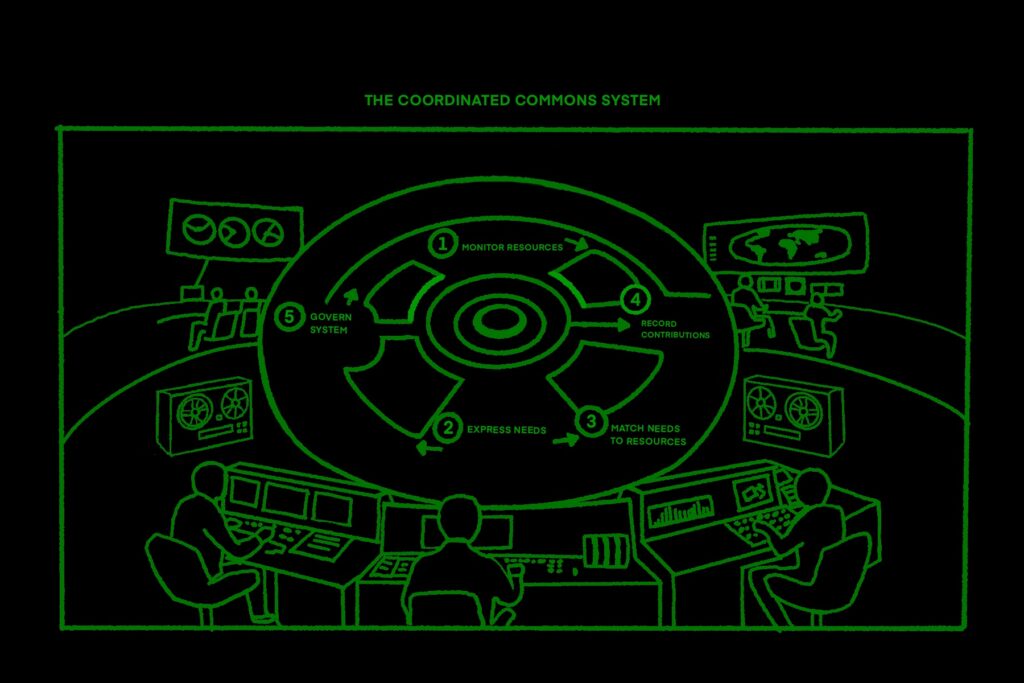
Motivated by the limits of the current capitalist system, in which accumulation often overrides social and ecological value, the Coordinated Commons System (CCS) proposes a framework that redirects technology and coordination towards equitable outcomes. The system functions through real-time resource monitoring, AI-driven allocation, and a contribution-based ledger, applying the three primary functions of money (medium of exchange, unit of account, and store of value) in a non-monetary context. By balancing efficiency, shared contribution, and environmental sustainability, the CCS envisions an alternative model in which value is measured not only in wealth but also in knowledge, care, and ecological stewardship.
It replaces price-mediated allocation with a multi-layered coordination protocol integrating real-time resource accounting, distributed contribution ledgers, and AI-driven constraint optimisation. Instead of markets clearing through monetary bids, allocation emerges from ecological limits, verified social contribution, and democratic governance parameters. Technology shifts from extractive platform ownership towards collectively stewarded digital infrastructure, transforming value from speculative accumulation into relational and regenerative coordination. So how does the CCS technically work?
Phase 1: Resource Accounting (Foundation Layer)
All physical and digital resources as well as energy, water, food, housing, materials, and logistics are continuously monitored using IoT sensors and smart infrastructure. Environmental limits (carbon budgets, land use, water capacity) are embedded as constraints. This layer answers the question: what exists, in what quantity, and under what limits? It ensures that the system always has an accurate view of available resources in real time.
Phase 2: Needs Expression (Demand Layer)
Individuals declare their essential needs such as food, healthcare, housing, or education through a digital interface. Requests are classified as essential (guaranteed baseline), developmental (learning, innovation), or discretionary (non-essential consumption). The system then captures human demand without money, translating it into structured inputs that feed the allocation engine.
Phase 3: Contribution and Trust Ledger (Coordination Layer)
Instead of money, the system uses a ledger to track contributions: work, care, teaching, community service, and knowledge sharing. This ledger is not tradable currency but a signal for trust, cooperation, and priority allocation. Contributions influence access to scarce resources, encourage reciprocity, and maintain balance in the community.
Phase 4: AI Coordination and Allocation (Optimisation Layer)
The heart of the system. AI algorithms continuously match available resources to expressed needs, considering constraints from Phase 1 and contribution signals from Phase 3. Allocation optimises for equity, sustainability, and resilience. The system adapts dynamically to shortages, surpluses, or shocks like climate events, ensuring that no single individual or group monopolises resources.Phase 5: Governance and Oversight (Control Layer)
Transparent, democratic governance ensures fairness and prevents manipulation. Human councils audit AI decisions, review rules, and adjust policies. Algorithms are open source and accountable, providing continuous feedback to the community. This layer guarantees that technology serves collective well-being rather than private gain.
Knowledge-Based Access Economy
Oumayma Kahri
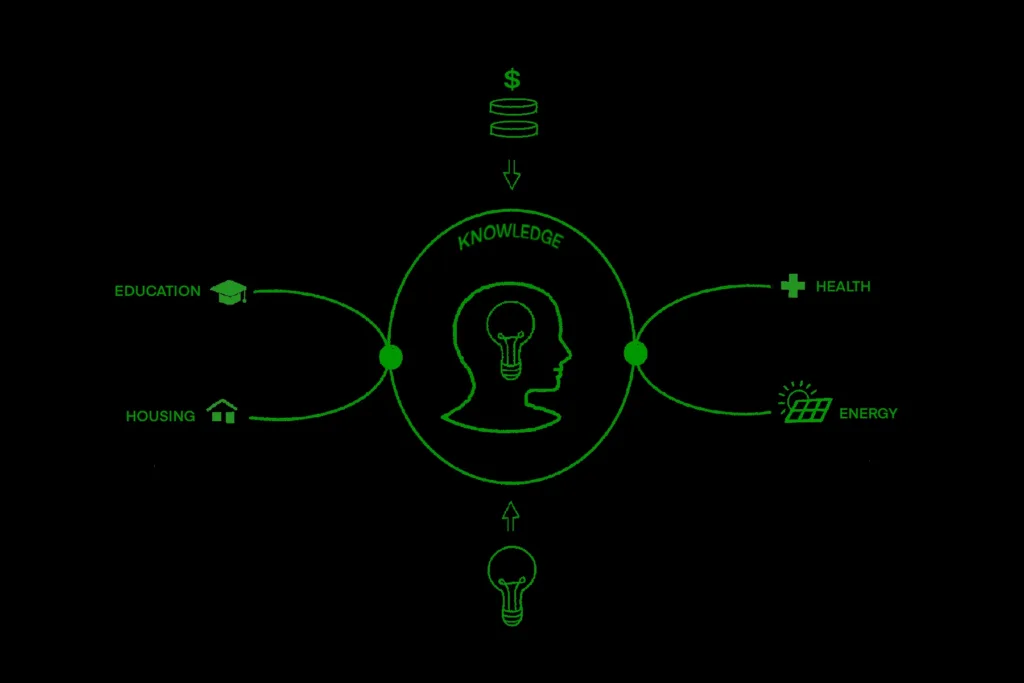
The concept of a Knowledge-Based Access Economy imagines a future economic framework in which money is no longer the central organising force. Instead, access to advanced opportunities, decision-making power, and certain privileges is gradually linked to knowledge and intellectual contribution. The essentials of life, meanwhile, remain guaranteed to all.
At the foundation of this system lies a non-negotiable principle: universal human dignity. Basic needs – housing, healthcare, transportation, energy, clean water, internet access, and fundamental education – are treated as rights rather than commodities. And in such a model, no individual’s survival or well-being depends on their economic productivity. Artificial intelligence and advanced resource-management systems coordinate the distribution of essential services, ensuring that everyone has access to the conditions necessary for a stable and dignified life.
Within this guaranteed foundation, knowledge becomes a way of organising responsibility rather than ownership. Instead of accumulating financial wealth, individuals gradually build a Knowledge Years Index (KYI) through education, research, teaching, or other intellectual contributions. Those who have accumulated higher KYIs do not gain financial reward but participate in higher levels of decision making, innovation networks, and societal planning. Crucially, this structure positions education as the most supported and valued sector in the system without restricting anyone’s basic access to resources—knowledge reflects expertise and civic role, not purchasing power. This distinction is important as it prevents knowledge from simply becoming a new form of currency.
The economic structure itself functions through an interconnected system of essential sectors that continuously reinforce one another. Education generates the knowledge needed to improve healthcare, environmental protection, and infrastructure. The energy sector powers the institutions that support learning and medical care. Healthcare preserves the cognitive and physical capacities of the population. Environmental systems protect the natural resources on which all sectors are dependent. Artificial intelligence plays a coordinating role, monitoring resource availability, ecological limits, and population needs to maintain long-term balance.
Environmental responsibility is integrated directly into the system’s structure. Water, for instance, is carefully monitored through intelligence infrastructures. When individuals consistently exceed sustainable consumption thresholds, the system does not impose financial penalties. Instead, temporary reductions in certain privileges associated with the Knowledge Years Index may occur. This approach reframes environmental responsibility as a social and civic obligation rather than a financial transaction.
Sustainability also extends to long-term population balance. Families receive full structural support for up to three children, ensuring resources remain equitably distributed across generations while guaranteeing every child access to education, healthcare, and basic services, regardless of family circumstances. Another core pillar of this framework is complete gender equality; access to education, knowledge development, and participation in societal systems is not influenced by gender or social background. By evaluating individuals primarily on the basis of their intellectual contributions and engagement with collective systems, the model seeks to unlock the full potential of human capability.
Symbion Economy
Sarra Jebari
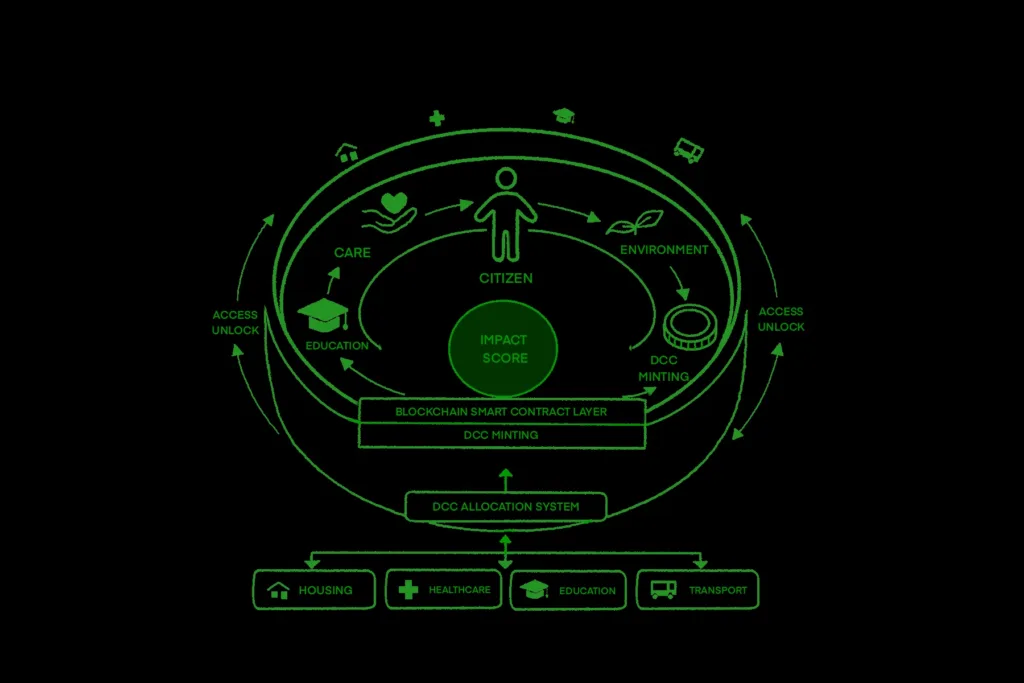
I introduce the Symbion Economy: a future economy that replaces traditional money with Digital Contribution Credits (DCC), which ensure basic access to living resources and reward social impact. Expanding on the decentralised shared security infrastructure symbion protocol, this economy is not a reform of capitalism but an alternative architecture for resource coordination. Rather, the Symbion Economy imagines an economy in which automation benefits human well-being and social contributions are valued more than profits.
The economy functions by providing every citizen with a universal base allocation of DCCs every month, guaranteeing access to all essential services. Alongside, extra credits are earned by contributing through caregiving, education, environmental conservation, or open innovation. To prevent accumulation and encourage circulation, credits expire gradually (a monthly decay of 5%, for example).
Each citizen, meanwhile, holds a cryptographically secured Digital Civic Identity that logs verified contributions, protects privacy via zero-knowledge proofs, prevents duplicate participation, and enables decentralised governance voting. Significantly, this identity separates personal data from contribution metrics.
At the core of this economy is the Contribution Assessment Engine where AI algorithms assess contributions. Through this engine, when a citizen performs a contribution like caregiving or reforestation, the system evaluates key metrics such as time invested, community validation score, measurable social impact, and sustainability index. Crucially, AI does not evaluate the person but the action. It uses transparent scoring functions such as:
Impact Score (IS) =
(Time Weight × Verified Hours)
(Community Validation × Trust Coefficient)
(Environmental Multiplier × Sustainability Index)
The resulting Impact Score determines the DCC reward. All scoring criteria are open source and auditable. Meanwhile, blockchain technology secures the economy by preventing fraud and allowing public access to resource allocation. More specifically, all credits will be issued and allocated via a public, energy-efficient blockchain. This will allow the use of smart contracts that automatically mint DCCs after impact validation, record transactions immutably, prevent double-counting, and enforce expiration logic. Therefore, no central authority or bank can arbitrarily print credits.
I created the Symbion Economy to address three structural failures of current economic systems:
- Automation increases productivity but concentrates wealth
- Care, environmental work, and social cohesion are undervalued—undermined even
- Money functions primarily as a wealth-storage mechanism rather than a coordination tool
By confronting these issues, this system seeks to imagine a society in which economic logic shifts from profit maximisation to impact optimisation.
———————-
5. Visual Accompaniment Recommendation
The most effective visual would be a layered system architecture diagram:
Center: Citizen
Layer 1: Contribution Activities (Care • Education • Environment • Innovation)
Layer 2: AI Contribution Assessment Engine
Layer 3: Blockchain Smart Contract Layer
Outer Layer: Access to Resources (Housing • Healthcare • Education • Transport)
Keep keywords minimal. Use arrows to show feedback loops.
Alternatively, a process flow diagram: Contribution → AI Impact Scoring → Smart Contract Minting → DCC Allocation → Access Unlock.
This would clearly demonstrate that it is a functioning system rather than a speculative idea.
The SDG Credit System: Touiza
Youssef Ben Hadj Abbess
Grounded in the principles of the UN’s Sustainable Development Goals (SDGs), yet adapted for a credit system (SDGCS) that draws from the Tunisian kinship model of Touiza, this model proposes a post-money framework in which contribution, impact, and collective responsibility replace financial accumulation as the dominant logic of economic organisation. Rather than traditional monetary exchange via currency, individuals and companies will earn credits based on measurable contributions across environmental, economic, and social dimensions established according to the collective good.
Currently, the SDGs represent a global commitment to sustainability, but they operate within market-based systems that prioritise growth and capital expansion. This creates a structural tension between sustainability objectives and accumulation-driven economic logic. Environmental protection and social equity are often treated as external factors rather than core to how value is determined.
This is a result of the current popular system of capitalism where, from the perspective of classical and neoclassical economics, value is determined through market exchange and price mechanisms. Growth-oriented models prioritise capital accumulation and productivity, often treating environmental and social costs as externalities. Within this framework, economic success is measured by expansion rather than balance.
Karl Marx’s critique of capitalism, for example, highlights how value is generated through labour but appropriated through capital ownership. Economic power concentrates through surplus extraction, reinforcing structural inequality. The SDG Credit System challenges this logic by separating value recognition from ownership and linking it to measurable contribution instead.
It reduces accumulation-based dominance and shifts focus towards collective impact. Additionally, by approaching markets as socially embedded (shaped by social institutions, cultural norms, and governance structures) rather than autonomous systems, the possibility of designing alternative frameworks based on collective institutional choices becomes clearer. What this depends on, however, is transforming governance structures in line with incentive structures and regulatory design that are decided on, first and foremost, sustainability and mutual shared benefit from which economic outcomes will adapt and flow accordingly.
This may sound abstract, so to ground this model in historical reality, this project draws inspiration from the Tunisian tradition of Touiza, a system of collective voluntary labour practised mainly in rural communities. Touiza is built on cooperation, reciprocity, and mutual aid. Community members gather to support one another in tasks such as harvesting crops, constructing homes, maintaining infrastructure, and completing large agricultural projects. No monetary exchange takes place.
Touiza operates through social governance instead of financial incentives. Value is produced through participation rather than financial reward. Participation is regulated by trust, reputation, and mutual obligation. Individuals contribute labour knowing that the community will reciprocate when they face their own needs. Social capital replaces monetary transactions as the primary coordination mechanism.
Economically, Touiza reduces transaction costs associated with formal labour markets. And socially, it strengthens cohesion and collective resilience. In times of crisis or heavy labour demand, communities can mobilise resources efficiently without reliance on external financial systems. That said, Touiza remains geographically localised and context-dependent, so its scalability is limited by the size of the community and strength of shared norms. Furthermore, modern economic transformations and urbanisation have reduced its prevalence.
Despite these limitations, Touiza demonstrates that contribution-based systems are not theoretical abstractions but historically embedded practices. It provides a prototype for organising production and cooperation without monetary mediation. And in the context of the SDG Credit System, Touiza functions as both inspiration and structural precedent. The project translates its logic into a modern framework by combining measurable impact indicators, digital coordination, and global sustainability objectives. Touiza represents the local foundation, the SDG Credit System represents its systemic evolution.
