
 Photo courtesy of Mohamed Somji
Posted in
Art & Photography, Exhibition
Photo courtesy of Mohamed Somji
Posted in
Art & Photography, Exhibition
Review: Majd Arandas’ “A Blank Wall and a Phone Camera” at Gulf Photo Plus
Text Reem Farah
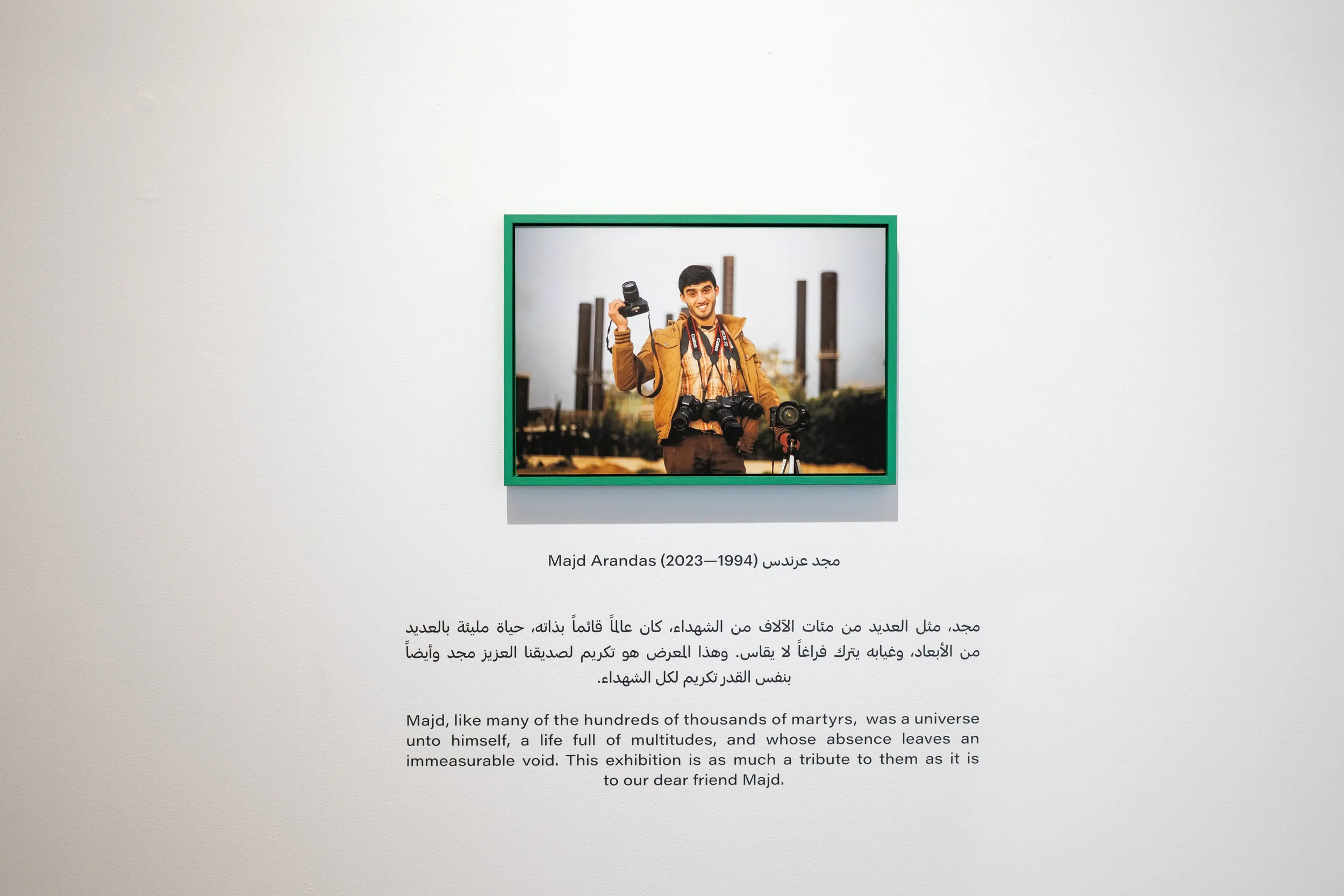
Walking into Gulf Photo Plus to view A Memorial in Fragments, a posthumous solo exhibition of the Palestinian photographer Majd Arandas brings to collision the double life: the one we are living in our physical body and the one we have been holding in the palm of our hand.
For almost two years we have asked ourselves: What does it mean to witness a livestreamed genocide? To hold the story of a martyr in our hands? To know that we are privy only to a sliver of an excruciating lived reality outside the frame? To repost pleas for food from a starving population? To do so while eating? Or to watch another night of terror from the comfort of a safe bed? What does this level of dissonance do to us?

With these questions looming, I walked along a row of warehouses in Dubai’s Alserkal Avenue and entered Gulf Photo Plus (GPP). There I found photos of Gaza on white walls, not of its rubble, but of the Gaza that Majd Arandas cherished for thirty years. Yes, he was only thirty. The last seventeen years of Arandas’ life had been marked by a suffocating Israeli blockade. He had become a photographer to contribute to the visibility of his world on the outside. However, since October 2023, these photos have become a treasure of what has been lost to Gaza itself.
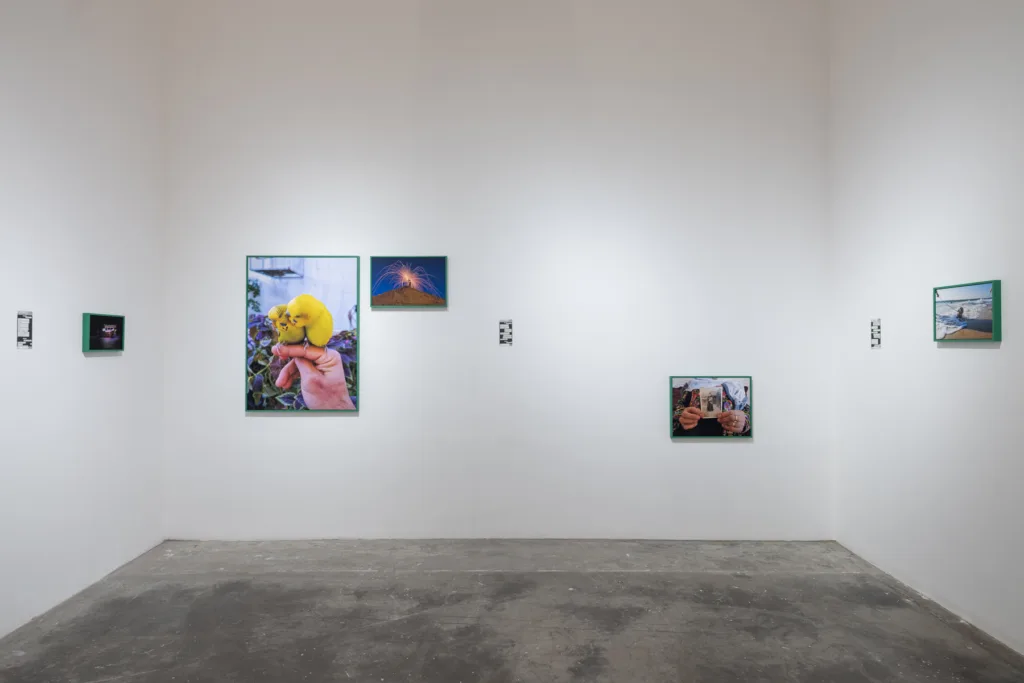
Despite the wars that Arandas has lived through, the last being final and fatal, these walls only bare the tenderness he showed and received; green leaves of a garden, purring cats, yellow lovebirds, and silhouettes of an adventure at sunset. The photographs are small in size, perhaps to pay homage to the digital grid, or how so many of us had come to know Arandas via Instagram.




In Ways of Seeing, the 1972 text by John Berger (based on his BBC doc-series), Berger presents a rather ordinary Van Gogh painting on one page, then on the next, he presents it again with a sentence beneath it that reads: ‘This is the last picture Van Gogh painted before he killed himself’. He does so to demonstrate how subtext changes the way we see. The same is happening here, as this exhibition can only be viewed and experienced retrospectively. Images of a meal shared in Ramadan 2021 as part of the project Iftar Journals that Mohammad Somji of GPP initiated and Arandas participated in, once connect us with Gaza on common ground. Now access to food– the very idea of a meal– is the biggest divider.
As Berger argues, unlike the traditional painting, a photo or a print can be reproduced and circulated, to be viewed at any time and place, and this changing context implicates its meaning and value. The camera had changed everything. These days, a livestream broadcasts moving time and place. With the advent of the phone camera and social media’s endless scroll, the pace at which we are seeing, and the attention we can give each image or video is not necessarily enhanced, rather it is oftentimes hindering our ability to process what we’ve witnessed, to derive meaning from it, and to give it value.
To look away from the phone and onto the blank gallery wall cuts the noise. There is a sacred silence to this kind of viewing. It relieves Gaza from the 24/7 news cycle. It allows it to be seen as it deserves to be seen. Not as art, but as valuable and dignified; as though it matters. This kind of vieweing relieves Arandas of the genocide too. The curatorial decision to exclude photographs of the genocide reflects respect for the sanctity of Aradas’ life and death. This more than anything makes the exhibition feel like a memorial. I have oftentimes questioned the role of art in genocide but here it is clear. Paying quiet attention to the beauty that Majd cherished and conserved from sea tides to sky hues is one way of paying our respects. In mourning, Majd and Gaza become one and the gallery transforms into a container for this grief. Herein lies a lesson: when we return to our phones, not to scroll past hurriedly, but to regard the martyr with attention, attention measured in time. Simply, to give the witnessing a holding space gives life value.
The exhibit includes the presence of a phone or two that physically hang on the wall; this reminds us of the centrality of the phone. Its role is not just as a lens but as a channel. Unlike the impenetrable sea that Israel has turned into yet another fatal front and which Arandas pictured so longingly, the phone can be a more direct line or access point. Interspersed alongside the photographs in the exhibit are correspondences; screenshots from messaging platforms, mostly of loved ones checking in, as he, being a thirty year old male and a photographer in Gaza, (but also being Majd) set out to be of service each day from October 9 till the day he was killed November 1. In one correspondence on the wall, Rita Kabalan asks for Arandas’ whereabouts. She writes ‘Where in Gaza are you?’. . .‘Please show me where so I can pay attention’. Arandas responds with his location on a map. The caption on the wall reads ‘You are a good friend’, perhaps something he said to her at some point. To me, this stresses the power of a simple gesture of care to a people who have been otherwise abandoned. When he was killed, Arandas knew he mattered.
One caption informs the viewers that early on in the genocide Arandas sold his camera leaving him with his phone to capture what he could. This is the phone that contained his memories and enabled him to broadcast them to us. It is the same device that we have used to enact our collective politic of ‘bearing witness’. Yet, the countless images Gaza’s citizen journalists produce and that we’ve consumed for 700 days and counting, have not stopped the genocide. In fact, as it continues to worsen, it has beaten many into passivity or submission. This is when we must remember, it is not enough to witness, we must also bear. To bear the burden of what is witnessed is to carry and amplify it. This is the most basic requisite for this time. The phone camera, unlike the camera that Berger wrote about in 1972, sends and receives. The screen is not static, it is a touch screen. The beholder of the image that we see, also feels. In our words and actions, we must make ourselves felt. This is the antidote to our own desensitization.