
 Posted in
Art & Photography, Aweng Chuol
Posted in
Art & Photography, Aweng Chuol
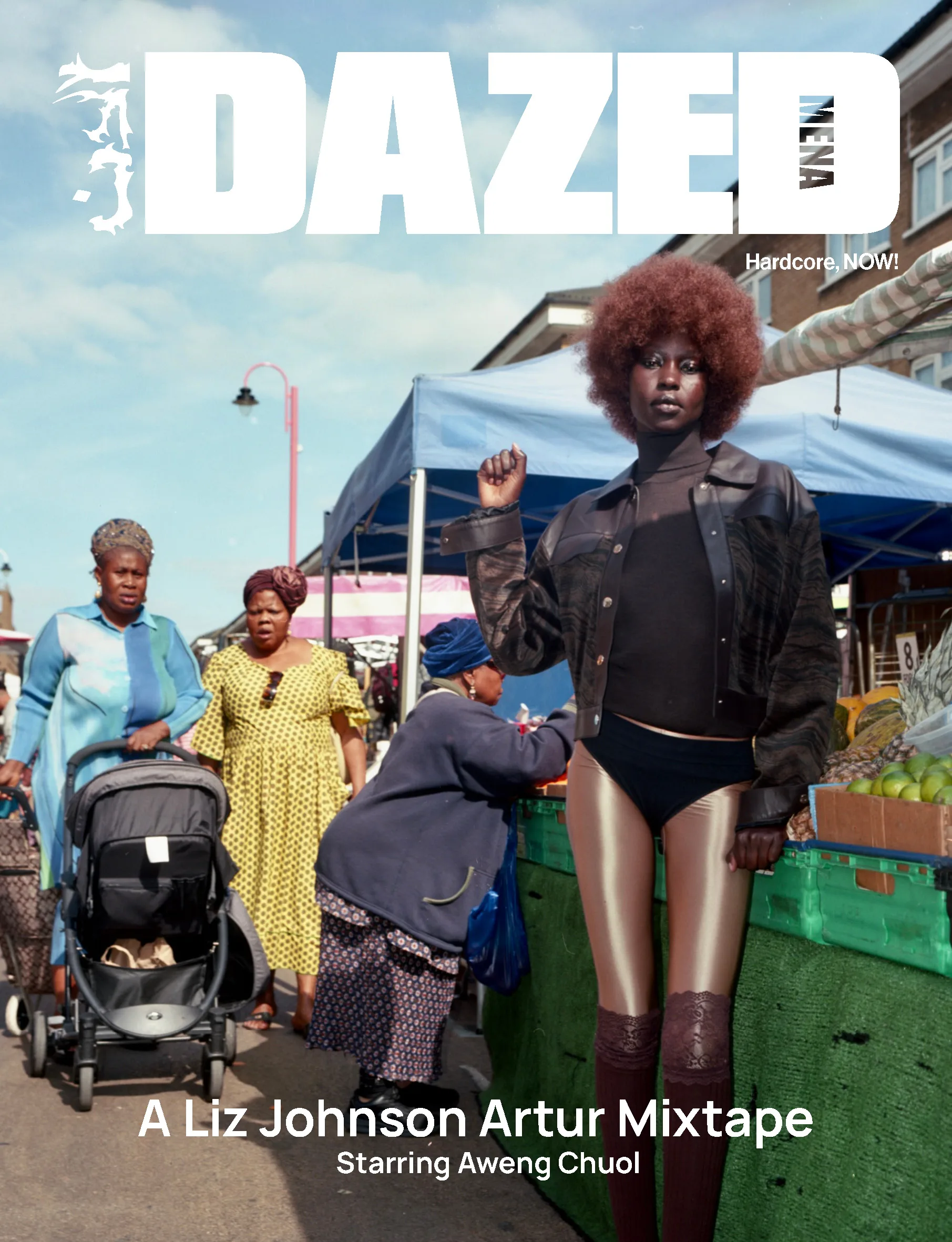
Listening to a Liz Johnson Artur mixtape starring Aweng Chuol
Text Oluwatobiloba Ajayi | LIZ JOHNSON ARTUR STYLING Feranmi ESO
“What I call an archive is one that runs on my rules,” says photographer Liz Johnson Artur, whose self-assured approach to capturing images has come to define her career. But it hasn’t always been this way.


When Artur first felt compelled to take pictures, she found she couldn’t because she didn’t know how to approach people she did not know. “When you’re taking pictures, you have to have a why. It doesn’t all come out as a question and answer, but you can’t just go and take.” Artur describes this mutual exchange as the social heart of photography. Without it, the process crumbles. “A lot of my work has to do with exposing myself,” she explains. “I have to be present. If I’m not in the right state of mind, I don’t go out. I’m not a superhuman, I can’t constantly go from one person to another. I do it when I’m able to give because I get a lot in return.”
For over 30 years, Artur has been taking pictures of people, mostly Black people – strangers, friends, neighbours, and communities – capturing subjects candidly in the rhythms of everyday life. Between city streets, churches, and dancefloors, the settings are unspectacular, but the recognition of value in these frenzied moments and the excessive attention required to recognise such value are what makes her photos sing. Artur is perhaps best known for her the Black Balloon Archive (1991-), what can only be described as a frantic, fevered, and unflagging documentation of Black people from across the diaspora.
The archive is purposely global in scope. Artur has photographed locals in Jamaica, Afro-Russians in St Petersburg, and creatives across Sudan, using her images to bring renewed attention to the brutality of their oft-ignored civil war. It is impossible to consider a body of work totally committed to capturing Blackness without also thinking of the politics of image making, of representation, of how photography is sometimes weaponised to render othered bodies captive. For Artur, there is far more to it than that.
“I think it comes from observing and wanting to be part of things, wanting to be closer,” she explains. “My work shows how I relate to people and how they relate to me looking at them. That’s really the moment I’m after. What I take from the archive is the idea that something needs to be preserved because it’s precious. It’s a human thing we do: we preserve so we can nourish ourselves from it in later times.”
Despite the conventional formality of an archive, hers emerged organically—through a desire to honour everyday lives. “I’m the total opposite of an archivist in terms of skills. Before I had any name for what I was doing, I was just doing it.” This impulse to capture occasions and revere them is common in migrant families, like Artur’s own. It’s all too common for children to only see their extended family through pictures, proof of relations and traditions that remain geographically distant. The Black Balloon Archive is very much in that same vein. “That’s why I’m not interested in showing someone sitting in the gutter. I’m more interested in showing something that you want to send home.”
Artur’s archive taught her how to listen as much as see, how to build a level of trust that allows strangers to feel dignified in front of her lens. “Very very rarely, I tell people what to do. They know what to do. That’s some of the beauty in the process: getting to watch someone be who they want to be.” It is probably this interpersonal attunement that lends her photographs a tactile, almost concrete quality. Looking at her images, you can feel, but not necessarily see the momentum surrounding the captured moment. The thrum of a bassline tickles, the shared body heat of a crowd lingers, and the weight of words just uttered hangs around her frames. Artur’s ability to tune into a wider sensorial register reminds me of Tina Campt’s invitation for us to “listen to” images.
Campt calls for a bodily engagement with photography, acknowledging how images are touched by those they image, by those who view them, as those who view them are touched by the images in turn. Hierarchies between photographers, those photographed, and viewers begin to dissolve. In that sense, Artur’s photographs are generous, but also self-preserving. Her visual outputs are only one part of a larger social narrative. This balance is critical to the process of image making, as Artur is hyperaware. “I’ve learnt a lot because I’ve overcome my shyness, but also the guilt. Because there’s guilt about going to a stranger and taking, and particularly taking their image. It is an act that can be very enjoyable for both sides, but it can also be quite traumatic if you’re just, boom, being snapped.”
Every attempt to take a photograph carries an inherent tension. There is always the potential for intrusion, and the degree of this risk depends on the context in which an image is taken. Alongside the Black Balloon Archive, Artur has been building another body of photographs taken at demonstrations across London and from her stint in Germany. These are less widely exhibited but motivated by the same impulse: to document the truths of lives lived in full, and to bear witness.
“The right to protest – for people to express whatever it is they need to express – is a luxury considering the times we live in. I’ve been going to protests since I arrived in London, and I have a whole collection of photographs from them. They’re an important record simply because it’s important to know that people went onto the streets and protested. In those contexts, I’m quite a veteran,” Artur reflects. Her wealth of knowledge, garnered over decades of attending demonstrations, means she moves through emotionally charged sites with precision. “I don’t snatch, I observe. I’m not there to provoke. I want to make my point if I’m at the demonstration, but I also want to capture people who demonstrate—they’re the ones who should be remembered.”
In London, protesters have marched against Israel’s genocide and apartheid regime in Gaza – and the UK’s military support of Israel – for 21 months now. The protests continue unperturbed in the face of increased policing and the criminalisation of political dissent, as evidenced by the UK government’s recent decision to proscribe direct action network Palestine Action. This extreme surveillance around public support of Palestine has caused increased anxiety around being photographed at a protest, where images can become proof of a criminal offence. Online images of protests show emojis over faces or crowds blurred en masse. We understand now, as ever, that image making can inform how communities are policed and demonstrations of solidarity are systemically delegitimised—with the photograph as a tool.
What Artur is doing is gathering irrefutable evidence: proof of a communal refusal to be complicit in the violence of our governmental regimes. This is an act of care, one that extends to her concern about where her demonstration photography will end up. “I took a lot of photos during the Palestine demonstrations. It is work I’d like to preserve and put in the right place. They are the most peaceful demonstrations I’ve been to because it wasn’t a political cause. It was a human cause. People from all walks of lives, different ethnic backgrounds, everyone was there because it was a human cause.”
In thinking of Artur’s photographs, I can’t help but to also think of the images coming from Gaza—not the barbaric and terrifyingly familiar images of razed hospitals and charred bodies, but content shared from those who keep living in these impossible circumstances. These images and videos are a refusal for the veracity of the genocide to be denied, and a resistance to the very circumstances captured.
In Listening to Images, Campt speaks of “practices of refusal”, of ways that photography’s subjects mobilise their autonomy in the face of racial dispossession. Artur’s growing body of protest photography contributes to these practices of refusal. They are a communal proclamation, intensified by the deluge of horrific images coming from the ground, that what is happening in Gaza cannot continue. The struggles of image making are interconnected, and Artur demonstrates how solidarity might be actioned through her medium of photography.
When asked to shoot a cover for this issue’s theme, Hardcore Now, the photographer chose to start in a place most familiar to her: South London. She chose her local market as a backdrop, along with Kennington Park, focusing on a monument inscribed with an excerpt from Maya Angelou’s poem, “On the Pulse of Morning”.
“History, despite its wrenching pain, cannot be unlived, but if faced with courage need not be lived again,” it reads. Artur states that this is what she’s trying to do with her images: face our times with courage. This courage, she posits, can be found in the environments closest to us: “I think it’s very important to show places where people meet and where they talk. I wanted to give presence to that. We’re all under whatever is on top of us. It doesn’t seem like anyone can escape this, so start with the things that are next to you, and who knows? It might lead to others.”
The quotidian spaces that Artur returns to – local markets where food can be sourced affordably or parks that offer space to pause – enrich our lives by giving us choices of where to walk, sit, or feed ourselves. This agency, for Artur, is hardcore. It is hardcore because it is not promised, and to revel in these practices is to protect their preciousness. That is what Artur’s Black quotidian is and has always been about: being highly committed to what is around you and its ability to make a statement when the time is just right.
I ask Artur about her legacy, and she resists the question. She is too busy, ever-present, still making. “I don’t use the word ‘legacy’ because I’m right here, right now, between everyone. My archive is my resource centre. It’s not just a museum, it’s a living presence. I’m right in the middle of it. Sometimes, I go out, take pictures, and put them in. And other times, I go in and take pictures out. That’s why I say I don’t think about legacy. These words don’t matter when you live.”
Instead, she’s focused on expanding the archive beyond the visual. “If you stimulate something that you see, it can make you think of a certain smell, touch, or sound,” she says. Music is another central character in her photographs—never captured but always present. In turn, I ask her what she is currently listening to. She shows me her extensive record collection and singles out Grace Jones’ Island Life and Roy Richard’s self-titled LP.
Artur’s approach is timeless, predicated on her person meeting others and trained to respond to a moment so it might resonate eternally. She “needs flesh and blood,” and beyond the people she works with, her analogue process offers the physical intimacy of touching, treating, holding, and teasing out. Times have changed around the artist. The global (re)awakening to systemic racism post-2016 brought a heightened attention to her work, and our increasingly politicised now brings new salience to her images. But Artur is simply doing what she has always done: responding to every moment with presence and with a picture.