
 Posted in
Art & Photography, arts
Posted in
Art & Photography, arts
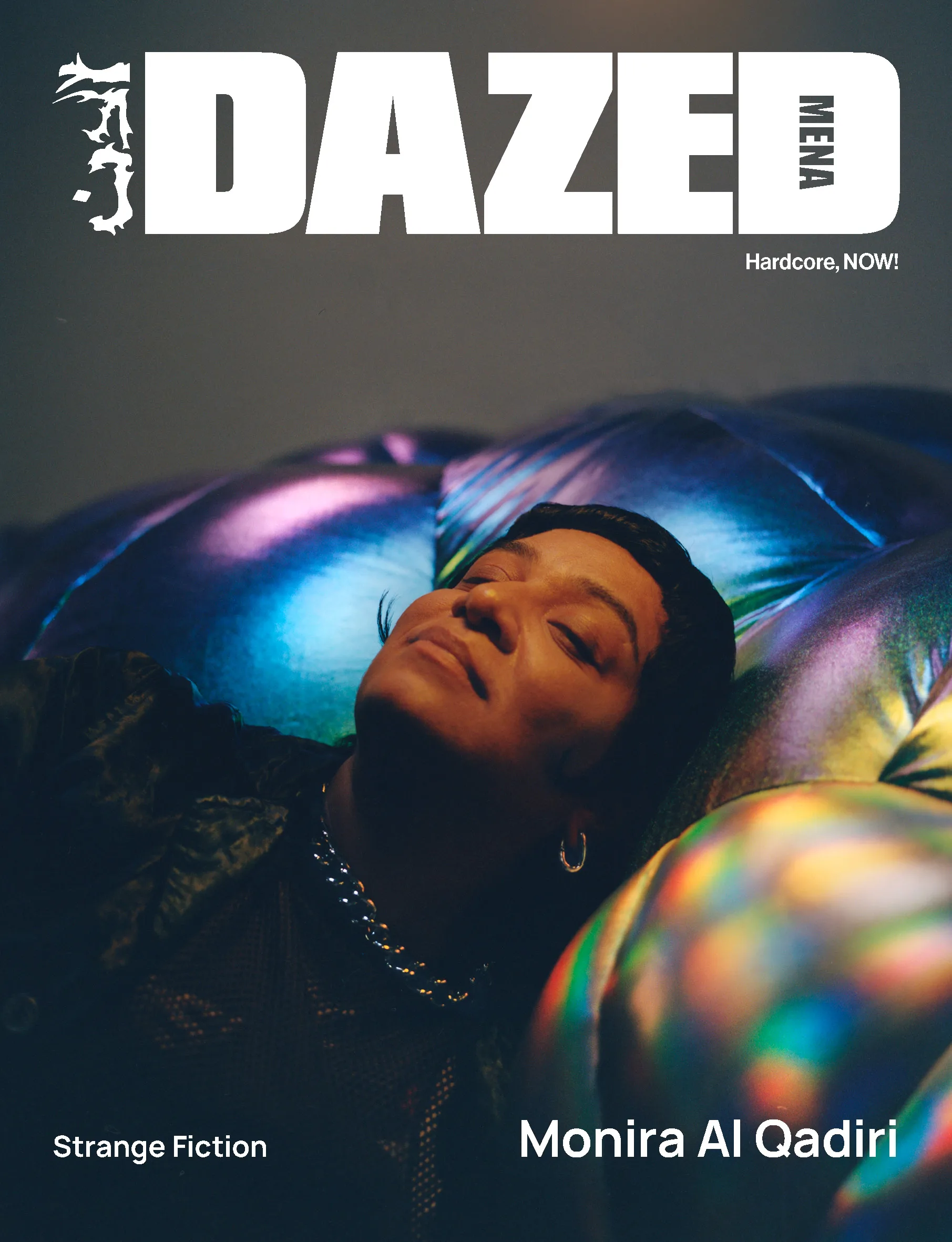
Monira Al Qadiri is mad about it
Text Selma Nouri | Photographer Chndy
“Madness is everywhere.”
These are the first words I write in my notebook during my conversation with Monira Al Qadiri. “Madness exists in exile, isolation, war, and liberty,” says the Kuwaiti artist. “It can be found everywhere, among both the powerful and the weak.” In recent years, however, madness has become a weapon (or a “locus of confinement” as historian Michel Foucault described it) used to segregate and oppress for the purposes of imperialism.
Through her work, Al Qadiri profoundly deconstructs this dynamic of power, proving our universal proximity to the absurd by way of sculpture, installation, film, and performance art. Visualising its manifestations across various time periods and socioeconomic groups, the visual artist reveals how madness emerges from a “freakish” thirst for power and capital.
Seduced by growth and hyperconsumerism, society has become blind or, more worryingly, apathetic to the irreparable damage that our aesthetic desires continue to inflict upon our planetary future. Through the likes of dystopia, spirituality, and the absurd, Al Qadiri offers urgent and uncanny omens for the future, forcing viewers to reflect on the longstanding consequences of overconsumption, colonialism, extractive capitalism, and greed. Igniting profound introspection, she encourages all of us to reckon with our complicity in the ongoing chaos and destruction of the planet.
Born in Senegal, raised in Kuwait, and educated in Japan, Al Qadiri describes her worldview as anything but ordinary. Her exposure to both decadence and war forced her, from a very young age, to reflect on the oppositional bounds of beauty and destruction—the immediacy and vulnerability of it all. Yet, despite the deeply personal foundation of her work, most of it transcends regional discourse, opening space for universal engagement and reflection.

“My upbringing was very strange,” she reflects. “The genealogy of art in my family began way before me. My mother is an artist, so I basically grew up in her studio. It was very natural to conflate play with creating art because it’s all I ever knew. In Kuwait, our house was always filled with paintings, print machines, and sculptures, so turning to art as a form of expression felt very instinctive.”
Reflecting the Gulf’s social and cultural nuances, Al Qadiri credits her parents’ open-mindedness as a catalyst for her expansive way of thinking. “They grew up in the 60s and 70s, in the era of discotheques and parties,” she says. “Their youth marked an extremely liberal moment in Kuwait’s history, one of rediscovery, wealth, and joy.”
A chapter often glossed over in western history books is Kuwait’s status as a British protectorate from 1899 to 1961. This was a period defined by imperial control and economic exploitation, particularly after the discovery of oil in 1938. When Kuwait finally gained independence in 1961, it ushered in an era of rapid wealth and prosperity. However, while the country flourished economically, it also brought with it political uncertainty and conservativism—an expected consequence in states grappling with the lingering legacies of imperial rule. Amid rising anti-colonial sentiment, many countries in the SWANA region, including Kuwait, began to push back against decades of western interference. Enough was enough.
“My parents had left Kuwait in the 1970s to attend university. They were still abroad when the Iranian revolution occurred and conservatism began to spread across the region. By the time they had returned to Kuwait in the early 80s, the country they knew was gone.” While overt imperial exploitation may have ended, it left behind new monsters – war, conservatism, and the intoxicating power of oil wealth – that gave rise to unforeseen manic and dysmorphic dissonances. One form of madness was merely exchanged for others, with complicity stretching across both East and West.
“I consider myself a post-oil baby,” she says. “I had missed both the poverty of the pre-oil era and the liberal period that followed independence. As a child, my image of Kuwait was one of sheer decadence, but my parents had witnessed it all. They knew Kuwait before the oil boom, when poverty was the norm and the landscape was little more than desert. My father grew up in a mud house that had to be rebuilt each time it rained. Then, when my parents were married, they lived through the post-imperial years of optimism and watched as that era gave way to the conservatism and extravagance born from oil wealth.”
Like much of the post-colonial SWANA region, Kuwaiti society was in constant flux—restless, unpredictable, and shaped by forces beyond its control. Al Qadiri’s generation was no exception. Marked by manmade chaos, it was a time of beauty, madness, and profound uncertainty. “Everything changed for me in 1990, when the Gulf War occurred. I was only seven,” she recalls. “My father wanted to be a part of the resistance, so while everyone around us fled the country, my family stayed.”
The experience left an indelible mark on Al Qadiri’s intellectual and artistic outlook. “The war changed my ideas about everything in life. The invasion happened in one day. Overnight, the street names had changed, and our society transformed from one of decadence to one of misery. All the luxuries that we had taken for granted were stripped away in what felt like a matter of seconds. Even when the war ended a year later, we were left with despair. With 700 oil wells set on fire, we were essentially surrounded by darkness. Black clouds poured black rain. The sea was black. Animals were drowning.”
The scene described by Al Qadiri is apocalyptic. Engulfed in flames, there is a single, haunting substance at the centre of it all: oil. Once a symbol of unprecedented prosperity, this iridescent substance became a source of profound death and destruction. “After the war was the first time, I think, that we ever really saw oil. That is when my relationship with it began. My art started to shift. I went from drawing funky, Japanese-inspired cartoons to darker, more sinister subjects.”

The scars of the Gulf War lingered in Kuwait’s collective memory for well over a decade and, for Al Qadiri’s generation, the impact never fully faded. “I still don’t think we are back to normal,” she admits. “I feel like my generation is a kind of freak generation in Kuwaiti history. We live with this constant sense of malaise, like anything could collapse at any moment. We know the oil won’t last forever. We’ve seen what it can do, how it brings both immense prosperity and immense destruction. The rug can be pulled from under our feet at any moment, and beauty can transform into something terrifying.”
A sense of guilt began to permeate society in the aftermath of the war, she recalls. “People started blaming themselves. They believed God had punished us for being too decadent. That’s why I think conservatism started to rise. There was this feeling of responsibility, of needing to atone—that malaise still lives in me.”
It is precisely this apocalyptic guilt – the juxtaposition of tragedy, the ethereal, and the absurd – that inspired Behind the Sun (2013), her first artwork exploring oil as both a subject and symbol. A compilation of amateur video footage capturing the oil fires that had been ignited during the retreat of invading forces – one final act of defiance at the end of the war – it captures the “beautiful madness” that emerges from a substance capable of giving life and taking it away.
These fires marked one of the most devastating manmade environmental disasters in recent history. The visuals are paired with audio monologues taken from Islamic TV programmes aired in Kuwait during the same era.
“Around the 80s and 90s, short religious segments would appear between regular programming. They were never introduced—they’d just suddenly appear on the screen, almost like divine interruptions, aimed to visualise God through natural wonders like waterfalls and mountains. The visuals were always stunning, and the narration – this deep, poetic voice – spoke beautifully about the miracles of the Divine. As a child watching those, I felt transported. It was like I was in heaven.”
Years later, when Al Qadiri came across raw footage of the burning oil fields, she was overwhelmed. “The images coming from this shaky handheld camera, the black smoke, the fire, all of it made me cry—and those old TV inserts immediately came to mind. That surreal combination of nature, humanity, and divinity. I began searching for them, though it was nearly impossible. Kuwait TV’s archive was mostly destroyed during the war, but some material survived,” she explains. “When I finally found clips, I knew this was exactly what I needed. I combined the poetry segments with the footage of the fire, creating one longer film.”
Together, the visuals capture a horrifying yet very real spectacle of the earth engulfed in flames. The land, the water, and even the sky appear to be burning. Layered over this devastation is a voice reciting poetic verses that praise nature and the divine order of the universe. By juxtaposing these two elements, the artist reveals a cruel irony: the same land being exalted as a symbol of divinity is simultaneously being annihilated by human hands.
“The inserts were about nature as proof of God,” Al Qadiri adds. “And yet, looking at these manmade fires as a child, I also thought they were beautiful—terrifying, yes, but sublime. They were unlike anything I had ever seen. Like the TV inserts, the tragic imagery transported me.” Her reflections strike at the heart of the work’s emotional tension: the coexistence of reverence and destruction, the sacred and profane. No matter how much beauty we create, madness remains inescapable. We are imperfect beings, capable of praise and wonder yet equally capable of devastation.
“Destruction is captivating, especially when you’re too young to fully understand it,” Al Qadiri reflects. “There’s something deeply human about that contradiction, our ability to praise the world with poetry one moment, and destroy it the next. It’s something we seem unable to escape.” This touches on a central theme in her practice. Beneath the seemingly fantastical surface of her work lies something profoundly personal and deeply human. “I don’t consider myself an activist,” she explains. “I wrote my PhD on the aesthetics of sadness in the Middle East, so I really just enjoy wallowing. I’ve always been fascinated by melancholy. Even as a child, my favourite part of a cartoon was the sad sequence, when the hero dies or something tragic happens. Those moments always spoke to me.”
For Al Qadiri, tragedy is not just a recurring motif; it is a lens through which she understands the world. “There’s always a huge element of tragedy involved in my work, and I enjoy that. I like this idea of a beautiful tragedy. Sadness and suffering are all part of the human experience. You can’t erase that. It’s beautiful, and it’s deeply imaginative.”
In fact, she believes that this intimate relationship with sadness is inherently embedded in Arab culture. “We don’t brush melancholy away,” she says. “We immerse ourselves in it.” What might be dismissed as excessive or melodramatic in western culture, she argues, is deeply misunderstood. Sadness is not a weakness. It is the root of empathy, the foundation for reflection, and the first step toward meaningful growth.
“I think in the Gulf, especially, the climate has a lot to do with it. People live in the desert. The conditions are harsh, and it is isolating. When someone dies in the desert, you often have to leave them behind, and you can never visit them again. There is this kind of built-in distance, a sense of longing and solitude that shapes the way we feel and express grief,” she explains. “Over time, I believe, that created a culture where sadness became something noble. It wasn’t seen as a sickness or a weakness. Instead, it was respected as a natural and necessary part of human life.”
For that reason, sadness is not just an emotional undercurrent but a vital source of strength in Al Qadiri’s work. It’s why much of her practice revolves around juxtaposition and nostalgia, underscoring the belief that meaningful change requires a reckoning with the past. To move forward, she suggests, we must first turn back, confronting the consequences of our actions and engaging with the very human notions of sorrow. Denying pain or evading truth doesn’t protect us; it corrodes us. It breeds apathy, arguably one of the most dangerous forces shaping our future. In the end, this denial of tragedy may be the precursor for chaos, the very force driving us mad.
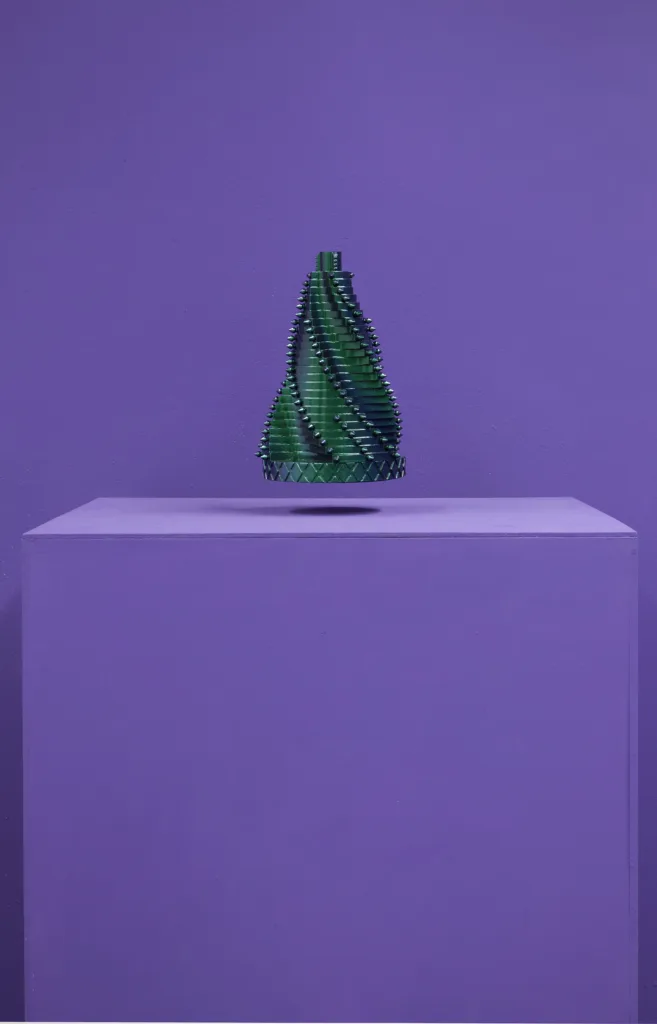
By transgressing boundaries between past and present, beauty and destruction, Al Qadiri’s most celebrated works interrogate the temporal and emotional tensions that underlie the dystopian realities of contemporary life. “One of my most popular works, Choreography of Alien Technology (2023), plays into this,” she says. The installation features several large-scale, iridescent sculptures that rotate slowly and silently.
“They’re coated in these seductive, shimmering colours. At first glance, you might mistake them for seashells, marine creatures, or futuristic life forms, but as you move closer, you realise they’re actually industrial drill bits used for oil extraction,” she reveals. In that moment, something seemingly beautiful transforms into something deeply unsettling, an eerie reflection of our complex and often destructive relationship with exploitation, extractive capitalism, and oil.
For Al Qadiri, oil is a kind of a “genie or trickster”. She describes it as a miracle liquid, one that generates immense beauty while simultaneously wreaking destruction. “It all stems back to the madness of desire and capitalism. We’re constantly striving for more – progress, innovation – but in doing so, we’re destroying everything else in our path. This, to me, is the greatest dilemma of our time.” Our boundless desires, she argues, are driving us towards environmental, ecological, and social collapse. “The degradation we’re witnessing is so extreme, yet the train doesn’t stop. No one seems to be thinking beyond themselves. There’s no sense of connection to time or emotion, no reflection on the consequences of our actions.”
However, as Al Qadiri’s work reveals, this is not the first time that society has been consumed by the extraction of a single substance or a precious resource. In Kuwait and across the broader Arabian Gulf, pearl diving once stood as a dominant economic industry. This history is subtly woven into Choreography of Alien Technology (2023), where the iridescent colours of the sculptures evoke not only the rainbow sheen of petroleum, but also the luminous surface of pearls.
Through this piece, the artist draws a deliberate parallel between the region’s pearling past and its oil-driven present, a forgotten history eclipsed by the rise of fossil fuel wealth. Through their form and finish, the sculptures illuminate the complex relationship between pearls and oil, making visible the historical rupture that oil has created. Their shimmering surfaces become symbols of wealth in transition, shifting from sea to land, from pearls to oil, and perhaps alluding to whatever resource might define the future once the oil wells run dry.
“People in the Gulf used to live and die for these pearls,” says Al Qadiri. “They endured unimaginable poverty, yet much of that history was erased and sanitised after the discovery of oil. Once the wealth began to flow, we completely abandoned the memory of our harsh and miserable past. And with it, we also abandoned the lessons we could have carried forward: the dangers of overconsumption and exploitation.”
The connection between pearls and oil came to Al Qadiri unexpectedly. “One day, I was walking down the street and saw a puddle of gasoline left by a car. It had this beautiful rainbow sheen, and I suddenly realised that pearls and oil share the same iridescence. It’s the same surface quality, just on different ends of the colour spectrum—lighter for pearls, darker for oil. That moment was a real epiphany. It completely transformed my life and my work forever.”
It was then that she began creating her iridescent drill sculptures. “This colour of iridescence became, for me, the colour of the Gulf’s history. It began with pearls, transformed into oil, and eventually will become something else. Iridescence is our history.” Having said that, she makes it clear that the horrors of oil consumption and capitalism are by no means confined to the region. “We are all complicit,” she asserts.

Over the past few years, she has produced over 20 works related to oil, exhibited in the Gulf and around the world. “My goal isn’t to assign blame or declare who’s right or wrong,” she explains. “Through oil, I’m addressing this societal beast we’ve created, this monster of exploitation.”
Now living in Europe, Al Qadiri notes the irony in how some audiences respond to her work. “I find it amusing when people come to my exhibitions and try to distance themselves from the subject, as if oil is only our problem. It’s baffling how unaware they seem. The west is among the biggest consumers. They own some of the largest oil companies. They began the very systems of exploitation that have bred imperialism. They’ve fought wars over this substance and, still, they try to act as if it has nothing to do with them.”
She recalls showing her work in Houston, Texas, one of the global epicentres of the oil industry. “In Houston, it’s said that every other person works in oil. Showing my work there, in the belly of the beast, was fascinating. A lot of people weren’t very happy with it. They believed my work to be a critique or even a threat, which wasn’t my intention, but it says a lot about the discomfort people feel when they’re confronted with a mirror.”
Unlike Europe or the US, she says, the reactions to her work in the Gulf are far more meaningful and closely aligned with the sense of reflection that she aims to evoke. People here don’t so much see her work as a critique—more as an existential warning, a glimpse into the future.
“I think it was 2017, when I showed my work for the first time in Jeddah. A young woman came up to me and started crying. She told me that she had never truly considered the consequences of our oil consumption, its impermanence and the lasting damage it is inflicting on our future. In that moment, I felt the weight and fragility of everything. It was deeply moving because I realised this is what matters most: showing my work to my own people and giving them a reason to pause and reflect.”

Oil, she explains, has always felt like a magic potion. “It exists in the background, making everyone rich. It is what granted me scholarships to study in Japan and become an artist. We believe the oil will last forever, but that’s simply not true. In the west, many refuse to face this reality. They turn away, retreating into apathy, but we must ask ourselves what comes next. What happens when the oil runs out? Who will we become?”
This is why madness is such a vital concept to deconstruct in the post-colonial era. Long manipulated by imperial and orientalist frameworks, it has been weaponised as a tool of control, a means of stereotyping and silencing the marginalised. True madness is not fragility, nor is it introspection or pause. It is apathy—the refusal to connect the past with the present, to imagine a future, and make meaning of humanity in the face of chaos.
Despite the seemingly charged or ‘hardcore’ nature of her work, Al Qadiri repeatedly specifies that she does not consider herself a political artist. Her work, she says, is more of a self-portrait. Weaving together relics of the past with the dynamics of the present, her unapologetically bold artwork juxtaposes beauty and decadence with the existential tragedies of destruction. Much like the funhouse mirrors we played with as children, her otherworldly work urges us to awaken from our stupor and meet our own gaze, almost as if it’s whispering: Do you recognise yourself?
“I offer a look inside the freakish nature of the world we’re currently living in,” she says. “If anything, I consider myself a time traveller. Art has a much longer arc than all of us, and I always think about what people from the future will imagine when they view my work one day. What will it tell them about our time?”