
 Posted in
Art & Photography,
Posted in
Art & Photography,
Thomias Radin: A painter with the mind of a dancer
Text Anna Bernice delos Reyes | Photo Andrea Rossetti
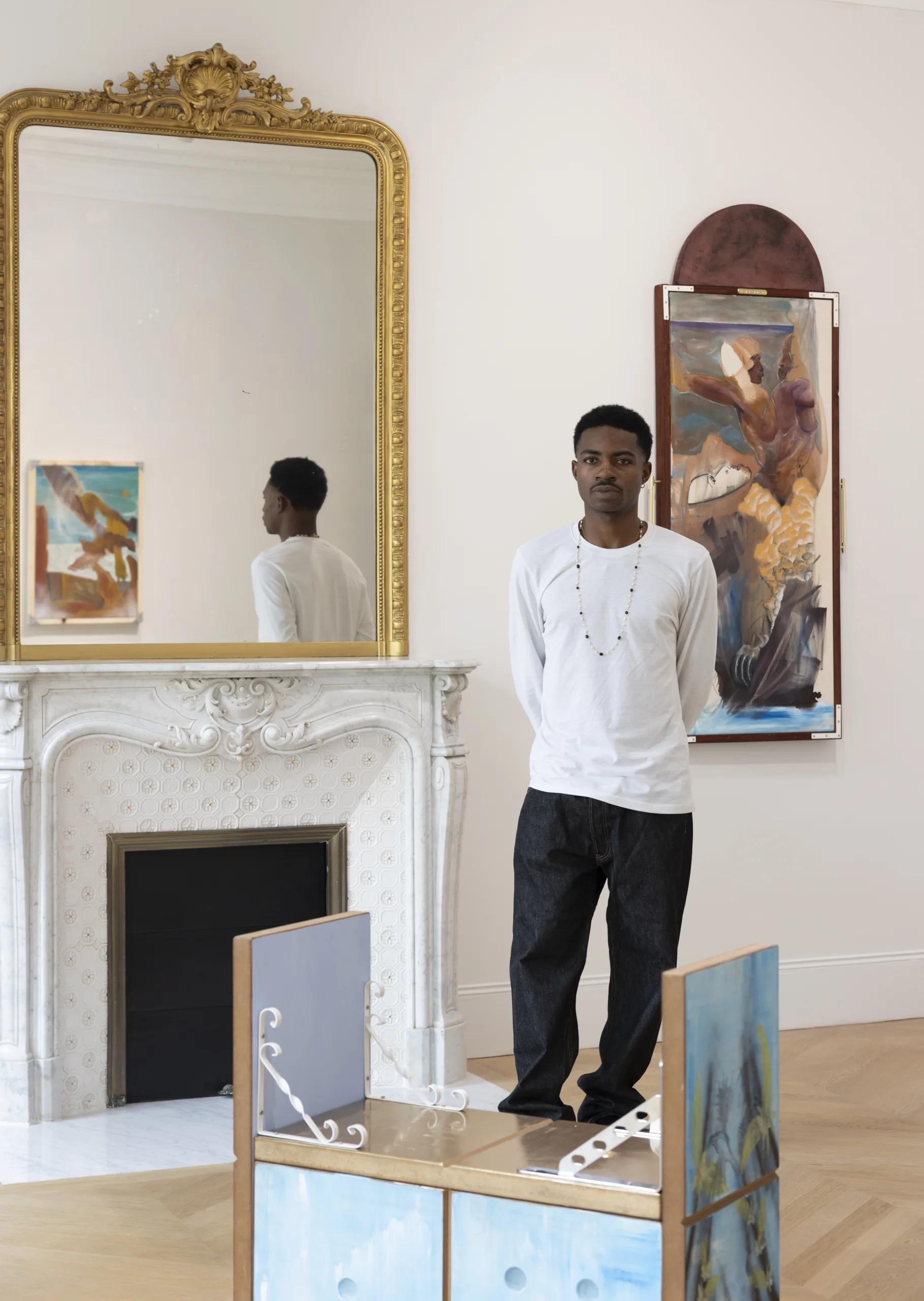
The late summer Parisian sunlight spills into Esther Schipper Gallery as artist Thomias Radin tours me through his homecoming solo show. Between Heaven and Earth: Human Contingency coalesces his decade-plus artistic practice. It continues his ruminations on the contemporary human condition through the choreographic legacies of Black contemporary dance trailblazers — like Ismael Ivo, Alvin Ailey, and Germaine Acogny — whose contributions are often sidelined within their canons. The Guadeloupean-French artist studies their movements and paints them as carriers of embodied ancestral knowledge, resistance, and reclamation of agency.
“I refer to the sky and earth as the main extremities within the frame of my paintings. And human contingency is the opposite of necessity,” he shares. “For me, events like politics or war are ‘human contingencies’ because we don’t decide for them, yet we need to live with and deal with them anyway.” In his paintings, he explores these ‘contingencies’ that occur between his set polarities. His painted figures are either in contention with, or fleeing from, an emblem of power: their fragments disembodied, like the fractures of our current humanity, yet showing slivers of resilience and resurrection.
Thomias’ work often centers movement: a body’s motion captured in-between its genesis and landing, existing in a void of ethereal landscapes. He suspends his subjects above the ground and before the skies, in varying dilemmatic co-existence with the elements of earth, wind, fire, water, and spirit: at once a portrait of both torment and transcendence.
He describes the polyphonic references in his works as ‘rhizomic’: interconnected yet decentralized, steeped in his curiosities in mythologies, global histories, dance methodologies, and spirituality’s metaphysics. His practice weaves these rhizomic references as frameworks of reflection on his lived realities between the archipelagic landscapes of Guadeloupe and the urban infrastructures of France.
His vast thematic explorations are sustained from his childhood musings and love for history. He recalls attending church with his mother at age 11, asking curious questions about the stained glass paintings on church windows, yet not receiving “satisfying answers”. “It created this frustration leading to a deep aim to know, to find answers. So I read books about Egypt, watched documentaries about the Renaissance, to understand where the paintings in the church came from.” 20 years of continuous research later, Guadeloupean folklore, Egyptian, Greek, and Christian cosmologies often imbue his work.
“The narrative technique of religious scriptures and mythology have the ability to cross borders. They are stories everyone knows somehow and they still make sense after thousands of years. Why? What qualities do they have?” he asks. “For me, they understand the nature and relation of human beings. These stories pinpoint what we are and how we behave.”
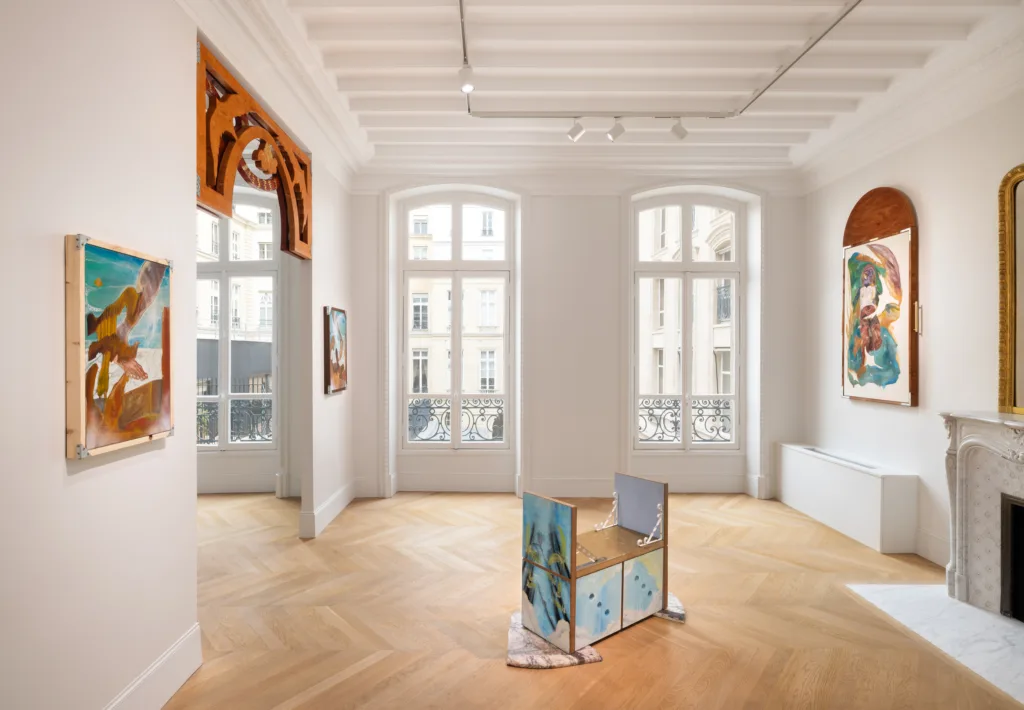

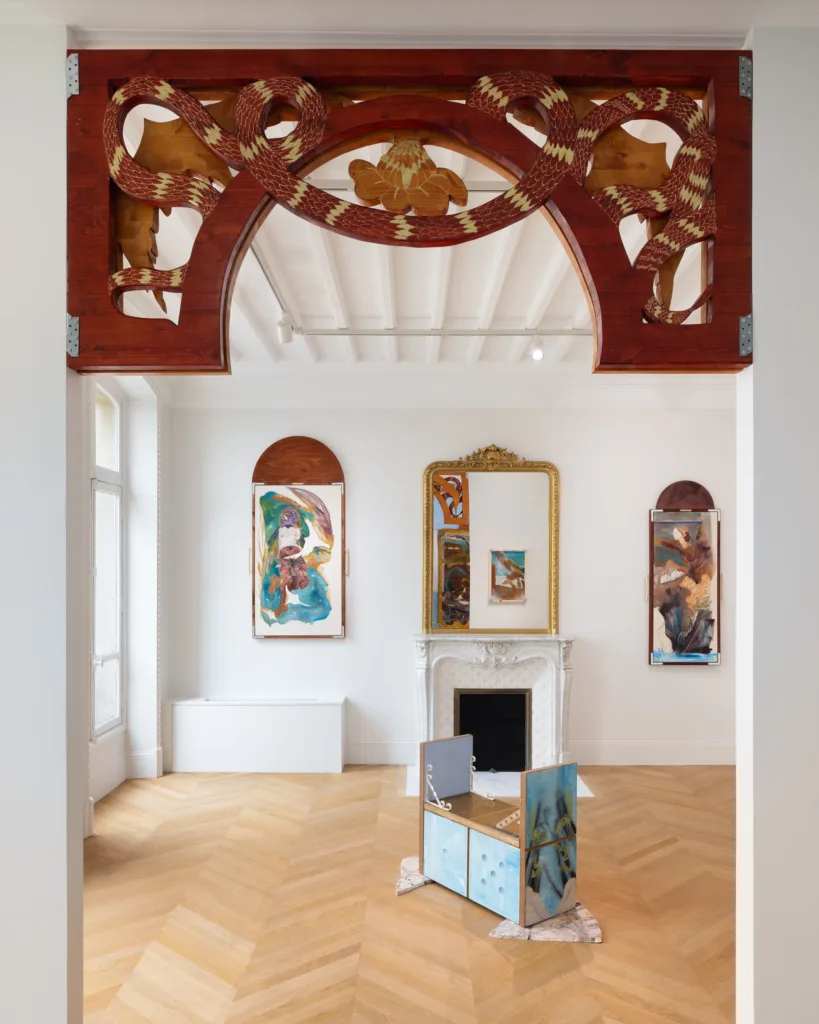

“I like to give my work the same qualities,” he adds. “Not that I want my work to become moral lessons, but I like that it embodies this connection between past, present, and future. I also hope that my work makes people reflect, because that’s what myths do: they’re a reflection metaphor.”
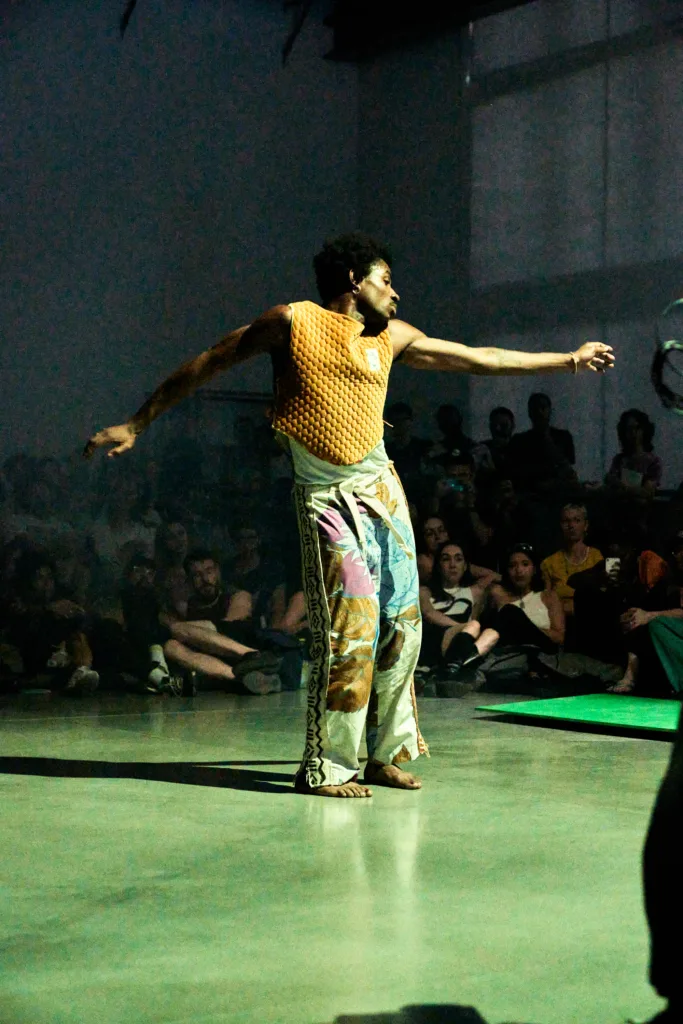
Thomias’ artistic process is built from his training as a professional dancer, specifically in Hip-Hop, Capoeira, and the Guadeloupean percussive music and dance of Gwo Ka. He thinks of himself as a painter with the mind of a dancer.
“It’s me transferring the philosophy of freestyle dance, keeping this same sensation when I’m painting,” he says, referencing dance battle methodologies as an analogy to his painting process. “The time for the image to be revealed to me, can take weeks, months… I need to be ‘on beat’ and respect the tempo of the idea.” While painting, he searches for the same ‘zone’ or ‘trance’ when dancing: a state of comfort when ideas and movement flow. “I don’t sketch the painting, I let myself be open… I never know what the painting would look like. Every time I paint, I start from zero. I need to doubt again. It’s like playing a game of chess with myself.” This deep sensitivity to his painterly intuition is supported by his accrued trust in his body’s technical skills, a rigorous discipline he learned in dance through ritualistic rehearsal and continuous upskilling. This manifests through his gestural brushstrokes that feel like remnants of a body in rigorous movement, the pure spaces of canvas he intentionally leaves dry, akin to the important silences in a dance.
Based in Berlin for the last 8 years, Thomias stays connected to his Guadeloupean heritage through his artistry. He embodies the living history of Gwo Ka, its principles of asymmetry and instability flowing from his dance oeuvre onto canvas and sculpture. “Gwo Ka dancers are never stable,” he notes. The concept of bigidi — its rhythm of collapse and control — is evoked through sketches of foot movements that are never quite grounded: this, to Thomias, is an emblematic paradigm. His growing sculptural practice is also rooted in inherited woodcrafting techniques from his father and uncle, who bear the indigenous knowledge of crafting the Ka, the Guadeloupean percussion vital to Gwo Ka.

As we spoke, Thomias’ career is as his paintings: in the rhythm of constant movement. This solo show comes at the tail of his 2024 LOOP Fair Acquisition Award, which acquired his film RIVÂL for the Loop and MACBA Foundation collections, followed by a fall 2025 group show in Chanel’s la Galerie du 19M in Paris. This November, he premiered his new film Us Icarus and a body of paintings in a solo booth at Turin’s Artissima Fair, where he was awarded the Oelle – Mediterraneo Antico Prize by the Fondazione Oelle. Early next year, he comes home to Guadeloupe, where an artist residency will not only allow him to reconnect with his motherland, but to shoot a film centering his heritage and the practice of Gwo Ka.
In our parting, I glance at his paintings once more and ask if this homage to dance trailblazers is something he’d continue.
“I’ll continue this series while I’m alive; I can do this forever. The idea is to challenge the mainstream narrative, because a lot of our known history is sometimes whitewashed or there’s an omission of people,” he laments. “In the museum nowadays, it’s very rare to see a painting about dance. So I put this mission to myself, to make movements from the Global South and diasporic dances visible in the museum. To make a portrait of them might not be enough as their movements and dance are their legacies… but still, I’d leave more traces of what they’ve worked on.”