
 Posted in
Feature, El Sett
Posted in
Feature, El Sett
“El Sett” Will Get You High – But is it Enough?
Text Edgar Mannheimer
A storm is raging in the Egyptian countryside, strong winds ripping through the wooden frames of a wedding pavilion. The guests have long since escaped the gale and men in jellabiyas and turbans are frantically trying to salvage whatever hasn’t been destroyed, barking orders at each other. Into this chaos appear a father and his two children, a daughter and a son. The daughter, dressed up as a boy since it is considered indecent for a woman to sing in front of strange men, is sitting on a donkey.
Who are you? asks the man responsible for the lion’s share of the barking.
We came to sing, as agreed! shouts the father over the roar of the storm.
What? Are you kidding? can’t you see the wedding is cancelled? Who are you going to sing for?
You! And the men! And to the open sky! Exclaims the father and hoists little Souma onto the trembling stage, compelling his 5-year-old daughter to sing. She shivers from the cold and looks scared. But within a few seconds, her gaze is fixed on something, calming her nerves. She starts to sing poetic words of praise to honour the Prophet Mohammed.
Souma is looking at the donkey she rode in on. The donkey is transfixed by the remarkable voice and stage presence of this little girl, staring at her as if understanding the words, while a thunderstorm shakes and breaks the world around them.
This scene, one of many director Marwan Hamed chose to shoot in black and white, is my favourite. For one, it depicts the first time Umm Kulthum locks onto an individual in the audience, in her mind singing only for them, in order to ease her stage fright – a practice she allegedly maintained throughout her life. On the other hand, it captures the comically absurd yet deeply spiritual nature of Egypt. The godlike figure of Umm Kulthum as a little girl dressed up as a boy, battling the elements in order to sing the prophet’s praises – to a donkey. Perfection.
I watched it twice. Or rather, I watched half of the film once and then again in its entirety during a second screening. Not because I necessarily wanted to, but because the electricity cut in the cinema during the first showing “The power will be back in one minute,” said an attendant. It did not.
I mention this only to say that having seen the film one and a half times I want to go back for a third and a fourth viewing. I’m not going to beat around the bush, I love this film. There are, of course, issues and question marks that I will address in due course. But I must say, the direction, acting and cinematography of this motion picture blew me away.
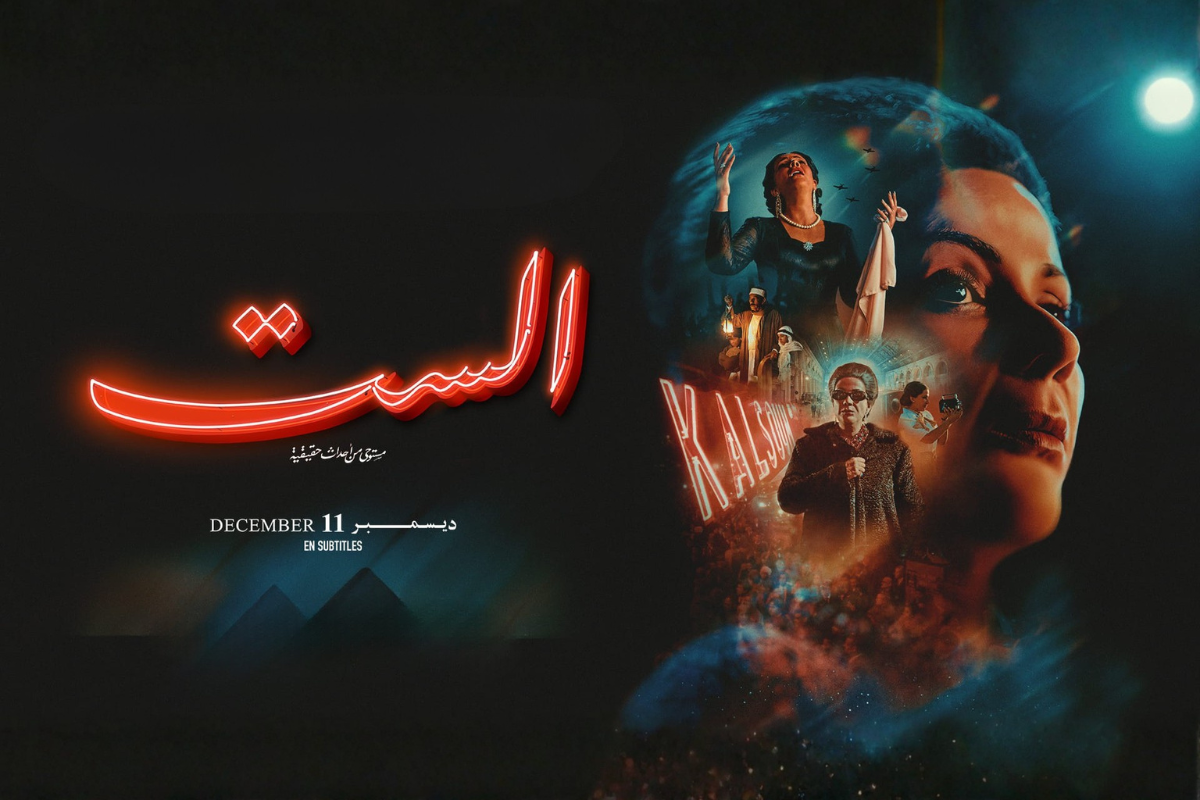
In a way, of course it did. This is a high value production about The Star of The East, The Fourth Pyramid, Umm Kulthum – her third and perhaps most iconic single-syllable moniker lending its name to the film’s title: El Sett (The Lady). When I heard this project was in the works, set to release on the 50th anniversary of her passing no less, my spontaneous reaction was let’s gooo. And going in with that energy, it did not disappoint.
“El Sett” brings to life the traditional lore we’re accustomed to hearing about Umm Kulthum: Her flawless mastery of the Qur’an, her father directing the family to exit the train from first class despite them riding in third, her rejection of composer Ahmed Rami for the culture and her 1967 Paris concert to raise money for the Arab war effort against Israel.
But what makes this film stand out is its focus on Umm Kulthum’s self. The title of the film is no coincidence. “El Sett” aims to answer the following questions: Who was the woman Umm Kulthum? What motivated her? Who, or what, was the focus of her love? How did she personally relate to her inexplicable greatness?
If you’re expecting a full rendition of Umm Kulthum’s life and career, including her interactions with all the important poets, composers, musicians and politicians of the day, disappointment will likely bitter the butter of your popcorn. Indeed, I was annoyed that the film skips past the entire Nasser era and Umm Kulthum’s impact on it, thereby denying the audience insights into her thoughts on Arab socialism, Palestinian liberation and relations with the West. After all, she did once sing that the prophet Mohammed was the “imam of the socialists”. Instead, those keen on politics were given fleeting references to the war in Palestine and the occupation as well as an admittedly stirring speech toward the end about self-sacrifice and love for one’s country in the face of the 1967 defeat.
Alas, this film is not about politics and it is not about the men who surrounded Umm Kulthum, it is about El Sett herself. Most of the pivotal musicians in her life, like Riad Al Sunbati, Mohammed Abdel Wahab and Baligh Hamdi, are not present in the film. Those who are present, like poet Ahmed Rami and composer Mohamed El Qasabgi, serve a specific purpose in the narration of Souma’s life. So instead of hearing her musings on politics or witnessing her craft that one song we love, the makers of El Sett want to focus on the artist rather than the art.
This relentless obsession with identity is not something unique to El Sett. Telling the story of a human being’s personal life and struggles, indeed the struggles of a woman in a patriarchal society, is the least common denominator. It is what the largest number of people can relate to at any given time. This is, after all, a blockbuster and needs to consider return on investment. It’s not a film meant to challenge us intellectually, and does not necessarily aim to teach us something. Unfortunately, posterity may come to view this film as shallow. I would love to watch a three hour production focusing mostly on the poetry and power of Umm Kulthum’s music and why it resonates with so many people. But let’s be real, this would not appeal to as many people as the juicy story of Umm Kulthum’s love life.
In a pivotal scene, poet Ahmed Rami proposes to Umm Kulthum. She is young, successful, rich and famous. Ahmed Rami is her mentor. He taught her the French language and philosophy, as well as Arab literary and poetic tradition. She was his muse and his life-long obsession. But she rejected him. Not because she didn’t love him, she certainly did. But because she possessed the foresight to realise what such a union would mean for her artistry. Getting married would mean children and tending to a home – all the practicalities of everyday life that could damage an artist’s spiritual connection with their art (there is a reason so many creative geniuses are lousy family members). She made the conscious decision to deny herself love and instead use the spiritual and amorous tension between her and Ahmed Rami to express love through song. Instead of sharing her love with a man, she shared it with the world.
Is there someone else? asked Rami.
Yes, said Souma, song.
Umm Kulthum had a strong sense of destiny. When she rejected Ahmed Rami she was only in her 20’s. Did she know that her career would span more than half a century? Did she know that over four million people would attend her funeral? Did she know that she would perform for kings, queens, presidents and emirs?
A friend of mine recently told me a story, told to him by his teta. His mother’s parents, uprooted from Palestine in 1948, had relocated to Libya, working as engineers in the country’s burgeoning construction industry. One evening, they were invited to a reception hosted by Queen Fatima el-Sharif – this was in the 1960s, before Muammar Qaddafi toppled the monarchy in a coup d’état. As the queen entered the salon, guests observed proper etiquette, bowing and curtsying as is customary, falling silent until the queen signalled for the crowd to continue mingling. A few minutes later, a famous singer walked into the room and the crowd lost it. For the rest of the evening, it was as if everyone forgot that the queen of Libya was in their midst since someone far more important was present, Umm Kulthum.
The American equivalent to Umm Kulthum, Bob Dylan (yeah I said it, it’s either him or Billie Holiday), defines destiny as “a feeling that you know something about yourself nobody else does. That the picture of yourself in your mind will come true.” In fact, Bob Dylan adored Umm Kulthum, and claimed the secret to her greatness was phrasing. Not necessarily the lyrics, the music, the voice or the spirit. It is the bending and pronunciation of words and sentences to convey meaning and emotion, the repetition of a single phrase over and over again, each time a little different. It is this phrasing and repetition that sent any audience listening to Umm Kulthum into an ecstatic frenzy.
Umm Kulthum is the undisputed master of Tarab, the Arab musical genre which roughly translates to ecstasy. The film beautifully captures this by showing the facial expressions of her listeners in pure ecstasy.
According to the chatter in Egyptian cultural circles, every actor in El Sett is brilliant, except Mona Zaki. I disagree. I think the acting is marvellous, including Mona Zaki’s portrayal of Umm Kulthum – stepping into the shoes of a legend is no simple task. But her acting is believable. When she tells the director of the Olympia theatre in Paris, “nous ne parlons pas la même langue” (we don’t speak the same language) after he asks her to tone down her politics, it is Umm Kulthum and not Mona Zaki who is saying it. Sayed Ragab’s warm smile breathes life into the role of Umm Kulthum’s father. His love and care for little Souma, delicately correcting her Qur’an recitation, brought tears to my eyes. Ahmed Rami’s tragic fate haunts me through Mohamed Farrag’s masterful depiction of the silent torture of unrequited love. A big shout out to Nelly Karim’s cameo as the ruthless, cut throat Queen Nazli – it gave me goosebumps.
Although the genre of biopic often veers toward the cringe, director Marwan Hamed (who directed The Yacoubian Building before turning 30) has created a masterpiece. What the chatter gets right, however, is that the choice of Ahmed Mourad for screenwriter was not ideal. The Egyptian language is so rich with poetic expression that the dialogue in El Sett sometimes feels superficial and, at times, absent.
Umm Kulthum would not recognise the Egypt that her biopic is being released into. An Egypt of billboards, talabat scooters, walled-off compounds in the desert, QR codes and Mahragan. Or would she? She may have loved koshary arancini, collaborated with Wegz and sang more national songs. We’ll never know, and for that I’m thankful.