
 Posted in
Feature, My brother My brother
Posted in
Feature, My brother My brother
My Brother, My Brother: the animated Egyptian short examining loss, memory, and twinhood
Text Selma Nouri
Loss remains one of the most complex experiences within the Arab world. Ours is a community that prizes intellect and innovation; the Islamic sciences, in particular, have played a foundational role in shaping the modern world. Yet we are also a community profoundly guided by faith. From a young age, we are taught to pray or to refrain from recounting bad dreams. We learn to submit to God’s will, and simultaneously, to sustain hope – to believe in the possibility of the impossible, especially when it comes to loss.
When outside of the region, articulating this duality can be especially challenging. It is often difficult to convey how scientific reasoning and spiritual conviction can coexist so seamlessly, and these tensions become even more pronounced in the context of death. What does it truly mean to accept that someone is gone? How do practices of remembrance align with expressions of faith? And how is it that, even for the most faithful, loss can become so crippling, so unscientific?
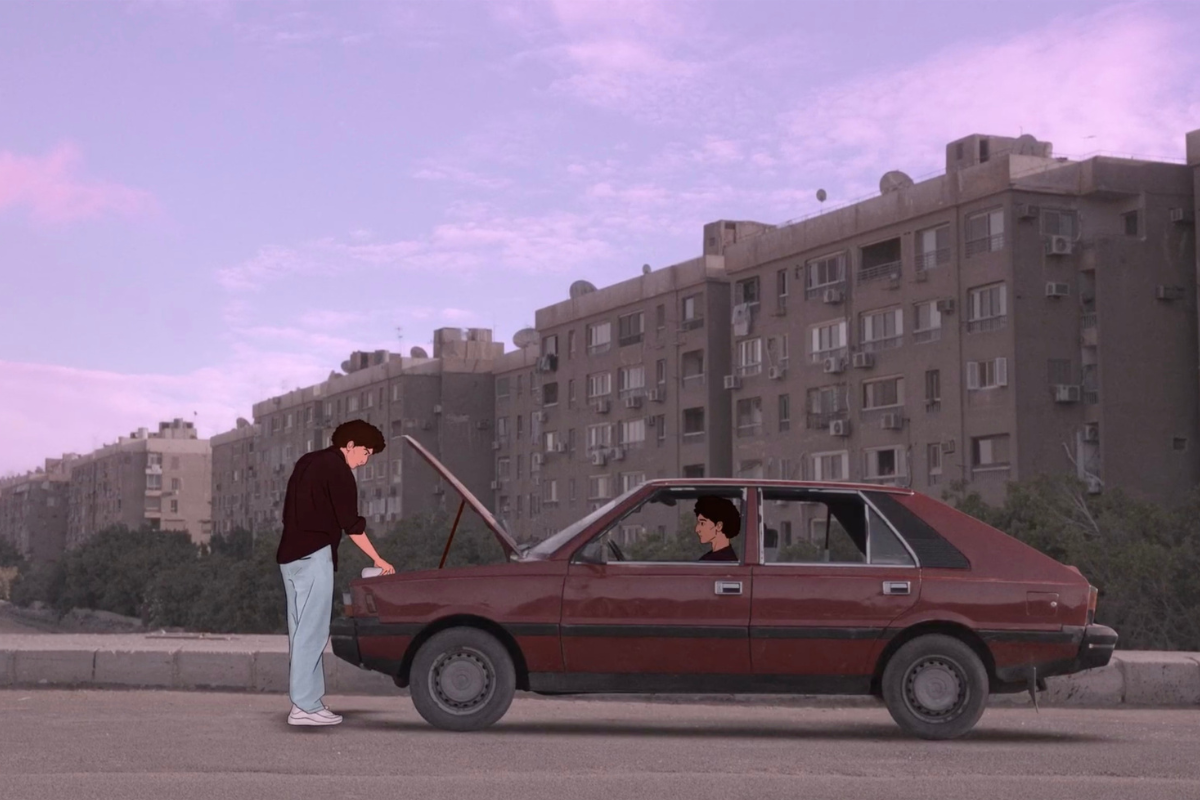
For the first time, I saw this complex experience articulated with exceptional clarity and sensitivity in the Egyptian short film My Brother, My Brother. The autofiction animation, which recently received the Africa Movie Academy Award for Best Animation and the Best Animation Short Award at the 29th Arab Film Festival, recounts the unarchived complexities of a past shared by identical twins, Omar and Wesam. Through a split narrative, the film presents parallel versions of their memories, beginning with their earliest moments together in the womb and culminating in their separation through the tragic death of one brother.
As the twins recount their lives, the film progressively blurs the boundaries between reality and fiction. Its combined use of rotoscoped 2D animation and live-action cinematography subtly manipulates viewers’ expectations, weaving together real and imagined recollections throughout the narrative and inviting the audience to inhabit and internalise these memories as if they were their own. Through this dynamic interplay of time and space, the film emerges as a “never-ending construction site” of memory, fundamentally shaped by conflicting ontologies and unresolved questions.
“I began writing this film with my twin brother, Saad,” co-director Abdelrahman Dnewar explains. “We started working on it after our mother’s passing, driven by a need to process everything that had led to that moment.” As the film evolved, however, so did its storyline. “It remains a film about loss,” explains Abdelrahman, “but now, one of a different kind…the loss of my twin brother Saad, my other half and co-creator of this film.” Saad had passed three years into making the film, at the young age of 29. “Because of this, the film has become profoundly personal to me,” he says, “perhaps the most important project I have ever worked on. It is Saad’s remaining legacy.”

Having grown up in a household where religious belief and scientific practice coexisted, Abdelrahman explains that he and his brother were perpetually “left longing for answers” about the world around them. This state of inquiry is embodied in the figures of Omar and Wesam, who, as children in the film, confront their mother with questions about human existence, procreation, and their aunt’s infertility. As they mature, these early curiosities are deepened by encounters with death and by the absence of a family archive that might have completed their fragmented memories. This lack prompts an ongoing interrogation of faith, science, and memory. At various moments, questions rooted in science give way to those of faith, and vice versa; yet neither framework ultimately offers resolution.
What remains constant throughout the film is the recognition that fate is, at times, beyond human control – neither fully reconstructable through memory nor entirely comprehensible through empirical fact. Uncertainty and questions of fate thus emerge as inescapable conditions of human experience, persisting across cultures and belief systems. In this sense, Omar and Wesam’s fractured memories and unforeseen destinies come to function as emblems of a shared human condition.
“Before he passed, my brother and I would often talk about moments from our past,” reflects Abdelrahman, “only to realise that we remembered the same events very differently. When we attempted to fact-check these memories, we found almost no archival material. The only photograph we discovered of our entire family is the one that appears in the film, where everyone is facing the camera except Saad and me. Instead, we are turned away, looking into a cage at the zoo…It is a very peculiar image. For years, we assumed we were looking at monkeys. However, when we later returned to the zoo to locate the precise spot where the photograph was taken, we discovered that we had in fact been looking at hippos.”

This realization eventually became the catalyst for the film. “We began to wonder how time and subjectivity could transform hippos into monkeys,” explains Abdelrahman, “and how memory reshapes reality through interpretation. This is why we decided to take on the autofiction form. We wanted to let go of the binary of what is real and what is not…In fact, this is a question that arises frequently during screenings. Viewers often ask, which details are true? But for us, that distinction is ultimately beside the point. What mattered to Saad and me was conveying the emotional truth of what had occurred. Our aim was to develop a cinematic form capable of capturing this dual narrative, where memory itself is split between the shared social experiences and divergent emotional realities of two twins.”
Both Abdelrahman and Saad were drawn to a mode of cinema that resists instructing emotion. As Abdelrahman explains, “our aim was to isolate our memories and make them universal.” He describes this as his preferred cinematic approach – one that captures an experience, detaches it from its point of origin, and allows viewers to encounter it on their own terms, regardless of belief or background. This philosophy fundamentally shaped their engagement with the film’s subject matter. Rather than anchoring meaning in specific cultural or biographical contexts, the filmmakers sought to create an open interpretive space, one where viewers – many of whom may not share the same experience of twinhood or the filmmakers’ cultural background – could nonetheless inhabit Omar and Wesam’s emotional world. As Abdelrahman notes, “the film encourages spectators to revisit its images and emotions beyond the moment of viewing, allowing them to evolve in relation to their own uncertainties, memories, and lived experiences,” ultimately prompting reflection on their own lives.

The strength of My Brother, My Brother ultimately lies in this sustained emphasis on the universal powers of memory and imagination – emotional processes shaped by forces far more complex than those typically acknowledged within rigid cultural frameworks. The divergent emotional trajectories and experiences of Omar and Wesam demonstrate how shared and transmitted memories persist over time, drawing the twins closer even as death abruptly intervenes to separate them. By resisting cultural reductionism and orientalist tropes, the film conveys a deeply human experience, rendered unapologetically through a non-Western lens.
As Abdelrahman explains, “That is the one thing Saad and I refused to accept. I don’t think it is the job of a filmmaker to preach…the cinema that I like is one that depicts real lives without feeling the need to justify or explain itself. I prefer to leave interpretation up to the viewer.” This perspective underscores a commitment to representing lived realities rather than adhering to aesthetic idealisation or ideological prescription. “I am not trying to please anyone,” he adds.
He further illustrates this ethos through personal examples. “Our mom wore the burqa outside, but inside she took it off. Saad and I were smoking joints on the mountain, but praying as kids. We didn’t feel the need to justify these dynamics to anyone in the film. And I mean, there is nothing to really explain anyway…Those were simply our experiences.” While their memories depict a social reality marked by contradiction and nuance, they also reflect the lived realities of many individuals across Egypt and within the diaspora. In this way, the film articulates a shared human experience, one that can be continually reinterpreted and re-understood both within Egypt and across diverse cultural contexts. As Abdelrahman explains, “To be authentic, of course, the film had to work in Cairo before it could work anywhere else…but ultimately it touches different communities globally in different ways, and that’s the whole point.”

For Abdelrahman and the entire team, this pursuit of authenticity became even more important after Saad’s death. Fellow twins and close friends of the Dnewar brothers, Hesham and Karim Marold, joined the project as producer and cinematographer, respectively. Abdelrahman’s older brother, Abdallah, also came on board as a producer, alongside collaborators Jessica Arfuso and Lucas Tothe. What began as a deeply personal endeavour thus evolved into a collective, community-driven project, shaped by a creative process that mirrored the film’s central themes of memory and continuity. As Karim reflects, “Making the film became a way for us to grapple with Saad’s loss…and in many respects, reflect its very essence. It allowed us to blur the lines between reality and fantasy, bringing Saad’s memories and vision to life even after death.”
Saad initially served as the film’s animator, and he and Abdelrahman had planned to share narration duties. Following his death, however, the remaining team was forced to assume all aspects of production. As Abdelrahman explains, learning Saad’s animation style and attempting to continue his work proved to be a prolonged and inherently imperfect process, ultimately extending production by an additional three years. While the resulting sonic and visual language could not fully replicate Saad’s voice or hand, these imperfections came to signify something far more profound than absence; they gestured toward the continued presence and evolving potential of his creative legacy.
Much like memory itself, the drawings in the film evolve over time rather than remaining fixed. Saad had produced a series of sequences he called “animation tests,” which he regarded as provisional – but “for us they were perfect,” Karim reflects. After Saad’s death, Abdelrahman and Karim developed a particular attachment to these drawings, even as some collaborators advocated reworking the animation entirely. Karim, however, was the first to articulate the importance of preserving their distinctiveness, arguing that the visible differences in Saad’s and Abdelrahman’s drawings were not flaws but strengths, and that the film could be visually structured around them.
This decision proved crucial. By embracing formal inconsistency as an expressive strategy, the film allows multiple visual registers to coexist, mirroring the fragmented and evolving nature of memory itself. In this way, it registers loss not only narratively, but materially – through its changing textures, rhythms, and modes of representation. While we can never be fully reproduced through spirit or science, traces of ourselves persist, transmitted through memory and the imagined realities we leave behind. The film’s mutable sounds and visual materials attest to this enduring presence.

“You know, I am Saad’s twin…I have his DNA,” reflects Abdelrahman, “but I am not him…and yet, somehow, in certain moments of creating the film and later watching it, I felt like he was coming back.” In the brief fifteen minutes of the animation, now shared with audiences around the world, Saad’s legacy endures as an archive of memory, one that is not fixed but can be transformed and transmuted into the memories of all those we have ever lost or loved. The film serves as a poignant reminder that the people we mourn are never fully gone; they persist in memory, both in the ways they shaped us and in the tangible and imagined traces they leave behind in our recollections. As Hesham reflects, “the purpose of the film is to carry you away, to transport you into your own emotional condition…this was a film created by community, for community, to sustain us through moments of loss and heartache.”
In desperation, we often turn to the spiritual or the scientific, seeking solace in the material frameworks we have created. Yet perhaps the most enduring means of preserving those we love, and those we have lost, resides in memory itself. Maybe that is the only way we can keep our loved ones alive, shaping us long after their absence.