
 Posted in
Feature, Iran
Posted in
Feature, Iran
Standing with the people first and foremost
Text Resistance Archives
This piece was originally published on Resistance Archive’s Substack on January 14, 2026
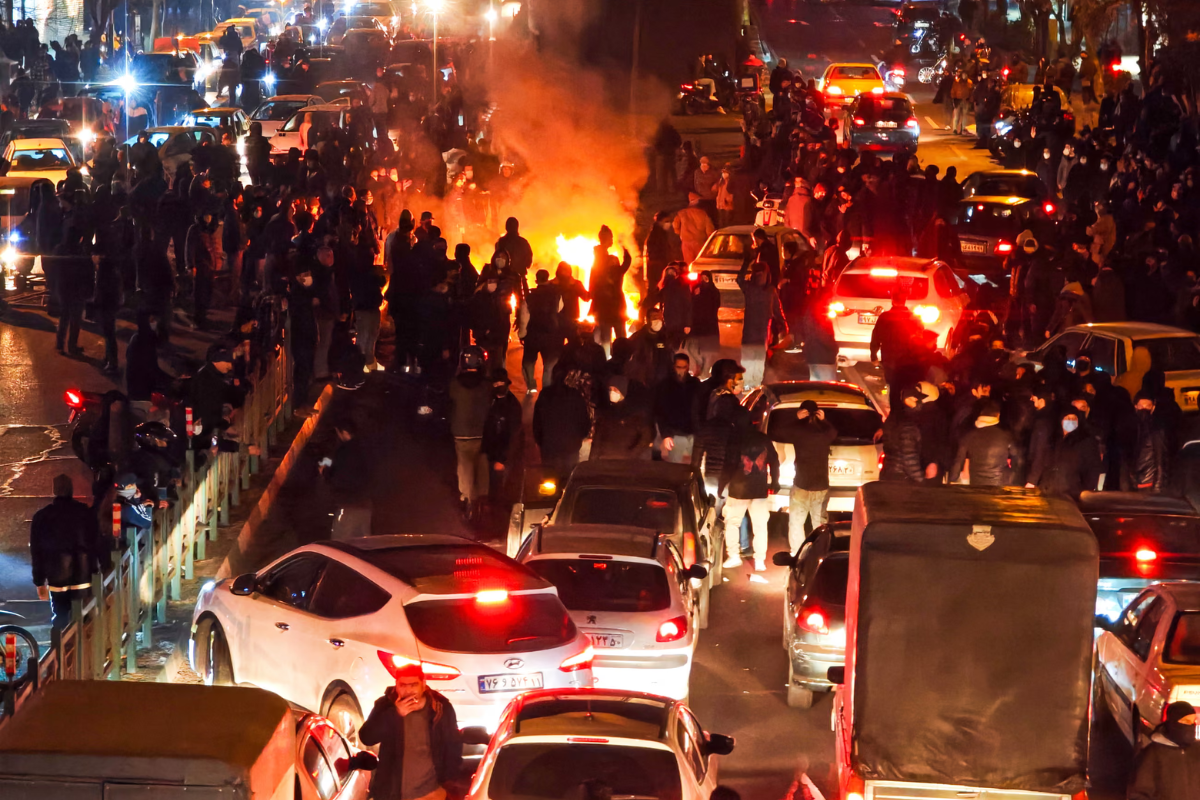
The protests now unfolding across Iran are being pulled into a familiar struggle over meaning. On one side is the Iranian state, working to portray dissent as criminality and foreign conspiracy. On the other are Western media ecosystems and diaspora political actors attempting to instrumentalise unrest into a justification for intervention, sanctions, or a “transition” that has already been politically pre-approved. Somewhere between these two projects lies the actual reality: a society strained by deep economic hardship, political exhaustion, and the accumulated violence of repression.
At this moment, the central task for those of us watching from outside is not to become narrators for any state’s propaganda. It is to practice a kind of solidarity that neither romanticises revolt nor criminalises it; neither erases the realities of Western economic warfare nor uses them as an excuse to dismiss the people’s anger. If our political commitments are serious, we have to be able to stand with the Iranian people without laundering the agenda of the Islamic Republic, and without swallowing the agenda of Washington and Tel Aviv.
The starting point has to be straightforward: people are in the streets because they are fed up. They are fed up with economic devastation, with stagnation, with disappearing futures. They are fed up with a state that has been incapable – or unwilling – to produce a stable and dignified life for the majority. Public protest does not emerge out of nowhere. It is not invented by foreign governments. It emerges when life becomes structurally unlivable.

It would also be politically naive to ignore the scale of pro-regime mobilisation inside Iran. On January 11, tens of thousands gathered in Tehran’s Enqelab Square for a rally framed as an “uprising against American-Zionist terrorism.” The event featured a speech by the Speaker of the Majlis (parliament), Mohammad Bagher Ghalibaf, who leaned heavily into an anti-intervention message and positioned the moment as a multi-dimensional confrontation with the West. He claimed Iran was facing a “four-front war”: an economic war, psychological warfare, a military war against the United States and Israel, and what he described as an ongoing war against terrorism. With chants and banners declaring “Death to America” and “Death to Israel,” Ghalibaf warned that any attack on Iran would be met with retaliation, vowing that the Iranian military would teach Donald Trump an “unforgettable lesson.”

Iran’s economic conditions as though they exist in a sealed container. The country is not merely mismanaged; it is also strangled. Western sanctions have functioned as a long-term regime of economic warfare that constricts normal economic development and makes daily life more precarious. Banking restrictions, trade blockades, blocked access to investment, technology, and international financial systems – these are not abstract policy mechanisms. They manifest in inflation, in scarcity, in unemployment, in lost savings, in instability that sinks into the ordinary routines of survival.
Iran has enormous economic potential: a highly educated population, an industrial base, energy reserves, and regional trade capacity. It is not inevitable that such a country should exist in permanent crisis. Sanctions, however, work precisely by ensuring that the economy cannot breathe. If we claim to stand with ordinary Iranians, then we have to treat sanctions as what they are: collective punishment. They are designed to produce social pressure and political instability, and they do not discriminate between government officials and working families trying to eat, pay rent, and survive.
This matters because it exposes the fraud at the heart of much of the Western commentary: the pretense that the West is merely an observer. It is not. The US and its allies have helped manufacture the conditions under which despair becomes everyday life, and then use that despair as proof of the Iranian state’s unfitness.
The propaganda trap: when solidarity becomes a battlefield
As soon as unrest begins, narrative warfare follows. It is always predictable: the regime frames protest as chaos, and foreign actors frame protest as opportunity. Both approaches require one common outcome: denying the people their agency. The state denies agency by calling them foreign agents. Western powers deny agency by treating them as raw material for a “transition” designed elsewhere.
This is why it has been disturbing to see how quickly some people online, and especially in spaces that claim to be anti-imperialist, have responded not with solidarity, but with suspicion and condemnation. The language is often identical: the protests are “US-backed,” “Mossad-led,” or at times even “Zionist.” Protestors become “rioters,” and demands become illegitimate simply because foreign powers may benefit from unrest.
This is a profoundly unserious way to understand mass politics.
Foreign powers try to benefit from almost every moment of social rupture. That is not unique to Iran. It is a structural feature of imperial power. The CIA and Mossad have historically infiltrated liberation movements, anti-colonial struggles, socialist parties, student uprisings, civil society, media ecosystems, and diasporic political networks. They do this not because protests “belong to them,” but because protests are openings – they are moments where political outcomes become uncertain, and uncertainty is something empires attempt to manage.
It should surprise nobody that intelligence agencies attempt to infiltrate Iranian protests. If anything, it would be strange if they did not.
But the existence of infiltration does not turn a popular movement into a foreign invention. Infiltration does not equal authorship. Tens of thousands of people are not suddenly puppets because foreign actors show up with cash, contacts, networks, and propaganda lines among a few handfuls of protestors. Imperial power always tries to hijack what it didn’t create.
And it is precisely here that some online commentary becomes dangerously naive: the belief that an Israeli or American politician openly boasting about involvement is credible evidence that the entire movement is “Mossad-led.” Not only is this a weak analytical approach, it misunderstands how covert operations actually work. The CIA did not publicly disclose its involvement in the 1953 coup against Mosaddegh at the time. It took decades, well into the 21st century, for portions of that record to become publicly acknowledged and documented. The logic of covert power is not confession. It is plausible deniability.

When Western or Israeli officials make loud insinuations about secret interference, we should interpret it as strategic messaging, not accidental truth-telling. Such statements are designed to trigger predictable reactions: to delegitimize protest in the eyes of those who fear foreign domination; to provoke state overreaction; to fracture solidarity; and to intensify polarization by turning a popular struggle into a proxy battlefield. In other words, when a foreign power claims credit, it is often less about reporting reality than about manufacturing it. None of this means external interference is imaginary. In many cases, these claims are exaggerated, but they are also often rooted in real attempts at infiltration, and are deployed to project power and manipulate perception.
Yes, intelligence agencies may be on the ground. Yes, they may be infiltrating. Yes, they will attempt to redirect protest energy toward their preferred political endpoint. But none of that makes the protests “Mossad-led.” That claim is not only false; it is politically paralyzing. It demands that people wait for a revolution that is perfectly uncontaminated by imperial attention, which is another way of demanding that people never revolt at all.
The Shah is not the solution
Another propaganda current running through this moment is the attempt to frame a monarchist restoration as democratic transition. Some diaspora voices and Western-aligned political circles treat Reza Pahlavi, the son of Mohammad Reza Shah Pahlavi, as an inevitable “post-regime” option. The message is often implied rather than stated: that stability requires a familiar figurehead, that order requires hierarchy, that national renewal requires inherited authority.
But monarchy is not democracy, and restoration is not liberation.

The Iranian monarchy was not a neutral period of “stability,” and it should not be romanticised as a lost era of freedom. Under Mohammad Reza Shah Pahlavi, the state consolidated power through systematic repression, political surveillance, and the violent elimination of dissent. Leftist forces (especially those tied to labour organising, socialist and communist movements, and anti-imperialist politics) were aggressively targeted through arrests, torture, and executions. But repression did not stop at the left: religious and Islamic opposition was also routinely crushed when it threatened the monarchy’s authority. The point is not that these groups represented the same politics, but that the Shah’s rule treated organised opposition of any kind as an existential threat, and managed that threat through force.
The monarchy’s survival depended on closing democratic space and neutralising popular movements that demanded sovereignty, redistribution, and genuine political participation. It could not allow mass politics to flourish, because mass politics in Iran consistently pushed toward anti-imperialism, resource sovereignty, and a break from foreign domination.
And that brings us to the other essential truth: the Shah’s regime did not stand on internal legitimacy alone. It relied heavily on Western backing, especially after the overthrow of Mosaddegh in 1953. The monarchy functioned not simply as a “national government,” but as a key pillar of Western strategy in the region during the Cold War: a reliable partner for US interests, a regional security asset, and a site of deep military cooperation and intelligence alignment. In practice, this meant that the monarchy’s internal authority and external support were intertwined: the more the regime depended on Western power, the more it required domestic repression to manage popular anger at that dependency.
In other words, monarchy in Iran was not merely an “alternative system” to the current regime. It was a historically specific authoritarian project, one sustained through coercion at home and alignment with imperial power abroad. To present its restoration today as democratic transition is not political realism. It is historical amnesia, and it risks substituting one structure of domination for another.
On burning mosques
This is where nuance becomes necessary, because propaganda thrives on single images. One of the most widely circulated claims has been that protestors are burning mosques, framed as evidence that the movement is inherently extremist, anti-Islamic, or guided by outside forces.
There are real incidents to discuss here, but the political meaning is routinely distorted.
The Islamic Republic has fused religious symbolism with state power so tightly that, for many Iranians, Islam is not experienced as a private spiritual framework. It is experienced as institutional authority. It is experienced as surveillance, policing, enforced morality, ideological coercion, and the use of sacred language to justify repression. When a state monopolizes religion as a technology of control, it should not be surprising that some people begin to associate the religion itself with the state.
This is not a moral endorsement of attacking religious spaces. It is an explanation of how oppression shapes political perception. People who live under a regime that weaponizes Islam will often come to see religious infrastructure as state infrastructure. In many cases, mosques are not treated as neutral community spaces but as sites of ideological reinforcement and regime legitimacy.
There is also the specific political context: many of the mosques being attacked are not random. They are closely associated with the regime, with clerical authority, and with the institutional symbols of Khamenei’s rule, including prominent locations tied to state sermons and public religious performance.
What we must resist is the opportunistic use of these incidents as a way to delegitimise the entire movement. All uprisings are messy. They all contain contradictions. They all include actions that are politically unhelpful, morally complicated, or strategically misguided. But to use imperfection as a reason to abandon the people is not principled politics, but a politics of distance.
This dynamic is not unique to Iran. In Gaza and elsewhere, Palestinians living under relentless Israeli military violence often come to associate Judaism with Zionism. This is not because they are incapable of distinguishing a religion from a political project, but because Zionist violence is frequently delivered through religious symbolism and explicitly ethno-religious messaging: menorahs lit in the rubble, religious ritual made into spectacle on top of destruction, the Star of David stamped into the skin of prisoners. Under conditions of total war, it becomes materially difficult to maintain distinctions that are demanded in calmer contexts. This does not justify antisemitism, nor does it require romanticising every act committed in moments of revolt, but it does require political honesty about how oppression reshapes perception and symbolic targets.
In November 2014, for example, a deadly attack on the Kehilat Bnei Torah synagogue in Jerusalem left several Israelis and one Druze dead. The point is not to collapse all resistance into a single moral category, but to insist that when people are being exterminated, starved, and caged, symbolic associations shift – and condemnation from a distance can easily become a form of political denial.

During the Spanish Civil War and the broader anti-fascist struggle against Franco, sectors of the Spanish left and anti-fascist militias engaged in intense anticlerical actions, including the burning of churches and attacks on Catholic property. This was not simply “hatred of religion,” nor can it be explained as irrational vandalism detached from politics. For many working-class communities, the Catholic Church was not experienced as a neutral spiritual institution, but as a pillar of elite rule that was aligned with reactionary forces, historically hostile to labour movements, and deeply implicated in the moral legitimization of repression. In that context, churches became symbols of an order that had disciplined the poor and sanctified fascist violence, and they were treated as political infrastructure rather than sacred space.

In Iran, many are responding to oppression as they encounter it: through the structures, symbols, and institutions the regime has built. That reality is uncomfortable, but pretending it does not exist will not produce better politics.
Conclusion: Solidarity begins with the people
The protests in Iran are not a Western invention, even if Western actors attempt to infiltrate them. They are not a Mossad project, even if Mossad tries to exploit them. They are not illegitimate because foreign powers may benefit. If that were the standard, then no people anywhere would ever be allowed to rise.
Standing with the people first and foremost means refusing every script that denies their agency: the regime’s script that frames dissent as treason, and the West’s script that frames dissent as an opening for managed sovereignty.
Our position must be clear enough to withstand propaganda:
We oppose repression and state violence.
We oppose sanctions and economic warfare.
We oppose foreign intervention and regime-change engineering.
We oppose hereditary restoration projects dressed up as democracy.
We defend the right of the Iranian people to determine their future.
There is hope beyond this moment in the principle of self-determination itself. Iran’s history contains real democratic aspirations, including the promise represented by Mosaddegh before it was crushed by foreign-backed overthrow. That history is not simply a tragedy; it is evidence that another political future is possible.
And that future must belong to the people – not the regime, not the king, and not the empire.