
 Posted in
Life & Culture, issue05
Posted in
Life & Culture, issue05
How to time travel to the present
Text Yasmin Alrabiei
In the epoch of the scroll, we network ideas that once stayed private, sharing the uncanny phenomena that connect us. The calendar synaesthesia trend was a perfect example; TikTok filled with tick tock schematics and users saying, “I didn’t know other people had this.” More philosophical than the colour-tasting, sound-seeing discourse of the 2010s, calendar synaesthesia is where people can vividly see time. Users posted handdrawn loops, S-curves, C-shapes, spirals, and polyforms mapping months as something the eyes could hold. Some stretched out their arms like hula hoops, placing March at their waist and rotating April around them; others bent calendars anticlockwise or felt months hovering overhead. Straight lines were, unsurprisingly, rare.
Affecting only 10-20% of people, the trend makes ideas of non-linear time feel far more harmonious than the rigid grids of our planners. And yet, looking at my own 2026 notebook, I see the domestication of time. A year turning only in right-hand pages towards the book’s end. Perhaps once all the land was cultivated, ‘they’ came for our temporal perception, too. Productivity-maxxing, 5-9 before the 9-5, electrolytes marketed on TikTok that claim to give you a 25th hour—self-betterment internet has packaged the neoliberal hallucination that you can win back your time. And every year, we buy the damn journal. Mine, ironically, has an eagle in flight on its cover.
We often speak of time as if it’s a natural element, like daylight or soil, but the clock is as much a construct of capitalism as the factory floor. Ever since the 14th century, industrial capitalism has imposed an interrelationship between the body and the factory, synchronising workers through clocks, railroads, and bureaucracy. In actuality, humans intuit rhythm—a flow of time, sure, but the link between the corporeal and the ‘clock’ is engineered. Neuroscience and endocrinology tell us that the body doesn’t experience itself linearly or in neat units. Nothing in nature does.
Visualising history as a straight procession to the future has been our modus operandi for aeons, yet it is new. It has been optimised to support the colonial power’s claim to be the universal arbiters of what advancement means through the logics of ‘development’ and ‘modernisation’. It also dictates our futurity by framing apocalypse as always on its way, and it’s this anticipation of an oncoming boogeyman that sustains catastrophe in the present. Through accusations of barbarism (read: Arab) or primitivity (read: African), linearity narratives cast entire continents as perpetually behind, as not yet reaching the tomorrow arbitrarily placed farther up the western-imposed line. Rightfully, we ask, what line? With life itself moving in loops, helixes, twists, and spirals, what world insists on a straight line if not just to leave people behind?

A science and a history of time
“Linearity is not the only model – it’s not even the dominant model – for how we construct or can deal with reality,” Rasheedah Phillips once asserted. Through co-founding the collective Black Quantum Futurism, the Afrofuturist writer, artist, and lawyer explores how Black communities experience and understand time and space differently, drawing on ideas from quantum physics to challenge dominant assumptions about who time serves.
Their book, Dismantling the Master’s Clock, coheres these Afrofuturist ideas and digs into the role of linear time in normalising racial domination. “Some of the very first acts of slavery and colonial terrorism were necessarily mediated by time as an accurate timekeeping device was crucial to maritime navigation and determining longitudinal measurements,” they share in an essay for The Funambulist.
“Time reckoning had historically been determined by solar time and other local methods,” Phillips observes in the text, describing the cyclical models of time that preceded the 1884 International Prime Meridian Conference. When male delegates from 25 US-aligned nations formalised Greenwich as the world’s prime meridian to synchronise armies and trains, Greenwich Mean Time (GMT) was established and Britain’s geopolitical authority was folded into the very clocks that order your days and mine.
Clocks, calendars, and maritime navigation tools were weaponised to control Black lives from enslavement till now. Time discipline meant clocking every hour of the body under control: when to work, eat, sleep, and follow orders. After emancipation, racism remodelled itself through systems of waiting—bureaucratic forms like housing policies, welfare systems, curfews, and paperwork that stole people’s time through administrative obstruction. This endlessly delayed justice shows that every clock is suspended for the subaltern. It’s hard to dream inside a temporality that constantly postpones your safety, sustenance, security, and peace. To be oppressed in today’s hour is to always be waiting.
Seen through this lens, Black Quantum Futurism’s work reclaims time as a site of fugitive creativity, especially in Afrodiasporic ecologies like Philadelphia, where “gentrification and racialised segregation have manipulated the landscape of Black communities”. It’s a chronopolitical friction where it becomes unnatural to host the master’s clock within the body, revealing how Indigenous practices can pry time loose from its violent origins, returning it to something more harmonious—like a time that loops.
Take the Yoruba week, for example. Traditionally four days but adapted to the seven-day Gregorian cycle for business, it engages social, spiritual, and economic rhythms, with each day dedicated to specific Orishas (divine spirits). The relational clocks of the natural world that spiralise time – animal migration, geologic scales, and flora blossoming – are what grounds each Yoruba day instead of merely a 24-hour allowance.
| Day (English) | Day (Yoruba) | Significance |
| Sunday | Ọjọ́-àìkú | Day of immortality |
| Monday | Ọjọ́-ajé | Day of profit |
| Tuesday | Ọjọ́-ìṣẹ́gun | Day of victory |
| Wednesday | Ọjọ́-rú | Day of sacrifice |
| Thursday | Ọjọ́-bọ̀ | Day of creation |
| Friday | Ọjọ́-ẹtì | Day of deadlock |
| Saturday | Ọjọ́-àbámẹ́ta | Day of consociation |
Many Indigenous perspectives see time not as a straight road but a field that swells and contracts around whatever happens within it, like a pregnancy of nine months or a family meal spanning an hour. Kenyan philosopher John Mbiti famously proposes a two-dimensional time: Sasa as the vibrant present, and Zamani as the long ancestral past to where all events settle. In African Religions and Philosophy (1969), he describes a year by the arrival and completion of two wet seasons and two dry seasons—not 365 days. The future is simply unknowable territory and, by this logic, time cannot be wasted, spent, saved, or lost.
Colonial anthropologies dismiss this event-first approach to time as primitivism probably because, for colonisers, the looting, invasion, ecocide, and pogroms wrought by them are events conveniently best left ignored. Meanwhile, events that support the west’s narrative of victimhood and purity are eagerly highlighted and preserved within the version of time we call “history”. Mbiti’s ideas are sometimes questioned within African scholarship for generalising such a diverse continent, yet remain influential for centring a non-linear way of feeling time.
I am reminded of the Arabic folklore I grew up on: kan ya makan fi qadim al zamaan (it was or it wasn’t in the oldness of time). I see that all futures are destined to become pasts. I would later read Toni Morrison’s words (“memory, prehistoric memory, has no time”) and understand the past as more omnipresent than simply a dead thing behind us. The past is an atmosphere continually blending into the breath of the present.
Spiral as form and philosophy
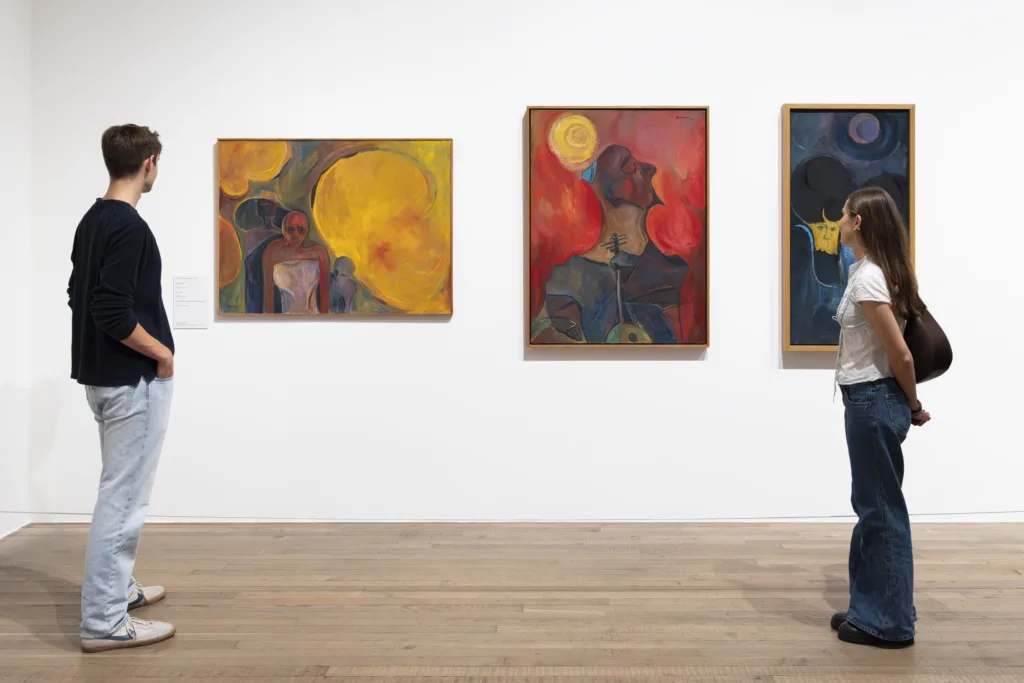
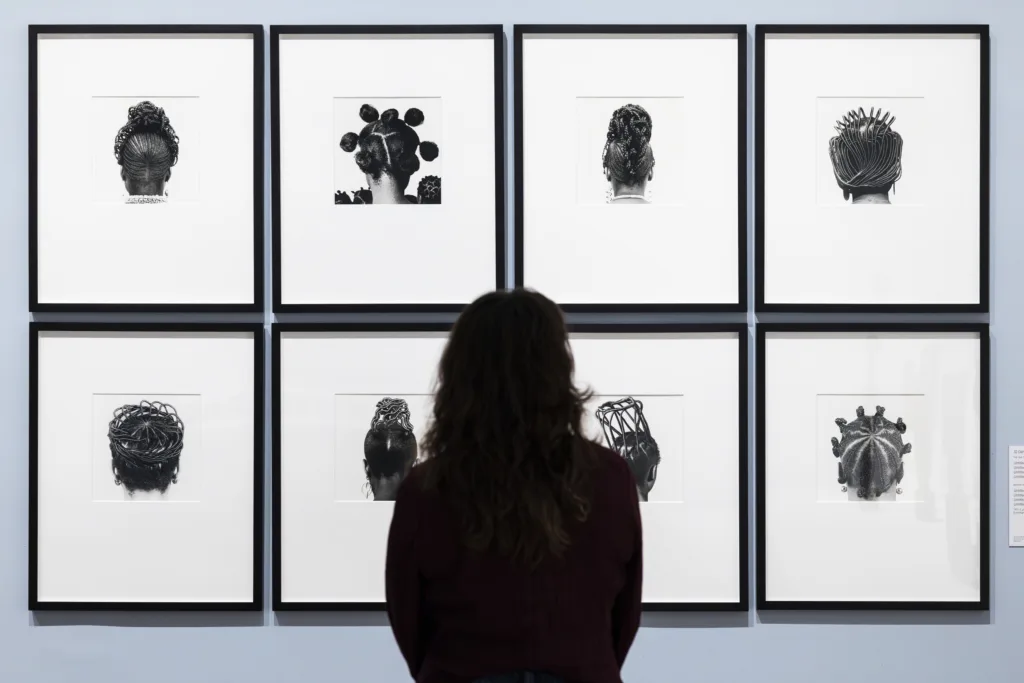
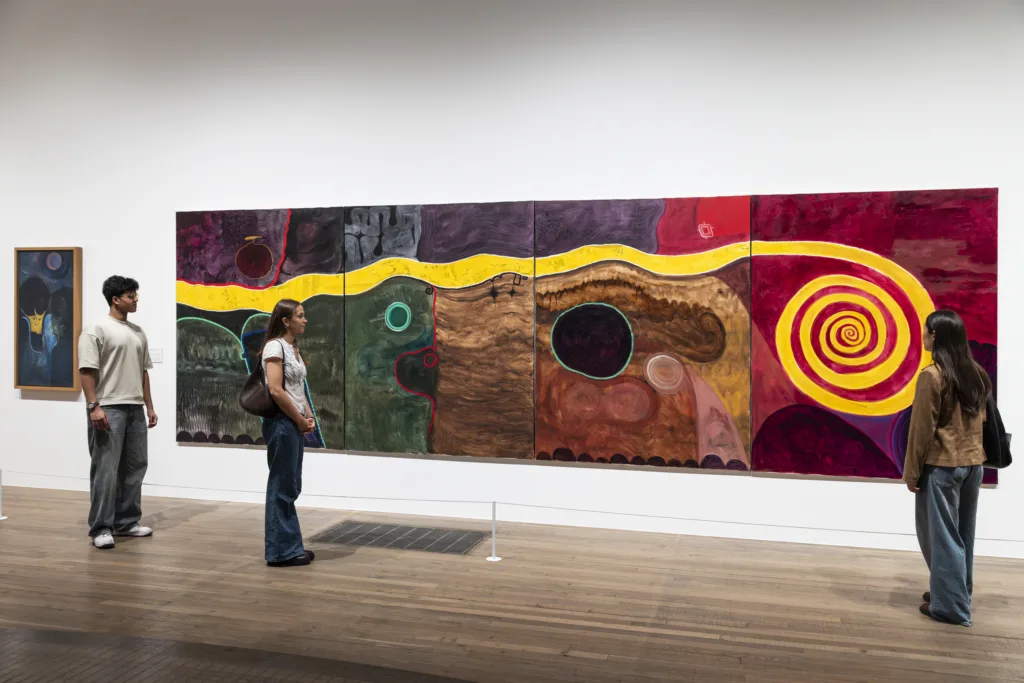
Cyclical time also takes visual shape, from spirals and circles to fractal curves. In Igbo art from southeastern Nigeria, the symbolic language Uli carries this sensibility, a tradition recently celebrated in Tate Modern’s Nigerian Modernism exhibition. Its origins, unsurprisingly, bloomed from women in communal knowledge-sharing spaces. “While the Nsukka artists who later translated Uli into modernist drawing and painting were predominantly men, their work is fundamentally indebted to the practices of the earlier women who formulated and sustained it,” explains Bilal Akkouche, Assistant Curator of International Art. “We could argue that these women were some of the earliest ‘modern’ artists of Nigeria.”
Also in the exhibition is Obiora Udechukwu’s Our Journey (1993), echoing both Uli and Nsibidi, another ancient graphic communication system created in southeastern Nigeria. “It explicitly references the sacred python, mythologised by the Igbo as a messenger of God that marks pathways and transit points,” adds Akkouche. “Here, the spiral operates simultaneously as a cosmological sign, communicative device, and visual structure.”
Our Journey also meditates on Nigeria’s postcolonial condition. Akkouche shares that the figures embedded within the yellow band recall both the civil war of 1967-70 and the political crisis surrounding the annulled 1993 election, the year the work was completed. “Time in the work does not move forward in a straight line; it loops, returns, and folds multiple historical moments into the same visual field,” he says. In textbooks, we tend to see era-defining events on separate pages, so placing multiple years within the same visual frame tugs at a spiral of time where a nation’s historicised events are all felt simultaneously in the bodies of its people.
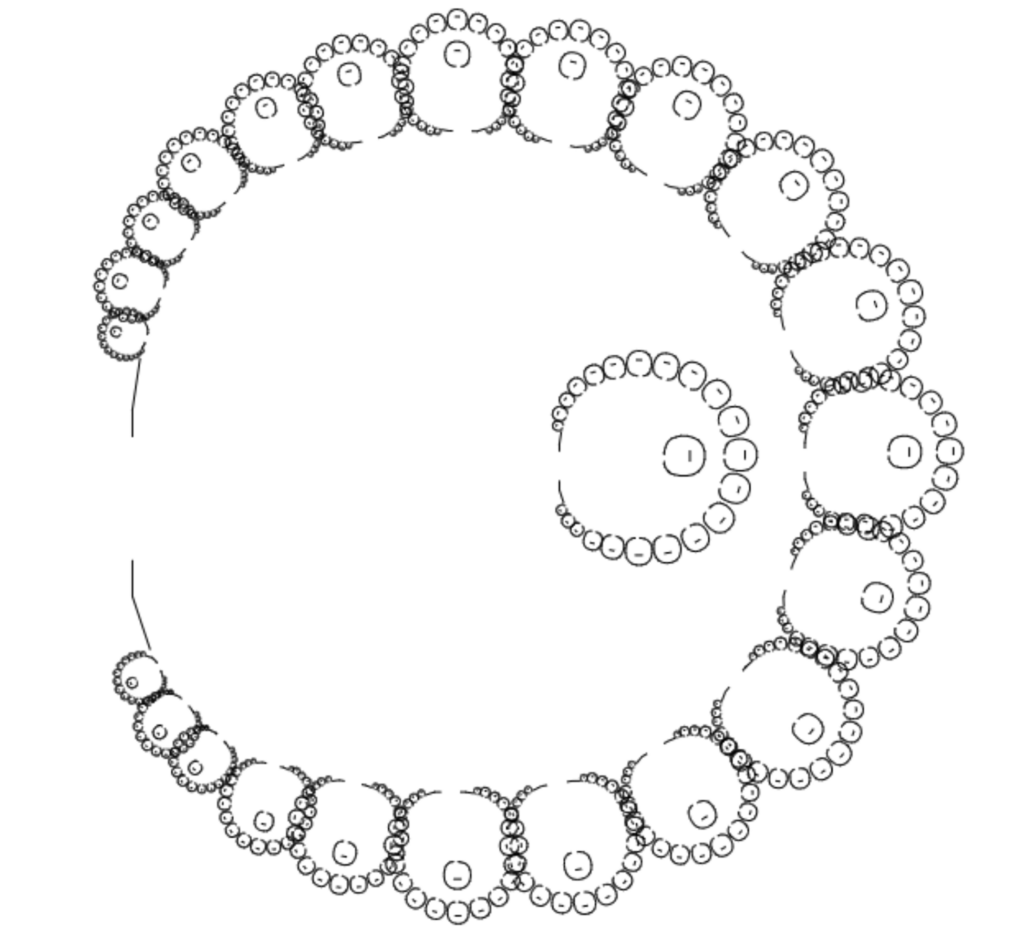
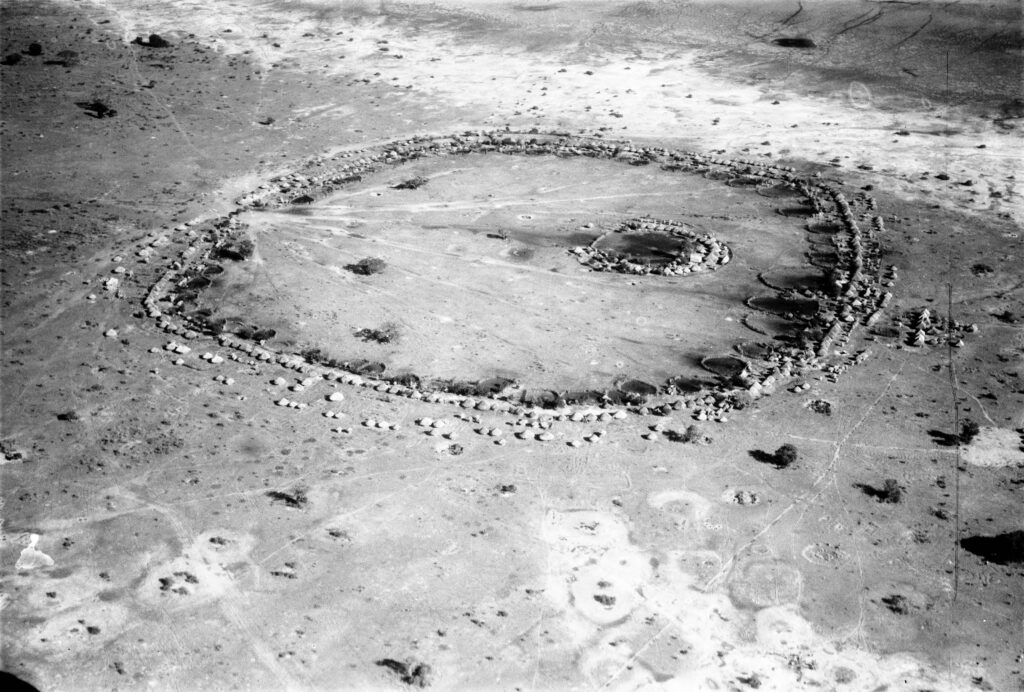
These curvilinear ideas shape how space is designed and inhabited, too. Indigenous African settlements often spoke in the tradition of fractal geometry: circles within circles, rectangles within rectangles. In the Ba-ila settlements of Southern Zambia, for example, smaller front circles house livestock while larger rear circles host human dwellings. The village chief’s unit, meanwhile, occupies the largest ring, enabling oversight and protection of the community—an authority that nurtures, summarised as kulela in Bantu languages. Kulela encodes social relations through how people inhabit and navigate it instead of rigid top-down hierarchies.
Because fractal, self-similar patterns can mathematically scale outwards forever, these villages expand or shrink in line with community needs without losing coherence. Such climate-adapted local designs embody a practical form of social ethics scarce in today’s soulless, tech‑bro architectural fantasies. Some, however, still revere Indigenous spatial concepts, like Tosin Oshinowo, a Nigerian architect at the vanguard of contemporary African architecture.
“Africa, often framed through the lens of technological ‘lag’, remains one of the few places where circularity persists as an everyday practice rather than a speculative future model,” she tells me. “Afrofuturism does not prescribe a singular outcome; it opens up multiple trajectories. It sharpens the relevance of materials of place and raises critical questions about what can be learned from both the distant and immediate past,” she explains, highlighting a spiral rhythm of time where wisdom continuously resurfaces.
Mapping the circular economy models of three of Lagos’ markets, her research into urban informal markets with self-organising movement appeared at last year’s Venice Architecture Biennale. Ladipo Market deals in secondhand car parts, Computer Village in used electronics, and Katangua in recycled fashion. The idea of waste as an endpoint loses meaning for these three markets because, well, it isn’t one. Materials remain in circulation, remain useful. These factory-style systems don’t simply grant a “second life” to objects as much as they reanimate them, discovering new uses and forms from the source material.
“They offer a living proof of concept: systems that are adaptive, resilient, and fundamentally sustainable. Operating outside formal planning structures, they nonetheless demonstrate the sophisticated logics of reuse, redistribution, and economic efficiency,” adds Oshinowo, describing this pragmatism as a distinctly African mode of urban organisation. “Architecturally, it offers an opportunity to work intentionally towards futures that are not predetermined, but adaptive and plural.”
The linearity of industrial capitalism says resources live a single life on a single timeline after extraction and consumption. British-Nigerian designer Nkwo Onwuka says otherwise. She illustrates this through Dakala, a textile she developed by stripping and stitching together discarded denim to create a fabric that looks and feels like it’s woven by hand. With her artisanal brand NKWO, Onwuka trains women in Abuja to transform the heaps of garment waste flooding in from Europe into new clothing using their traditional textile skills, keeping economic value within the local community.
Rather than a straight timeline of production to disposal, these cycles follow a regenerative spiral time as they consistently patch old objects into objects of the future, studying any ‘waste’ for signs of its next life. It reminds me of something I learned from Afro-Indigenous worldbuilding curator Helen Starr. “Those K’an symbols you see, they are from the Mayan calendar and exist in my culture. The symbol for zero is a seed because, in my culture, zero is understood as fullness rather than nullness.”
Starr connects artists with cutting‑edge technologies through her curatorial initiative, The Mechatronic Library. Her resonant words, for me, plant a worldview in which all beginnings – seeded from the same fertile void – are equally capacious for potential. Death and birth – of an item or of a living thing – feel entirely different when we consider the fecundity of the seed.
For example, when birth is placed at zero of an ever-steepening gradient, we have only so much time to accumulate the individualist accomplishments of clout, wealth, and countries travelled for IG Highlights before death arrives to break the chart. When you parse life like that, you’re always indexing the image of success to your corresponding ‘milestone’. The anxious productivity that rushes modern reality and severs us from communal enrichment moves inside of us first: neoliberalism’s secular doomsday that dangles death in our ageing faces. Spiral time unshackles us from the ‘milestone’ or at least the urgency towards it, revering priority instead. What needs solving now? Who needs helping now? Charts and graphs have no fertile soil. They do not house seeds. Gardens do.
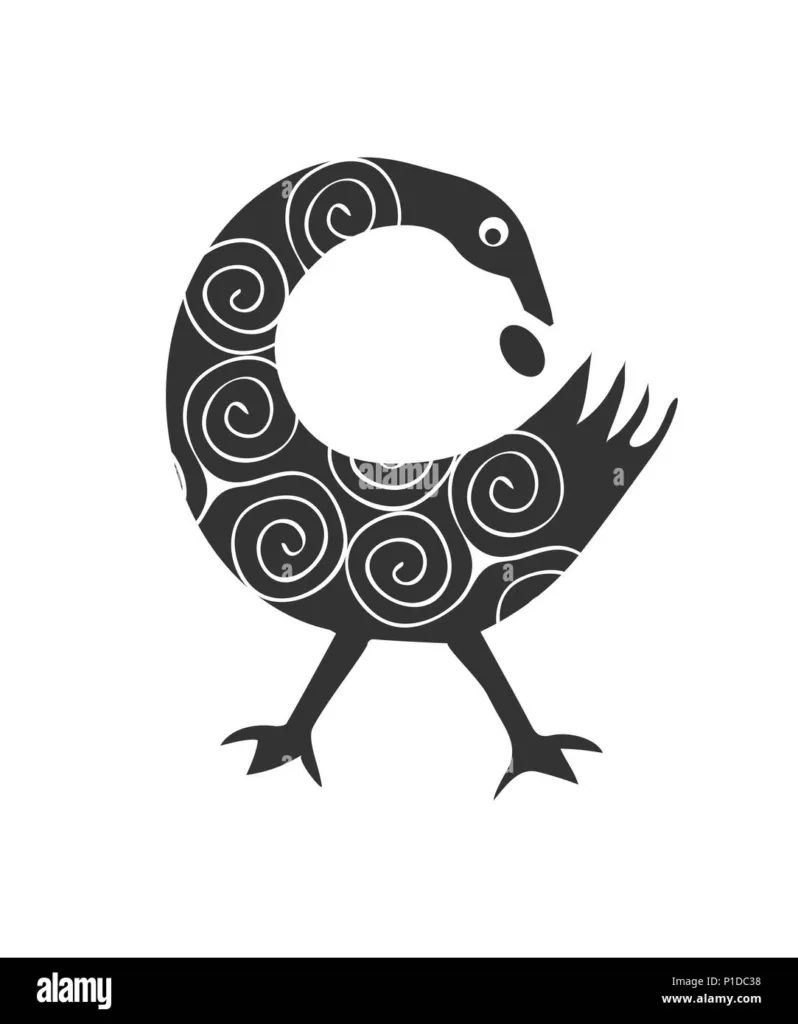
I first probed these kinds of ideas with Iraqi visual artist Sarah Al-Sarraj after writing about her moving-image work, Isthmus Ancient River. Commissioned by Starr, the exhibition melts timelines between descendant and ancestor to connect us beyond a single terminal horizon. Everything changed for me after our conversations. This dialogue between our forebears and the kin we don’t have yet, this slippage between minutes and years brings me to a kind of time travel through the Ghanaian symbol, Sankofa. Simply put, it means ‘go back and fetch it’.
Go back and fetch it
Symbols help us mine the past for its wisdom. They survive us, carrying forward lessons to our descendants who, at one cosmic hour, may require our advice. The Akan people of Ghana had their own code to start, Adinkra, a system of ideographic symbols. Interestingly, many Adinkra symbols display geometric principles akin to logarithmic scaling, like the horns of a ram (Dwennimen) or the leg of a hen (Akoko Nan). This sophisticated mapping of growth patterns predates western spiral maths, like the Fibonacci sequence and the Golden Ratio, which algorithmically model how plants grow, storms gather, music resolves, and populations rise (famously explored by mathematician Ron Eglash in his landmark book, African Fractals: Modern Computing and Indigenous Design).
An Adinkra symbol I return to is Sankofa, depicted as a bird gazing backwards while holding an egg. It’s accompanied by the Akan proverb that translates to ‘it is not taboo to fetch what is at risk of being left behind’. Sankofa prompts the retrieval of ancestral data to clarify the murky present. Humans don’t move through time so much as we move through story, and Sankofa opens a portal akin to traversing time through re-storying. A time that loops is one that resuscitates history to glean new political, social, and philosophical doors to walk through. Sankofa isn’t the door; it’s the stopper keeping it ajar.
Sankofa even appears at the African Burial Ground National Monument in New York, a call to go back and fetch what was stolen. But it endures through somatic and generational memory. Like tree rings circling around each other, marking a trunk’s age, Sankofa invites one to grow around history rather than away from it. These ideas of turning in/backwards to shape a stronger ‘now’ are crucial in a world awash with the narratives that stifle self-empowerment.


Philosopher Frantz Fanon writes of a colonisation in the aftermath of land and body conquest, turning its weapons inwards, on the mind—a schiz of self where confusion about your worth is a remnant of white supremacist control. Being ‘other’ in a white society is the perfect petri dish for self-non-recognition, but he insists: “Black consciousness is immanent in its own eyes… I am wholly what I am.” There is a violence in entrusting your worth to a gaze other than your own, after all.
Like Sankofa’s call to reclaim ancestral knowledge, Fanon urges us to face inwards, assert Je suis (I am), and reject colonial rumours of who we are, unravelling the impossible aspiration to be validated by a racist society. This is about knowing yourself so profoundly that their efforts to fragment your identity fail, but not through moving up the line or accelerating towards some external horizon. We are asking, again, what line?
I look outside, and I see that the west’s desperation to summon the future has yielded little more than widening inequity. The onset of their supposed tomorrow lingers, but our horizon still invites dreaming. I think of these calls to converse with our decorated pasts—not to see the spiral as Ouroboros or endless return but as a structure where each growth gathers new insight, new eyes to see new worlds with. To transform while nested in the silk spun from our own matter. How else might we grow wings?