
 Posted in
Life & Culture,
Posted in
Life & Culture,
Selfhood for Sale
Text Dee Sharma
My face is the front of shop
My face is the real shopfront
My shop is the face I front
I’m real when I shop my face
The opening lines of the late artist Sophie’s track “Faceshopping” loop in my head every time I walk down a high street. Not like background music, but as an internal monologue that is synthetic, intimate, vibrating through glass and skin. Each repetition collapses the distance between product and person, making it impossible to tell which one is performing the other.
As the song goes, a shopfront is more than a consumer interface. It is a screen, a stage, a mirror. It doesn’t reflect a single self, but a kaleidoscope of selves spinning inside commodified aesthetics and algorithmic desire. Glass invites projection, refracts longing, and absorbs the gaze in both directions. Every polished pane contains a parallel life, waiting to be bought in fragments.

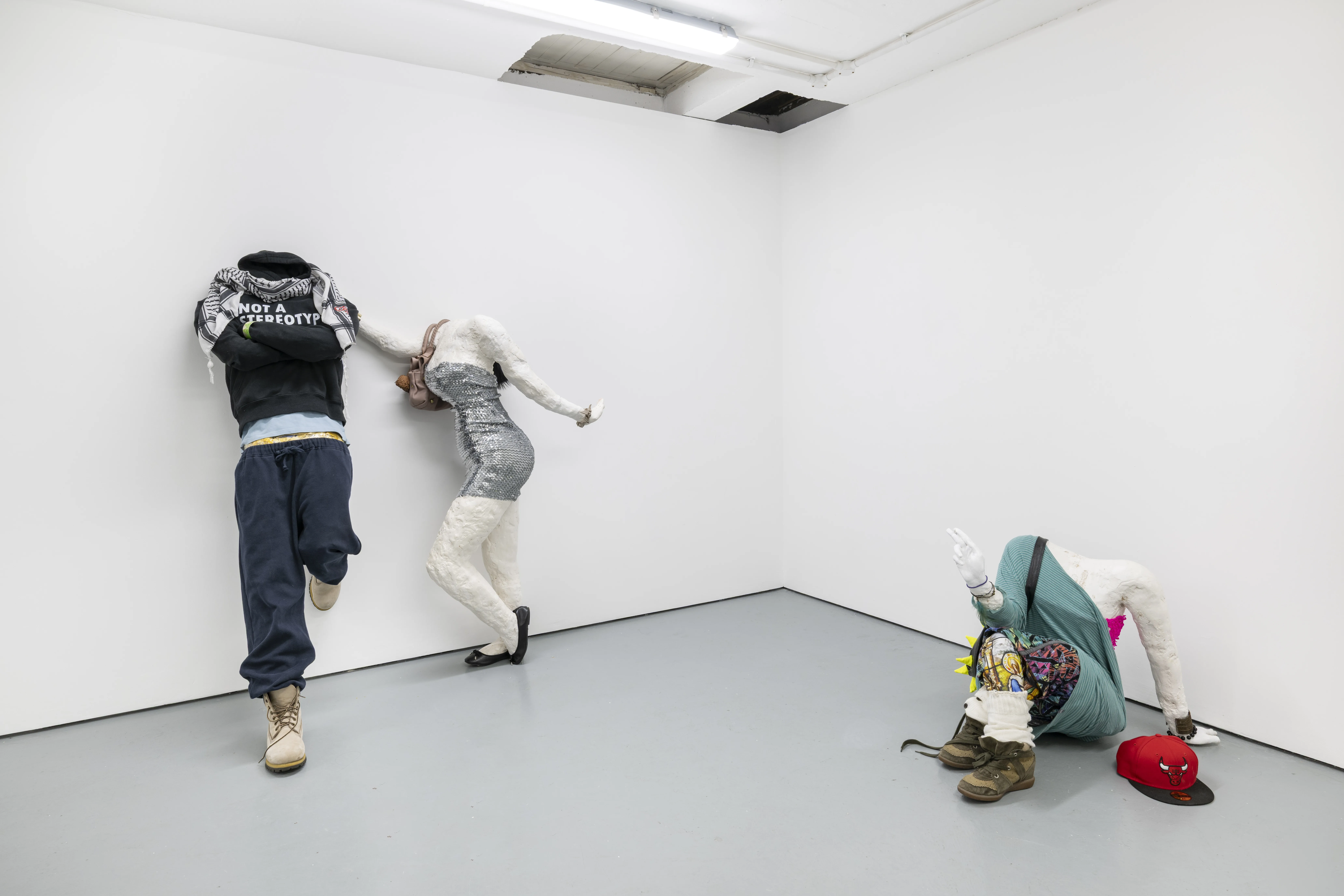
Mise En Scene (2025), Miriam Simanowitz.
Photo: Damian Griffiths. Courtesy of the artist
Miriam Simanowitz.
I never feel more fragmented than when I go window shopping—sometimes by accident, drifting past displays on my way to get a coffee, other times avoiding them deliberately because my bank balance doesn’t match my wants. Yet, even in avoidance, the temptation persists. Excessive personalisation always makes me feel smaller, not only because I cannot afford the products, but because I want to possess every personality on display.
It’s like Isla Fisher in Confessions of a Shopaholic, trying to get closer to her selfhood through the threads of a green scarf. This item becomes a talisman, a condensed promise of transformation. Mannequins speak without speaking. They hold still, yet whisper possibilities. Displays become portals. I hover between my life and the life that the display insists I could have. Is this escapism, or is it the commodified performance of a personality disorder? These reflections follow me long after I have moved on. Each pane of glass offers a ‘built world’ that I could inhabit one day. I know it is fiction, yet I still strive towards it. The window display is a nutritional supplement that never nourishes, promising vitality while delivering only the appetite for more. It gaslights better than most men I have known, offering affection through aspiration, then withholding.
Every display is a surface of projection and surveillance, where identity splinters into glossy, consumable fragments. This fragmentation exists alongside horrors that should halt desire. The genocide in Palestine erases faces, names, and memories, while elsewhere, the market trades in simulated identities. Faceshopping for some. Facedeleting for others. These are not separate economies; they are entangled in the same global circuitry of value, attention, and erasure.
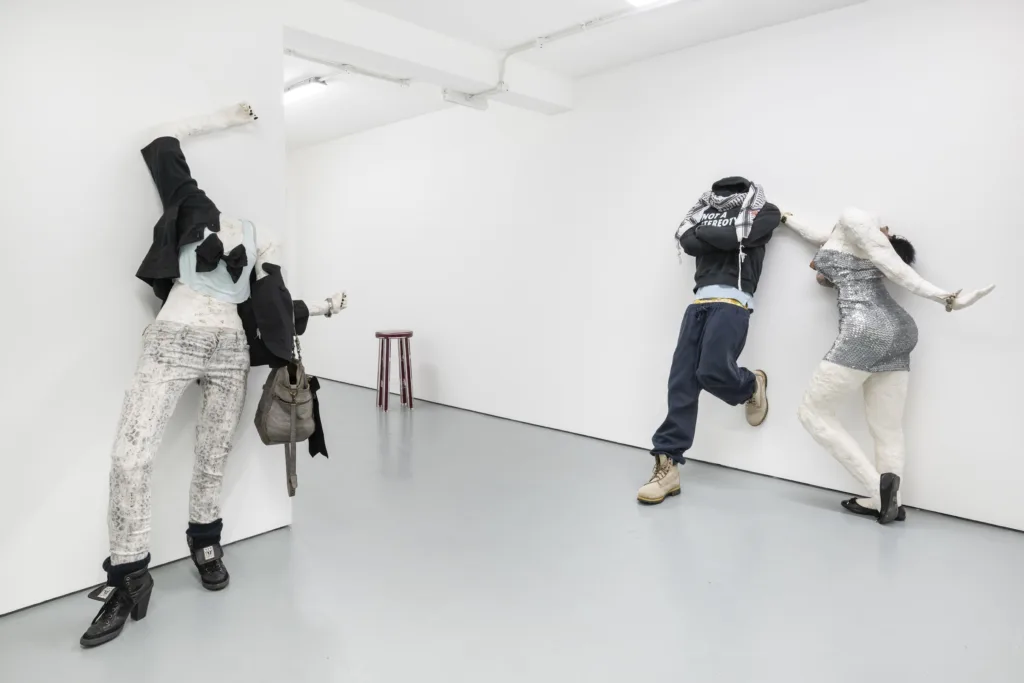
Body Count (2025), 96 Robert Street, London. Exhibition view 13
July – 23 August 2025. Photo: Damian Griffiths. Courtesy of the
artists Thibault Aedy and Miriam Simanowitz
Philosopher Paul Preciado writes that the body is no longer natural, but a living archive of “pharmacopornographic” control. Colonised by hormones, pixels, plastics, and prescriptions, it becomes both laboratory and showroom. The shopfront is the theatre of that colonisation, staging a fantasy of choice and transformation. It shatters the self like a broken mirror: here, the fantasy of gender; there, the dysphoria of the flesh; everywhere, the promise that you are only one purchase away from wholeness.
Faceshopping: a site of manic discovery that only became possible because we started selling personhood in bite-sized pieces, wrapped up in buzzwords and aesthetics.
I love window displays, especially the ones that make me pause and yearn, the ones where the marketing cues are so subtle that I fall victim to its nonchalance. The shopfronts can be whimsical, theatrical, and inventive. But in an oversaturated economy, overcuration induces paranoia, hallucinatory states even. Each reflection of the self is brimming with desire, performance, and visibility, always one step removed from an unmediated self—if such a thing could even exist.

Body Count (2025), 96 Robert Street, London. Exhibition view 13
July – 23 August 2025. Photo: Damian Griffiths. Courtesy of the
artists Thibault Aedy and Miriam Simanowitz
Schizophrenia here is not merely a clinical diagnosis. It becomes a structural condition enforced daily. As philosophy’s so-called odd couple Deleuze and Guattari write, “Schizophrenia is not the identity of the person but rather the break of the person.” Choice, once imagined as freedom, turns out to be a false prophet. When every choice is politicised, monetised, and mediated through commerce, what kind of self does that produce? Choice becomes a wireless collar, painless and invisible, offering the illusion of autonomy while tightening its grip. The leash is made of pixels, and we hold it ourselves. I am trying to imagine the backroom conversations between storefront designers; how do they calculate vanity so precisely? They sell us ambition, the desire to embody seven lives like a cat. But unlike cats, we fall for the prophecy of the green scarf every time.
The promise of ‘finding oneself’ through consumption is a pathological lie. Capitalism’s final fuel source is identity itself. Without selling selfhood, it collapses. Theorist Franco “Bifo” Berardi calls our current condition “semiocapitalism”, where signs, images, and effects are the primary means of production. The post-Fordist subject has internalised the neoliberal demand to be flexible, creative, and endlessly productive. In this framework, choice becomes psychic labour. Berardi names depression as the dominant mood of late capitalism, but there is also addiction to the micro-rewards of choice itself. The Micro-Treat Economic syndrome.The US$7 matcha latte to a collection of Le Creuset sets to ease our lifelong rents and absence of savings. Capitalism does not just extract from the soul; it trains the soul to desire extraction, too.
This is the essence of faceshopping: the mannequin’s silent taunt that you will never become it, albeit the thrill of trying anyway. The product is never the item itself but the process, the anticipation, the unboxing, the performance of acquisition. We now live in cores – Coastal Grandmother Core, Dark Academia Core, Tomato Girl Core – each a micro-identity that stabilises us for a week or two before the next arrives. The body is no longer a temple, it is a mega mall. Selfhood becomes litter, with discarded personas piling up in the consciousness bin. Even in pseudo-communist Vietnam, ancient ruins are secondary to tourism-driven shopfronts, as I observed in Hoi An—mannequins adorned in silk, racks of leather jackets, and handpainted ceramics are curated for the digital nomad’s fantasy.

Body Count (2025), 96 Robert Street, London. Exhibition view 13
July – 23 August 2025. Photo: Damian Griffiths. Courtesy of the
artists Thibault Aedy and Miriam Simanowitz.
What would the DSM-5 call this condition? I love living in multitudes, but what happens to our neural pathways when they are stuck in a Subway Surfers mode of constant personality shifts, no rest in a stable identity? Will my hallucinations be of faceless mannequins when I am old? Will my psychotic breakdown resemble an unboxing video? The link between faceshopping and schizo-culture is no longer metaphorical—we are already in the pipeline.
Our cultural machinery does not simply sell products; it sells identity templates, ready to be worn and discarded. And each template carries the illusion of personal choice while reinforcing the same structural dependencies. The high street is a psychogeographic maze, shop windows operating like moodboards for possible lives. The mannequins are avatars, silent influencers of flesh and fibre. We pass them, they pass through us. The relationship is both parasitic and symbiotic. Without our attention, the display loses meaning. But without the display, our sense of potential selves flattens.
In the digital layer of this landscape, the shopfront is multiplied infinitely—Pinterest boards, Instagram grids, and TikTok hauls are the new glass panes. The window shopping never ends because the street never ends. The desire loops continuously, fed by algorithmic personalisation that knows more about our longings than we do. Here, curation and surveillance become indistinguishable. When Sophie sings, “I’m real when I shop my face,” it is not irony, it’s a diagnosis. Reality is authenticated through visibility, and visibility is mediated through consumption. The self is verified not through inner truth, but external signs we can buy, display, and post.
Sociologist Zygmunt Bauman’s “liquid modernity” helps explain this endless churn. In a liquid society, stability is suspect. Identities are provisional, designed for mobility and disposal. The shopfront thrives in this liquidity, offering temporary vessels that can hold us for a moment before we dissolve again. Faceshopping becomes a ritual of liquidity, a practice of trying on selves without the burden of keeping them. Characterising postmodernism, Fredric Jameson’s “waning of affect” deepens this picture—in a culture saturated by images, our emotional responses flatten. We encounter endless representations of authenticity, rebellion, desire, yet each one is already commodified. The mannequin’s gaze is hollow not because it is inert, but because it mirrors our own numbed recognition. Window shopping becomes a performance of feeling rather than feeling itself.
Together, Bauman and Jameson reveal the double bind: liquidity demands that we keep moving, while the waning of affect ensures that no single identity can anchor us. The shopfront is both the stimulus and the symptom, tempting us with novelty while confirming that novelty will never be enough. Faceshopping is not simply a trend; it is a survival strategy in a marketplace where the self is the most valuable commodity and the stalls never close. The challenge is to move through this liquidity without mistaking the reflection for the self. Perhaps the task is not to escape the shopfront, which may be impossible, but learn how to stand before it without being absorbed entirely.To shop the face without losing it.
To resist the liquidation of our own solidity.