
 Posted in
Life & Culture,
Posted in
Life & Culture,
Ways of sitting
Text Haya Zaru
As a designer, I spend a lot of time thinking about how people sit and, as a Palestinian, just as much about how people remain. Chairs and tables are among the most intimate objects we study as designers. In my practice, creating them feels less like shaping objects and more like shaping conditions for care and comfort.
In contexts where presence is constantly challenged, creating environments that foster care and reviving everyday acts of comfort becomes an essential tool against systems of control—sitting is never neutral where movement is violently forced under oppression. Rather, it becomes a gesture of remaining, a still act of durability that operates within a politics of care transmitted through Indigenous lifeworlds rooted firmly in place.
It is this understanding that resonates with the politics articulated by poet and writer Audre Lorde, who framed care as a radical response to the colonial present. As scholars such as Nikolas Rose and George Huxley have discussed, Lorde’s work positions it not as a finite resource or gendered virtue but a collective practice essential for survival, organising, and imagining other futures. In this sense, care functions as a shared infrastructure that sustains life against systems of oppression. Crucially, as a political theory, it describes an ethic grounded in the communal responsibility required for human life.
Historically, sitting has always been tied to narratives of power and strength. Designed seatings were never simply places to rest but positions from which power was exercised and stability asserted. The language of comfort itself reflects this history. In anglophone traditions, the verb ‘comfort’ originates from the Late Latin confortare (meaning ‘to strengthen much’), derived from fortis, meaning ‘strong’. Sitting, therefore, was originally associated with fortification, not ease, the strengthening of the body to remain disciplined and controlled.
The design of western furniture has always mirrored evolving attitudes towards the body, power, and status. With the Industrial Revolution, mass-produced furniture prioritised individual convenience over collective engagement. Comfort became tied to external support, producing rigid seating hierarchies and a passive relationship between the body and environment, further shaping our modern understanding of ways of sitting.
If comfort in this tradition is something provided to the body by an object, care operates differently. Care emerges through relationships between bodies, spaces, and communities rather than the external support of furniture alone. Sitting, in this sense, is not only a matter of comfort, but also how environments enable people to remain together, sustain one another, and inhabit space collectively.
Eastern and Indigenous traditions of sitting emphasise self-reliance and bodily strength, adaptability, and closeness to the ground. Many cultures have long embraced floor-sitting postures such as squatting or sitting cross-legged, which promote bodily strength, flexibility, and endurance. Both internal balance and communal interaction are fostered. Across Arab societies, for example, gathering often takes place in a majlis, a space dedicated to hosting conversation and receiving guests. Rather than using individual chairs, it is organised with long mattresses or cushions along the room’s perimeter, leaving the centre open, with people sitting close to the ground and adjusting their posture as conversations unfold. Drawing from these spatial practices, I studied traditions of gathering, sitting, and observation within the agricultural landscapes of Bethlehem as part of my research Natara: Waiting, Watching and Collective Seeing. The project draws on historical manateer (stone watchtowers) whose architecture allowed farmers to oversee their land, rest, and observe seasonal rhythms.
In this context, sitting becomes an active practice of remaining, a temporal engagement with both the landscape and community that mirrors the collective and relational aspects of care. I began to see everything in what once seemed a mundane act: at every seated moment, I witnessed people free from displacement, acts of care unfolding, and bodies easing into comfort. I saw people remain and, since then, I have never sat the same. Curious about how sitting takes shape across cultures, I invited designers, architects, and archivists to share their own ways of sitting.
Nour Gary
Chairs of Jeddah
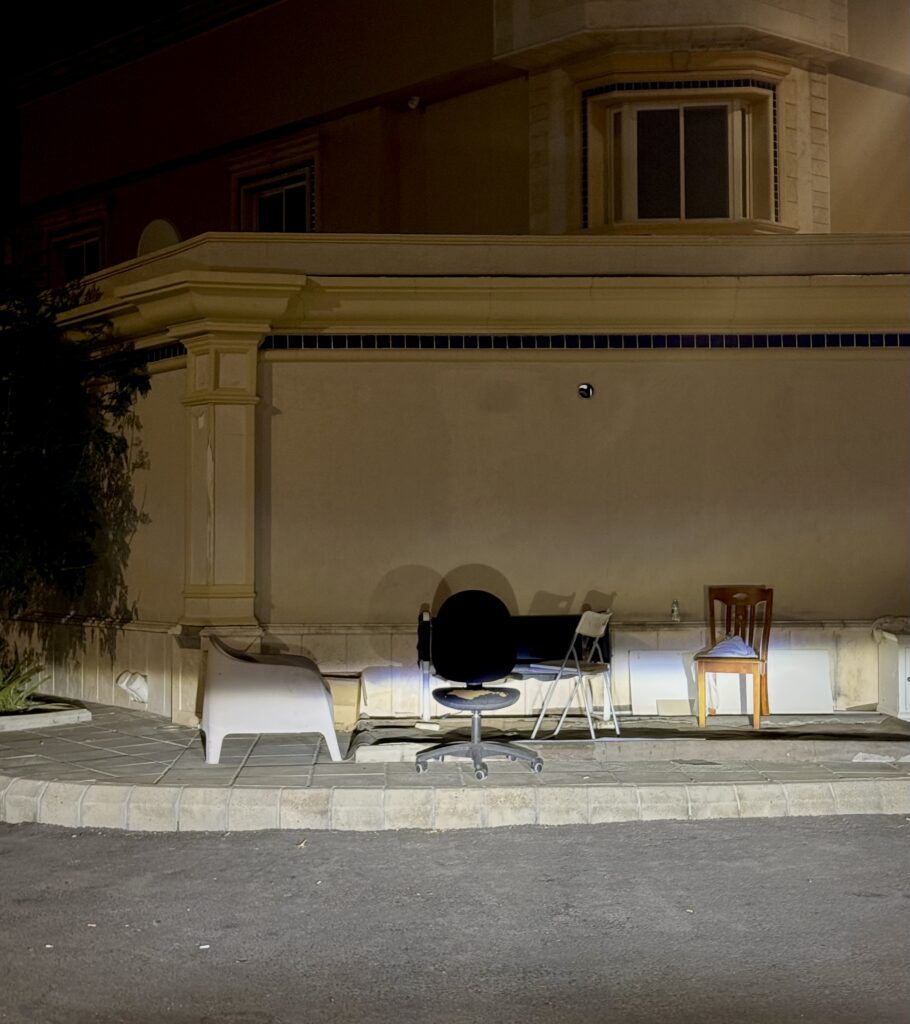
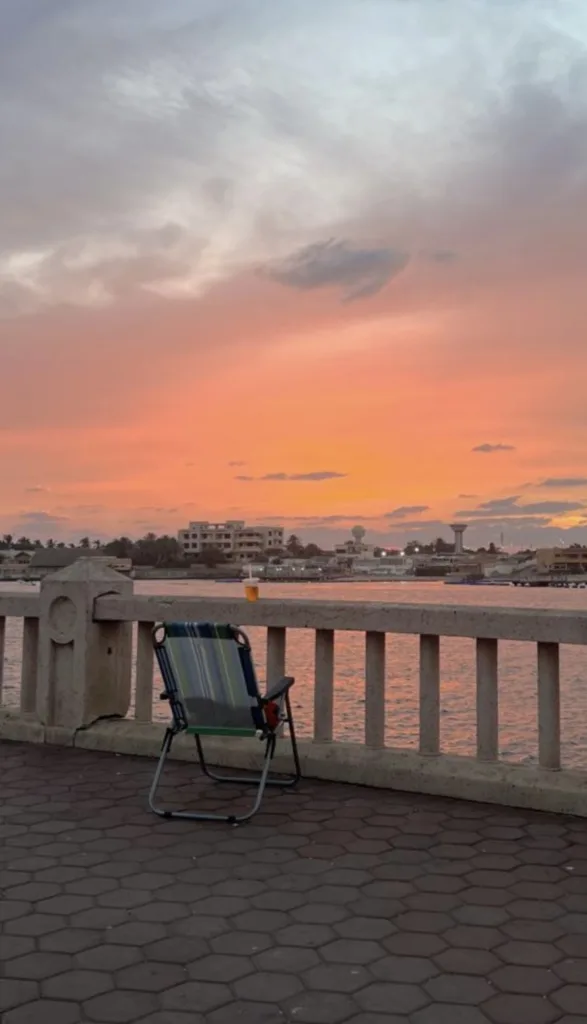
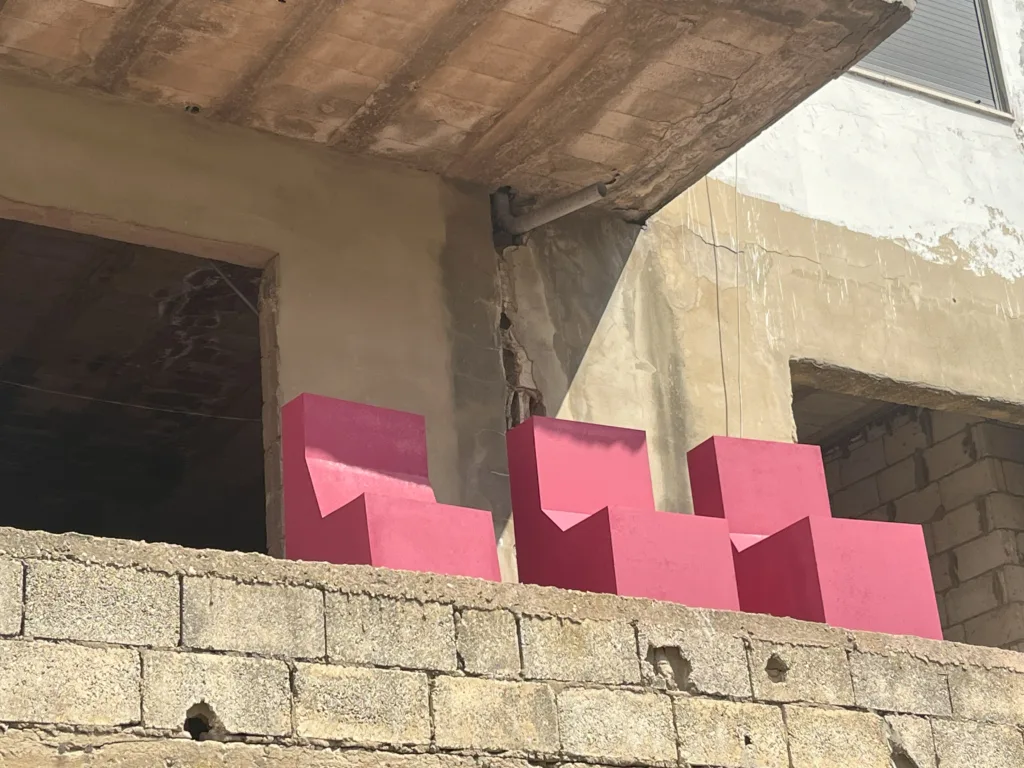
Chairs of Jeddah is an archival Instagram account founded by Nour Gary, an architect and arts curator based in Jeddah, Saudi Arabia. Gary’s documentation takes seemingly mundane items, presenting them as significant parts of our community. By focusing on chairs, she captures the essence of moments in the streets, emphasising the interplay between the environment and the objects within it. The account became a platform that brings together a community that notices and shares images featured in the archive.
The simple moments of sitting for finjan shay (a cup of tea) or playing Baloot with friends bring people together for leisure. These moments help us connect and bond, whether it’s sitting down for a family lunch, gathering for a picnic, or watching the sunset from the corniche. These few ways ground and allow us to share our lives with each other. Public spaces also take shape organically within some neighbourhoods—you’ll find mismatched chairs grouped together on the side of a house or in the middle of the street’s traffic island. Some unwanted seats are left outside for passersby to either take or put together in a corner as outdoor furniture.
In Jeddah’s historic area, Al-Balad, men often gather outside on elevated seats called Al Mirkaz, inviting passing neighbours for a cup of Saudi coffee and a chat. This practice both builds community and reflects their hospitality, and is seen forming in different ways across some neighbourhoods as well. Women, on the other hand, usually have a more planned way of meeting at homes or in cafes, and food is always a factor involved in the gathering.
Matteo Guarnaccia
Cross-Cultural Chairs
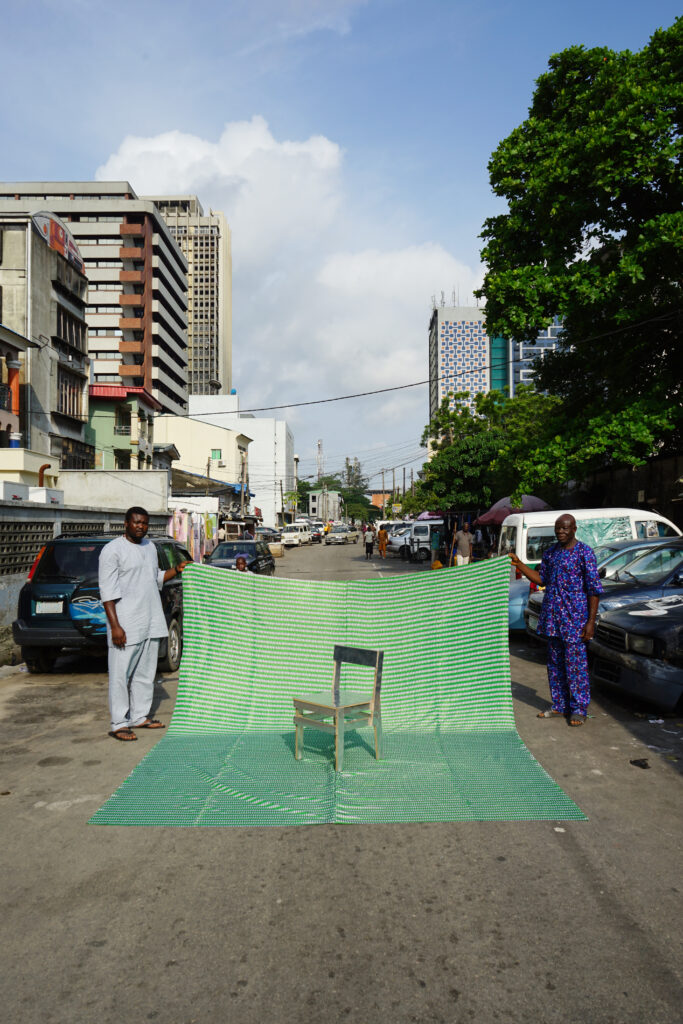
Matteo Guarnaccia is a Sicilian freelance art director and designer, based between New York and Sicily. His work explores the cultural and social dimensions of design, traversing different fields while trying to dodge categories. Guarnaccia’s projects often investigate how everyday objects reflect cultural behaviours and global exchanges, most notably in Cross-Cultural Chairs, a research project and exhibition examining how people sit in different cultures around the world.
Sitting together becomes an act of care when it invites presence and listening, creating a temporary space of attention – like finding a moment to dedicate to the other person – where stories, advice, and emotional support circulate among the people. This often happens in everyday spaces: kitchens, courtyards, sidewalks, and parks, but it’s also easy to think of a cafe, a church, or a mosque. Sometimes it relies on designed furniture such as chairs, benches, or stools, but they appear just as often through improvisation, with people gathering on steps, curbs, or blankets. Shaped by climate, culture, and social rhythms, these settings are flexible and adapt to context.
Many cultures embed sitting practices within rituals of hospitality, storytelling, and shared meals. Sitting in circles, around low tables, or on the floor often signals equality and collective participation. In West Africa, these arrangements are called a palaver circle, often under a tree and used to encourage dialogue across generations or resolve a conflict. The majlis in the SWANA region invites guests to sit on floor cushions arranged along the walls, creating a circle for conversation, hospitality, and communal decision making. The Dalai Lama, for instance, always has to sit above anyone else in the same space, even if it’s just a difference of a pillow. Such examples are many because the different moments of sitting are numerous and, most importantly, present in every culture. The difference lies in how each of them tries to address the same need, hopefully far from trends and closer to culture.
Zmorkha & Mamou
Gather, Rest, Resist!
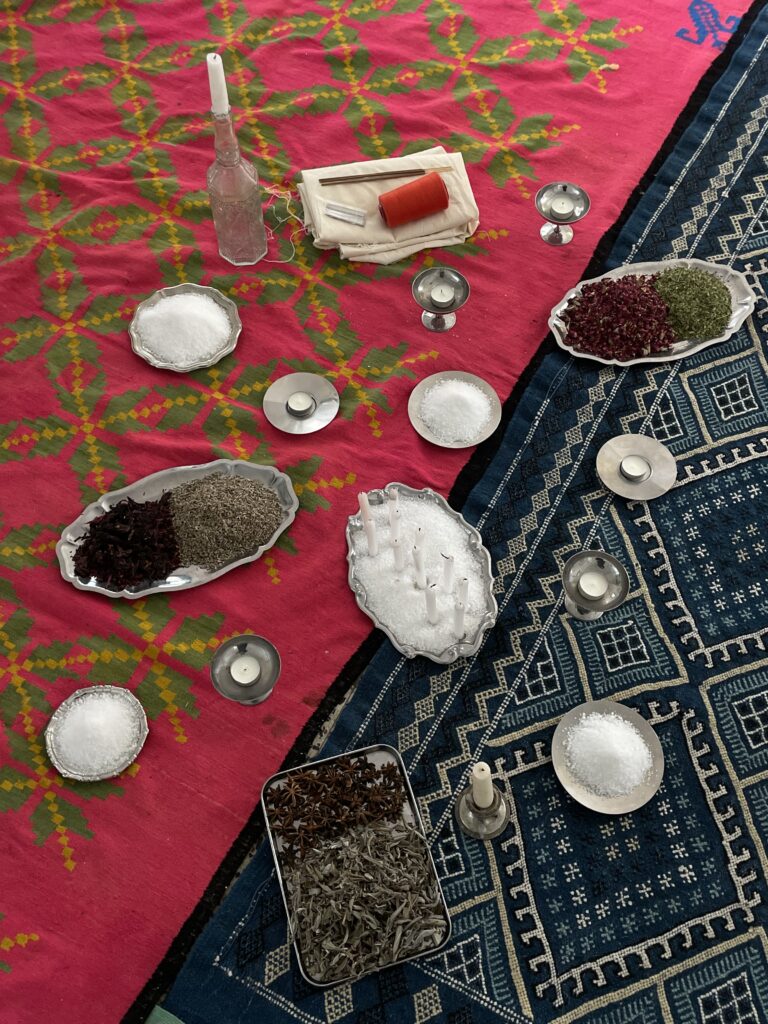
Gather, Rest, Resist! is an experimental event format that brings together personal and ancestral storytelling with practices of collective rest operating in Tunis, Tunisia. Through shared narratives of self, memory, and resistance, the gathering opens a dialogue on identity and belonging beyond colonial frameworks. It creates a safe space for embodied practices, inviting the body to slow down, allowing rest to emerge as a collective gesture of care and resistance.
Our work hinges on an invitation for non-heteronormative people to come together within the unstable and dislocated political state we are currently living through in Tunis, where many third places that once served as refuges for the community have been shut down. Getting together, holding a safe space, and sharing care are the main pillars of the event. It is inspired by collectively nostalgic, hot summer days: cleaning up the space, cooling the floor with water, laying down large carpets, and scattering cushions so that everyone can organically inhabit the space in whichever way feels comfortable, allowing storytelling to gently flow.
We believe sitting together on the ground allows the community to sustain connection and solidarity. If we were to take you on a tour around Tunis, the recurring image would be people sitting on the ground—whether a group of men in a mosque for khutba (a sermon delivered by an imam), a group of women preparing food in a courtyard, or a family sharing tea and exchanging stories with passersby. These moments are not just social; they transmit skills, stories, and collective memory from one generation to the next. In our event, we invite these same rituals to recreate spaces of care and connection, sustaining practices that nurture community life and continuity.
Sumayya Vally
Counterspace
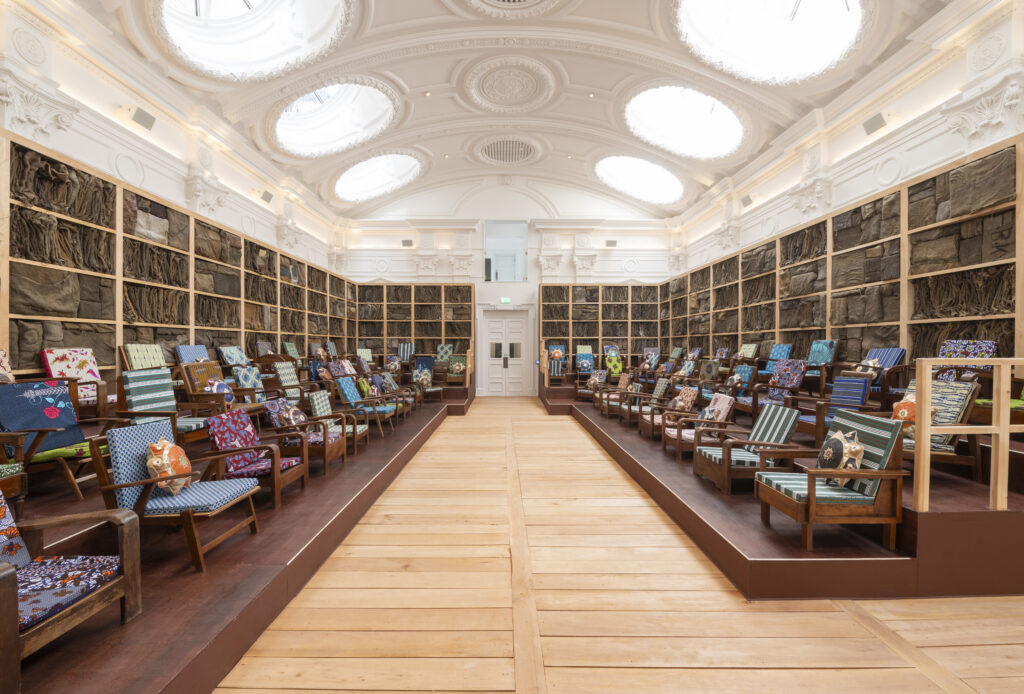
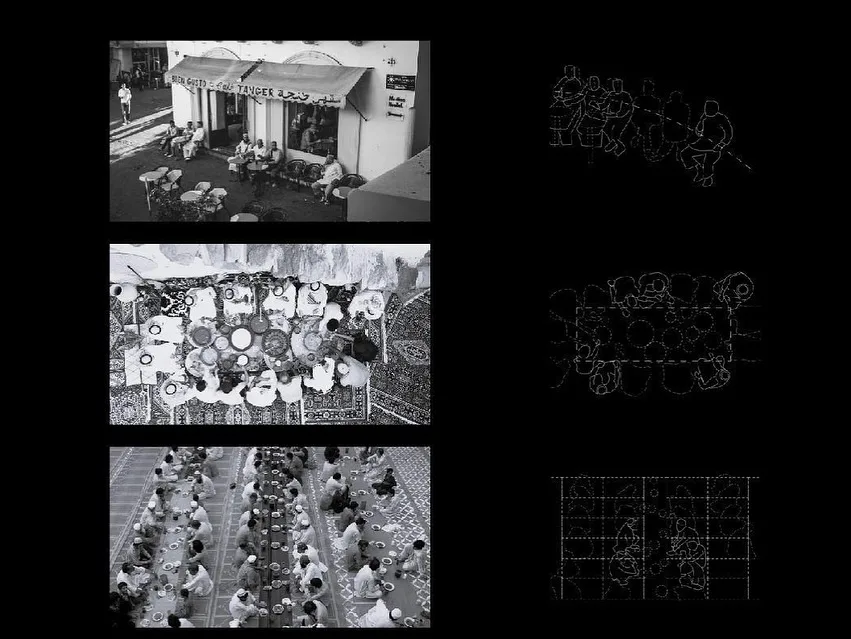
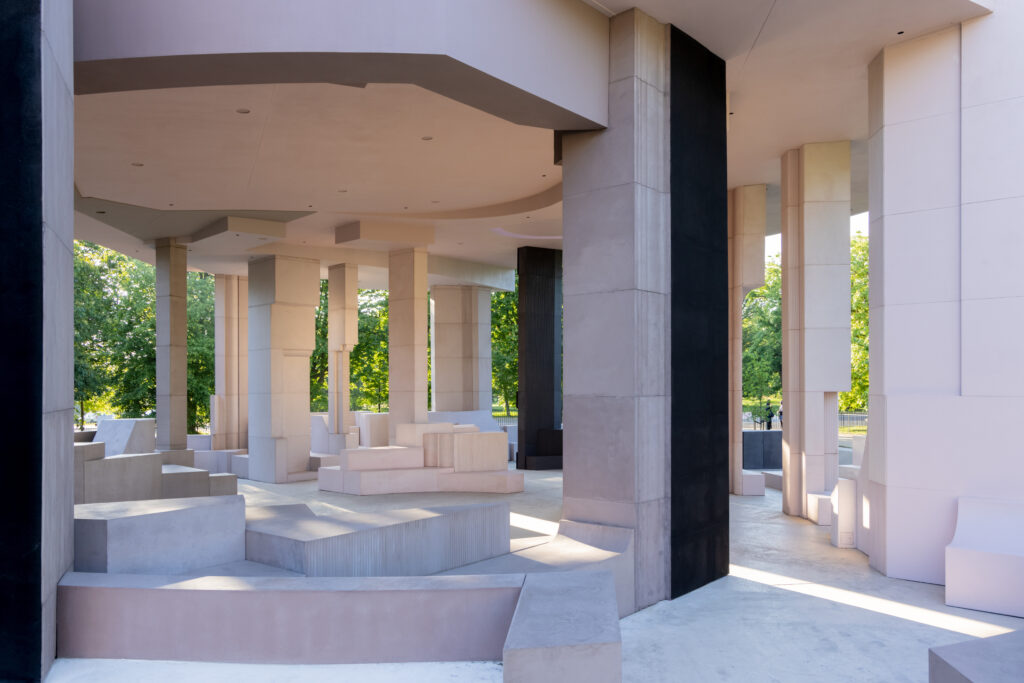
Sumayya Vally is the principal of Counterspace, an architecture and research practice exploring hybrid identities and spatial relationships, with a particular interest in the complex relationships between territories and places. A WEF Young Global Leader and recognised by TIME100 as someone who will shape the future of architectural canon and practice, she is the youngest architect commissioned to design the Serpentine Pavilion in London.
Sitting, for me, is never just a bodily position. It is a form of knowledge transfer. When I think of sitting as comfort and care, I think of the many ways that bodies orient themselves towards one another: the lean, the turn, the almost imperceptible adjustment that says, “I am here with you. I am not leaving yet.”
These orientations were demonstrated so vividly at my Serpentine Pavilion in 2021, which drew on past spaces of belonging and resistance from across London, translating surfaces across which people gathered – stoeps, tables, porch steps, congregations. We witnessed how the space itself became an act of community in its ability to hold space for sitting, listening, sharing, convening.
In the communities that have shaped me – South African, Indian, Muslim, diaspora – sitting together is inseparable from the act of witnessing. To sit with someone in their grief, in their celebration, in the ordinary drum of their life is to participate in a kind of architectural act. You are constructing something temporary and sacred simultaneously.
These moments almost never happen in designed spaces. Or rather, they happen despite or around designed spaces. They happen on stoeps. On the edges of things. On the kerb outside the mosque after Jumu’ah, where conversations continue long after the formal gathering has ended. On the floor because in so many of our traditions, the floor is not a place of diminishment; it is the place closest to the earth, and therefore a place of honesty.
I am drawn endlessly to the threshold, the in-between place that is neither inside nor outside. The Islamic Arts Biennale 2023, which I artistically directed, explored the significance of the act of gathering and what it means to be a member of the Muslim community. This condition was central to the artworks brought together in the space. They questioned how one constructs belonging (to a group, a time, a place, places in our collective imagination and mythology, and our collective home in nature) and how, through its reconstruction and in our convening, creative opportunities for learning and cultural exchange emerge.
The majlis stands as one of the most enduring spatial institutions within Islamic civilisation, embodying the seamless integration of architectural form, social function, and spiritual principle. More than merely a physical space, the majlis represents the architectural manifestation of Islamic values of consultation (shura), hospitality (karam), and community cohesion, serving as both a microcosm of Islamic social order and a bridge between the private and public spheres of Muslim life.The majlis serves as a crucial site for the intergenerational transmission of knowledge, facilitating the transfer of oral heritage like folk narratives, poetry, and traditional wisdom, making it an informal yet essential institution for cultural preservation and continuity. For our work at Ibraaz [cultural centre] in London, we drew on this typology for the main assembly space, itself named ‘Majlis’. The intention with these spaces is that they host artists’ works that, at their heart, are about hosting others. The idea is that it will always have a work that is about majlis (salon, gathering) and allows for the concept to evolve into various configurations.