
 Posted in
Feature, Cheb Terro
Posted in
Feature, Cheb Terro
A tribute to Cheb Terro: Sousse’s very own
Text Maryam Fathi
Rayen Hermassi, known to many as Cheb Terro, constructed a universe with nothing but raw instinct, borrowed technology, and an imagination shaped in the basement of his family home in Sahloul, Sousse, Tunisia. Today, what we’re left with is not simply music, but an archive of feeling, neon-coloured, raw, and fiercely alive.
At the height of his presence in Tunisia’s underground hip-hop scene, Cheb Terro had already become a reference point. Not a celebrity, not a product, but something more elusive. His sudden passing did not shock his listeners as much as it moved them. People returned to his archive, probing his lyrics and fractured beats, dissecting his visual language, tracing his internet footprint, searching for clues they may have missed while he was still here.
What they found was not prophecy, but honesty. And honesty, once archived, has a way of continuing, of expanding.
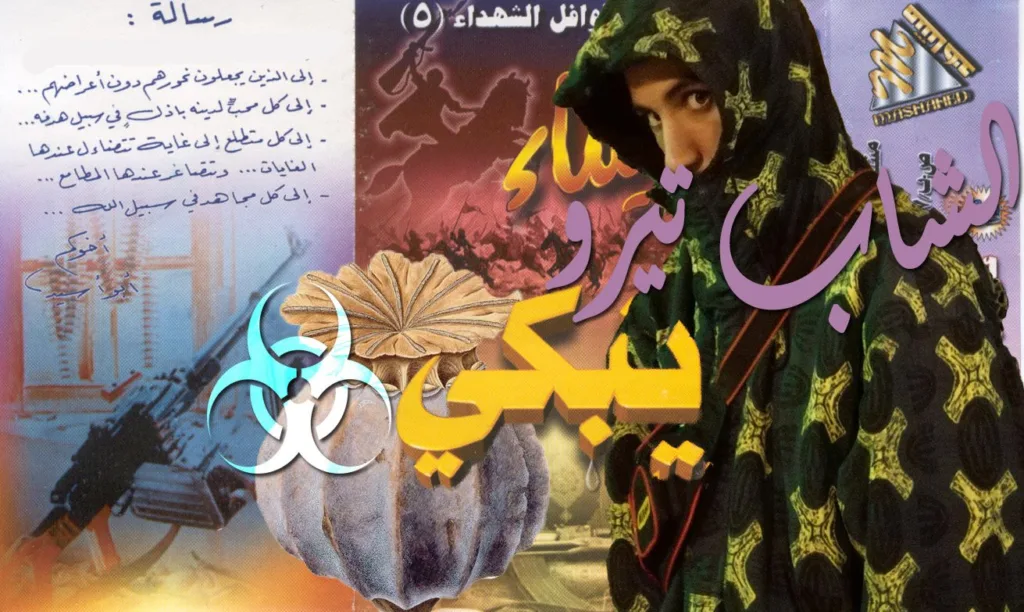
Origins: Sahloul, Sousse, Tunisia
Sousse is often flattened into a postcard: sunlit beaches, tourism, temporary pleasure. But it is a port city shaped by arrivals and departures, defence and resistance. It carries both movement and stagnation at once. For those growing up there, especially those misaligned with dominant narratives, the city becomes both shelter and exile, and the neighbourhood of Sahloul was Cheb Terro’s ground zero.
But before Cheb Terro, there was Rayen Hermassi, a core part of early collectives like Houmazen, experimenting with sound, language, and identity. Those who witnessed that phase of Tunisian rap speak of Hermassi becoming louder, more unfiltered. Cheb Terro was not a mask to hide behind. It was Rayen who turned up.

Punk rap as a posture
Cheb Terro’s music existed in opposition by default.
Punk rap, in his case, was less a genre and more a stance. Boom bap foundations were bent into something angular and local, filtered through Tunisian cadence, street humour, paranoia, and emotional fatigue. His delivery never felt like a performance. It was simply release.
Consent to express himself was never something he asked for. Instead, he overwhelmed convention beautifully. Language was stretched, broken, and rebuilt. Arabic was not treated as sacred or limited. It was played with, attacked, and rewired. This approach was, in itself, a refusal of social constraints, particularly those placed on Arab youth regarding how they should sound, speak, or feel.
Terro’s penmanship extended beyond lyrics. He edited raw video compilations pulled from long adolescent days online. He collaged single artworks, cut and pasted visual identities, and, in a lesser-known chapter, designed colourful, expressionless clothing, wrapping himself inside his own creations. Art was not something he made. It was something he inhabited, often unconsciously becoming part of the work itself.
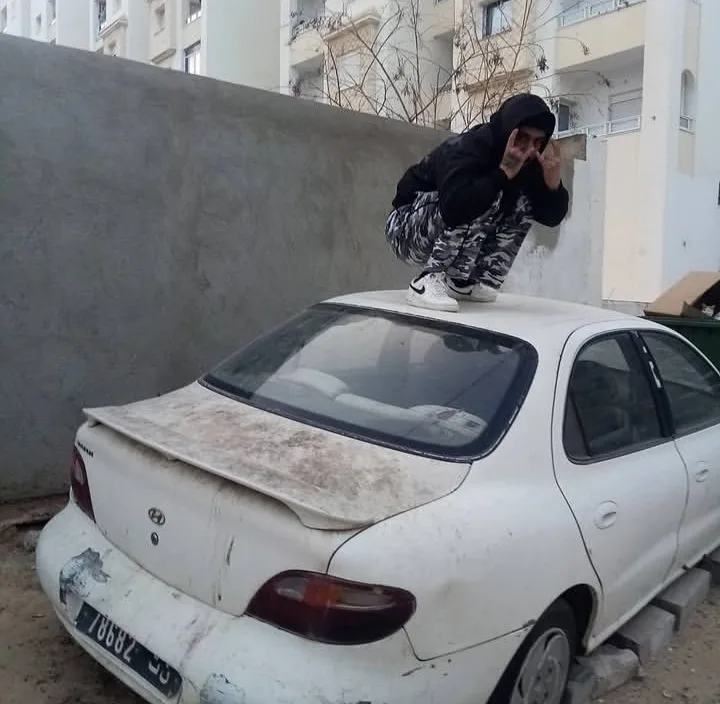


Toxic Club: a shared frequency
Alongside DJ Hrizen, Flow Tha Key, Amine Fradi, and Baha aka tyrantdistrict, Cheb Terro co-founded Toxic Club, not a collective in the traditional sense, but a shared frequency.
They spoke a language entirely their own. Track titles emerged from inside jokes, made-up words, and mutated phrases. Beats were ripped from YouTube, pirate-style, then reshaped into something distinctly theirs.
Amine recalls how they coined terms that became part of their internal mythology: Arabpunk, Cyberphonk, Cyberdark, Robotpunk, Underadar, Underrebel, and Underplanet.
The first meeting between Flow tha Key and Terro happened at one of Terro’s friends’ houses in Sousse, where they ended up freestyling together all night. The casual hang became a deep creative session, both feeding off each other’s energy and ideas until early morning. That night revealed how natural their connection was. Each verse and rhythm flowed effortlessly, reflecting a powerful chemistry. This spontaneous session became an early sign of how their collaboration could push boundaries and create something authentic and original.
In one verse, Terro described a disco in Baghdad plainly, almost casually—a disco in the middle of the city, and him inside it. Someone once described it as imagining what a disco in Baghdad might look like, shy in public, loud in truth.
Toxic Club was also deeply embedded in the streets of Tunis. Their tags appeared outside grocery stores and in alleyways. Signals meant for those who knew how to read them. To some, it looked grim. To others, deliberate. Necessary.

Sampling as reconstruction
For Cheb Terro, sampling was never nostalgia. It was reconstruction.
He sampled dubbed Arabic cartoon commentary, but most notably, Toxic Club’s first album.
That same energy translated into their music. Back-and-forth synergy, playful intuition, tracks that felt discovered rather than planned.
Under Spacetoon, Terro absorbed a shared childhood language across the region, hours spent with dubbed anime that quietly shaped an entire generation. Japanese magazine cut-outs appeared across his visual work.
The Legend of Zelda offered the logic of quests and parallel worlds, while Conan, Boy of the Future, echoed survival, innocence, and persistence. Beetlejuice returned as a recurring apparition, humour living comfortably inside darkness.
Undocumented by design
One of the most compelling aspects of Cheb Terro’s legacy is its continued obscurity.
There were no polished press cycles, no official archives, no systematic preservation. This absence created hunger. Listeners gravitated toward fragments: lost tracks, low-quality videos, half-remembered verses. The lack of documentation became part of the work itself.
People wanted more because there was never enough.
Posthumous echoes: Drowned By Locals & beyond
Cheb Terro did not cease to exist after his passing. If anything, his visibility expanded.
The release of Drowned By Locals, widely considered one of his strongest projects, brought renewed attention, especially as it arrived after his death. The collaboration with DJ Die Soon and the label’s role in facilitating its release gave Terro’s work a new afterlife, introducing him to listeners who had never encountered him while he was alive.
His sudden absence reframed everything. Lyrics once heard casually became heavy. Beats, once playful, carried weight.
Negotiating culture, visibility, and refusal
From seemingly simple entry points, oral histories passed quietly between generations, the early age of the internet, dubbed Arabic animation, and the unconscious absorption of Japanese visual culture, Cheb Terro developed a dense inner language. Like many Arab youth of his time, he encountered these materials without immediately understanding how deeply they were shaping him. Only later did their influence surface as a shared subconscious, with recurring symbols of sacrifice, transformation, endurance, and restraint, and as echoes of the cultural expectations imposed on young bodies and voices.
These references never appeared as direct imitations. Instead, they became tools of negotiation. Cheb Terro was a self-taught artist who balanced tradition, privacy, reputation, and autonomy. His work moved carefully between what could be shown and what had to remain protected, between inherited codes and invented ones. Loss, resistance, and transformation were not thematic choices. They were conditions of life. And grounding all of it was community: fragile, intimate, constantly in flux.
His practice remained intentionally ephemeral and largely undocumented. Tracks disappeared, visuals circulated without credit, and performances went unrecorded. This refusal of permanence was not accidental. It quietly challenged fixed ideas of authorship, ownership, and access, raising questions that still linger. Who has the right to archive? Who benefits from visibility? What does cultural responsibility look like in spaces shaped by extraction and consumption?
Rather than flattening culture into something easily legible or marketable, Cheb Terro’s work resisted reduction. It refused to polish. It refused translation. Instead, it created a free-flowing expressionism, raw, unresolved, deeply personal, one that questioned who is seen, who remains obscured, and who ultimately controls the narrative within our communities.
Cheb Terro is incomparable to anyone who came before or after him. Not because he chased originality, but because he remained uncompromisingly honest. He repeatedly demonstrated that the platform never mattered. Whether the work lived on a forgotten webpage, in a low-resolution video, in a basement performance, or in an anonymous file shared between friends, what endured was the content itself and the truth that drove it.
Final echo
Cheb Terro is a mirror of the present moment: endless scrolling, fragmented belonging, traces left where algorithms meet memory.
He remains an archive, a rupture, and a mirror. A voice that chose freedom over permission. A life that continues to echo, not because it was loud, but because it was true.
His work stands.
His world remains open.
And his legacy belongs to everyone who ever felt unseen and chose to create anyway.
“خيالي ما يوفى بد رغم كبر سني”
“My imagination never runs dry, no matter how old I get.”