
 Posted in
Anniversary Issue, Anniversary Issue
Posted in
Anniversary Issue, Anniversary Issue
Always and Forever: Bella Hadid in conversation with Yasmine Diba
Text Yasmine Diba



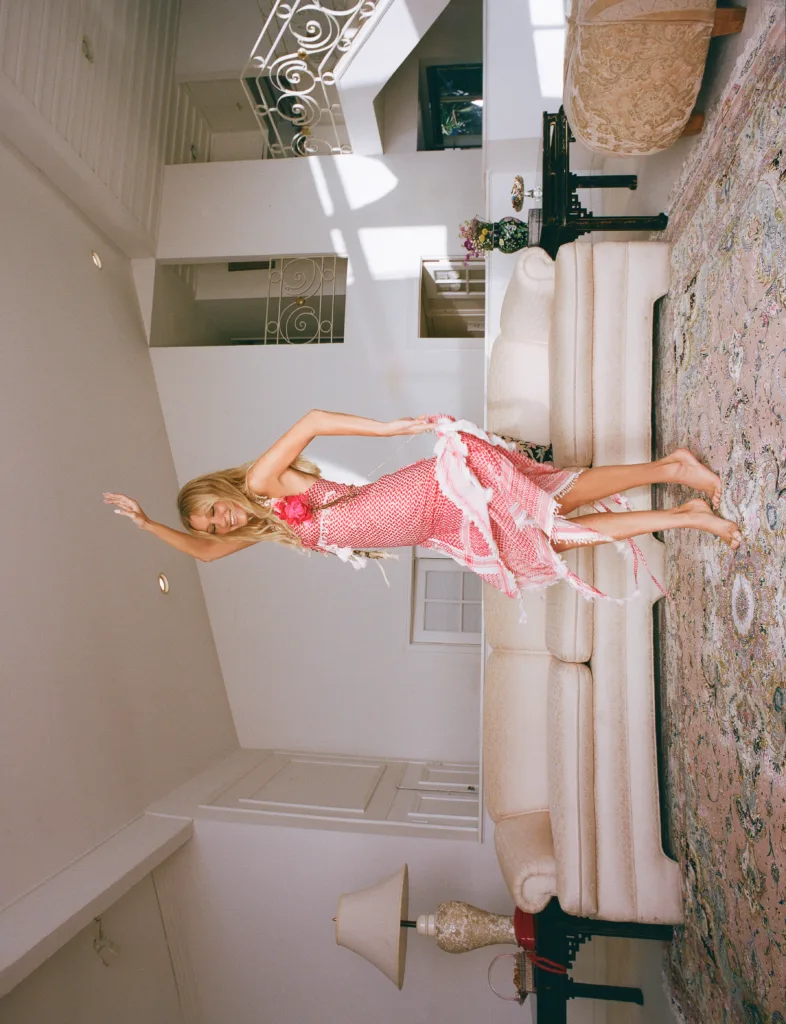
On 23 May 2024, Bella Hadid stepped onto the French Riviera for ice cream with her childhood friend, photographer Yasmine Diba, during the 77th Cannes Film Festival. It was one of those rare moments that transcended the news cycle to become crystallised in the pop culture canon because of her look: a red-and-white keffiyeh dress made 24 years earlier by the cult design duo Michael Sears and Hushidar “Hushi” Mortezaie of New York label Michael & Hushi. It was also a measure of how well the supermodel understands her superpower, skillfully wielding it to draw attention not to herself but her unyielding message about the intention of love.
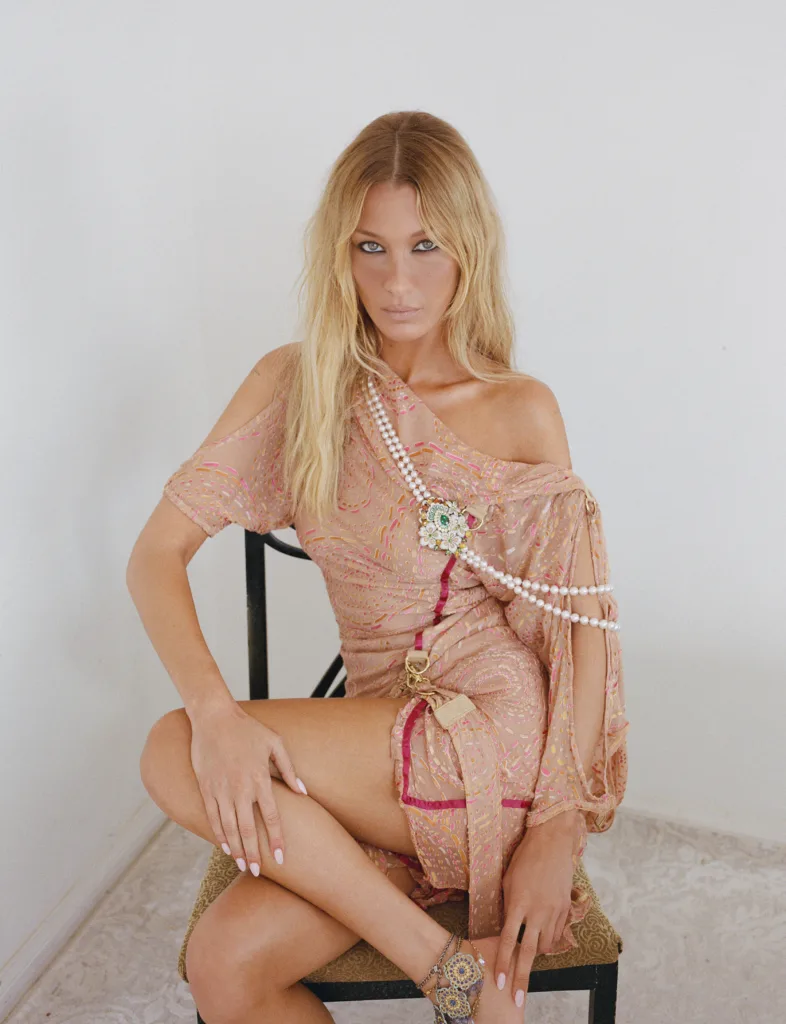
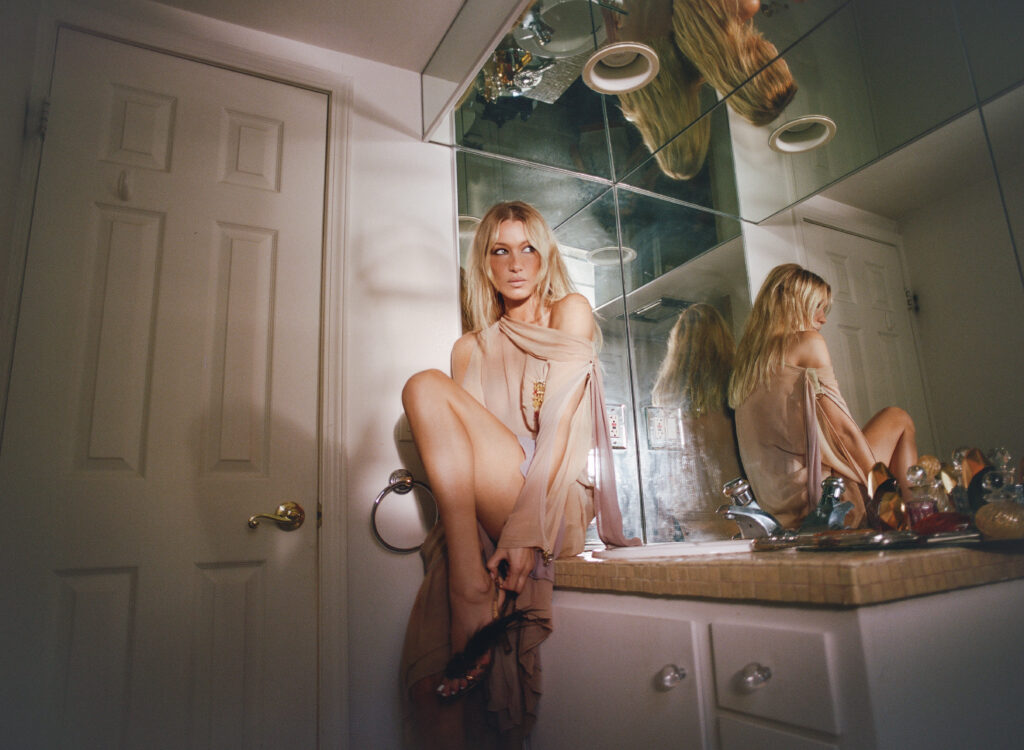
For our anniversary issue and her first MENA cover story in nearly a decade, Bella reunites with both Yasmine and Hushi in a story that echoes that very moment in Cannes and the message at its heart. Here, donning the rebellious and romantic textures of Michael & Hushi’s archive and lensed by Yasmine (who lent her the dress that started it all), she reflects on the importance of ancestry and bringing her eponymous beauty brand Orebella to the Arab world.
Yasmine Diba (YD): If you had told little us in PE class that we would be doing this together, we wouldn’t have believed it.
Bella Hadid (BH): Yeah, I wonder what we would’ve said. I don’t think we would have considered this a real possibility. It definitely wasn’t what either of us thought we were going to do, or even that we’d be cool enough for anyone to ask us to do interviews together, in general, so this is pretty huge. But after 17 years of friendship, you’re the only person I would want interviewing me, so I’m very grateful, and I love you so much.
YD: It’s such a trip—12-year-old us would not have even thought about this. We were just two dorky little horse girls. As 15-year-olds, we would’ve been like, ‘What a dream!’
BH: I remember when I walked straight into that PE class. I was the new girl coming from Santa Barbara, and I swear, I found the only other Middle Eastern girl sitting on her little square during first period. I saw you and said, ‘That’s my best friend for life.’ Since then, we have never missed a beat.
YD: Also, it’s honestly so crazy that we ended up doing this interview in Malibu, right across from our middle school and high school, not on purpose.
BH: I wish we could show people the photo you just showed me of us, 17 years ago, in this same spot. Life really does go so full circle, and it’s magical to be here in Malibu. We didn’t even plan this, actually.
YD: No, we didn’t. We woke up, had Lily’s burritos this morning, and came to the beach—it’s the same thing.
BH: I know, I’m just very lucky to have you.
YD: As you said, you were my first and only Middle Eastern friend growing up, so it’s special that our first big project together like this is centred around a Middle Eastern publication and right before your baby [Orebella] launches in the region, which is such a full-circle moment, too. Do you feel like you’ve had a chance to take it all in?
BH: I mean, we’ve shot together hundreds of times; you were the first person to ever really shoot me in high school, which is funny. The fact that Dazed MENA is the first cover we’re shooting together and, on top of it, the biggest launch for me is so special. What I’m most excited about is being able to build a brand that is not only true to who I am, but also to my roots, my culture, and everything I stand for. I’m excited to return to the region and show my Arab friends how much they’ve influenced and shaped Orebella as a whole.


YD: Absolutely. I often think about how much it’s connected to your roots and to the story you told me about when you went to your aunt’s home in [Washington] DC and saw the bottles.
BH: Yes, it was smack in the middle of when we were still deciding on bottles, juices, the whole nine yards of Orebella. I was actually in DC for the funeral of my aunt Ghada, who had such an impact on me and my life. But not only that, everything that was in her house the night that we went back to celebrate her was such an ode to Orebella, and everything I had thought about in my head. I thought they were little dreams of mine, but they were memories. Walking into my aunt’s bathroom and having all of these old perfume relics that she had collected over the years—it was a baseline of what I wanted for Orebella. It was really exciting to go back to everything I’ve ever wanted: being true to myself when creating a brand I represent.
YD: There’s also this intuitiveness that you abide by in your life in general and how you feel things so deeply—it was already a part of you and even your genes. Your uncle used to make fragrances, right?
BH: Yes, my uncle Mahmoud. I found this bottle, it was actually an essential oil concoction that he had made in the 70s. From then on, I knew I was on the right path because not only was it starting from a dream, but also to see that it was almost woven into my blood, heart, and genetics. It felt like a gift my ancestors gave me through the universe.
YD: I often say to everyone that the first trait of yours I’d mention, besides your kindness, is your bravery. You’re so brave and proud of where you come from, and that’s something I’ve looked up to you for since we were little. It made me feel more comfortable.
Growing up, it wasn’t exactly ‘cool’ to be Middle Eastern, and as I’ve gotten older, seeing you wear it so proudly has helped me feel proud of it, too. More broadly, I have seen so many Arab, Muslim, and Middle Eastern girls worldwide look up to you. How does it feel to know that you’ve helped people of all ages feel brave?
BH: For me, it’s God-given and a huge responsibility that I don’t take lightly. I have such deep imposter syndrome, so it’s almost scary to consider the impact that I have. I’ve learned to embrace it as I’ve gotten older, but it’s such an honour to know that young girls look up to me because all I can do is walk in my truth and just hope that there are people who will walk next to me on my journey of finding myself—and knowing that there are so many girls on it with me is a beautiful thing.
Ultimately, my answer to what I hope they take from my journey is to always be proud of where you come from and to always be yourself, no matter what. My goal is to show the next generation that they’re allowed to stand up for themselves and what they believe in.
YD: To your point, I do wonder what it would’ve been like if we’d had someone like you to look up to when we were younger. But that’s the thing—as you said, once you get older, you realise there’s no point in being anything but yourself. In the end, the people who are like-minded will be there for your truth rather than a version of yourself that you’re trying to be.
BH: Regardless of how we feel, there is a history that’s already been written, and to be grounded within that knowledge is so important, as is walking with pride when it comes to the resilience of our ancestors. It got us to a point where we can openly address what we care about. Certain types of people have been portrayed antagonistically, but in my opinion, that’s wrong in so many ways. For example, I was raised around Arabs and Palestinians who are so full of love, kindness, openness, and generosity. Walking into an Arab home, I’ve never heard or seen with my own eyes any negative ideology, which is often the stereotype. That’s not our culture. It’s not how we were raised, so to grow up hearing that people have such negative opinions about a group of people only makes me want to stand up and scream louder from the rooftops about how false the narrative is.
YD: You’ve been both a bridge and a target when it comes to Palestine. How do you navigate the tension between being seen and being silenced?
BH: It’s a really strange thing to navigate. It’s also extremely painful to know that your love for your people, your history, your home can ever be seen as controversial.
That said, speaking from the intention of love is what I repeatedly go back to. It’s what makes me feel grounded in my words and my presence. So, at this point in my life, I don’t really seek validation anymore. I come from a place of knowing our history, the history of Palestinians.
Ultimately, I remind myself that if I can make even one young Palestinian boy or girl feel seen or proud of where they come from, it’s all worth it to me. The noise fades, but the connection and the pride for what’s in our blood will last forever.
YD: It goes back to me saying the word ‘brave’. Whether you’re face-to-face with someone who has similar or different perspectives, there’s no twisting the fact that you always speak from your heart.
BH: When I talk about navigating all this knowing my intention is love, what I want to add is a love for my people, a love for a future in which no child has to feel shame in stating where they’re from. I don’t want any kid to grow up thinking that they can’t be Palestinian and proud—proud in all the beauty of who we are.
Whether Palestine or anywhere else in the world, none of us had a say in where we were born. The trajectory of your life could have been extremely different if you were born even 15 minutes away from where you were. That alone should prompt deep empathy, knowing no one was ever able to choose their final destination. We should all care for one another as if we come from the same place instead of trying to separate from each other while we’re here on the ground.
The reality is that so much of the hatred and division comes from government systems that want us to all be political pawns when what we should be doing is coming together to make a better world, one that is more inclusive, remembering that we’re twice as strong if we’re able to fight against greed and power with love.
I want to add that I don’t ever want anyone to feel bad for me when it comes to some of the reactions I’ve had for being vocal on social media. I want it to be very known that the backlash I face online is not even a speck of the struggles and pain endured by Palestinian people. And I would do it 100 times over just to see one child know that they are seen and loved and thought about from across the world.
I am very adamant that when it comes to the internet and how hurtful it might be in the moment, I continue knowing that it couldn’t even hold a candle to the pain that our people have experienced. Justice will inevitably come to light. I know that even when I get tangled up in social media hate or propaganda, I can come back to the fact that I know my history and address all religions and cultures with respect. That’s what keeps me steady.
YD: Since you’ve grown to be more in the public eye, you’ve spoken out so much about this. I feel you’ve played a big role in bringing so much more awareness to the situation at hand in the region through your platform.
BH: I can both agree and disagree because of the fact that I know and have seen how many have been fighting for this cause across multiple generations. I’m just one of the lucky ones who had a platform and wasn’t afraid to use it, I guess.
I remember writing ‘Free Palestine’ with paint on my hand when we were 17, and being called all the names in the book. Even at that point, 12 years ago, with no political words, I was already a target—to be anti-anything was shocking to me because we didn’t grow up with the mindset of anybody hating anybody, so it was very hard to see the way that my love for my history and my people was taken as a threat. `
A couple of years ago, I had walked out of an event and got into my car before realising that I was literally behind an entire rally. And I remember my agent at the time saying, ‘You don’t know what you’re getting yourself into,’ so I fired him the following day. I remember getting out of my car and running into the protest by myself. It was a family affair; I felt like I met all of my brothers and sisters in one sitting. The impact of the people around me is crucial and huge. I can’t take credit for any of it, really.
On that note, I truly believe the companies that fired me for my stance was the best thing they could’ve done for me because I will always be Palestinian in my blood. Walking in your truth and letting go of things that weren’t meant for you is a must.

YD: Since we were little, you’ve always marched to the beat of your own drum. So much of the world obviously sees your work as a model, but a huge part is also your process with the design, art, and creative direction—all the little decks you make, whether they’re for a commercial job or your own projects. What does that look like for you? Can you walk us through your creative process, starting from where ideas begin to how they find their final form?
BH: My process has always been very instinctual. That’s why, over the years, people have made fun of how I dress. But my style changes all the time. I wake up and sort of put on something that mirrors how I feel on that particular day. Whether it is building a deck or producing the campaigns that we do with Orebella, l wouldn’t say I’m a control freak, but I definitely aim to make sure that my hands are on everything that we do. I want to ensure what I’m putting out is something that will make people happy. They’re spending their hard-earned money on the things that I am making, so I never want to sell them something that they’re not going to love. Even when it comes to campaigns, every detail matters to me.
At Orebella, we’re a big family — we go back and forth on what we want and what the consumer wants. But we’re still a small start-up; there’s so much work that goes into building a business that people don’t see. The creative side is the best part; the business side is the hardest. It’s interesting—because of social media, you have to be on all the time and posting constantly at a time when there’s so much going on in the world.
Over the past two and a half years, it’s been hard for me to post about my everyday life or even Orebella, even though it is my lifeline. It pulls on your heartstrings to have to pick and choose between posting about something that feels so materialistic over posting about the things that I feel so strongly about. It causes a lot of internal battles around trusting your own instincts and having to make decisions that could possibly face a lot of consequences. When it comes to Orebella, I want to be very authentic, even if I don’t post a lot.
YD: Going back to being intuitive: I feel one reason why people are so attracted to you is because you are so yourself. And that can also go back to how often you post—it’s genuine, it’s real. It’s quality, not quantity, right? I’m no social media guru, but I think people feel that from you.
BH: At the end of the day, I am who I am. There’s so much to be said about staying authentic when it comes to online personas—I never want to be something I’m not. It’s hard for me to post happy posts when I’m straight up not happy. I’m so grateful for my life and everything in it, but I do struggle, whether it is generational trauma or the things that feel heavy when I wake up in the morning, chronic illness and my own mental health issues.
Being open about that online does change how you’re perceived, but I’m so grateful to have Orebella because it does bring me back to my creativity. Everything I do – from social media to Orebella, my creative output to what goes into my decks – stems from feeling. It can be something small, like a colour, a feeling, a sound, or a memory that sparks an entire world in my head.
It was hard for me to go to set and be a mannequin, but now, a lot of people seem to like what I can bring to the table creatively. I’m so grateful that I’m at that point in my career where people trust my creative vision.
YD: Well, your love for all this started behind the lens. You have the knowledge and such deep love for art and movies and all the details that come into a lot of the work you do, besides being the model yourself.
BH: Both of us going to film school made me hyper-focused on all of those things, but it did make me a better model because I really appreciate all the sides of a shoot. Even when I had to choose between finishing school and starting work at 17, I still loved films, the craft, the cameras, the lights, all of it—but I didn’t necessarily love being a model.
I had to pick and choose. If I wanted to model, I had to find joy in it. And I had to find beauty in it elsewhere. I was lucky enough to have the best photographers in the world to look up to when it came to the process behind a photoshoot.
YD: I always say there’s some cases where I’m shooting a traditional model, and others where it feels more like I have an actor in front of me. They get into character, as do you—it’s never about merely looking pretty. You’ll do what’s needed to be the character. And that really brings this energy and light into the work that you do.
BH: It’s all about storytelling for me, modelling included. I love being different characters. That’s the beauty of art, and that’s why I want to get into film—whether I’m directing my own movies or you directing a movie and I act in it. Sometimes, I’ll wake up in the middle of the night with an idea for a film and write eight pages of a whole movie plot. That’s how my brain works. One day, being able to envision my own characters or being a character for somebody else’s vision would be so exciting.
It’s hard for me to stay static. When we work together, I love your Super 8 shots and when you take candid pictures of me talking. I prefer those to being super posey; it doesn’t feel authentic to just stand there and look pretty. That’s why I also love it when you’re on set with me because I know I can be myself.
YD: It really has been a lifetime of having fun and creating characters. The beauty of growing up when we did – before a lot of social media – was getting to be kids, all that playtime we got. It probably shaped how we do everything today.
BH: So many of my childhood memories are of you. Oh, gosh, I’m gonna cry. You’ve built me into the person I am today. Becoming different characters is something I had to do to get out of where I was mentally, but you always made me feel like myself.
Now that we’re in the same industry and able to work together so often, you bring me back to remembering who I am at my core. You’re actually the only person in the industry that I don’t have to be a character for. I’m very grateful for that. That’s also something I want to say to anyone reading this: if you’ve got a best friend that loves you, keep them around forever.
YD: I feel the same way. It’s special having people who know you so well, even better than you know yourself. You bring me back to the centre when I forget where I’ve gone, when I’ve drifted off.
BH: The universe works in powerful ways. Even bringing Hushi into my world, you were the one who brought that keffiyeh dress in your luggage to Cannes—being able to attend the festival, wearing a dress that represents who I am, was important to me. The fact that it could possibly be a threat to anybody blows my mind a little.
I’ve long known who Hushi was, but the way that dress came into your orbit, then mine, and now we’re here shooting our Dazed MENA cover with Hushi on set with us, having all of the Michael & Hushi masterpieces around was such a full 360 moment. So thank you, Yaz, for bringing us all together. You are so the mitochondria of all of us, I’m gonna just say that.
Hushi and Michael created this fusion of their own identities while blurring the boundaries between fashion, art, and activism—that’s what I’ve always wanted to stand for. Meeting Hushi, seeing his sensitivity and generosity, his love for fashion, art, and science is so inspiring. Throughout the years, Michael and Hushi were the ones standing up for people with integrity and a true heart, speaking their poetry and truth through clothing. That’s both beautiful and hard to do. I applaud them for being among the first who have done that in our industry. At the same time, I know so many people have followed behind them on that path, and it’s heartening to see how their legacy continues. I hope they know how important they are to the fashion industry, our community, and Middle Eastern people as a whole. Hushi, if you’re reading this, I love you!
YD: Looking ahead, do you see yourself creating more projects in the MENA
region?
BH: Absolutely. I feel so connected the minute I touch down in pretty much any country across the region. Every time I visit, I feel a deeper pull to create, to collaborate, and to give back to different communities.
There’s so much talent, energy, and soul, but the world can’t see it through everything that is happening, and I really want to be a part in changing that. I would like to highlight the beauty that already exists, amplifying local craftsmanship and storytelling in ways that feel authentic.
If I’m able to, hopefully bring more projects there, I can work with people who teach me so much—not only about business, ethics, art, fashion, and film, but also about myself.
YD: What kind of legacy do you hope to build?
BH: I’m hoping to create something that connects young artists in the region with global opportunities while honouring their roots. I want my work to remind people that they don’t need to leave their culture behind in order to succeed. I want my brothers and sisters to know that they can stand tall in their culture. I will make sure that I hold their hand so they can embrace that in whatever field they decide to pursue.
Everything leads back to something and, for me, everything does lead back to what’s in my blood. I can now say that I’m proud of myself for embracing who I am as a whole, but I do feel I have so much more learning and embracing to do. And I guess if I can build something that lasts beyond me, then that’s the legacy I want to leave—something that’s rooted in love, community, authenticity, and God.
YD: Something you’ve spoken openly about living with Lyme disease and dealing with different mental health obstacles. What have you learned about your own strength in that process?
BH: After my last dose of treatment, I feel the hardest part for me right now is rebuilding myself. I’ve been at it for years—it’ll be good for a couple of weeks, or days I should say, and then I’ll have a bad flare-up and crash, after which I have to rebuild again. It’s this constant cycle of being so excited about the things I can do and then not, doubting my body, not knowing if I can move forward with the workload and putting my body to the side so I can focus on what I love, you know?
It’s my mind against my body, and that’s really hard because my work ethic is to never stop. Whether it’s in the middle of the night or first thing in the morning, if I’m in bed and can’t get up for days, Orebella and the things I have to do are still on my mind. But that cycle is pretty detrimental because of the fact that it causes so much anxiety. Being so tired, you can’t do any of it anyway, and then fall into deep depression because you almost get so stripped of all the joy from your life.
My support system is so vital, especially God. There’s so much I’ve reflected on, and having faith in something is so important to my healing. During treatments, my mom and I would pray together and, in general, I talk to God and my angels a lot. Living with an ‘invisible’ disease and something that people have long said is incurable, it almost forces you to strip yourself down to the rawest version of yourself.
YD: I don’t even have the words to describe your ability to push through. Having a front row seat, I don’t know how you do it—you show up with a good face on and work your ass off, dealing with a million things in a day. And here you are, still functioning.
BH: Something that I had to unlearn is that productivity and the things that you do don’t equal your worth. For so long, especially in this industry, you build so much of your self-worth off the jobs that you do, how many shows you walk. And I never knew that I could say no. I did every single job that was offered to me because I was grateful to be there. With my imposter syndrome, I thought I didn’t even deserve to be here.
I don’t regret taking any of those jobs, some of which I did for not even a fourth of my fee only because I loved the designer and the concept, or I wanted to support somebody on set. Anything that I could do to make others happy, I did, but it ran me into the ground after so many years. I’ve found that saying no is a powerful thing.
I thought I would never get a job again when I stopped working to go to my first round of treatment a couple years ago, but I had to choose my body. When I came back, I was flooded with so much love. I’m really grateful to my peers in the community for always allowing me to take the rest that I needed to be able to come back stronger.
There are companies like Chopard that supported me every single time I needed a step away. That’s something I’ll remember: [Artistic Director] Caroline Scheufele never doubted me. She always knew my heart, knew where I stood, because she leads with her heart the same way I do. She is such an angel in so many different ways – she’s creative, giving, generous, loving – and I’m grateful that I get to call her a friend.
YD: Speaking of being yourself, you’ve done a really good job of dedicating more of your time to riding horses and being in nature these past few years. I’m proud that you’ve allowed yourself to prioritise something that’s so true to you. I feel it helps when it comes to your creative outlets; it allows you to work even better because you’ve taken that time.
BH: The best part about horses is that there’s no ego, there’s no judgment, there’s no miscommunication. It’s presence–being in the here and now with another living being. It’s taught me so much about connection, patience, and true love. Horses are my first true love, and they’ve taught me trust in so many ways.
A couple of years ago, I went to work on my mental health for a few weeks and when I got there, they said, ‘We have equine therapy.’ And I replied,‘I do equine therapy every day. I’m always with my horses.’ I didn’t know what that meant initially, but it’s incredible how horses are our mirrors. In any aspect of your life, there are so many things that horses can show you if you’re really present and connecting. Also, being able to care about something other than yourself is so important.
That was something my mom embedded in me. She would bring us to the barn super early in the morning to feed and muck the stalls, just as she did when she was younger, working in her community barn in her hometown in Holland. She would work to be able to ride any horse or pony that was available. That’s how she taught me responsibility, showed me the ropes on taking care of a horse, and it’s why I now want to make sure everything is done and everybody’s happy.
I will always come back to a small house on a lot of land with cows, horses, and all of the animals that get rejected. That’s what people say, that I’m gonna have a farm for ‘all the delinquent animals’—and I’m very much okay with that. That’s just where I want to be. I’m grateful to the fashion community for allowing me to be a part of their world, but home will always be on the grass, my shoes off, with my dog and my man.

YD: Moving back to family, your grandmother Khairia Daher Hadid was from Nazareth and displaced in 1948. And you carry her name. What memories or stories of hers stay with you, and how has her legacy shaped who you are today?
BH: My teta is at the core of everything I am, along with my oma, my Dutch grandmother. But specifically, my teta is actually why I have my middle name, Khair, which means ‘goodness’ in Arabic. Even though I was still young when she passed, she was the most incredible, graceful, generous, strong, powerful, kind, and loving woman and grandmother I’d ever seen. She’s everything that a Palestinian woman is at the core. Her presence has always been alive around me. She’s the one on my shoulder when I want to talk about something, alongside my Dutch grandmother. I think about them often because they’re among the most significant fighting forces for me in the spiritual world and being able to speak with pride about Palestine, to stand up for what I believe in. The stories I’ve heard of her from my family – about the cups of coffee, the smell of things baking in the oven, the memories – stay with me.
There’s a certain aura around Arab women. It’s beauty, grace, dignity, strength, love, and kindness. You can see it in the eyes, they never lie. I think of my teta having to leave the place she called home for so many years, generations, lifetimes. She picked up her children and her family, and started walking. If it weren’t for her and my grandfather, my jido, none of us would be here.
They stayed strong and held their heads up high, but never had hatred in their hearts. That takes a lot of courage. I respect them for never giving up. You look back at our grandparents and our parents, and all they did for us to be able to get to the point where we are today—it’s impossible to express. I owe so much to them. There are the cutest pictures of my mom and dad in Palestine in front of our old family house. She looks gorge. She has her keffiyeh and everything, she really was a ride-or-die for my dad and his family. And she wanted to give me that middle name. And it’s a daily reminder of where I come from. It reminds me of everything that my ancestors had to go through for me to be able to sit here today. For me to be anybody that people look up to is such an honour considering I get to carry the name of my ancestors. That’s what I’m proud of. And that’s what I want my legacy to be.
YD: I often think about everything our families went through. They don’t carry anger, just love and gratitude. And that’s what they’ve taught us to practice. On this note, how do you want to be remembered?
BH: I want to be remembered for the love that I gave, not for the things I’ve done necessarily, which I’m proud of obviously—that will never go away. But, eventually, you’re left with just your soul. That’s all I reflect on when I move through life now. I want to be remembered for how I made people feel.