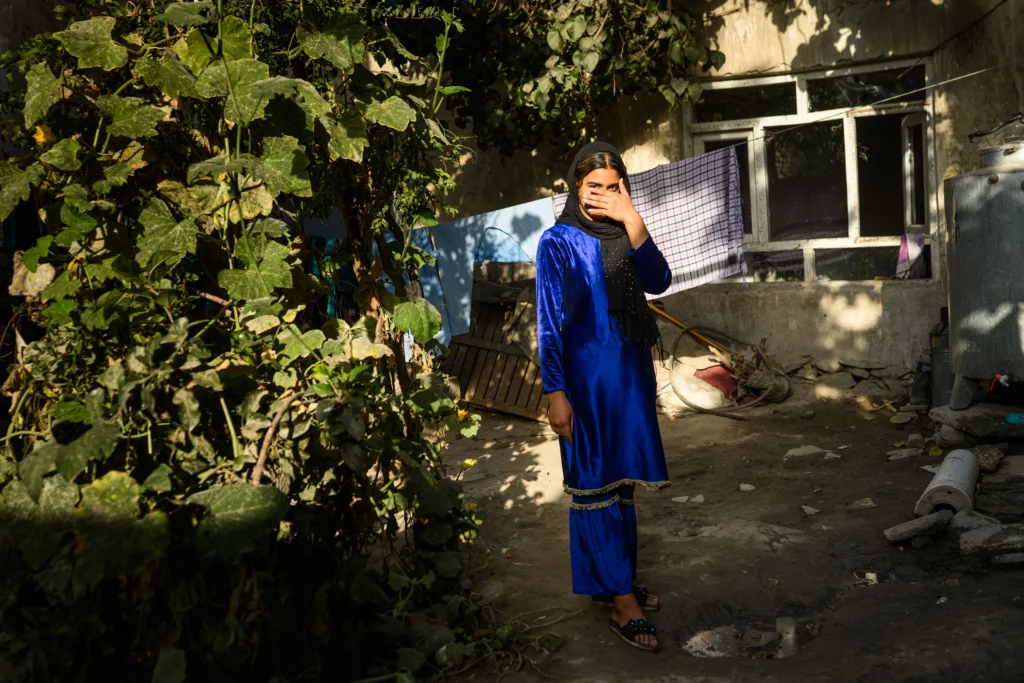
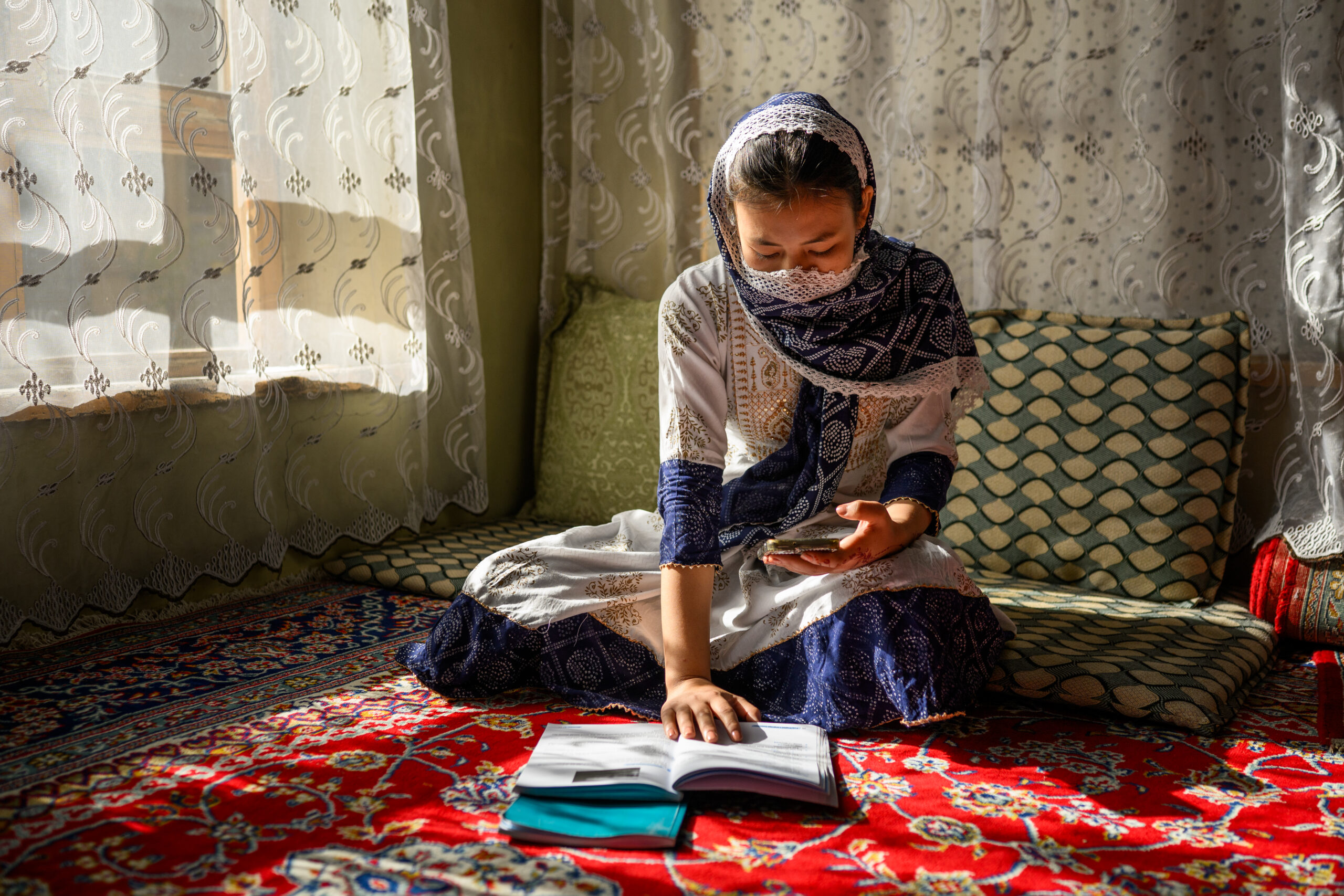
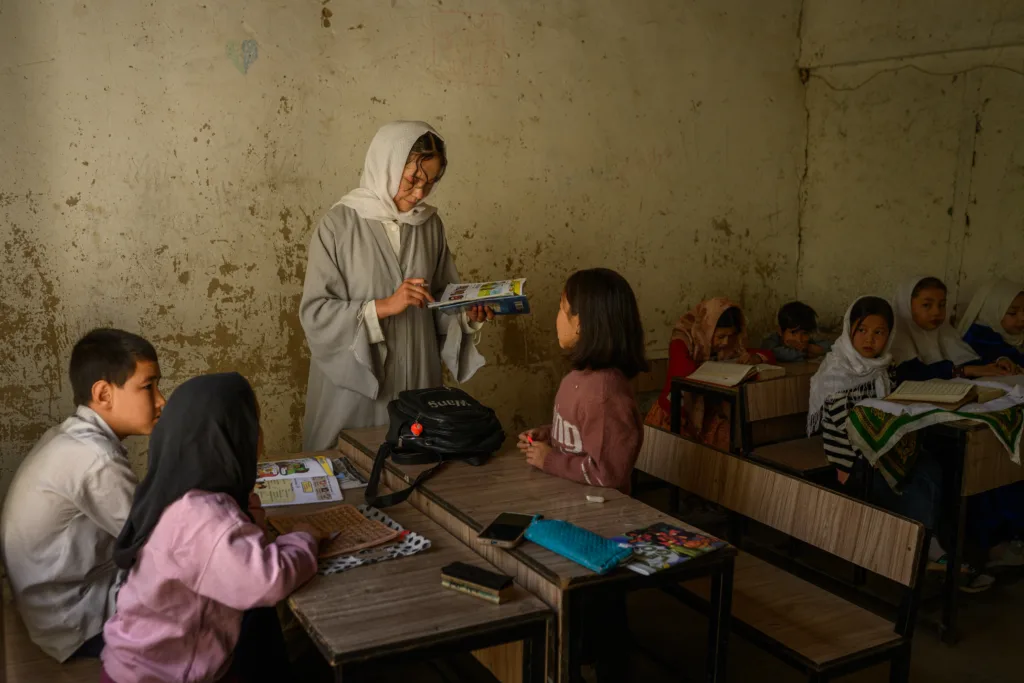
 Noora prepares for the class she teaches to primary school children, on October 12, 2025 in Afghanistan.
Posted in
Life & Culture, Afghanistan
Noora prepares for the class she teaches to primary school children, on October 12, 2025 in Afghanistan.
Posted in
Life & Culture, Afghanistan
Afghan girlhood republished
Text Silai Estatira | Photography Elise Blanchard
Mah-Rukh Niyaz writes, “If the world were in the hands of women, where would there be wars?”
And Layla Sarahat Rushani writes:
پرنده گك؟
Little birds?
درین بهار بی بهار
This spring, without a spring
چگونه عشق را ترانه میکنی؟
how will you sing about love?
به دشت های لاله پوش
For the steppes lush with tulips
چگونه این حماسه های سرخ را
تو جاودانه میکنی؟
how will you eternalise
these crimson sagas?
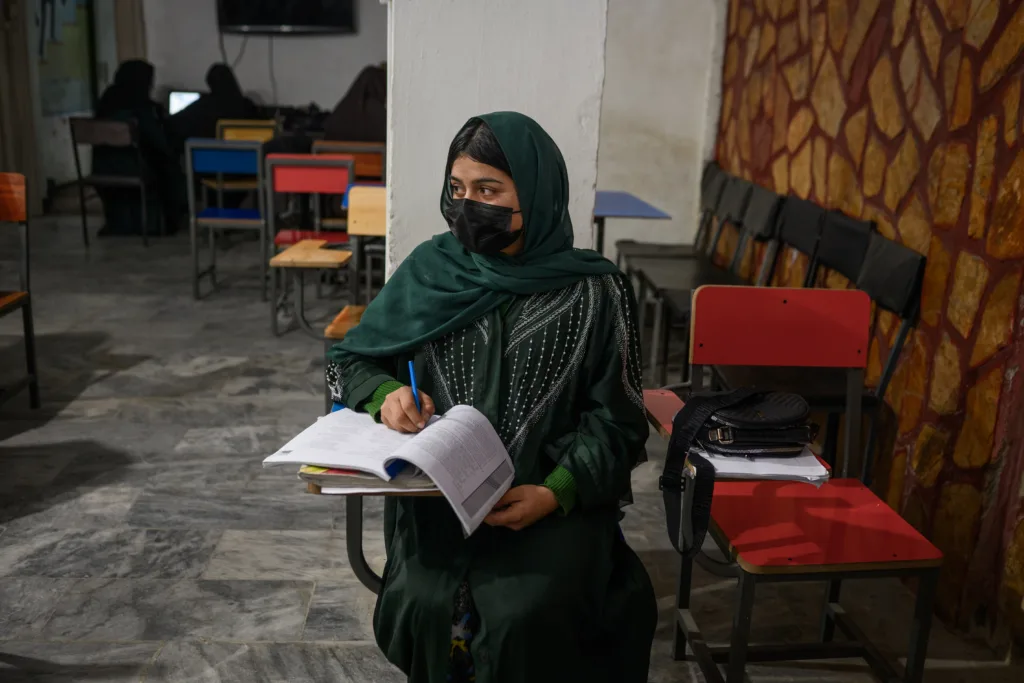
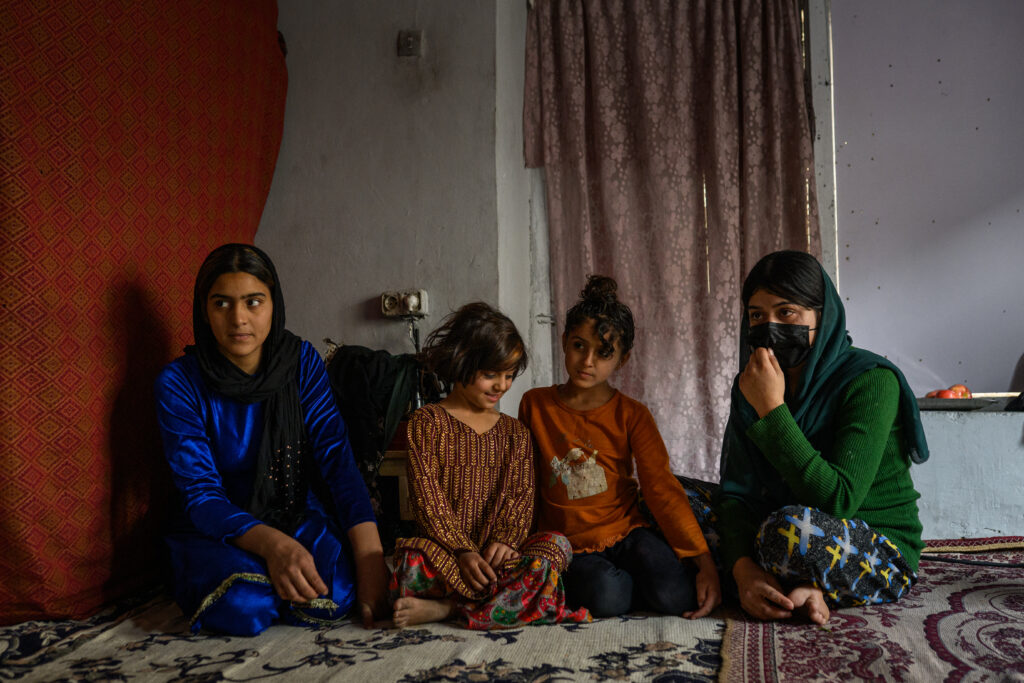
When Elise Blanchard reunited with the Afghan girls she captured last year, the air was bright with excitement and anticipation—they weren’t nervous, but happy to be photographed again, recalls the photojournalist. For the first series, they chose their favourite dresses. This time around, Lisa, Mina, Nuri, Girl of the Ocean, and The One Who Will Not Lose Hope wanted to share their daily lives. “What amazed me is how much they have going on,” says Blanchard. “No one came to help or give them opportunities. They made it happen themselves.”
The girls’ liveliness unfolds against a backdrop of economic uncertainty. The photos are brightly lit, featuring the girls as they embrace a steady pace of self-guided activity and routine. However, what these moments of light conceal is the scale of constraint surrounding them. Blanchard reminds us that the pictures should not give the impression that they have an easy or naïve life: “At their age, they face difficulties and pressures I cannot imagine, even if I witness it.”
As Afghanistan continues to find its footing after the 2021 Taliban takeover, girls have had to figure out how to keep up their studies while facing widespread economic difficulties. Foreign aid, for starters, has largely been withdrawn due to the regime’s lack of international recognition. At the same time, in a manoeuvre that’s blatantly neo-colonial, Washington, DC has frozen over US$7 billion of Afghanistan’s central bank reserves, further destabilising an already fragile economy—one in which 97% of the population could be living below the poverty line.
With reserves sealed, the central bank cannot reliably supply cash or foreign currency to commercial banks. The result is ordinary families unable to access their own savings and businesses struggling to pay workers. This act of economic asphyxiation extends imperial control by holding a nation’s survival hostage to western political interests. As for the justification behind the freezing of assets? The Taliban’s policies on women.
From Laura Bush’s impassioned broadcast on the “plight” of Afghan women, which forced moral pretext for a decade-long US occupation, to the Taliban’s own rallying cries to safeguard its women from foreign influence, it somehow happens that they’re always at the centre of the country’s narrative arc and impending wars, both domestic and abroad. It was even on the premise of gender reform that King Amanullah Khan’s reign of reform eventually fell. Decades later, the Soviet-backed socialist government would meet a similar fate when the People’s Democratic Party’s policies for women provoked fierce rural resistance, fuelling mass migrations and distrust towards the government.
I write of this not to obscure the humane but to highlight that the ‘plight’ of Afghan women is the battleground upon which wars are fought, lost and won. Now, the fall-out is once again borne by the people. With painful irony, under the same banner of women’s rights, the asset freeze and abrupt withdrawal of aid have devastated opportunities for women and girls, collapsing the fragile means through which they sustain themselves and their families. The result is a structural absence that makes the girl’s futures conditional upon political legitimacy.
It is this dire economy, and its slow violence, that The One Who Will Not Lose Hope writes of when she tells us about her past year. Since we last spoke, she has been studying English at a small private school, attending four to five hours of lessons each week while searching for work to pay for her tuition and sister’s medical bills. “The rest of the time, I don’t have anything to do,” she writes. “I just daydream about the day I will achieve my dreams.”
Dreaming is often a tool of creative survival, futurity’s refusal to die selflessly. Under constraint, it is the practical orientation towards the not-yet-graspable, which makes another world attainable. In modernity, we call this manifestation. For Ibn Arabi, this was the notion of khayal, or imagination, where meaning takes form in the imaginal before it arrives in the sensed world. The girls frequently dream here: Mina dreams of becoming a judge, Girl of the Ocean visualises an entrepreneurial empire, Nuri hopes for a scholarship in South Korea, and Lisa aspires for self-sufficiency and mastery over the English language.
Like dreaming, crafts and textile work are both an economic opportunity and a creative pursuit. Situated at the crossroads of the historical Silk Road routes linking Central Asia with Iran, South Asia, and China, Afghanistan has inherited a rich textile tradition cemented in long-distance exchange—cotton, silk, and wool moved with caravans and techniques, as did patterns and motifs. Archaeological finds from a Harappan site even show some of the earliest silk threads found in the Indus Valley Civilisation (2450-2000 BC). In textual and material sources, stitching and embroidery appear among valued crafts, with textile work largely in women’s hands.
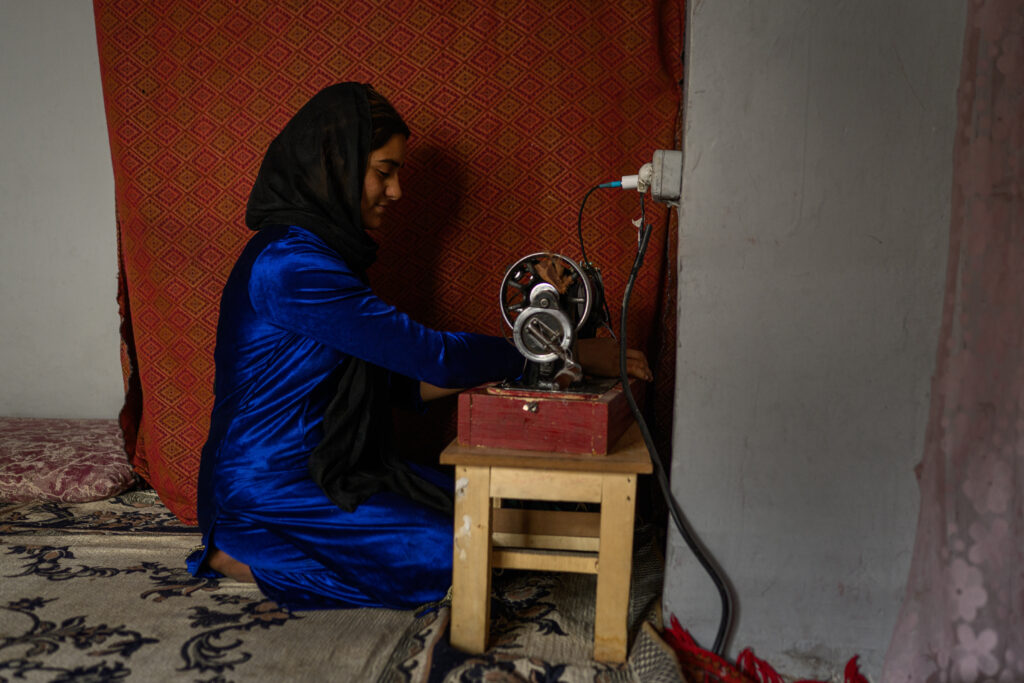
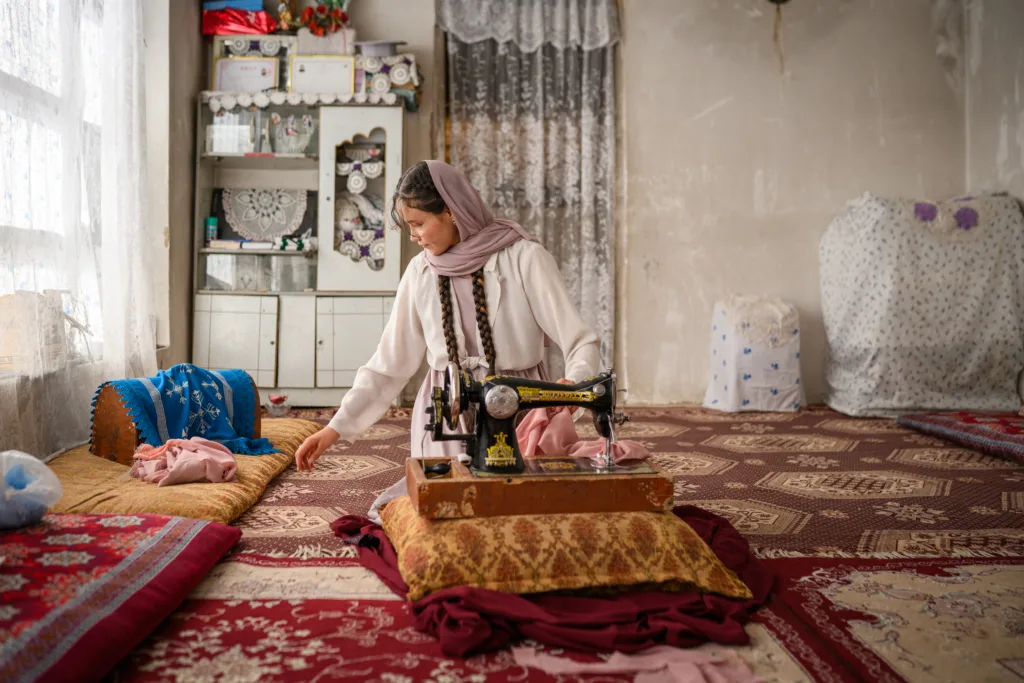
Today, this act of making is visible in regional embroidery traditions: suzani dowries are made by women and often begin in a girls’ childhood, while khamak – unique to Kandahar – is executed as ornate white-satin stitching on fine cotton and silk. Carpets, meanwhile, are predominantly woven by women, with their earnings often sustaining their entire families. In their diary entries, Lisa’s Friday sewing circles, Mina’s tailoring course, and Girl of the Ocean’s abaya workshop chart this familiar course of women-led art and livelihood.
Knowledge acquisition is a central feature in our girls’ accounts—not only as a way of dream-realisation, but also as an economic necessity. The links between learning, the state, and the economy have long been theorised as both a site of reproduction and emancipation. In her ethnographic field work in Herat, Naheed Gina Aaftaab observes how the value of learning lies in comparison and continuity for many Afghan girls: they look to their mothers and imagine something better. The value of knowledge is “measured in a comparative manner… based on an assumption that changes within society and culture are taking place”.
Here, the continuation of learning, whether through a private class or an online course, becomes a small pathway into a future of one’s own. And it is within these structures that Nuri and Girl of the Ocean continue their journeys.
Nuri is a budding polymath: an Islamic scholar, photographer, and public speaker extraordinaire who dreams of a computer science scholarship in South Korea. Reminiscent of female leaders and scholars such as Bibi Sahiba (an Afghan Sufi scholar-saint whose network of students and colleges stretched from Kandahar to Yemen and China), she is a force to be reckoned with, as illustrated by her diary entry alone.
Since last year, she has been awarded a certificate of completion by a four-year madrasa programme that includes Quranic recitation, translation, Arabic grammar, jurisprudence, and religious studies. Alongside, she has completed a public speaking course and begun exploring photography, which she practises both as a skill and a therapeutic outlet. Nuri’s writing reveals a deep sense of purpose, drive, and self-discipline; she studies English through WhatApp classes and learns photography techniques from online creators. She was especially excited to show us her notebooks and the creative drawings doodled around her handwriting.
Girl of the Ocean’s focus, meanwhile, is on building and leading, hoping to someday become the most successful entrepreneur in her country by implementing AI to train and design product advertisements. She runs a small tailoring business that employs young women, producing abayas and selling them to local shops, and speaks of her love for writing and filmmaking as they transform emotion into expression. Writing, she says, gives her “a way to express emotions, thoughts, and realities that many people experience but are afraid to share, [while] filmmaking gives life to that voice”.
The girls’ accounts bring to mind Lola Olufemi’s book Experiments in Imagining Otherwise, an invitation to investigate and imagine between the space that is and what could be. Our girls here live, work, and struggle for a hopeful otherwise, an imagining ‘against’. The Black feminist writer writes of this concept:
“Against is bound to trying, and all the frustration inherent in these concepts are an important component in this method. To try is to take the prospect of the future (now, then, to come) so seriously that we dedicate our lives to living in and with it.”
Our girls are agents of an ‘against’—against the backdrop of a past that has justified violence on their behalf, against the backdrop of a present that views their existence as a thing to be contended with vis-a-vis internet blackouts, against foreign aid cuts and increasingly incremental laws, and against a future attempting to limit the horizons of possibility.
“Even though I still have to work very hard, I believe I will succeed,” asserts Lisa. “I am excited to see the future – although it is difficult to predict – and I want to explore what I can do for myself, my family, and society.”
Last year, we spoke of girlhood, but this year, we’re asking what it actually is. What constitutes girlhood? Who is afforded girlhood? In “Geographies of Muslim Women”, scholars Ghazi-Walid Falah and Caroline Nagel remind us that girlhood – like childhood – is not a universal category but a social construct shaped by gender, class, religion, and geography. In the mountainous regions of Gilgit-Baltistan, a landscape culturally intertwined with Afghanistan, ethnographer Sarah Halvorson observes how “the meanings of Muslim girlhood are (re)interpreted by families, secular and religious development actors, and the state” as livelihoods shift from subsistence to market economies. And so, caught in the middle of this disputed terrain, Girl of the Ocean writes:
“I see myself going through the hardest test of my life. I am trying my best to pass through it. By this, I mean the challenges we girls face—we who have never truly enjoyed our childhood, who live in a society full of chaos and uncertainty about the future. This is the greatest test of life for me. Calling it a ‘test’ helps me see it not as a punishment, but as something I can overcome with strength and courage.”
It is this strength and courage that shines through our girls’ diary entries as they carve out their future in real time because it is both necessary and still possible. When I ask Blanchard to choose her favourite photograph, she says it isn’t her most beautiful nor her most technical. It shows The One Who Will Not Lose Hope and her sister Mina dancing, ignoring the camera entirely. Blanchard recalls the uninhibited joy of that moment, the quiet brilliance of a dance that always continues.



Lisa
(Daily life)
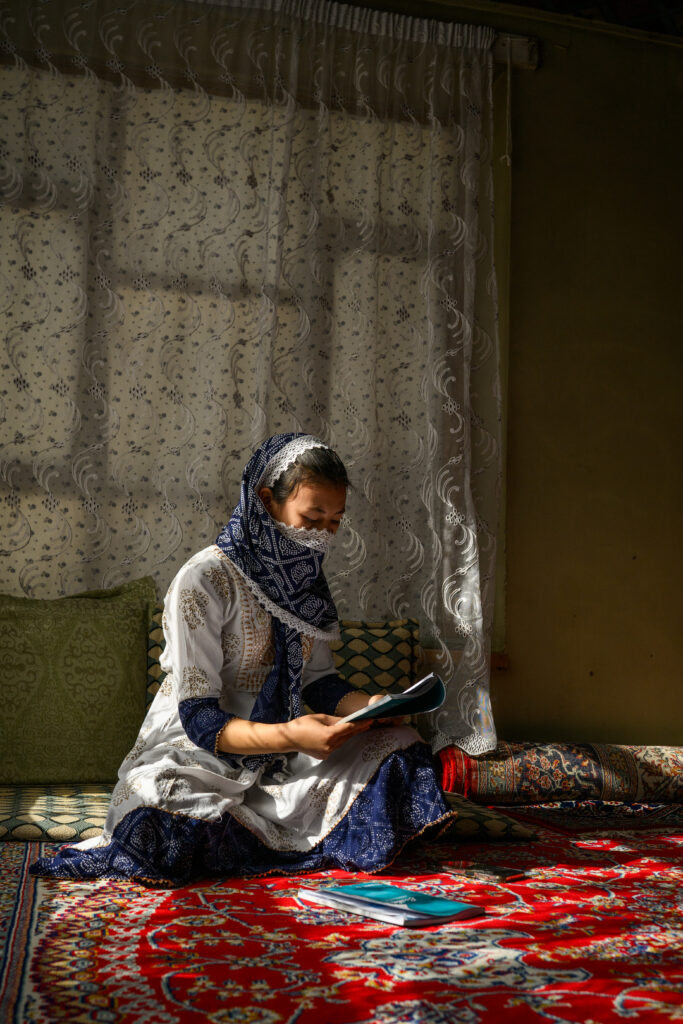
I’ve found a job; I teach Quran and beginner’s English to children at a private school from 10am to 11:30am, and I receive a salary for this work. After school, at around 1pm, I go to the madrasa, where I study Islamic studies, Quranic lessons, Arabic, and literature. Once I get home, I study on my own until 5pm. That’s my week.
Fridays are my day for recreation, so I go out, read, study, visit friends, and do other things. I enjoy embroidery. I gather with my friends, the girls from the neighbour’s house, to do things like tailoring or embroidery. We try to cooperate and be creative to design and create new embroidery projects—it is fun and rewarding.
(Change)
This past year, my life has mainly revolved around studying and completing daily tasks. Studying my lessons from the madrasa has become an important part of how I use my time. I also studied for the madrasa exam and took the test. Now, I try to continue to study with focus and dedication.
I am doing better now than I used to in my studies, emotions, and personal life. Despite the challenges I’ve faced, I can see that I’m making real progress. By this, I mean I’m truly improving in ways that matter, like handling challenges better, feeling stronger emotionally, and growing as a person.
My biggest wish is to achieve more success and progress, stand on my own feet, and fully learn the English language, which I have loved for a long time. Previously, I could not pursue it due to various reasons, but now I hope to start again. The issue is to find funds to finance courses. I had started before, but had to stop because of this.
Compared to a year ago, there have been many changes: I feel closer to my goals. Even though I still have to work very hard, I believe I will succeed. I am excited to see the future – although it is difficult to predict – and I want to explore what I can do for myself, my family, and society. At the same time, I worry that all my effort might go to waste because the current situation is difficult for women and young girls, with limited access to formal education.
Over the past year, I have also changed in the sense that I started wanting to go outside and interact more with people. Previously, I did not have many friends and often felt lonely. Now, with a few friends, I feel a sense of hope and joy. I also teach students by reading them children’s stories and playing with them, which brings me happiness and a sense of fulfillment.
Other positive changes I’ve noticed in myself include the ability to stay calm and patient, even on days that feel slow or uneventful, but suddenly, new ideas come to my mind, and I begin to act on them. These self-driven changes give me renewed hope to continue my education, work, and personal growth.
The One Who Will Not Lose Hope
I go to English language courses at a small private school for about four to five hours every week. I began working as a cleaner, but after a while, the shop closed. Now, I am trying to find a new job to cover my daily expenses and the cost of my studies. The rest of the time, I don’t have anything to do. I just daydream about the day I will achieve my dreams.
(Entry)
Ever since you took my picture, I have been working hard and putting in a lot of effort. I studied diligently and kept trying to improve myself. Our neighbour worked in the cotton department of a company that makes made hygiene products, cream, and shampoo. She recommended me, and they told me, “Come, do this work—bring your products and sell them, and for every person you introduce to the company, you will get points. And if your points increase, you will get a monthly bonus.”
I was trying to find some money to buy products so I could sell them, and I tried very hard to find money without borrowing it from anyone, but it was impossible. That day, I cried a lot. My heart was very broken. The next morning, I thought, ‘I’ll borrow from our neighbour’s daughter, then later, if I work in the company, I can repay it.’ I borrowed 5,000 Afghanis from her and gave it to the company because the products were of good quality and I could sell them at high prices.
I started by setting up an online shop to sell the products more easily, which I was very happy about. In my mind, I was thinking, ‘I will work, get a house, get a car.’ I like cars a lot, and I want a house for my mother because she’s very sad that we don’t have one. She often says, “If you leave, where will I go, a widow with five children?”
Our neighbour’s daughter was experienced in online business and did all the registration and company-related steps for me. Once I registered, I gave the money to the exchange office to deliver to them, and a week later my products arrived. I was very happy. A month later, not a single product had been sold and I had no money to repay my loan. The neighbour’s daughter knew this, so she didn’t demand the money, but I still had to find a way to return it.
At the same time, my little sister became very sick with a contagious disease. We took her to a government-run hospital. They said we should have her blood tested outside and bring it back. We went to a lab, where the doctor said the test would cost 800 Afghanis. We had no money, so I sold my mobile phone to get the medicines and pay for the blood test. My sister got better, but I was sad because of my products and the debt.
I made a plan: I would take my products to general stores that sell women’s products. If they buy my product, I can pay off my debt. I prepared the goods, but every shop I went to in the city said, “We don’t sell this product. It’s fake.”
But I didn’t give up and went to other shops, further away. One shop bought three of my products. My confidence increased. I told myself, ‘You can do it, keep trying hard.’ On the first day, I sold six products; on the second day, two products; on the third day, many products.
After a month, I sold all the products but didn’t make any profit. After a long time, I went to a shop and said, “I will do all the cleaning work here; just give me money because I am very short on it.” They said, “Okay, you must come at six in the morning and clean everywhere, and you must leave at six in the evening.”
I was happy that I found work because, at that time, I really needed it. I thought, considering the conditions, this work is very good and I can also earn money. I worked there for three months for 3,000 Afghanis. I was happy that I could do some work, but then it closed.
Now, I am still working hard to succeed and find a way to become independent and self-sufficient. My hope and dream is to become a pilot one day. I know it may not be impossible in Afghanistan, but I keep trying because I believe there is a way.
Mina
Since last year, I haven’t done anything very significant. I only sewed a few sets of clothes, three or four maybe. I enrolled in a tailoring course, completed a first aid course, and received a diploma for it.
I always daydream because I have a lot of hope for the future. I never give up easily, and I am always strong—perhaps even stronger than many others. I don’t talk much to everyone, and I’m not close to just anyone, but I am very kind. I imagine a very good future for myself, and I never dwell on negative things. My dream is to become a judge, so I can save the innocent.
When my father was alive, some inheritance came from my grandfather to him, but my uncles treated him poorly and took what was rightfully his. Under the previous government, justice favoured those with money; even a murderer could be considered innocent with a bribe. If these injustices hadn’t happened, we would have had a safe place to live.
Those experiences caused us a lot of pain, but I believe we will grow up and, one day, the best things will be ours. We will not stay here; our future will be somewhere better.
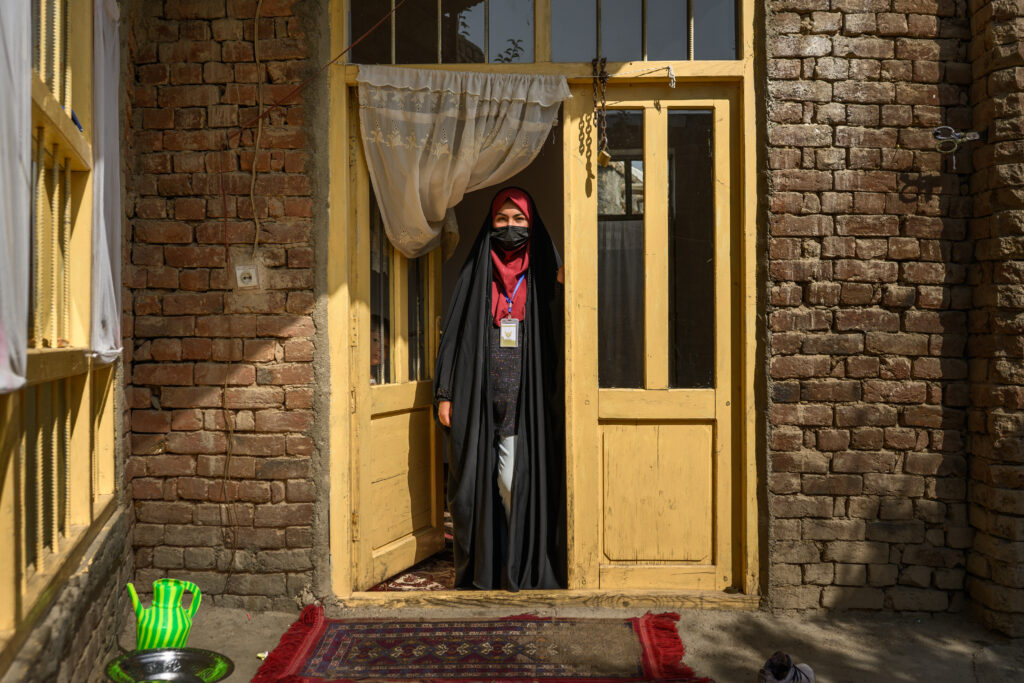
Nuri
Since last year, I have made many changes in my life. One of my greatest achievements has been completing my four-year programme at the madrasa, which included Tarteel (Quranic recitation), translation of 15 parts of the Holy Quran, Sarf and Nahw (Arabic grammar), Ahkam (Islamic rulings), correct writing, religious education, and Tajweed (rules of Quranic pronunciation). In the end, I received a certificate for it.
I also completed a public speaking course at the Positive Life Academy, and I’m very happy that I was able to finish it because, in the past, I had difficulty expressing myself and communicating my thoughts clearly to others.
At the moment, I spend my time studying at school, practising photography, and attending Mahdaviyat (messianic) lessons. I study in primary school. I had taken delays in my education because of family issues, and now I am trying to finish this. I also learn English with lessons on WhatsApp.
Daily Schedule:
• Morning: I wake up at 4:30am, perform ablution (wudhu), and pray. Then, I recite a few pages of the Quran and do a few minutes of exercise. I review my school lessons, prepare and eat breakfast, post a gratitude message on my WhatsApp story, and write a few positive words on the mirror.
• School: I get ready for school and leave home at 6:10am. It takes about 20 minutes to reach the school bus, and I arrive at school by 7am. Attendance is taken at 7:10am, and lessons begin. I study 10 school subjects and eight religious subjects. We have a break at 9:40am, and lessons continue from 10:10am.
• Afternoon: School ends at 12pm, and I reach the last bus stop by 12:20pm, then walk home. After arriving home, I change clothes, pray, and eat lunch. I rest until 3pm, then complete all school homework and review lessons until 6pm. I help my sister with household chores, then read books between 9pm and 10pm.
Friday Schedule:
On Fridays, I attend Dua-e-Nudba (Supplication of Nudba) and Mahdaviyat lessons from 5:30am until 10am. In the afternoon, I go to my sister’s house and return home at night. Some Fridays are also filled with attending seminars or meeting friends for special occasions.
Activities and Achievements:
I participate in a variety of activities, including cultural, religious, and financial projects. I have worked with the Nilufaran Madrasa and Nabuwat Madrasa in religious fields.
I have completed courses in photography, videography, and public speaking at an academy, and I have received certificates for these achievements. I also attend major motivational seminars there to continue learning and improving myself.
My life has changed a lot. We moved to a new house and, over the past year, I’ve made many changes in both my lifestyle and my spiritual life.
I have many hopes and try to reach them step by step. I want to become a skilled photographer—not as a job, but as a hobby and a source of relaxation because photography brings me peace.
My main goal, however, is to get my 12th grade certificate and learn English. I also wish to receive a scholarship and continue my education abroad. My favourite field of study is still Computer Science, and I’ve chosen South Korea as my destination for higher education.
Right now, what excites me most is the photography I do, especially when the person I photograph tells me that I captured their picture exactly how they wanted it. Besides photography, I really enjoy reading books and watching famous photographers on Instagram, getting inspiration from their work.
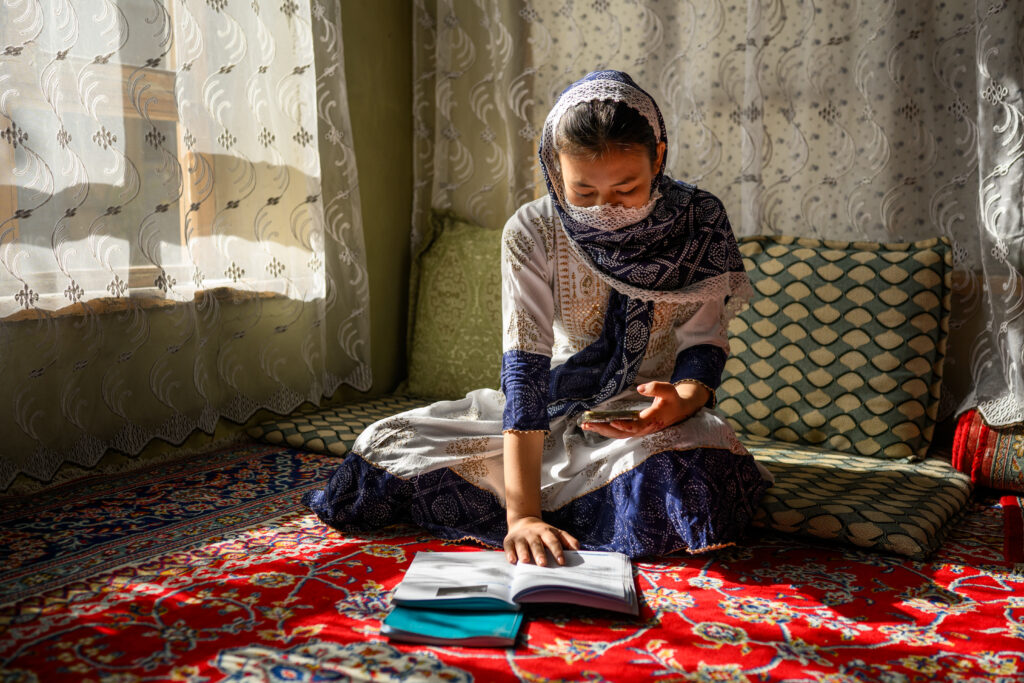
Girl of the Ocean
I have a relatively small tailoring business where I support and lead young women who need work, so that production can happen and they can earn a living. We make abayas and sell them to a shopkeeper. And every day, I teach a class to primary-level children at a private school from 3:30pm to 4:30pm.
The photographs, a year ago, were not just a few pictures to me—they were a source of motivation. Through them, I saw the beauty of my own self, my culture, and the wonderful connection among people of every race and nation. For me, that moment became a turning point. It gave me the strength and confidence to move forward towards my goals with greater determination.
I see myself going through the hardest test of my life. I am trying my best to pass through it. By this, I mean the challenges we girls face—we who have never truly enjoyed our childhood, who live in a society full of chaos and uncertainty about the future. This is the greatest test of life for me. Calling it a ‘test’ helps me see it not as a punishment, but as something I can overcome with strength and courage.
My biggest dream is to become one of the most successful women entrepreneurs in my country. Still, I have fears sometimes surrounding me, like the possibility of not being able to continue my activities or being forced into an early marriage and becoming a housewife. But I’m sure these fears are temporary.
I have a deep passion for writing and filmmaking. Writing gives me a voice, a way to express emotions, thoughts, and realities that many people experience but are afraid to share. Filmmaking gives life to those stories. I’m especially drawn to social and realistic films that carry a message and touch people’s hearts and minds.
For me, filmmaking is a way to give life to stories that matter. I mean, through filmmaking, I can show real stories, not just tell them with words. I can bring important ideas, emotions, and experiences to life on screen so that others can see, feel, and understand them deeply. Through them, I hope to reflect truth, inspire hope, and help others see the strength that still exists within us—even in the most difficult times.
No matter what it takes, I will build my own business. I plan to establish a factory and implement an AI system to design product advertisements and train my employees to use it effectively. I truly believe that with hard work and persistence, I will achieve this dream.